Best High Yield Business Accounts for Canadian Businesses
Best High Yield Business Accounts for Canadian Businesses compared for 2026. See rates, fees, CDIC notes, and savings vs interest-bearing operating options.

Ahmed Shafik
Co-founder

Trusted by 15,000+ Canadian businesses
Business banking for Canada
Local CAD and USD accounts, corporate cards with cashback, the lowest FX rates in Canada, free local transfers, and more.
Idle cash can do more for your business than sit in a non-interest-bearing account. For Canadian business owners and finance teams, the challenge is earning a competitive return while keeping funds available for payroll, vendor payments, GST/HST, corporate taxes, rent, inventory, and other operating expenses.
This 2026 roundup compares the Best High Yield Business Accounts for Canadian Businesses across two practical categories: business savings accounts and interest-bearing business chequing or operating accounts. That distinction matters. Some companies want a dedicated place to park reserve cash, while others need a business account with interest that still supports day-to-day access and cash movement.
The highest advertised rate does not automatically make an account the best fit. Business account interest rates, monthly fees, transaction limits, CDIC protection, eligibility, payment capabilities, and operational features can change the true value of an account. Before applying, verify current rates, fees, features, and eligibility directly with each provider, since terms may change.
How We Chose These Accounts
We assessed the best high yield business accounts for Canadian businesses using criteria that matter beyond a headline rate. First, we prioritized ongoing interest or yield over short-term promotional offers. We then reviewed monthly fees, minimum balance requirements, liquidity, and how easily a business can move money through transfers, bill payments, cards, or Interac e-Transfer® where available.
Eligibility also matters. Some accounts support corporations only, while others may accept sole proprietors. We considered CDIC protection for bank deposits, plus comparable coverage structures when accounts use partner institutions or trust-based arrangements. Finally, we weighed practical business usefulness. A high interest business savings account can help preserve cash value, but accounting sync, FX, card controls, payment tools, and tax-payment capabilities can matter when the same account supports daily operations.
Quick Comparison Snapshot
Use this snapshot to compare the Best High Yield Business Accounts for Canadian Businesses by provider fit, yield, fees, account structure, and coverage before reading the detailed platform sections.
Rates, features, fees, and eligibility were reviewed in July 2026 and may change, so verify current terms directly with each provider before opening a high interest business savings account.
Venn
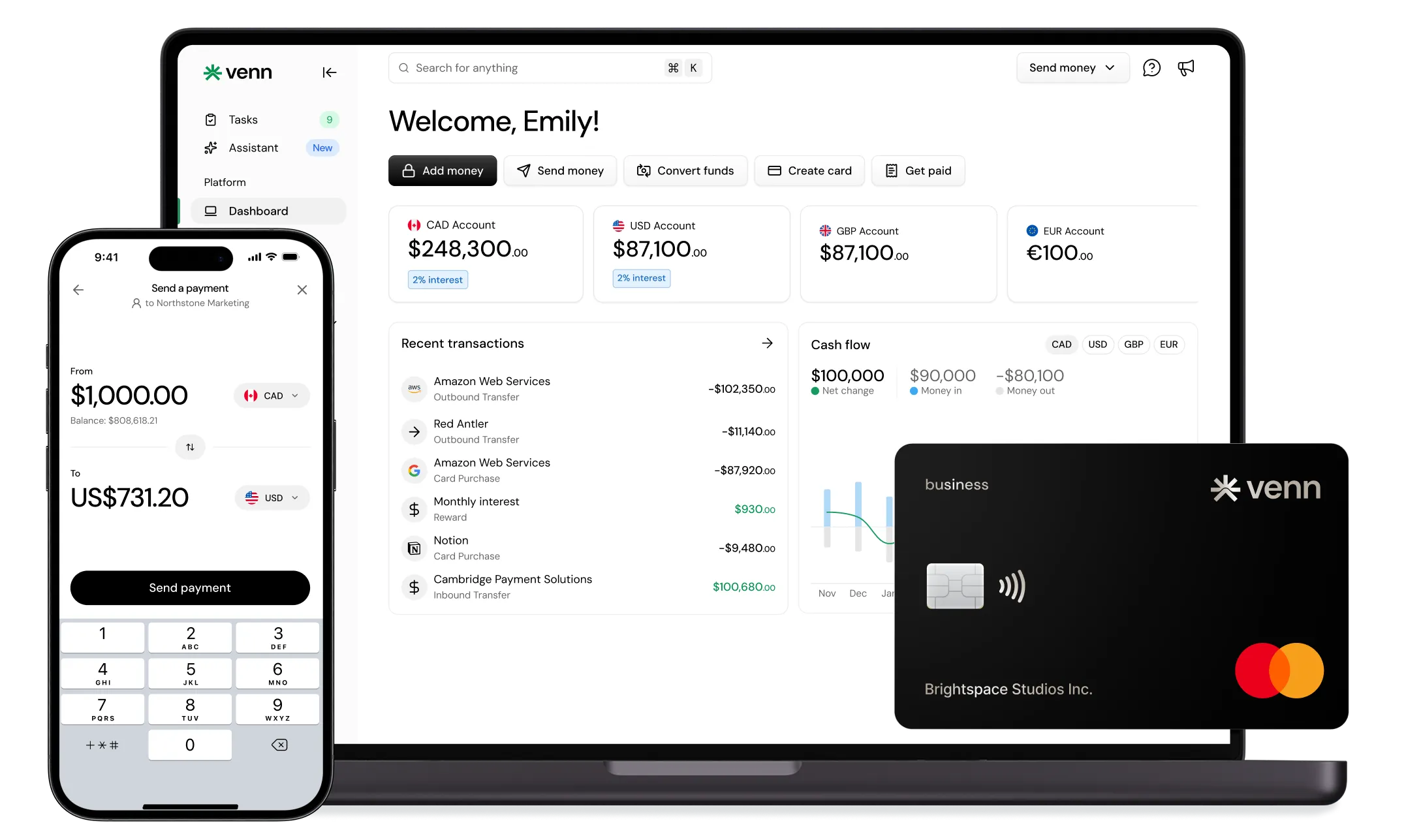
Best for businesses that want interest on operating cash plus multi-currency tools. Venn fits companies that want an interest-bearing business account for working capital, while also managing cross-border payments, cards, expenses, FX, and accounting workflows in one platform.
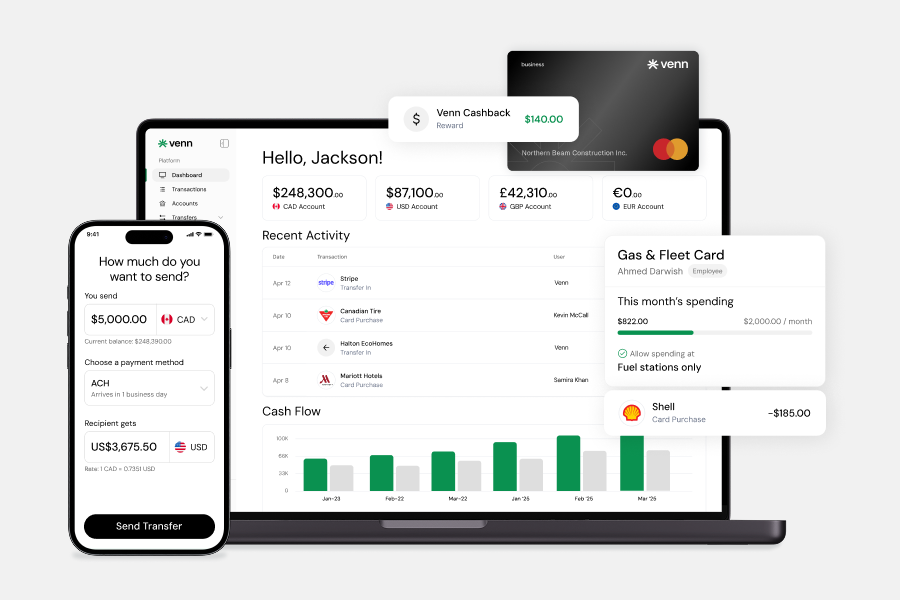
Venn offers 2.75% interest on CAD balances and up to 3.5% interest on USD balances (learn more), CAD, USD, GBP, and EUR accounts, and free unlimited Interac e-Transfer®. Businesses can access a local USD account with ACH, local rails for EFT, SEPA, and UK Faster Payments, plus international payments to 180+ countries in 36 currencies. The platform also supports QuickBooks and Xero, expense management features, and OCR receipt capture.
Pricing is plan-based, with options at $0, $40, and $100 per month. Venn also offers 1% cashback with plan-based caps, including unlimited cashback on Pro. FX ranges from 0.25% to 0.45%, depending on the plan.
Venn is a technology company, not a bank or financial institution. Eligible deposits with Venn are covered by CDIC insurance protection, subject to applicable limits, with account balances held at Bank of Montreal. Venn is not currently available to businesses in Quebec.
Wealthsimple Business Chequing
Wealthsimple Business Chequing is best for incorporated businesses that want low fees, simple yield, and a straightforward CAD operating account.
The account offers up to 2.25% interest, based on combined personal and business assets held with Wealthsimple. The rate starts at 1.25% for businesses with under $100,000 in combined assets, so the headline rate depends on your asset tier rather than applying equally to every balance. Businesses can open up to 8 free business chequing accounts, make direct CRA payments for corporate income tax and GST/HST, and sync transactions directly with QuickBooks and Wave. For other accounting tools, Wealthsimple supports CSV exports. Its current offer also includes a prepaid business Visa with 1% cash back and no FX fees.
Pricing is simple: $0 monthly fee. That makes it a credible option for Canadian businesses comparing the best business bank account with interest and trying to keep business account fees low.
The main limitations are eligibility and operating depth. Wealthsimple Business Chequing is available to incorporated businesses, not non-incorporated businesses such as sole proprietorships or partnerships. Its current page does not mention Xero integration, and it may be less compelling for companies with multi-currency operating needs, especially compared with providers built around cross-border workflows.
RBC Business Essentials Savings Account
Best traditional-bank option for accessible surplus cash, especially for businesses that want a major bank relationship, branch access, and a familiar business savings account Canada structure.
RBC’s Business Essentials Savings Account works well as a companion to an everyday business operating account. It has no minimum monthly fee and pays tiered interest from the first dollar, which makes it practical for companies that want to earn some return without locking away cash. The account also includes up to 999 credits, two free cheques or debits per month, and free transfers when you move funds online, through the RBC app, or at an ATM.
The tradeoff is usage flexibility. RBC does not position this as a full operating account replacement, so businesses with frequent outgoing payments may face transaction fees beyond the included activity. Its business account interest rates are also tiered and less headline-forward than newer high interest business savings account offers.
BMO Business Premium Rate Savings Account
Best for businesses that already use BMO as their primary banking relationship and want a simple place to earn interest on surplus cash.
BMO positions the Business Premium Rate Savings Account as its core business savings option. It lets businesses earn interest without locking in funds, which can suit cash reserves earmarked for taxes, payroll buffers, seasonal expenses, or upcoming vendor payments. In a comparison of the best high yield business accounts for Canadian businesses, this account fits the traditional-bank category rather than the all-in-one operating platform category.
The pricing structure is straightforward: there is no monthly fee. That makes it easier to keep idle cash separate from a business chequing account without adding another fixed account cost.
The main tradeoff is visibility. BMO’s yield marketing is less transparent than many newer entrants, so businesses may need to confirm current business account interest rates directly. The account also has fewer obvious differentiators around multi-currency workflows, rewards, or accounting integrations. It may appeal most to companies that already value BMO’s branch network, relationship banking, and familiar account structure.
TD Business Savings Account
Best if you want a branch-led big-bank savings account with familiar TD access.
TD’s Business Savings Account pays competitive, tiered daily interest, which can make it a practical place to park surplus cash while keeping funds available. Businesses can move money to and from other TD accounts for free, and TD provides 24-hour access, which helps if your operating account already sits within the TD ecosystem.
Fee structure matters here. Deposit and withdrawal fees apply, so this account works best when you use it for planned transfers rather than frequent transaction activity. Deposits may be insurable by CDIC, subject to eligibility and applicable limits, which may appeal to businesses comparing a CDIC business savings account through a major Canadian bank.
Opening the account typically means booking an appointment, visiting a branch, or working through a TD account manager. That branch-led path suits businesses that value in-person support, but TD may add more fee friction than newer operating-account alternatives. It is also less suited to teams prioritizing software integrations or multi-currency functionality.
Business Savings Account Vs Interest-Bearing Operating Account
A business savings account is usually the better fit for reserve cash: money your company wants to keep accessible, but does not need for every transaction. Think tax reserves, retained earnings, emergency funds, or a payroll buffer you only move when needed. In a traditional business savings account Canada model, the account sits beside your main business chequing account and helps surplus cash earn interest until the next planned use.
An interest-bearing operating account serves a different job. It suits cash that must stay liquid for daily business activity, such as vendor payments, payroll runs, software subscriptions, inventory purchases, and short-term working capital. Instead of transferring money back and forth between chequing and savings, the business can keep funds in one place while still earning some return.
This distinction matters when comparing the best high yield business accounts for Canadian businesses. Traditional financial institutions often separate the two roles. RBC, BMO, and TD, as covered above, are clearer examples of companion savings options that pair with a primary operating account. Newer platforms may blur the line by combining yield with practical business functionality. Venn and Wealthsimple, also covered above, are examples of hybrid-style options where businesses can earn interest while keeping cash closer to day-to-day use.
For many companies, the right choice depends less on the label and more on cash flow behaviour. If funds will sit untouched for quarterly taxes, a high interest business savings account may work well. If the same funds need to move frequently, an interest-bearing business account may reduce friction.
How To Choose The Right Account For Your Business
• If you are a sole proprietor: Start with eligibility before comparing yield. Some high interest business savings account options focus on incorporated entities, while others support a broader range of business structures. Shortlist only the accounts you can actually open, then compare access, fees, and operating fit.
• If you are incorporated and rate-sensitive: Use the comparison table first, then revisit the Venn, Wealthsimple, and traditional-bank sections. The best business bank account with interest may be a hybrid operating account, but a companion business savings account Canada option can still make sense for reserve cash.
• If you keep operating cash in CAD and USD: Put multi-currency support and FX needs ahead of headline yield. A slightly lower return can be worth it if the account reduces friction when receiving revenue, paying suppliers, or managing cross-border balances.
• If you need direct CRA payments: Give extra weight to the provider section where that capability is covered. Tax-payment workflow can matter more than yield if you make frequent remittances.
• If you use Xero: Look back to the Venn section and confirm whether its current support matches your accounting process. Software fit can reduce manual reconciliation.
• If branch access matters: Compare RBC, BMO, and TD more closely. Traditional-bank options may suit businesses that want in-person support, a familiar branch relationship, or a clearer separation between operating cash and surplus cash.
Conclusion
The Best High Yield Business Accounts for Canadian Businesses are best judged by cash purpose, not headline yield alone. If your company wants to park reserve cash for taxes, seasonality, or contingency planning, a traditional business savings account structure may feel cleaner because it separates surplus cash from daily transactions. If you want working capital to keep earning while it moves through payroll, supplier payments, cards, and other operating workflows, an interest-bearing business account or hybrid operating account may fit better.
Cross-border businesses should also evaluate currency access, FX costs, and payment workflows alongside yield. The best business bank account with interest is the one that matches how cash actually moves through your company.
FAQ
Q: What is the difference between a business savings account and an interest-bearing business chequing account?
A: A business savings account usually helps companies set aside reserve cash while earning interest, with fewer day-to-day transaction features. An interest-bearing business chequing account, or hybrid operating account, lets a business keep cash liquid for payments, transfers, and regular operations while still earning yield. See the comparison table and the business chequing vs. business savings account section above for the practical tradeoffs.
Q: Are business accounts in Canada covered by CDIC protection?
A: CDIC protection depends on the provider, account structure, CDIC member status, and applicable coverage limits. Some business accounts may qualify, while others use different safeguarding models or may not qualify in the same way. Always review the provider terms before opening a CDIC business savings account or interest-bearing business account.
Q: Can sole proprietors open high-yield business accounts in Canada?
A: Sometimes, but eligibility varies by provider and business structure. Some platforms focus on incorporated companies, while others may support sole proprietor business account applications. Check the provider sections above before choosing from the best high-yield business accounts for Canadian businesses.
Q: Is the highest interest rate always the best choice for a business account?
A: No. Business account interest rates matter, but fees, liquidity, transaction needs, eligibility, and daily operations can change the total value of an account. The best business bank account with interest should match how your company receives, stores, and moves cash.
Q: Which business accounts work best for CAD and USD cash flow?
A: If your business regularly receives, pays, or holds both CAD and USD, prioritize multi-currency support and operating flexibility, not yield alone. Hybrid and multi-currency business account options may fit better than a traditional high-yield business savings account in Canada. Refer back to the hybrid and multi-currency sections above to compare which account structure matches your cash flow.
---
**Disclaimer:** This publication is provided for general information purposes only and does not constitute legal, tax, financial, or other professional advice from Venn Software Inc., its subsidiaries, or its affiliates, and is not a substitute for advice from a qualified professional. All comparisons and competitor information reflect publicly available information believed accurate as of June 1, 2026; features, pricing, rates, and terms referenced are subject to change and may differ at the time you read this. All product names, logos, and brands referenced are the property of their respective owners; their mention does not imply affiliation with or endorsement by Venn. Any comparative statements reflect Venn's views and are provided to help readers evaluate options. We make no representations, warranties, or guarantees, express or implied, that the content is accurate, complete, or up to date.

Venn is all-in-one business banking built for Canada
From free local CAD/USD accounts and team cards to the cheapest FX and global payments—Venn gives Canadian businesses everything they need to move money smarter. Join 15,000+ businesses today.
Frequently asked questions
Everything you need to know about the product and billing.
Join 15,000+ businesses banking with Venn today
Streamline your business banking and save on your spend and transfers today
No personal credit check or guarantee.