Best High Interest Business Accounts for Sole Proprietors
Best High Interest Business Accounts for Sole Proprietors in Canada 2026: compare Venn, EQ, RBC, TD and Scotiabank by rates, fees, and eligibility. CDIC rules.

Ahmed Shafik
Co-founder
Trusted by 15,000+ Canadian businesses
Business banking for Canada
Local CAD and USD accounts, corporate cards with cashback, the lowest FX rates in Canada, free local transfers, and more.
This Canada-focused comparison looks at the best high interest business accounts for sole proprietors in 2026, with practical guidance for freelancers, consultants, solo founders, and registered sole proprietors.
The goal is simple: make idle business cash work harder without adding unnecessary friction to everyday banking. Many Canadian “high-interest business accounts” serve different purposes. Some function like operating accounts, while others work better as business savings accounts for cash reserves. Some pay interest only on separate savings balances, and some lose appeal once monthly fees, minimum balances, or transaction costs enter the picture.
This guide compares both interest-bearing business accounts and business savings options, since sole proprietor business banking often requires a balance between yield, access, bookkeeping clarity, and day-to-day usability.
Why Canadian Sole Proprietors need accounts with high interest
Canadian sole proprietors often face a practical banking problem: the account with the strongest headline rate may not support their business type, may pay annual interest only through a separate business savings account, or may add a monthly fee, transaction charges, or minimum balance requirement that reduces the real return on idle cash.
This comparison focuses on the best high interest business accounts for sole proprietors by looking at two categories readers often group together: interest-bearing operating accounts and business savings accounts. An operating account supports day-to-day chequing activity, while a savings product usually suits cash reserves, tax set-asides, or short-term surplus funds.
The goal is to help you compare real usability, not just the posted interest rate. That means weighing access to funds, fees, eligibility, liquidity, and CDIC coverage before deciding where business cash should sit.
Best High Interest Business Accounts for Sole Proprietors in Canada
This shortlist treats the best high interest business accounts for sole proprietors as use-case fits, not a fixed ranking. A freelance consultant may need a primary operating account that earns interest on idle cash, while a contractor may prefer a simple digital account with minimal administration. Others may want a business savings account for sole proprietorship cash reserves connected to an existing traditional banking relationship.
The comparison focuses on Venn, EQ Bank, RBC, TD, and Scotiabank, with Wealthsimple addressed separately where eligibility affects fit.
Quick Comparison Table
For the best high interest business accounts for sole proprietors, compare eligibility, fees, and whether the account works better for operating cash or business savings.
Venn
Venn is best suited to registered sole proprietors who want an interest-bearing business account with everyday operating tools, rather than a standalone business savings account. It may fit freelancers, consultants, and solo operators who manage client payments, expenses, bookkeeping, and foreign currency from one platform.
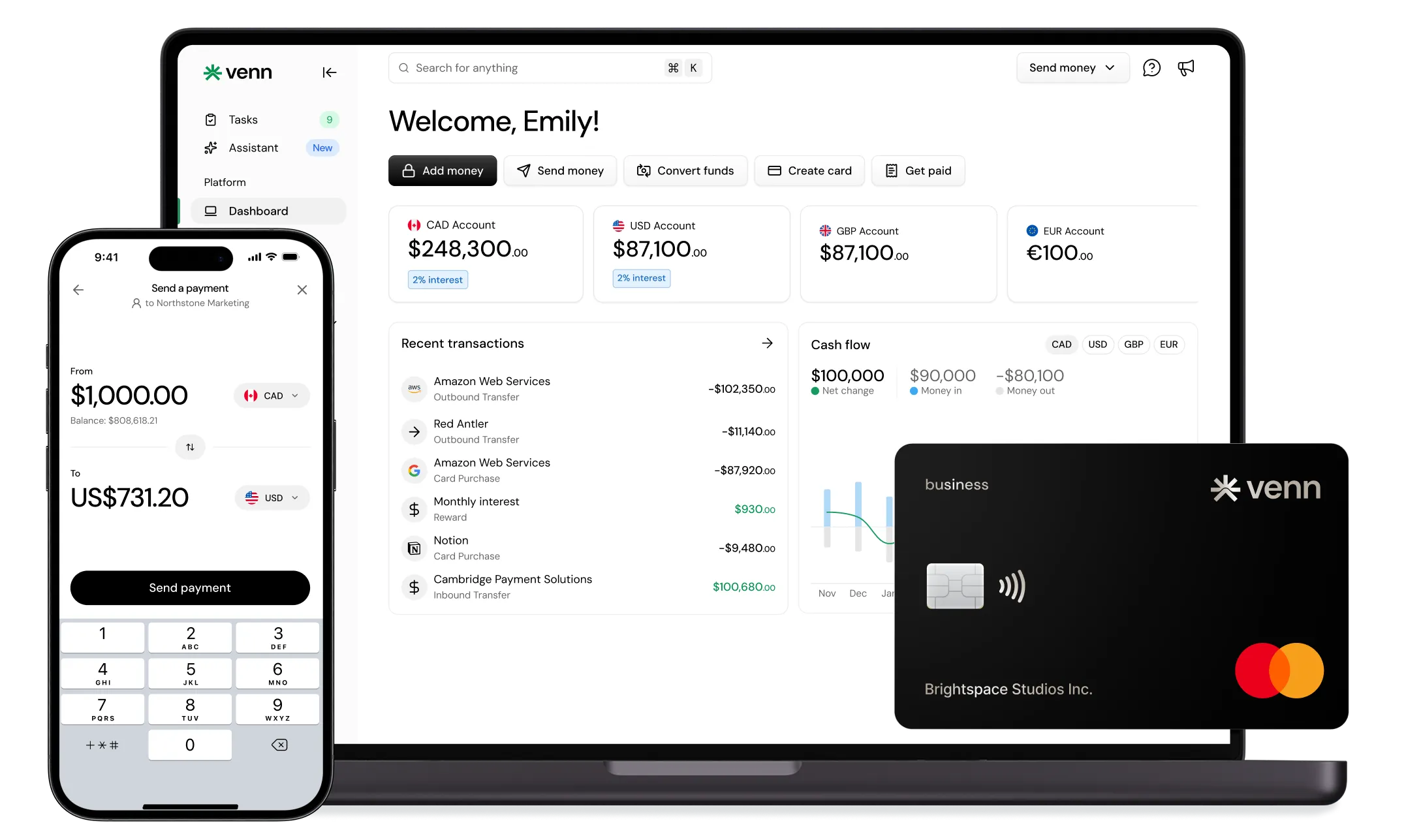
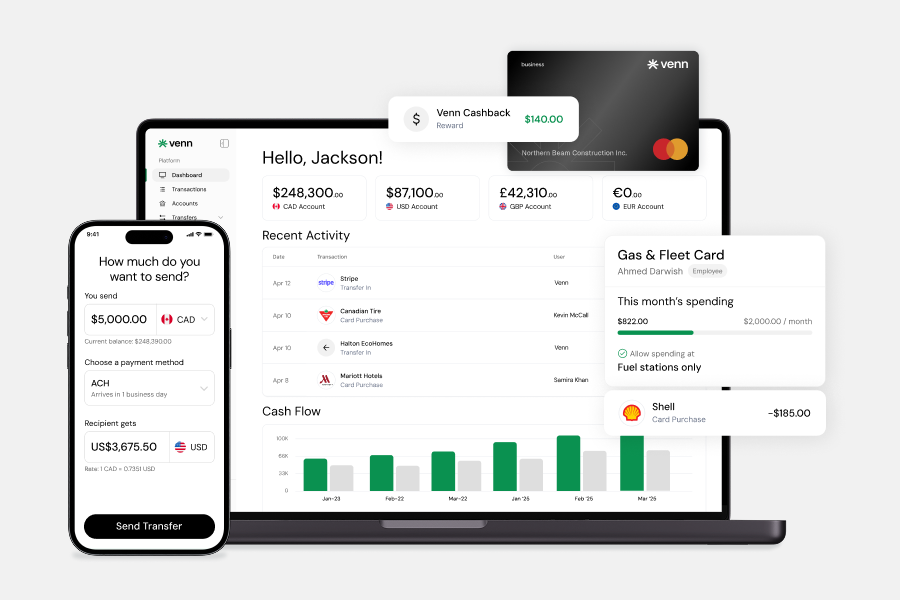
Venn is a business banking platform, not a bank. It supports sole proprietors and corporations registered in Canada, excluding businesses in Quebec. Venn offers 2.75% interest on CAD balances and up to 3.5% interest on USD balances (learn more), plus CAD, USD, GBP, and EUR accounts for businesses that invoice clients or pay suppliers across currencies. All plans include free unlimited Interac e-Transfer®.
Pricing depends on plan tier. Venn lists competitive FX rates from 0.45% to 0.25%, with the lower rate tied to higher plans. Some advanced benefits also sit behind paid plans, so sole proprietors should compare their expected transfers, FX volume, and operating needs before choosing a tier.
Eligible deposits are covered by CDIC insurance, and account balances are held at Bank of Montreal. Venn also connects with QuickBooks and Xero, and includes expense management features with OCR receipt capture. Its 1% cashback Mastercard charge card adds secondary value, with unlimited cashback only where current plan terms support it.
EQ Bank Business Account
EQ Bank Business Account fits registered sole proprietors who want a simple online business savings account with a competitive rate and no monthly fee.
EQ Bank says the account pays 2.25%, which makes it a practical high yield business savings account for idle cash and short-term reserves. The $0 monthly fee also helps preserve returns, especially for freelancers, consultants, and solo operators who want a business account with no monthly fee and minimal administration.
Eligibility is narrower than the headline may suggest. EQ Bank says the account is available to registered sole proprietors and corporations, but not to unregistered sole proprietors. It is also not available in Quebec. Eligible deposits receive CDIC coverage through Equitable Bank.
This option suits users who prioritize yield, simplicity, and digital access over a broader operating-tool stack covered elsewhere in this comparison.
RBC Business Savings Options
RBC fits sole proprietors who already use RBC for day-to-day business banking and want a savings companion inside the same traditional banking relationship.
RBC frames its Business Essentials Savings Account as a companion to day-to-day chequing, which makes it more of a place for cash reserves than a primary operating account. It pays tiered interest, so the rate depends on the balance level, and it can suit sole proprietors who want to separate idle cash from everyday transaction funds without moving outside RBC.
On pricing, the Business Essentials Savings Account has no minimum monthly fee. RBC also offers the Business Premium Investment Account for businesses with $100,000 or more to invest, which positions it toward larger reserve balances rather than new or low-balance sole proprietorships.
RBC states that sole proprietors can open business accounts, and some single-owner businesses can start online. For readers comparing the best high interest business accounts for sole proprietors, RBC may feel less compelling if the priority is a modern all-in-one interest-bearing operating account rather than a savings add-on.
TD Business Savings Account
TD Business Savings Account fits sole proprietors who already run their business banking through TD and want a traditional-bank place to separate idle cash from day-to-day operating funds.
TD says the account pays tiered daily interest, which can make it useful for cash reserves that do not need to sit in a chequing account. It also includes free transfers to and from other TD accounts, a practical feature if you already receive client payments, pay suppliers, or manage taxes through TD business banking.
The fee structure needs close review. TD lists transaction charges such as $1.00 per deposit or credit and $5.00 per withdrawal or debit, so frequent movement can reduce the value of the interest earned. TD’s small business account pages also include a sole proprietorship path and outline documentation requirements for sole proprietors.
For this reason, TD works better as a business savings account for sole proprietorship reserves than as a primary modern interest-bearing operating account.
Scotiabank Right Size Savings for Business
Best suited to sole proprietors who want to park larger CAD cash reserves in a traditional business savings account.
Scotiabank’s Right Size Savings for business can fit a registered sole proprietor with predictable idle cash, especially when the goal is to separate operating funds from reserve balances. Scotiabank’s business account opening guidance explicitly includes sole proprietorships, which helps address a common eligibility concern for readers comparing the best high interest business accounts for sole proprietors.
The account has no monthly maintenance fee, a useful feature for owners who want a business account with no monthly fee for reserve cash. The main condition is the minimum balance requirement: interest is paid only when the minimum daily closing balance reaches $10,000. Tiered variable rates apply, so the return depends on both balance level and Scotiabank’s current rate schedule.
This structure works better for more established sole proprietors with consistent CAD reserves. Newer operators, seasonal freelancers, or lower-balance businesses may find the $10,000 interest threshold limits the practical value of the account.
ICICI Bank Canada
ICICI Bank Canada earns an honourable mention as a simple reserve account for sole proprietors who want a basic business savings account.
The tradeoff is the lower headline interest rate compared with the top digital alternatives covered above. ICICI’s FAQ says sole proprietorships can apply, making it a straightforward business savings account for sole proprietorship cash that does not need daily operating features.
Exclusions matter because sole proprietors often search by interest rate first, then discover the account rules later. Some popular business chequing products may look relevant because they advertise interest on business cash, but they do not necessarily pass the eligibility test for sole proprietor business banking. For this list of the best high interest business accounts for sole proprietors, eligibility carries as much weight as yield.
How To Choose the Right Account as a Sole Proprietor
Start with how your cash moves, then compare rates. The best high interest business accounts for sole proprietors should match your operating reality, not just advertise an attractive return.
Use four filters:
• Operating needs: Decide whether you need an interest-bearing business account for daily cash flow or a business savings account for idle cash reserves. If client payments, bill payments, and transfers happen often, usability may matter as much as yield.
• Eligibility: Confirm whether the provider supports your business structure, registration status, and province. A strong rate means little if your sole proprietorship cannot open the account.
• Real net return: Look past the headline interest rate. Review monthly fees, minimum balance rules, tiered interest, transaction costs, and any promotional terms. The best business savings account for a sole proprietor is the one that leaves more money in your account after normal usage.
• Workflow fit: Match the account to how you invoice, reconcile books, manage expenses, and receive payments. If your work involves U.S. or international clients, currency handling and FX costs also belong in the decision.
Use the comparison table above to shortlist accounts by fit before ranking them by interest rate.
Decide Whether You Need an Operating Account or a Savings Companion
Start with the cash’s job. If client payments land there, subcontractors get paid from it, and funds need to cover software, tax instalments, inventory, or rent, look for an interest-bearing business account with operating features. Liquidity matters more than a slightly higher posted rate.
If the money represents GST/HST set-asides, income tax reserves, emergency funds, or savings for equipment, a separate business savings account for sole proprietorship cash may fit better. The best high interest business accounts for sole proprietors make this distinction clear: working cash should stay accessible, while reserve cash can sit apart from day-to-day chequing.
Check Eligibility First
Confirm eligibility before comparing interest rates, because the best high interest business accounts for sole proprietors only matter if you can actually open them. Start with your legal status: some providers distinguish between a registered sole proprietor and an unregistered business operating under your personal name. Then check provincial availability, required business registration documents, and personal identification requirements.
For practical sole proprietor business banking, also confirm whether the provider supports online setup for a single owner. If the application requires a branch visit, additional trade name proof, or manual review, that friction may outweigh a slightly higher rate on idle cash.
Look Past the Headline Interest Rate
A higher advertised interest rate can shrink quickly once account rules meet day-to-day sole proprietor business banking. Compare the real return after monthly fees, minimum balance requirements, tiered rates, promotional periods, transaction costs, and transfer limits. Also consider how often cash needs to move between your operating account, tax reserve, payroll, suppliers, and personal draws.
For the best high interest business accounts for sole proprietors, practical access matters. A lower-friction interest-bearing business account may deliver better value than a high yield business savings account that limits withdrawals, penalizes lower balances, or forces extra transfers before you can use your cash.
Consider Your Actual Business Workflow
For a one-person business, operational fit can matter as much as the savings rate. Before choosing an interest-bearing business account, map how you work each week: invoicing clients, updating bookkeeping, sharing records with your accountant, approving supplier payments, capturing receipts, and setting card controls. If you bill U.S. or overseas clients, pay foreign suppliers, or carry FX exposure, review the relevant provider section above. The best business bank account for a sole proprietor should support daily cash movement, not just idle cash.
How We Chose These Accounts
We built this shortlist for Canadian sole proprietors who need practical access to idle cash, not just a headline rate. Our review favoured accounts with clear sole proprietor relevance, transparent pricing, understandable interest structures, liquidity for real business use, and disclosures around fees, minimum balances, eligibility, and deposit protection.
For this comparison of the best high interest business accounts for sole proprietors, we considered both interest-bearing business accounts and business savings account options, since many owners use those terms interchangeably. Rates, fees, promotional terms, and eligibility rules can change, so verify every detail on the day you apply or publish in 2026.
Suggested Methodology
Evaluate the best high interest business accounts for sole proprietors against criteria that affect both yield and daily operations:
• Sole proprietor eligibility: Confirm whether the account supports registered sole proprietors, unregistered businesses, and your province.
• Transparent pricing: Review monthly fees, minimum balance rules, transaction charges, and conditions that may reduce net interest.
• Interest structure: Compare rates, tiers, eligible balances, promo terms, and whether interest applies to operating cash or savings only.
• Liquidity and access: Check how easily you can move funds, pay expenses, and receive client payments.
• Practical usefulness: Prioritize tools that fit a one-person business workflow.
• Trust and deposit protection: CDIC eligibility depends on the institution and product structure.
• Digital usability: Assess onboarding, mobile access, reporting, and bookkeeping support.
Conclusion
The best high interest business accounts for sole proprietors depend on how you use your cash. If you want a simple place to earn on idle balances, prioritize yield, low friction, and clear account terms. If you value in-person advice or already run your finances through a major institution, a traditional branch-based option may fit better as part of your broader sole proprietor business banking setup. If your account needs to support daily operations, client payments, bookkeeping, and cash reserves in one workflow, look beyond a standalone business savings account.
For Canadian sole proprietors comparing an interest-bearing business account with practical operating tools, Venn is worth exploring alongside the other options covered above. Visit venn.ca to see whether its business banking platform fits how your sole proprietorship earns, spends, and manages cash.
FAQ
Q: Can a sole proprietor open a business savings account in Canada?
A: Yes, but availability depends on the provider and whether your sole proprietorship is registered. Some financial institutions support registered sole proprietors, while others require incorporation or specific business documentation. Check the eligibility requirements before comparing any high-yield business savings account.
Q: Do I need a separate business account as a sole proprietor?
A: A separate business account helps you organize revenue, expenses, tax set-asides, and cash reserves. It also gives your bookkeeper or accountant a clearer record of business activity. Even if you operate alone, separating business and personal funds can make sole proprietor business banking easier to manage.
Q: What is the difference between a business savings account and an interest-bearing operating account?
A: A business savings account is generally best for reserve cash that you do not need to access every day. An interest-bearing operating account is designed for more active use, such as receiving client payments, paying suppliers, and managing working capital. The right choice depends on whether you prioritize higher separation for savings or everyday liquidity.
Q: Are these accounts protected by CDIC insurance?
A: CDIC coverage depends on the financial institution, deposit category, and product structure. Do not assume every business account with no monthly fee or interest feature receives the same protection. Review the provider's disclosures and CDIC eligibility before opening an account.
Q: Which account is best if I get paid in USD?
A: If you receive USD from clients or online platforms, look closely at an account's multi-currency features. A suitable account can reduce unnecessary currency conversions and help you keep USD funds separate from your CAD operating balance. For sole proprietors, currency support can be just as important as the advertised interest rate.
---
**Disclaimer:** This publication is provided for general information purposes only and does not constitute legal, tax, financial, or other professional advice from Venn Software Inc., its subsidiaries, or its affiliates, and is not a substitute for advice from a qualified professional. All comparisons and competitor information reflect publicly available information believed accurate as of June 1, 2026; features, pricing, rates, and terms referenced are subject to change and may differ at the time you read this. All product names, logos, and brands referenced are the property of their respective owners; their mention does not imply affiliation with or endorsement by Venn. Any comparative statements reflect Venn's views and are provided to help readers evaluate options. We make no representations, warranties, or guarantees, express or implied, that the content is accurate, complete, or up to date.

Venn is all-in-one business banking built for Canada
From free local CAD/USD accounts and team cards to the cheapest FX and global payments—Venn gives Canadian businesses everything they need to move money smarter. Join 15,000+ businesses today.
Frequently asked questions
Everything you need to know about the product and billing.
Join 15,000+ businesses banking with Venn today
Streamline your business banking and save on your spend and transfers today
No personal credit check or guarantee.