Best Bank Account for Sole Proprietorships in Canada 2026
Discover the best bank account for sole proprietorships in Canada. Compare top options to simplify banking, lower fees, and maximize rewards for your business.

Ahmed Shafik
Co-founder

Trusted by 15,000+ Canadian businesses
Business banking for Canada
Local CAD and USD accounts, corporate cards with cashback, the lowest FX rates in Canada, free local transfers, and more.
Running a sole proprietorship means you are operating a real business without the complexity or paperwork of incorporation. But this raises a question that trips up many Canadian business owners: do you actually need a dedicated business bank account, and if so, which one offers the best value? If you are searching for the best business bank account in Canada as a sole proprietor, the answer depends on your transaction volume, international needs, and how much time you want to spend on administrative work.
As your revenue grows, mixing business and personal transactions creates chaos for tax preparation, complicates CRA audits, and undermines your professional credibility. Most importantly, you miss out on tools that could save hours of administrative work and thousands in fees. This guide compares the best sole proprietorship bank account options across traditional banks and modern fintech platforms. We will examine fees, invoicing capabilities, multi-currency support, and accounting integration to help you make an informed decision.
Do Sole Proprietors Need a Business Bank Account in Canada?
Sole proprietors are not legally required to open a business bank account in Canada if they operate under their own legal name. However, if your business uses a registered trade name different from your personal name, you are legally required to open a separate business account. Even when not legally mandated, the practical reality makes separation essential.
The CRA expects clear documentation of business income and expenses. When personal and business transactions mix in a single account, you create significant audit risk. Auditors must untangle every transaction to determine what qualifies as a business expense, a process that increases scrutiny and the likelihood of disallowed deductions. Separating your finances from day one protects you from these complications and demonstrates professional financial management.
Beyond compliance, dedicated business banking unlocks merchant services, business credit building, and professional invoicing features that personal accounts simply cannot provide. These tools become increasingly valuable as your sole proprietorship grows and your financial operations become more complex.
How a Business Account Differs From a Personal Account
The most important distinction is the separation of finances. A business account keeps all business income and expenses distinct from your personal transactions, which simplifies bookkeeping and CRA reporting at year-end. When every deposit and payment in an account is tied to your business, you eliminate the guesswork of sorting through months of personal purchases to identify what is deductible. This clarity saves significant time during tax season and protects you if the CRA ever requests documentation to support your filed deductions.
Business accounts also provide access to features that personal accounts lack. These include invoicing tools, multi-user access for bookkeepers or accountants, expense management tools, and direct integrations with accounting software like QuickBooks or Xero. Personal accounts were designed for day-to-day living expenses, not for managing receivables, tracking project costs, or reconciling business transactions at scale.
Finally, operating from a business account builds professional credibility. Clients and vendors notice when payments come from a named business account rather than a personal chequing account. If you operate under a registered trade name, paying and receiving funds through a matching business account signals legitimacy and establishes your business as a serious operation. It strengthens trust during contract negotiations, simplifies onboarding with new vendors, and makes it easier to establish lasting business relationships as your sole proprietorship grows.
Benefits of a Separate Business Bank Account for Sole Proprietors
Simplified Tax Filing
A dedicated business account makes tax season straightforward. Every transaction in the account is business-related, eliminating the need to sort through personal purchases to identify deductible expenses. You can generate clean statements that show exactly what your business earned and spent throughout the year, making it simple to calculate net income and claim legitimate deductions.
CRA Audit Readiness
If the CRA audits your sole proprietorship, having a separate business account provides a clear paper trail from day one. Auditors can review your business transactions without wading through personal spending, which reduces the scope and duration of any review. Clean, well-organized records demonstrate that you take your business finances seriously and operate with integrity.
Professional Credibility
Clients and vendors notice when invoices display business account details rather than personal banking information. A dedicated business account signals that you operate a legitimate, professional enterprise. This credibility matters when negotiating contracts, establishing vendor relationships, or seeking larger client engagements.
Clearer Cash Flow Visibility
When business funds are isolated in their own account, you can see exactly how much working capital you have available at any given moment. There is no guessing about which portion of your balance belongs to the business versus personal savings. This clarity helps you make informed decisions about reinvesting in your business, hiring contractors, purchasing equipment, and managing seasonal revenue fluctuations.
Easier Bookkeeping and Accounting Integration
Modern business accounts integrate directly with accounting software like QuickBooks or Xero, automatically categorizing transactions and reconciling your books. This two-way sync eliminates hours of manual data entry each month and reduces errors that could affect your financial reporting.
Liability and Record Clarity
While sole proprietors do not have the same liability protection as incorporated businesses, maintaining separate accounts still provides important record clarity. If disputes arise with clients, vendors, or tax authorities, having dedicated business records makes it significantly easier to document your position and resolve issues quickly. This separation also protects your personal finances from being entangled in business disputes.
Top Business Bank Accounts for Sole Proprietors in Canada (2026)
Sole proprietors have different needs than incorporated businesses. You need low fees since you are watching every dollar, easy setup without complex corporate documentation, and features that scale with you like invoicing, expense management, and multi-currency support if you work internationally. Finding the best business bank account in Canada starts with understanding how the top options compare across pricing, features, and the types of businesses they serve best.
Quick Comparison: Best Accounts for Sole Proprietors
1. Venn Multi-Currency Business Account, Best for Multi-Currency and International Payments
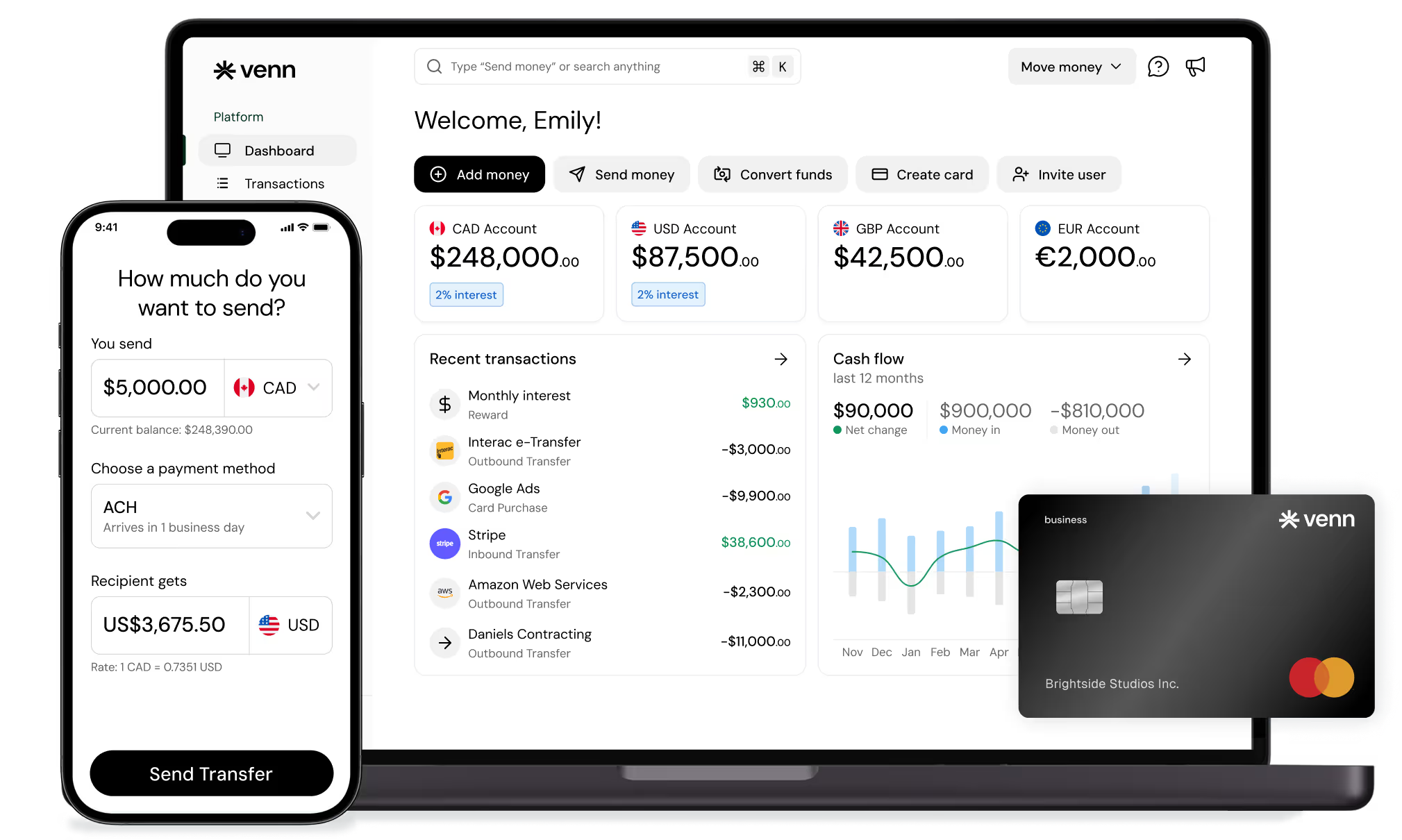
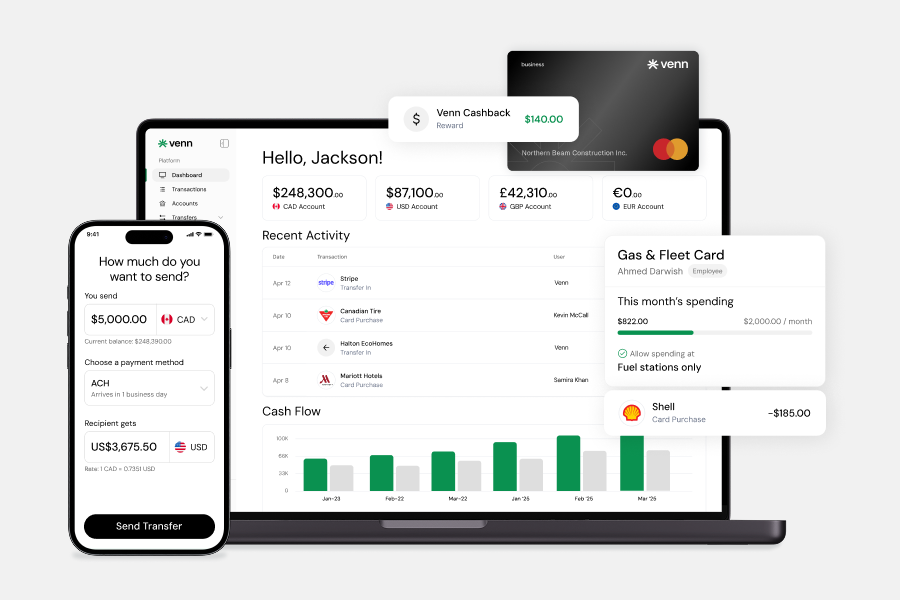
Venn is a modern financial platform built specifically for Canadian businesses, including sole proprietors. Unlike traditional banks that require separate products for cards, international transfers, and expense tools, Venn consolidates everything into one streamlined interface. From the Venn app, sole proprietors can view available funds, send transfers, and create cards directly from their phone. This makes running a business easier for sole proprietorships, as you spend less time jumping between financial platforms and can spend more time growing your business.
Best for: Sole proprietors who invoice clients, work with international customers or contractors, or need professional payment infrastructure without premium bank fees.
Key Features:
- $0 monthly account fee on Essentials plan
- Real CAD and USD accounts with local account details and up to 3.5% interest on CAD/USD balances (learn more)
- AI Accounting (Receipt Capture, Auto Categorization, Rule Flow)
- Free unlimited Interac e-Transfers® (only fintech in Canada offering this)
- 1% unlimited cashback on corporate card spend
- Multi-currency accounts (CAD, USD, GBP, EUR)
- 0.25% FX conversion rates (vs. 2.5-3% at banks)
- Built-in invoicing and expense management
- Two-way sync with QuickBooks and Xero
- No branch visits required, fully online onboarding
Pros:
- Truly unlimited free Interac e-Transfers®, saving hundreds monthly
- Integrated multi-currency accounts with the lowest FX rates in Canada*
- All-in-one platform replaces multiple software subscriptions
- Real Canadian banking infrastructure supports tax payments and payroll
Cons:
- No physical branch locations for in-person support
- Newer platform compared to established banks
Venn addresses the core pain points sole proprietors face: high fees for basic services, complicated international payments, and disconnected tools for invoicing and expense tracking. The platform's real Canadian account infrastructure means you can pay taxes, bills, and even run payroll, something most fintech alternatives cannot support. We recommend opening a free Venn account today to trial the platform and see if it is the right fit for your business.
2. BMO eBusiness Plan, Best for Low-Fee Day-to-Day Banking
BMO's eBusiness Plan is the only no-fee business account offered by a major Canadian bank. It is designed for sole proprietors who operate entirely online and do not need cash deposit services or frequent Interac e-Transfers®.
Best for: Online-only sole proprietors with straightforward domestic banking needs and minimal e-Transfer usage.
Key Features:
- $0 monthly fee
- Unlimited electronic transactions
- 2 free Interac e-Transfers® per month ($1.50 each after)
- Unlimited Moneris deposits for merchants
- No minimum balance required
- No cash deposits allowed
- Requires in-branch appointment to open
Pros:
- No monthly fee from a major Canadian bank
- Unlimited electronic transactions included
- Access to BMO's branch network if needed
Cons:
- Only 2 free Interac e-Transfers® per month
- No multi-currency support or USD accounts
- No built-in invoicing or expense management
- High FX fees (approximately 2.9%) for international transactions
- Requires in-branch visit to open
The main limitation is that you will pay for every e-Transfer after the first two, which adds up quickly if you are paying contractors or vendors regularly. There is also no multi-currency support, no built-in invoicing, and FX fees hover around 2.9% for any international transactions.
3. TD Basic Business Plan, Best for High-Volume Transactions
TD's Basic Business Plan targets sole proprietors in the earliest stages, those testing a business idea or running a side hustle with very few monthly transactions. The $5 monthly fee is among the lowest at traditional banks.
Best for: Part-time sole proprietors or side hustlers with fewer than 5 transactions per month.
Key Features:
- $5 monthly fee
- 5 free transactions per month
- $1.25 per additional transaction
- $2.50 per $1,000 cash deposited
- No minimum balance required
- No free Interac e-Transfers®
- No accounting software integration
Pros:
- Low monthly fee for basic banking
- Access to TD's extensive branch and ATM network
- Established bank with long track record
Cons:
- Only 5 free transactions per month
- No free Interac e-Transfers®
- No USD accounts or multi-currency support
- No invoicing tools or accounting integration
- Costs escalate quickly with moderate transaction volume
This account becomes expensive fast once you exceed the transaction limit. If you are processing more than a handful of payments monthly, the per-transaction fees will quickly surpass the value of the low monthly fee. There is also no support for USD accounts, no invoicing tools, and no cashback on spending.
4. RBC Digital Choice Business Account, Best for Branch Access and Digital Tools
RBC's Digital Choice account is positioned as a modern, online-friendly option for small businesses and sole proprietors. At $6 per month, it offers unlimited electronic transactions and a modest number of free e-Transfers.
Best for: Sole proprietors comfortable with digital banking who occasionally need in-branch support.
Key Features:
- $6 monthly fee
- Unlimited electronic debit and credit transactions
- Unlimited mobile cheque deposits
- 10 free Interac e-Transfers® per month ($1.50 each after)
- No minimum balance required
- Can open online in under 15 minutes (requires branch visit to activate)
Pros:
- Unlimited electronic transactions
- 10 free Interac e-Transfers® per month
- Canada's largest bank with extensive branch network
- Online account opening available
Cons:
- $6 monthly fee adds up over time
- No multi-currency support
- High FX fees (2.5-3%) for international transactions
- No built-in invoicing or expense management
- No cashback rewards
- Requires branch visit to activate account
While the unlimited electronic transactions are appealing, the account lacks modern features like multi-currency support, automated accounting sync, or any form of cashback. FX fees remain high (2.5-3%), and there is no built-in invoicing or expense management functionality.
5. Wise Business Account, Best for USD Payments and Freelancers
Wise is a UK-based fintech platform that excels at international money movement. For sole proprietors who work with clients or vendors in multiple countries, Wise offers local account details in 40+ currencies and transparent, low-cost FX conversions.
Best for: Freelancers and consultants working internationally who prioritize low FX fees over domestic Canadian banking features.
Key Features:
- $0 monthly fee
- One-time $55 setup fee for full features
- Hold and convert 40+ currencies
- Local account details in CAD, USD, GBP, EUR, and more
- Mid-market exchange rate with 0.4-0.6% conversion fees
- Integration with QuickBooks, Xero, and Wave
- No Canadian Interac e-Transfer® support
- No cashback on spending
Pros:
- Excellent multi-currency support with 40+ currencies
- Transparent, low-cost international transfers
- Local account details in multiple countries
- Good accounting software integrations
Cons:
- No Interac e-Transfer® support for Canadian payments
- Cannot pay Canadian taxes or run payroll through Wise
- One-time $55 setup fee
- Limited domestic Canadian banking functionality
- No cashback on card spending
Wise's biggest limitation for Canadian sole proprietors is the lack of Interac e-Transfer® support, which is how most Canadian businesses pay contractors and receive domestic payments. There is also no built-in invoicing beyond basic tools, and you cannot use Wise to pay Canadian taxes or run payroll through traditional channels.
6. EQ Bank Business Account, Best for No-Fee Banking With Interest
EQ Bank offers a no fee business bank account in Canada that appeals to sole proprietors who want to avoid monthly charges entirely. The account has no monthly fees, no minimum balance requirements, and earns interest on deposits. For business owners with simple banking needs who want their idle funds to work for them, it is a straightforward option worth considering.
Best for: Sole proprietors who prioritize zero fees and a digital-first banking experience over advanced business tools.
Key Features:
- $0 monthly fee with no minimum balance
- Interest earned on business deposits
- Unlimited electronic transactions
- Interac e-Transfer® support included
- Fully digital application and account management
- No branch access
Pros:
- Genuinely no-fee with interest on deposits
- Simple, digital-first experience with a clean interface
- No minimum balance requirements
- Good option for sole proprietors just starting out
Cons:
- No multi-currency accounts or USD banking
- No built-in expense management or corporate cards
- No branch locations for in-person support
- Fewer integrations and business-specific tools compared to platforms like Venn
- Limited invoicing features for client billing
EQ Bank is a solid choice for sole proprietors with straightforward domestic banking needs who want to keep costs at absolute zero. However, if your business requires multi-currency support, built-in invoicing, expense management, or corporate cards with cashback, you will likely need a more full-featured platform. The account works best as a low-cost home base for sole proprietors whose banking needs have not yet outgrown the basics.
How to Choose the Right Bank Account for Your Sole Proprietorship
The best account for your sole proprietorship depends on three factors: your transaction volume, whether you work internationally, and how much administrative automation you need. Here is what to prioritize.
Consider these critical factors before committing to an account:
- Transaction volume: Count your monthly payments, invoices, and transfers. Accounts with transaction limits become expensive fast, especially as your client base grows. There is no need to limit transactions either, with many of the options allowing for unlimited transfers on a free plan.
- International needs: If you invoice in USD or pay foreign vendors, prioritize multi-currency accounts with low FX fees (under 1%).
- Interac e-Transfer® usage: Most Canadian businesses rely on e-Transfers. Unlimited free e-Transfers save significant money. Platforms like Venn enable this for small businesses.
- Accounting integration: Two-way sync with QuickBooks or Xero eliminates hours of manual bookkeeping.
- Invoicing capabilities: Built-in professional invoicing saves money on separate software subscriptions. With recurring invoices you can automate a significant portion of your accounts receivable.
- Growth trajectory: Choose an account that scales with you, especially if you plan to incorporate later.
- Payment acceptance: If you use Stripe, Shopify, or PayPal, look for platforms that reduce cross-border fees.
Most sole proprietors underestimate their transaction volume and end up paying more in per-transaction fees than they would with an unlimited account. Similarly, hidden FX markups on even occasional USD transactions can cost hundreds or thousands annually. The right account eliminates these surprise costs while providing the professional infrastructure to run your business efficiently. Take the time to map your actual monthly transaction volume and international payment needs before choosing an account.
Interested in learning about the best credit cards for sole proprietors? Explore the best credit cards for sole proprietors in Canada.
What Documents Do You Need to Open a Business Bank Account?
Opening a business bank account as a sole proprietor in Canada is simpler than you might expect. Because your business is not a separate legal entity, you will not need incorporation documents or articles of association. Understanding the sole proprietor business account requirements in Canada upfront can save you time and prevent delays during the application process.
The core documents most institutions require include:
- Government-issued photo ID: A valid driver's license or Canadian passport.
- Social Insurance Number (SIN): Since sole proprietorships are not separately incorporated, your SIN is used for tax identification purposes.
- Business Number (BN): If you have registered with the CRA for GST/HST, payroll, or import/export accounts, you will need your Business Number.
- Provincial business registration or trade name registration: Required if you operate under a name other than your legal name. This document confirms your registered business name with the province.
- Proof of address: A recent utility bill, bank statement, or lease agreement showing your current address.
Requirements vary by institution, so it is worth confirming the specific documentation list before you apply. Traditional banks like BMO, TD, and RBC typically require an in-branch appointment to verify documents in person, which can add days or even weeks to the process depending on branch availability. Digital-first platforms like Venn have streamlined the experience considerably. You can open a Venn account online in minutes, with identity verification handled digitally. This is especially convenient for sole proprietors who want to get their business banking set up quickly without scheduling branch visits or taking time away from client work.
Why Venn Is the Best Business Account for Canadian Sole Proprietors
Sole proprietors need an account that works as hard as they do, without the premium fees or complexity designed for large corporations. Venn was built specifically to address the gap between expensive traditional bank accounts and limited fintech alternatives.
Unlike traditional banks that charge for basic services like e-Transfers or force you to open separate USD accounts, Venn includes everything in one platform. You get real local CAD and USD accounts (not just virtual ones), meaning you can send and receive ACH payments, pay Canadian taxes and bills, and even run payroll as you grow. Funds are covered under CDIC insurance protection. Free unlimited Interac e-Transfers® eliminate the $1.50 per-transfer fees that add up to hundreds monthly at other providers. This makes Venn one of the strongest business banking options for Canadian sole proprietors.
For sole proprietors who work internationally or invoice in multiple currencies, Venn's 0.25% FX rate saves thousands compared to the 2.5-3% banks charge.* The platform's built-in invoicing, expense management, and automatic QuickBooks/Xero sync replace multiple software subscriptions, while the 1% unlimited cashback on all card spend puts money back in your pocket. Most importantly, you can open your account entirely online in minutes; no branch visits or complex paperwork required.
Open your Venn account today and experience the difference.
Conclusion
The best business bank account for a Canadian sole proprietor depends on your priorities: whether you need the lowest fees, multi-currency capabilities, or a full suite of integrated business tools. Each account in this guide serves a different type of sole proprietor, from side hustlers who need basic no-fee banking to international freelancers managing invoices in multiple currencies.
For sole proprietors who want multi-currency support, low FX fees, and integrated expense management without monthly charges, Venn delivers the most complete solution. Sign up for a Venn account and start banking like the business you are building.
Frequently Asked Questions About Sole Proprietor Bank Accounts in Canada
Q: Am I legally required to open a separate business bank account as a sole proprietor in Canada?
Legally, if you operate under your own legal name, you can use your personal account. However, if your business has a registered trade name different from your own, you are legally required to open a separate business account. Even when not required, separating finances simplifies tax preparation and protects you during CRA audits.
Q: What documents do I need to open a sole proprietor business account?
You typically need valid photo ID, your Social Insurance Number (SIN) or Business Number (BN) from the CRA, and your trade name registration certificate or master business licence. Requirements vary, but modern platforms like Venn allow completely online onboarding without the need for an in-branch visit.
Q: What is the true cost of a sole proprietor bank account in Canada?
While many accounts advertise a low or $0 monthly fee (e.g., BMO's eBusiness Plan), the true cost comes from hidden fees. Watch out for per-transaction charges, Interac e-Transfer® fees ($1.50+), and especially high Foreign Exchange (FX) markups (2-3%). Providers like Venn offer free unlimited e-Transfers and the lowest FX rates (0.25%) to minimize these hidden costs.
Q: Can sole proprietors get multi-currency business accounts?
Yes. Unlike traditional banks which typically require separate, fee-heavy USD accounts, modern platforms like Venn offer integrated multi-currency accounts. Venn provides local CAD, USD, GBP, and EUR accounts under a single login, which is essential for freelancers and businesses with international clients.
Q: What is the difference between a sole proprietor account and a corporate account?
Sole proprietor accounts are simpler to open as you and your business are legally the same entity. Corporate accounts require official incorporation documents and articles of incorporation. Sole proprietor accounts often have simpler requirements and may have fewer features than those designed for large corporations.
Q: Can the CRA audit me for using a personal account for my business?
Using a personal account does not trigger an audit, but it complicates audits if they occur. Auditors must sort through all transactions to identify business activity, which increases scrutiny and the likelihood of disallowed deductions.
Venn is a technology company and not a bank or financial institution. Funds are safeguarded by Venn's banking partners and covered under CDIC insurance protection. ®Registered trademark of Interac Corp. Used under license. Based on internal analysis of total markups and FX fees charged by major Canadian financial institutions as of January 2026.
---
**Disclaimer:** This publication is provided for general information purposes and does not constitute legal, tax or other professional advice from Venn Software Inc or its subsidiaries and its affiliates, and it is not intended as a substitute for obtaining advice from a financial advisor or any other professional. We make no representations, warranties or guarantees, whether expressed or implied, that the content in the publication is accurate, complete or up to date.

Venn is all-in-one business banking built for Canada
From free local CAD/USD accounts and team cards to the cheapest FX and global payments—Venn gives Canadian businesses everything they need to move money smarter. Join 15,000+ businesses today.
Frequently asked questions
Everything you need to know about the product and billing.
Join 15,000+ businesses banking with Venn today
Streamline your business banking and save on your spend and transfers today
No personal credit check or guarantee.