Best High Interest Business Accounts for Canadian Businesses
Best High Interest Business Accounts for Canadian Businesses updated June 2026. Compare rates, fees, CDIC notes, and operating vs savings options for teams.

Ahmed Shafik
Co-founder

Trusted by 15,000+ Canadian businesses
Business banking for Canada
Local CAD and USD accounts, corporate cards with cashback, the lowest FX rates in Canada, free local transfers, and more.
Canadian business owners want idle cash to earn interest, but that cash still has a job to do. It may need to cover payroll, vendor payments, tax obligations, transfers between accounts, and month-end reconciliation. Choosing a high interest business account, therefore, is not as simple as picking the highest advertised business account interest rate.
Some accounts in this category are traditional business savings accounts, designed mainly for parking surplus cash. Others function more like operating or business chequing accounts that also pay interest on balances. The difference matters. A strong high interest business savings account may offer value for reserves, while a hybrid operating account may create more day-to-day utility for founders, operators, finance managers, and small business owners.
What Makes A Good High Interest Business Account In Canada?
Start by deciding what role the account needs to play. A traditional business savings account usually suits surplus cash that can sit aside from daily operations. A business chequing account prioritizes payments, withdrawals, deposits, and cash flow management. A hybrid operating account that pays interest sits between the two, giving businesses a way to earn on working capital while still supporting transactions.
That distinction matters more than the headline business account interest rate. Compare the ongoing rate against any promotional rate, then check what happens after the offer period ends. Review minimum balance rules, monthly fees, debit costs, transfer fees, and limits that could reduce the value of a high interest business savings account.
Usability deserves equal weight. If the account must support payroll, bill payments, tax payments, vendor payments, pre-authorized debit, ACH, EFT, or Interac e-Transfer®, confirm those capabilities before opening it. Also assess how well the account fits your accounting workflows, including exports, reconciliation, and permissions for finance teams.
Deposit protection should be part of the review. A CDIC business savings account can provide eligible coverage when structured through a CDIC member institution, subject to applicable limits and categories. In the business chequing vs savings account decision, the strongest choice depends on net yield after costs, access to funds, and whether the account can handle the way your business actually moves money.
Compare The Best High Interest Business Accounts For Canadian Businesses
Use this table to compare account type, interest structure, fees, minimum balances, fit, and tradeoffs across leading high interest business account options in Canada.
6 Best High Interest Business Accounts For Canadian Businesses
The following reviews assess each provider by practical fit and main limitation, rather than ranking one universal winner. For Canadian businesses, the right choice depends on how the account will be used: everyday operations, surplus cash storage, business chequing, business savings, or a mix of both.
Each platform receives comparable depth, including Venn alongside traditional banks and other digital options. The goal is to clarify tradeoffs so you can shortlist the Best High Interest Business Accounts for Canadian Businesses based on your operating needs.
Venn
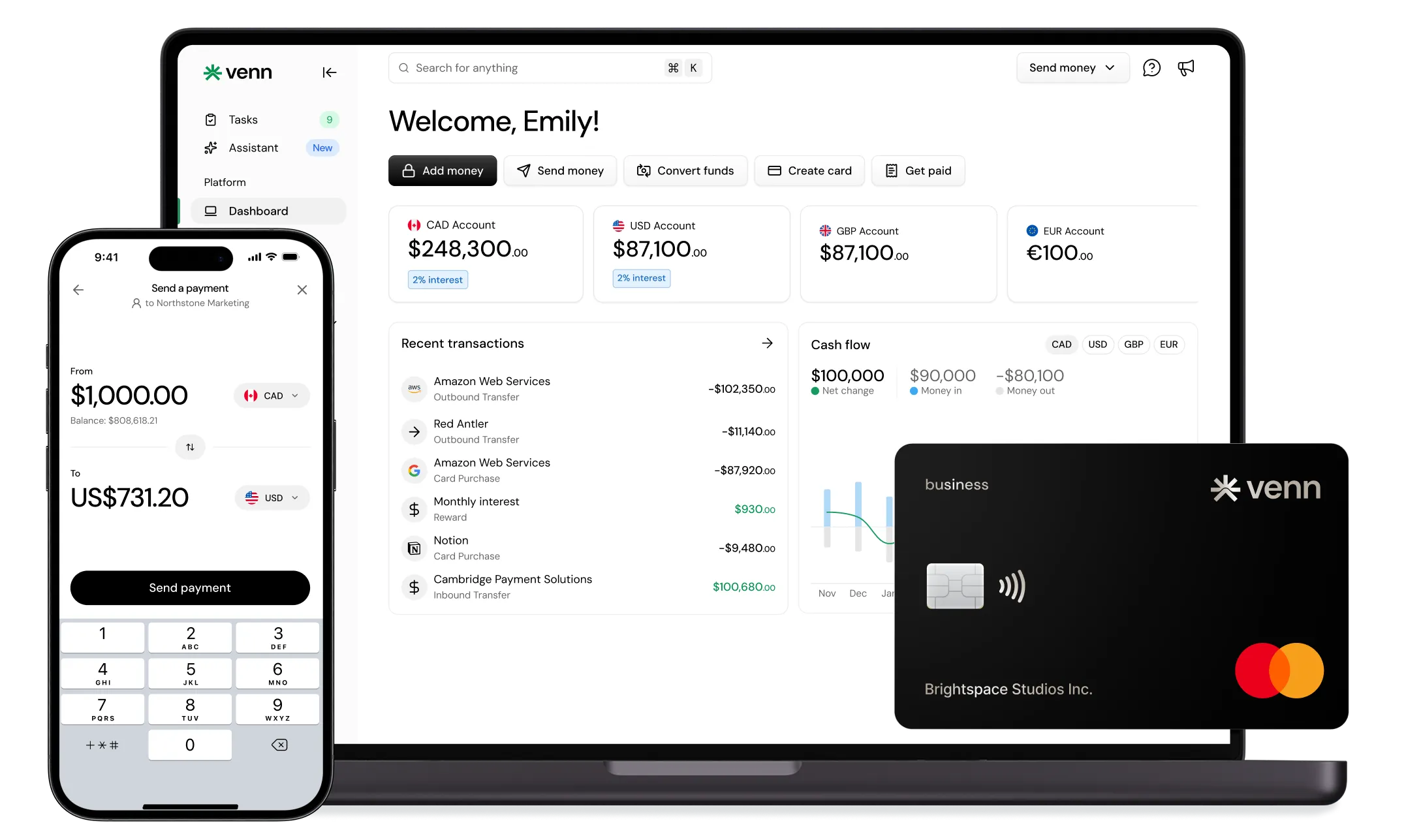
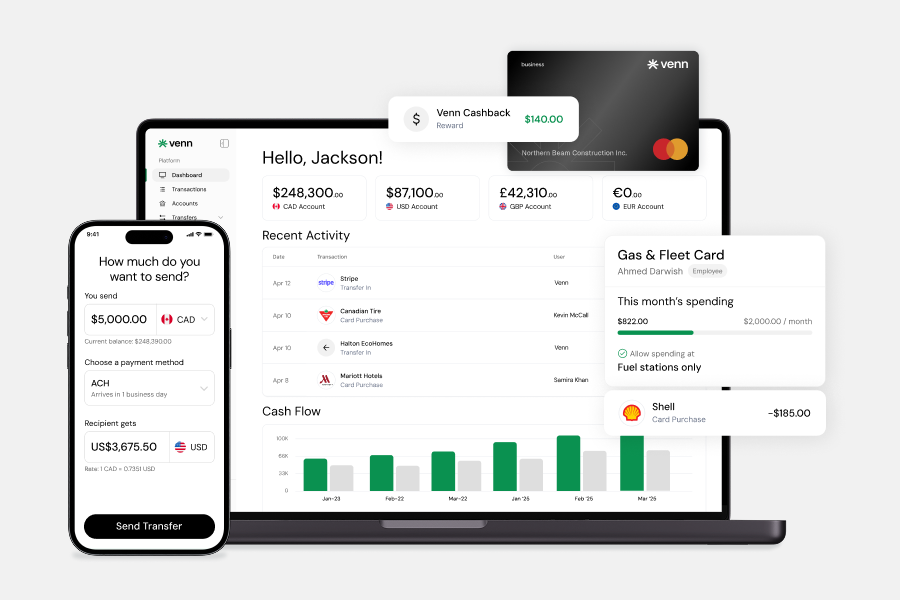
Venn is a strong fit for Canadian businesses that want to earn interest on operational balances while also managing payments, currency, card spend, and accounting workflows. It pays 2.75% interest on CAD balances and up to 3.5% interest on USD balances with no minimum (learn more), which makes it relevant for companies comparing the Best High Interest Business Accounts for Canadian Businesses but still needing daily access to working capital.
The account supports CAD, USD, GBP, and EUR, with FX markups from 0.25% to 0.45% by plan. Venn also supports global payments, including local transfers priced by plan, plus free unlimited Interac e-Transfer® on all plans. For finance teams, QuickBooks and Xero support can help reduce reconciliation work, while expense management features include spend controls and OCR receipt capture.
Pricing runs across monthly tiers of $0, $40, and $100. The card offers 1% cashback, plan-capped on Essentials and Plus and unlimited on Pro. Eligible deposits with Venn are covered by CDIC insurance protection, and Venn account balances are held at Bank of Montreal, a CDIC member, per Venn’s site footer.
Wealthsimple Business Chequing
Wealthsimple Business Chequing is a low-friction option for incorporated Canadian businesses that want a no-monthly-fee operating account with interest. It charges a $0 monthly fee, has no minimum balance requirement, and pays 1.25-2.25% depending on deposit levels.
Its day-to-day strengths are simplicity and low fixed costs. Businesses can make direct CRA payments, which is a practical advantage for teams that want tax remittances handled inside the same account.
The main tradeoffs are scope and eligibility. Wealthsimple currently supports corporations only, so sole proprietors and partnerships need another option. Its product focus is also CAD-first, and it offers fewer global banking and finance-operations capabilities than Venn compared with the broader finance stack covered above.
Scotiabank Right Size Savings For Business
Scotiabank Right Size Savings for Business is a traditional major-bank business savings account for companies that want branch-backed familiarity while parking surplus CAD reserves.
The account has no monthly maintenance fee and pays tiered interest, which can make it a straightforward companion to a primary operating account. To earn interest, however, the business must maintain a minimum daily balance of $10,000. Balances below that threshold may provide convenience, but they do not deliver the yield businesses typically seek from a high interest business savings account.
Pricing becomes more important if cash moves often. Common debit transactions cost $5.50 per debit, so frequent withdrawals, transfers, or payment activity can quickly reduce the net value of the interest earned. That structure suits reserved cash better than working capital that needs regular movement.
This option fits businesses that prefer a major bank relationship and plan to hold larger CAD balances. It is less ideal for daily payments, frequent withdrawals, or integrated finance operations.
BMO Business Premium Rate Savings Account
BMO’s Business Premium Rate Savings Account works best as a companion business savings account for surplus cash, not as a full operating account.
For features, the account gives Canadian businesses a straightforward way to separate reserves from day-to-day operating funds. That can help with tax set-asides, seasonal cash buffers, or retained earnings that do not need to sit in a primary business chequing account.
On pricing, BMO advertises no monthly fee and no minimum balance, which makes it a practical no fee business savings account for businesses that already bank with BMO. BMO also uses promotional-rate language tied to new deposits, so verify the current promotional window, eligible deposit rules, rate tiers, and end date on publish day. Promotional rates vs ongoing rates can materially change the account’s value.
The main limitation is operational depth. This account looks less compelling for businesses that want one business account for payments, multi-currency needs, spend management, and accounting workflows. Existing BMO business clients who want a simple linked place to hold surplus CAD funds will likely find the clearest fit.
RBC Business Essentials Savings Account
RBC Business Essentials Savings works best as a simple companion account for businesses that already use RBC for operating banking.
The account has no monthly fee, which keeps fixed costs predictable for companies that want to separate surplus cash from day-to-day working funds. RBC also allows free online transfers into the savings account, making it easy to move excess operating cash into savings when balances build up. For existing RBC clients, that internal transfer flow can reduce friction compared with moving funds between unrelated providers.
Access is intentionally limited. The account includes two free cheques or debits per month, so it suits occasional withdrawals rather than frequent payments, vendor activity, or active cash movement. Businesses comparing the Best High Interest Business Accounts for Canadian Businesses should view this as a parking place for accessible reserves, not a primary operating account with broader digital finance tools.
CIBC Business Investment Growth Account
CIBC’s Business Investment Growth Account is a traditional bank savings option for companies that want flexible access, low fixed costs, and light transaction activity.
The account has a $0 monthly fee and no minimum balance, which makes it accessible for businesses that do not want to commit cash just to avoid maintenance charges. That structure can appeal to owners comparing the Best High Interest Business Accounts for Canadian Businesses, especially if they need a no fee business savings account from a major Canadian bank.
The tradeoff sits in transaction pricing. CIBC applies charges on both credits and debits, including $5 per debit transaction. That matters if deposits, withdrawals, or transfers happen often.
Used as a place to hold surplus cash with occasional movement, the account can keep costs predictable. Used like an operating account for regular vendor payments, cash movement, or frequent withdrawals, per-transaction fees can quickly reduce the value of any business account interest earned.
How To Choose The Right Account For Your Business
The right account depends less on the headline business account interest rate and more on how your company will use the cash. Daily operating funds need fast access, payment flexibility, and clean reconciliation. Reserve cash may fit a high interest business savings account if you can limit movement. International payments call for currency and FX considerations. Tax payments require dependable remittance workflows. Accounting teams should also weigh how easily transactions flow into bookkeeping systems.
Use the next scenarios to match account structure to cash purpose, whether you need business chequing functionality, business savings discipline, or a hybrid setup for working capital.
If You Want To Earn Interest On Operating Cash
Choose a hybrid operating account when the cash still needs to fund payroll, vendor payments, subscriptions, or short-term working capital. This is where options like Venn and Wealthsimple may fit better than a traditional high interest business savings account, as outlined in their provider sections above.
This use case differs from parking reserves. A savings-only account can work for surplus cash, but daily operating balances need business chequing-style access, predictable movement, and minimal friction.
If You Want To Park Surplus Cash At A Big Bank
Choose a major-bank business savings account when branch access, relationship pricing, or keeping reserves beside your operating account matters more than all-in-one functionality. Scotiabank, BMO, RBC, and CIBC can all fit this role for surplus CAD cash, especially if your business already uses one of them for deposits, lending, merchant services, or treasury support.
Compare the account against your transaction patterns, promo eligibility, expected withdrawal frequency, and how quickly you may need to move funds back into business chequing. For many Canadian businesses, the practical choice is the bank that reduces friction across your existing workflow.
If You Need Multi-Currency Banking
A posted business account interest rate tells only part of the story if you invoice U.S. customers, pay international vendors, manage overseas contractors, or receive payouts from global platforms. Compare how each provider handles currency balances, conversions, transfer fees, and reconciliation before choosing a high interest business savings account or operating account.
Venn is relevant for Canadian businesses with cross-border cash flow because of its multi-currency support, as outlined in the Venn section above. For specific international transfer needs, specialized providers such as Wise may also be worth considering.
If You Need Direct CRA Payments
Prioritize a business account that lets you pay the CRA directly from the platform, especially if GST/HST, payroll remittances, or corporate tax instalments create recurring deadlines. Wealthsimple is a strong fit for this workflow because it supports direct CRA payments, which can reduce manual steps and help keep tax payments inside your regular banking routine. For Canadian businesses, that convenience may matter as much as the business account interest rate.
If Your Finance Team Uses Xero
Accounting workflow can tip the decision when two high interest business account options look similar on rate, fees, or minimum balance. If your finance team relies on Xero, prioritize accounts that support cleaner reconciliation and reduce manual exports at month-end. Venn stays relevant here because its Xero support was covered above. Teams using QuickBooks, Wave, or Xero should confirm current compatibility before opening an account, especially if reconciliation speed matters.
FAQ
Q: Is a business savings account better than a business chequing account for earning interest?
A: A business savings account often offers a higher business account interest rate, but it may limit day-to-day usability through withdrawal limits, transfer delays, or transaction charges. A business chequing or hybrid operating account may earn less interest while supporting more frequent payments, deposits, and reconciliation workflows. When comparing the best high interest business accounts for Canadian businesses, consider whether you need higher returns on surplus cash or interest on funds used for everyday operations.
Q: Are business account balances CDIC protected in Canada?
A: CDIC protection depends on the product structure, the financial institution involved, and whether the balance qualifies as an eligible deposit. Do not assume every high interest business savings account or fintech business account provides the same level of coverage. Confirm the provider's terms, legal disclosures, and CDIC member institution details before opening an account.
Q: Can I use a high interest business account for payroll and vendor payments?
A: Some high interest business accounts are designed for day-to-day operations, while others are better suited as companion accounts for surplus cash. If you need payroll, vendor payments, PAD, EFT, Interac e-Transfer®, or accounting integrations, review the account features and limitations before choosing a provider. A higher interest rate offers less value if the account cannot support your normal payment workflows efficiently.
Q: What matters more, the rate or the fees?
A: Net value matters more than the advertised interest rate. Monthly fees, minimum balance requirements, transaction costs, and transfer limits can reduce or outweigh the interest earned. The best business savings account in Canada for your business should align with your average cash balance, transaction volume, and operational workflow.
Legal And Rate Disclaimer
---
**Disclaimer:** This publication is provided for general information purposes only and does not constitute legal, tax, financial, or other professional advice from Venn Software Inc., its subsidiaries, or its affiliates, and is not a substitute for advice from a qualified professional. All comparisons and competitor information reflect publicly available information believed accurate as of June 1, 2026; features, pricing, rates, and terms referenced are subject to change and may differ at the time you read this. All product names, logos, and brands referenced are the property of their respective owners; their mention does not imply affiliation with or endorsement by Venn. Any comparative statements reflect Venn's views and are provided to help readers evaluate options. We make no representations, warranties, or guarantees, express or implied, that the content is accurate, complete, or up to date.

Venn is all-in-one business banking built for Canada
From free local CAD/USD accounts and team cards to the cheapest FX and global payments—Venn gives Canadian businesses everything they need to move money smarter. Join 15,000+ businesses today.
Frequently asked questions
Everything you need to know about the product and billing.
Join 15,000+ businesses banking with Venn today
Streamline your business banking and save on your spend and transfers today
No personal credit check or guarantee.