Best Bank Account for Profit First Accounting in Canada 2026
Best bank account for profit first accounting in Canada. See top picks like Venn, RBC and TD, plus a setup guide for fast transfers and low fees for teams.

.png)
Trusted by 15,000+ Canadian businesses
Business banking for Canada
Local CAD and USD accounts, corporate cards with cashback, the lowest FX rates in Canada, free local transfers, and more.
Running Profit First in Canada comes with a specific challenge: you need multiple bank accounts working together without bleeding money on fees or drowning in administrative friction. The methodology requires separate "buckets" for Profit, Tax, Owner's Compensation, Operating Expenses, and Reserves. Most traditional banks make this expensive and painful.
This guide compares the best Canadian business banking options through a Profit First lens. We evaluate each platform on bucket flexibility, transfer speed, fee stacking, multi-currency capability, and accounting integrations. Whether you run an agency, ecommerce store, or professional services firm, you'll find the right setup here.
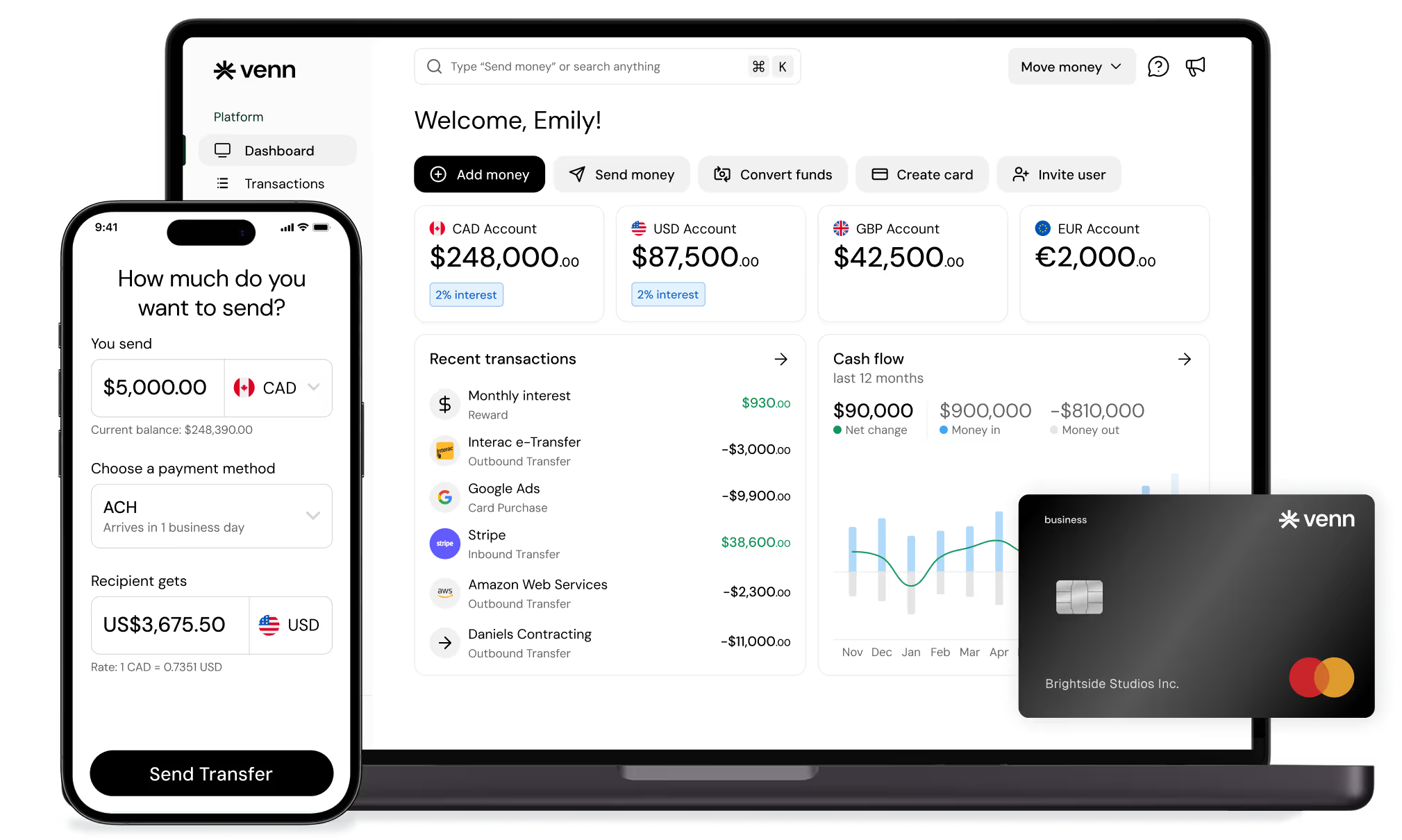
Quick recommendation: For Canadian businesses implementing Profit First, Venn delivers the strongest combination of bucket-friendly infrastructure, multi-currency accounts, and operational tooling. The platform supports organizing funds across multiple purposes while providing local CAD, USD, GBP, and EUR accounts, 1% unlimited cashback, and direct QuickBooks and Xero integration.
The Profit First method was created by Mike Michalowicz and introduced in his book Profit First. Profit First® is a registered trademark of Mike Michalowicz.
Comparison Table: Profit First Banking Features That Matter
| Platform | Best For | Multiple Accounts / Buckets | Transfer Types | Multi-Currency | Accounting Integrations | Cards & Rewards | Key Watchouts |
|---|---|---|---|---|---|---|---|
| Venn | Overall Profit First + multi-currency setup | Yes, flexible structure | EFT, ACH, wires, free unlimited Interac e-Transfer® | CAD, USD, GBP, EUR (local accounts) | QuickBooks, Xero | 1% unlimited cashback | Not a traditional bank |
| RBC | Branch access, cash deposits | Yes, but fee stacking | EFT, wires, Interac e-Transfer® | USD accounts available | QuickBooks, Xero | Various card options | Monthly fees per account add up |
| TD | Traditional full-service banking | Yes, multiple accounts | EFT, wires, Interac e-Transfer® | USD accounts available | QuickBooks, Xero | TD Business Rewards | Per-transaction fees on many plans |
| Scotiabank | Existing Scotiabank customers | Yes, multiple accounts | EFT, wires, Interac e-Transfer® | USD accounts available | QuickBooks, Xero | Scotia Rewards | Best value mainly within existing relationship |
| Wise Business | International transfers | Multi-currency balances | SWIFT, local transfers | 40+ currencies | QuickBooks, Xero | Wise debit card | Limited domestic EFT capabilities |
What Profit First Requires From a Bank Account
The Non-Negotiables
Running Profit First means operating 5-8 separate accounts without painful fees eating into your margins. Every dollar lost to monthly maintenance charges or per-transfer fees undermines the methodology's purpose.
Fast internal transfers matter more than most business owners realize. If moving money between buckets takes 2-3 business days or requires manual intervention, you'll skip allocations. The system fails when friction exceeds motivation.
Your banking setup must support outbound payments without forcing you into expensive workarounds. Payroll, vendor payments, tax remittances, and bill payments should flow smoothly from your OPEX and Tax buckets. Many Canadian fintechs fall short here because they lack the infrastructure for pre-authorized debits or direct tax payments.
Clean bookkeeping integration closes the loop. Downloadable statements, consistent transaction categorization, and direct feeds to QuickBooks or Xero transform Profit First from a spreadsheet exercise into an automated system.
Nice-to-Haves That Make Profit First Stick
Account naming or labeling helps you stay organized. Seeing "Profit" and "Tax" instead of account numbers ending in 4521 and 4522 reduces cognitive load during allocations.
User permissions become essential as your team grows. Your bookkeeper needs different access than your operations manager. Role-based controls prevent accidental transfers from the wrong bucket.
Interest on reserves turns your Vault account into a working asset. Even modest yields compound over time, especially when you maintain 3-6 months of operating expenses in reserve.
Best Overall: Venn (Why It Fits Profit First in Canada)
Why Venn Works for Profit First Buckets
Venn's infrastructure supports the account structure Profit First demands. You can organize funds across Profit, Tax, Owner's Compensation, OPEX, and Reserves without multiplying monthly fees. The platform's design assumes businesses need multiple funding purposes, not just a single checking account.
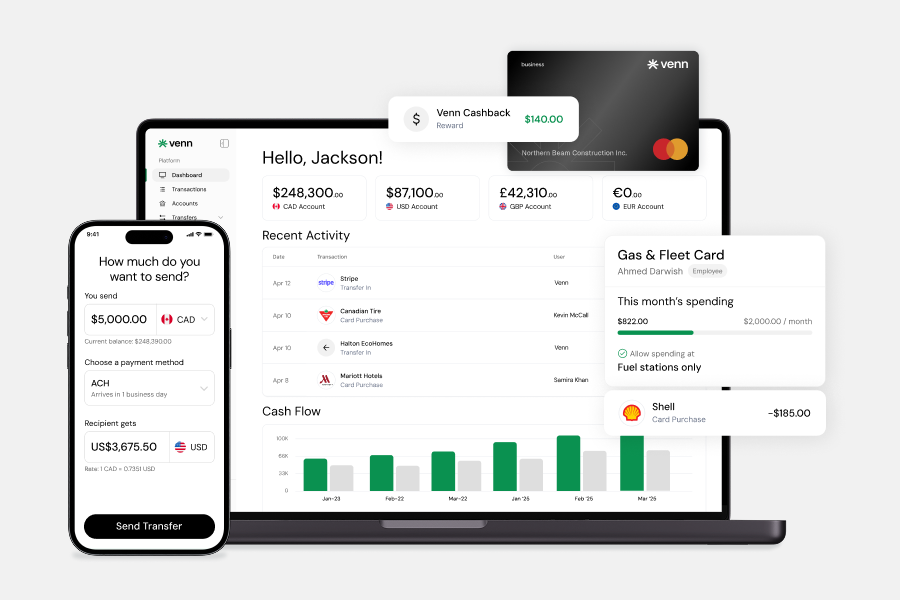
The operational workflows reduce what most Profit First practitioners call the "spreadsheet burden." Rather than manually tracking allocations across disconnected accounts, Venn provides visibility into your complete cash position. This matters on allocation days when you need to see Income, calculate percentages, and move funds quickly. From the mobile app, you can access your funds, send transfers, and issue cards without leaving your phone.
Venn connects directly to Canadian banking rails through its partnership with Peoples Trust Company. This means you can pay taxes, process payroll, and handle bill payments from within the platform. Many competing fintechs force you back to a traditional bank for these essential functions, fragmenting your Profit First system.
Start banking smarter with Venn
Open a business account in minutes with no monthly fees, low FX rates, and corporate cards.
Get Started →
Profit First + Spend Control: 1% Unlimited Cashback
The 1% unlimited cashback on Venn's card directly supports Profit First outcomes. Every dollar saved on operating expenses improves your net margin before you even run allocations. If your business spends $20,000 monthly on cards, that's $200 back into your system each month, or $2,400 annually.
Unlike competitors that require minimum spend thresholds before cashback kicks in, Venn's reward starts from dollar one. This makes it practical for businesses of all sizes, not just those with massive monthly spend.
The multi-currency card automatically uses the currency you're paying in first. Paying a US-based SaaS vendor? The card draws from your USD balance without forcing a conversion. This eliminates hidden FX fees that quietly drain operating expenses.
Multi-Currency Advantage (Especially for USD Revenue)
Canadian businesses earning USD face a persistent problem: forced conversions eat 1.5-3% on every payment received. Venn provides local US, CAD, GBP, and EUR accounts. Local means you can send and receive ACH in the US, Faster Payments in the UK, and SEPA in Europe.
For agencies billing US clients, ecommerce stores selling through Shopify, or service businesses invoicing internationally, this changes the math entirely. You receive payments in local currency, hold them until you need to convert, and move money at competitive FX rates when you do.
This capability simplifies Profit First allocations for multi-currency businesses. You can run allocations in USD for your US revenue stream and CAD for domestic income, keeping each clean rather than forcing everything through expensive conversions.
Accounting Stack Fit (QuickBooks + Xero)
Venn integrates directly with QuickBooks and Xero, the two accounting platforms most Canadian small businesses use. Transaction feeds flow automatically, reducing manual data entry and reconciliation time.
For Profit First practitioners, this integration makes monthly and quarterly reviews dramatically faster. You can see actual allocations against targets, track Profit distributions over time, and generate reports showing whether the system is working. Without clean accounting integration, Profit First becomes a manual tracking exercise that most businesses eventually abandon.
Other Top Options
RBC Business Banking: Best for Cash Deposits and Branch Support
RBC offers the most extensive branch network in Canada, making it the practical choice for businesses handling significant cash. Retail stores, restaurants, and service businesses with cash-heavy operations need somewhere to deposit funds, and RBC provides that infrastructure.
You can open multiple business accounts to support Profit First buckets. The challenge lies in fee stacking. Each account carries monthly maintenance fees, and transaction limits on lower-tier plans mean active businesses quickly exceed included transactions. Running 5-6 accounts for Profit First can cost $50-100+ monthly in fees alone before you process a single payment.
RBC's digital experience has improved but still lags behind modern platforms. Moving money between your own accounts often requires navigating multiple screens, and international transfers typically mean visiting a branch for larger wires.
Best for: Businesses with regular cash deposits, those requiring in-person service, or companies needing established banking relationships for credit facilities.
TD Business Banking: Best for Full-Service Traditional Banking
TD provides comprehensive business banking products including operating lines of credit, business credit cards, and merchant services. For businesses planning to grow into more complex credit needs, establishing a TD relationship early can pay off.
Multiple accounts are available, though the same fee-stacking concern applies. TD's transaction-based pricing on many plans means Profit First's twice-monthly allocation rhythm can trigger per-transfer charges that add up.
The TD Business Rewards program offers value for businesses concentrating spend on a TD card, though rewards rates don't match the 1% unlimited cashback available elsewhere. International payment capabilities exist but often require branch visits for larger transfers.
Best for: Businesses planning to pursue operating lines of credit, those wanting full-service traditional banking under one roof, or companies with existing TD personal banking relationships.
Scotiabank Business Banking: Best for Existing Scotiabank Customers
Scotiabank delivers the most value to businesses already within its ecosystem. Cross-account visibility, simplified transfers between personal and business accounts, and relationship pricing make it attractive for existing customers.
The international banking network provides advantages for businesses with Latin American connections, reflecting Scotiabank's geographic focus. Multi-currency accounts are available, though capabilities don't match dedicated multi-currency platforms.
Fee structures follow traditional banking patterns. Multiple accounts for Profit First will accumulate monthly charges, and transaction limits require careful monitoring to avoid overage fees.
Best for: Businesses with existing Scotiabank relationships, companies with Latin American trade connections, or owners wanting personal and business banking consolidated.
Wise Business: Best for International Transfers When Banking Features Are Secondary
Wise excels at international money movement. Competitive exchange rates, transparent fee structures, and multi-currency balances make it valuable for businesses with significant cross-border payment needs.
The limitation for Profit First is domestic banking infrastructure. Wise lacks the Canadian payment rails needed for tax payments, many bill payments, and some payroll services. You cannot use Wise as your primary business bank if you need full Canadian banking functionality.
Many businesses use Wise as a complement to their primary banking, holding international currency balances and making outbound international payments while maintaining a Canadian bank for domestic operations. This adds complexity to Profit First since you're now managing buckets across two platforms.
Best for: Businesses with heavy international payment volumes who already have a primary Canadian bank, or freelancers with simple domestic needs and significant foreign income.
How to Choose the Best Profit First Bank Account
Step 1: Count Your Buckets and Calculate Total Fees
Start with the standard Profit First accounts: Income, Profit, Owner's Compensation, Tax, and OPEX. Most businesses add a Vault or Reserves account. That's six accounts minimum.
Many Canadian businesses need additional buckets: GST/HST holding, payroll funding, contractor holdback, or capital expenditure reserves. Count your realistic bucket needs, then calculate what running that many accounts costs at each platform. Fee stacking can make traditional banks surprisingly expensive for Profit First.
Step 2: Match Your Payment Flows
Document how money moves through your business. Do you receive USD payments from Stripe, Shopify, or international clients? Do you pay contractors via EFT, vendors via wire, or use Interac e-Transfer® for quick payments?
Businesses receiving USD revenue benefit significantly from local US accounts that can receive ACH. Without this, you're paying inbound wire fees and unfavorable conversion rates on every payment. Venn's local USD account capability addresses this directly.
Step 3: Evaluate Accounting Integration Quality
The best Profit First setup fails if you can't track it accurately. Verify that your chosen platform integrates cleanly with your accounting software. Look for automatic transaction feeds, proper categorization, and reliable synchronization.
Poor integration means manual data entry, reconciliation headaches, and eventually abandoned Profit First discipline. The few dollars saved on banking fees aren't worth hours of monthly bookkeeping friction.
Practical Setup: Profit First Accounts Map
Recommended Account Structure
Income Account: All revenue deposits here first. This is your central clearing account before allocations.
Profit Account: Your predetermined profit percentage moves here on allocation days. This money is not for operations.
Owner's Compensation Account: Funds your salary or owner draws. Separate from profit distributions.
Tax Account: Holds estimated income tax, GST/HST, and other tax obligations. Never touch this for operations.
Operating Expenses (OPEX): Funds day-to-day business operations, payroll, rent, software, and vendor payments.
Vault/Reserves: Your emergency fund and capital reserve. Target 3-6 months of operating expenses.
Allocation Cadence
The standard Profit First rhythm runs twice monthly, typically on the 10th and 25th. On each allocation day, check your Income account balance, calculate percentages, and transfer to each bucket.
Monthly reviews assess whether your percentages are working. Quarterly reviews evaluate progress toward target allocation percentages and plan adjustments.
Implementation Tip: Start Simple
Don't launch with eight buckets on day one. Start with the core five (Income, Profit, Owner's Comp, Tax, OPEX) and add Vault once you've established the rhythm. Additional buckets like GST/HST holdback or contractor reserves can come after your first 90 days.
Complexity kills consistency. A simple system you actually use beats a sophisticated system you abandon after three allocation cycles.
FAQs
Q: How many bank accounts do I need for Profit First in Canada?
Most Canadian businesses need five to six accounts at minimum: Income, Profit, Owner’s Compensation, Tax, Operating Expenses, and Reserves (often called the Vault). Some businesses also add GST/HST, Payroll, or Contractor Holdback accounts, bringing the total to seven or eight. The best approach is to start with the core five and expand only after your allocation rhythm is established.
Q: Can I do Profit First with one bank account?
Technically yes, by tracking allocations in a spreadsheet as “virtual buckets.” In practice, this undermines the psychology that makes Profit First work. Physical separation of funds removes temptation, reduces decision fatigue, and creates clarity. Businesses that use one account tend to revert to old habits under pressure.
Q: What should I look for if I’m paid in USD?
Prioritize a local US account with ACH capability. This allows you to receive payments from US customers without inbound wire fees and lets you hold USD until you choose to convert. Platforms like Venn provide local USD accounts with ACH access, which is still rare among Canadian business banking options.
Q: Do I need a separate business savings account for the Vault?
Not strictly, but earning interest on reserves materially improves outcomes. The Vault should be accessible but psychologically separate from operating funds. Interest-bearing accounts turn idle cash into a productive asset while preserving the discipline of Profit First.
Q: What’s the biggest mistake when setting up Profit First bank accounts?
Over-complicating the structure while underestimating banking fees. Many businesses launch with too many accounts, incur high monthly charges, and abandon the system when cost and complexity outweigh perceived value. Start simple, confirm real banking costs, and add accounts only when the system is already working.
Funds held with Venn are covered under CDIC insurance protection.
---
**Disclaimer:** This publication is provided for general information purposes and does not constitute legal, tax or other professional advice from Venn Software Inc or its subsidiaries and its affiliates, and it is not intended as a substitute for obtaining advice from a financial advisor or any other professional. We make no representations, warranties or guarantees, whether expressed or implied, that the content in the publication is accurate, complete or up to date.
Profit First® is a registered trademark of Mike Michalowicz, who created the method and detailed it in his book Profit First. Venn is not affiliated with or endorsed by Mike Michalowicz or the Profit First brand; this article is an independent guide to applying the method.

Venn is all-in-one business banking built for Canada
From free local CAD/USD accounts and team cards to the cheapest FX and global payments—Venn gives Canadian businesses everything they need to move money smarter. Join 15,000+ businesses today.
Frequently asked questions
Everything you need to know about the product and billing.
Join 15,000+ businesses banking with Venn today
Streamline your business banking and save on your spend and transfers today
No personal credit check or guarantee.