Best Accounting Software for Canadian Law Firms 2026
Best Accounting Software for Canadian Law Firms compares Actionstep, Clio, QuickBooks, Xero, PCLaw and Venn for trust compliance, taxes, billing and integrations.

Ahmed Shafik
Co-founder


Trusted by 15,000+ Canadian businesses
Business banking for Canada
Local CAD and USD accounts, corporate cards with cashback, the lowest FX rates in Canada, free local transfers, and more.
Canadian law firms carry financial obligations that go well beyond standard bookkeeping. Every firm must manage client trust ledgers separately from operating funds, track disbursements at the matter level, handle GST/HST or applicable provincial sales tax, produce billing that meets client and court expectations, and satisfy the compliance standards set by their provincial law society. Generic small-business accounting software was not built with those requirements in mind.
This guide compares six of the best accounting software options for Canadian law firms in 2026, covering tools across three distinct categories. The first category includes legal-specific accounting platforms built around trust accounting, billing, and law society compliance. The second covers general accounting platforms that Canadian firms widely use, such as QuickBooks Online and Xero. The third introduces financial operations companions, including Venn, a business banking and expense-management tool that works alongside an existing accounting stack rather than replacing it.
Each option is evaluated on trust accounting capability, Canadian tax support, billing and time tracking, integrations, and practical fit by firm size. No single tool wins for every firm.
What Canadian Law Firms Should Look for in Accounting Software
Canadian law firms carry accounting obligations that most other small businesses never encounter. Before comparing any software, firms should evaluate options against the following criteria.
Trust accounting and three-way reconciliation. Legal-specific software should support separate trust and operating accounts, produce client trust ledgers, and automate three-way reconciliation. Ontario firms must complete monthly trust reconciliations within required timelines, and trust funds must remain strictly separate from operating funds. BC firms handling trust funds face formal trust assurance standards and compliance oversight from the Law Society of British Columbia. These are not optional workflows. Obligations vary by province, so confirm your specific requirements with your law society and accountant.
Audit trails and matter-level reporting. Every transaction touching a client file should be traceable. Look for software that logs changes, supports matter-level reporting, and produces clear records for billing, retainers, and disbursement tracking.
GST/HST and provincial sales tax support. Legal services are taxable supplies in most contexts. Your accounting software should handle GST/HST correctly, support provincial sales tax where applicable, and produce CRA-ready reports without manual workarounds.
Billing and retainer management. Time tracking, invoice generation, retainer drawdowns, and trust-to-operating transfers should all flow through the same system or integrate cleanly with your practice management platform.
Integrations and bank feeds. Direct bank feeds reduce manual entry and reconciliation errors. Strong integrations with practice management tools, payroll, and banking platforms extend the value of any accounting system.
Ease of use and firm size fit. A solo practitioner has different needs than a 20-lawyer firm. Evaluate whether the software scales with your headcount, supports multiple users with appropriate access controls, and matches the technical comfort level of your office manager or bookkeeper.
Comparison Table
Actionstep Legal Accounting
Actionstep is a strong fit for midsize Canadian law firms that want legal-specific accounting depth, trust compliance workflows, and financial reporting in a single platform. Unlike general SMB accounting tools, Actionstep was built with legal operations in mind, which makes it a more natural choice for firms where trust accounting and law society compliance are non-negotiable.
The legal accounting product can be purchased on its own or bundled with Actionstep's practice management suite. Pricing is typically structured per user plus implementation fees, though the vendor uses a quote-based model. Verify current pricing directly with Actionstep before making a decision.
On the feature side, Actionstep includes a multi-currency general ledger, banking reconciliation, accounts payable and receivable, budgeting, and financial reporting. Its Canadian compliance positioning covers HST, GST, and PST workflows, built-in three-way trust reconciliations, and provincial trust account requirements, including the kind of audit-trail controls that Ontario and BC firms need to meet law society expectations.
The limitations are worth noting. Pricing transparency is limited, and implementation typically requires planning time and internal resources. For solo practitioners or very small firms, the platform may offer more functionality than the practice actually needs, which can translate into unnecessary cost and complexity.
Clio for Canadian Trust Accounting Workflows
Clio is the strongest fit for Canadian firms that want legal practice management and trust accounting workflows in one platform, then sync financial data to a dedicated accounting tool. It is not positioned here as a standalone accounting solution. The safer and more accurate framing is that Clio supports Canadian trust accounting workflows and connects with external platforms such as QuickBooks Online and Xero.
Clio's Canadian presence is well-established. The company operates with Canadian-focused support, and its platform is built to handle client trust ledgers, retainer management, and the trust account controls that Canadian law societies expect. For firms already using Clio Manage for time tracking, billing, and matter management, the trust accounting layer fits naturally into an existing workflow rather than requiring a separate system for day-to-day legal operations.
The QuickBooks Online and Xero integrations are a practical strength. Firms can manage trust and billing activity inside Clio, then push financial data to their accounting platform for back-office reporting, GST/HST tracking, and CRA-ready records.
Two limitations are worth noting. First, firms will likely still need a separate accounting platform to handle full back-office bookkeeping, payroll, and tax reporting. Second, the specific feature set available depends on the Clio plan selected and the connected software stack. Firms evaluating Clio should confirm current plan inclusions directly with Clio before committing.
QuickBooks Online
QuickBooks Online suits Canadian law firms that want a familiar, well-supported accounting platform and already have separate trust accounting controls in place, whether through legal practice management software, a dedicated trust accounting tool, or rigorous manual procedures overseen by a professional accountant.
On the accounting side, QuickBooks delivers genuine strength for Canadian firms. GST/HST tracking and CRA-oriented workflows are built into every plan, making tax reporting and remittance preparation straightforward. The Essentials plan adds bill management, multi-currency support, and time tracking, which covers the core bookkeeping needs of most small to midsize practices. The Advanced plan supports up to 25 users, making it viable as a firm grows. Accountants across Canada know QuickBooks well, which simplifies year-end work and CRA compliance. The app ecosystem is broad, and several legal practice management tools integrate directly with QuickBooks Online, allowing firms to sync billing, matter expenses, and disbursement tracking without manual data entry.
The key limitation is that QuickBooks is not legal-specific software. It has no native trust accounting layer, no built-in three-way reconciliation for client trust ledgers, and no law-society-oriented compliance workflows. Firms handling trust funds under Ontario Law Society or BC Law Society requirements should not rely on QuickBooks alone for trust account management. Paired with appropriate legal software and professional oversight, QuickBooks works well as the bookkeeping and tax reporting backbone of a law firm's finance stack.
Xero
Xero suits Canadian law firms that want a clean, cloud-first accounting experience and plan to build their finance stack by connecting legal practice or billing software on top. It handles CRA-oriented tax reporting well, automates GST/HST calculations, and supports bank feeds from major Canadian institutions including BMO and CIBC. The app ecosystem is broad, and the interface is consistently praised by bookkeepers and external accountants who manage books for multiple clients.
For firms working closely with an outside accountant or bookkeeper, Xero's multi-user access and clean audit trail make collaboration straightforward. It also connects with a range of legal billing and practice-management tools, which is how most firms extend it into matter-level reporting and client trust workflows.
That said, Xero is not purpose-built for legal trust accounting. It has no native client trust ledger, no built-in three-way reconciliation, and no law-society-oriented compliance workflows. Firms that rely on Xero need a separate legal billing or practice-management layer to handle trust transactions properly, along with clearly documented reconciliation processes to meet provincial obligations. Treat Xero as a strong general accounting foundation, not a complete solution for law firm compliance.
PCLaw
PCLaw suits firms that want legal-specific billing, accounting, and trust workflows consolidated in a single environment, without piecing together a general SMB accounting tool with legal add-ons.
With more than 30 years in the legal software market, PCLaw has built its platform around the workflows law firms actually use: matter management, time tracking, legal billing, vendor payments, and trust account management. That depth of purpose-built functionality appeals to firms that value an established system designed specifically for legal practice rather than adapted from general bookkeeping software.
For Canadian firms managing client trust ledgers and operating accounts, PCLaw's trust accounting workflows are central to its value proposition. The platform is designed to keep trust and operating funds separate and to support the reconciliation processes that provincial law societies expect.
Pricing is quote-based, so firms should contact the vendor directly for current figures. Some teams may find the user experience less modern compared to newer cloud-first products. Before committing, confirm the extent of cloud functionality with PCLaw directly, as current deployment options should be verified against up-to-date vendor documentation rather than assumed.
Venn
Venn is best suited for law firms that already have accounting or legal trust-accounting software in place and want a stronger business banking, expense management, and multi-currency layer sitting alongside it. Venn is not legal trust accounting software and does not replace QuickBooks, Xero, PCLaw, or any other accounting stack. It works as a companion to those platforms, not a substitute.
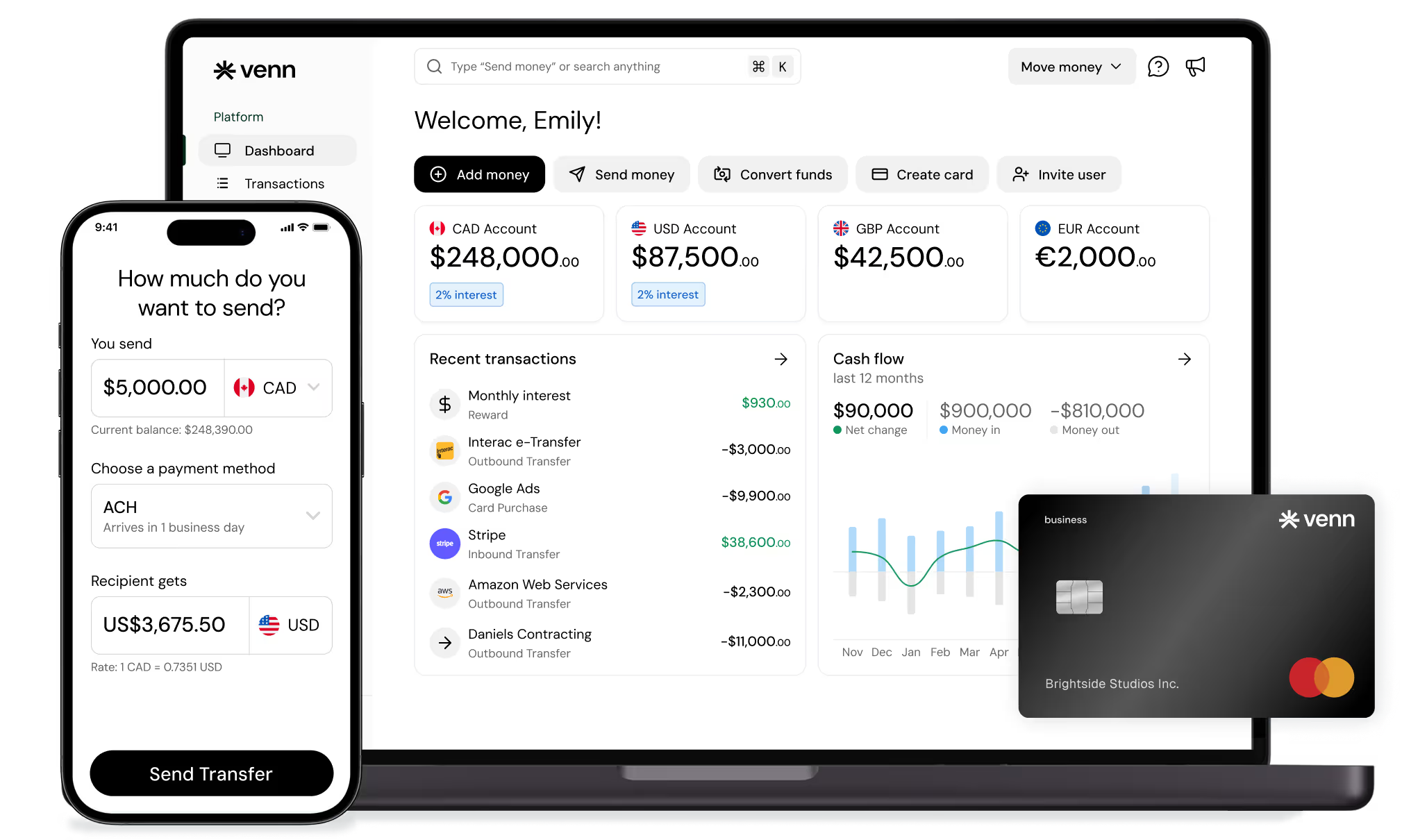
For firms already running QuickBooks Online or Xero, Venn connects directly to both, keeping transaction data flowing without manual exports. The mobile app also lets teams access funds, send transfers, and create cards directly from their phones. Corporate cards with built-in expense controls let firms set spending limits by card or category, and OCR receipt capture reduces the manual work of reconciling disbursements and team spend. Firms handling cross-border work can hold balances in CAD, USD, GBP, and EUR, with competitive FX rates on conversions between those currencies.
Venn's pricing runs at $0, $40, or $100 per month depending on the plan. Eligible accounts earn 1% cashback on card purchases, subject to plan-based caps, and 2.75% interest on CAD balances and up to 3.5% interest on USD balances (learn more). Vendor payments via Interac e-Transfer® are included.
Venn is a technology company, not a bank. Account balances are held at Bank of Montreal, a CDIC member, and are eligible for CDIC deposit insurance up to applicable limits. Venn is not currently available to businesses in Quebec.
Which Option Is Best for Your Firm?
No single platform wins for every Canadian law firm. The right choice depends on your firm's size, trust accounting obligations, existing software stack, and how much financial operations complexity you manage day to day.
Choose Actionstep if your firm wants legal-specific accounting depth in one platform. Its built-in three-way trust reconciliation, HST/GST/PST support, and provincial law society compliance framing make it a strong fit for midsize firms with serious trust accounting requirements.
Choose Clio if practice management and trust workflows sit at the centre of your operations and you are comfortable syncing to QuickBooks Online or Xero for back-office accounting. Clio's Canadian trust account management tools and integrations work well for firms already running their matters through Clio Manage.
Choose QuickBooks Online if your firm wants mainstream Canadian accounting, strong CRA tax reporting, and broad accountant familiarity, and already has separate processes or software handling trust account compliance.
Choose Xero if you prefer a clean cloud accounting platform with a strong app ecosystem and work closely with an external bookkeeper or accountant who knows the tool well.
Choose PCLaw if your firm values a long-established, purpose-built legal environment where billing, matter management, and trust accounting operate together without requiring third-party integrations.
Choose Venn if your firm already has accounting software covered and wants tighter cash management, team expense cards, spend controls, Interac e-Transfer® vendor payment support, QuickBooks and Xero connectivity, and multi-currency accounts in CAD, USD, GBP, and EUR alongside your existing legal accounting stack.
For most growing firms, the strongest setup combines a legal-specific or general accounting platform with a financial operations companion that handles banking, cards, and cash flow visibility.
Conclusion
The best accounting software for a Canadian law firm depends on what the firm actually needs to solve. Firms with active trust accounts and provincial compliance obligations should prioritize tools with native trust accounting, three-way reconciliation, and law-society-oriented workflows. Firms already running on QuickBooks or Xero may find that pairing those platforms with a legal practice management layer covers most of their needs. Firms that want a single, purpose-built environment for billing, matter management, and trust accounting will find PCLaw or Actionstep a closer fit.
One point applies across every option: trust accounting obligations vary by province, and the software setup must reflect your specific law society's requirements. Confirm the details with your accountant and provincial law society before going live.
If your firm already has legal accounting covered and wants a cleaner banking, expense-management, and multi-currency stack that connects to QuickBooks or Xero, Venn is worth evaluating alongside your software shortlist.
Legal / Editorial Disclaimer
This article is for informational purposes only. It does not constitute legal, tax, accounting, or financial advice. Trust accounting requirements for Canadian law firms vary by province and can change without notice. Confirm your firm's specific obligations with your provincial law society, a qualified accountant or bookkeeper, and a legal operations advisor before selecting or configuring any software.
Pricing, product availability, feature packaging, and Canadian-specific capabilities for all software mentioned in this article should be verified directly with each vendor on the date of publication. Promotional pricing and plan structures change frequently.
If this article is published with a card image or Mastercard logo, the following disclosure applies: Venn Mastercard Charge Card is issued by Peoples Trust Company under licence from Mastercard International Incorporated. Mastercard is a registered trademark, and the circles design is a trademark of Mastercard International Incorporated.
FAQ
Q: Can a Canadian law firm put retainers on a credit or charge card?
A: Yes, but only if the payment routes directly into a trust-compliant account and the firm follows its law society's rules for trust handling and recordkeeping. Ontario's guidance, for example, requires that retainers paid by card go straight to the designated trust account, not to a general account first. Firms should confirm the specific requirements with their provincial law society before accepting card retainers.
Q: Can a law firm use one card processor for both trust retainers and billed invoices?
A: Not always. Some processor setups only permit one destination account, which creates a compliance problem when trust retainers and billed fees need to land in separate accounts. Ontario's Law Society has specifically flagged this risk, noting that firms must verify their processor can route funds to the correct account type before accepting card payments.
Q: Are all client disbursements exempt from GST/HST?
A: No. CRA treatment depends on whether the firm incurred the cost as agent for the client or otherwise than as agent. Costs incurred as agent are generally not subject to GST/HST on reimbursement, while costs incurred otherwise than as agent can form part of the consideration for a taxable legal service. Firms should confirm the treatment of specific disbursement categories with their accountant or tax advisor.
Q: Do all Canadian provinces use identical trust-account rules?
A: No. The core principles are consistent across Canada, but deadlines, reporting requirements, and procedural mechanics vary by province. Ontario requires monthly trust reconciliations completed within 25 days of month-end, while BC requires reconciliations within 30 days and also mandates annual trust reports. Always verify the current requirements with your own law society.
Q: What should a law firm compare when choosing an operating account or card platform?
A: Prioritize spend controls, accounting integration with tools like QuickBooks or Xero, matter-level expense tracking, reimbursement workflows, compliance support, and audit trail quality. Card rewards are a secondary consideration. A platform that simplifies monthly reconciliation and supports clean matter coding will deliver more operational value than one chosen primarily for cashback rates.
---
**Disclaimer:** This publication is provided for general information purposes and does not constitute legal, tax or other professional advice from Venn Software Inc or its subsidiaries and its affiliates, and it is not intended as a substitute for obtaining advice from a financial advisor or any other professional. We make no representations, warranties or guarantees, whether expressed or implied, that the content in the publication is accurate, complete or up to date.
This publication is provided for general information purposes only and does not constitute legal, tax, financial, or other professional advice from Venn Software Inc., its subsidiaries, or its affiliates, and is not a substitute for advice from a qualified professional. All comparisons and competitor information reflect publicly available information believed accurate as of June 2, 2026; features, pricing, rates, and terms referenced are subject to change and may differ at the time you read this. All product names, logos, and brands referenced are the property of their respective owners; their mention does not imply affiliation with or endorsement by Venn. Any comparative statements reflect Venn's views and are provided to help readers evaluate options. We make no representations, warranties, or guarantees, express or implied, that the content is accurate, complete, or up to date.

Venn is all-in-one business banking built for Canada
From free local CAD/USD accounts and team cards to the cheapest FX and global payments—Venn gives Canadian businesses everything they need to move money smarter. Join 15,000+ businesses today.
Frequently asked questions
Everything you need to know about the product and billing.
Join 15,000+ businesses banking with Venn today
Streamline your business banking and save on your spend and transfers today
No personal credit check or guarantee.