2026 Guide: Mercury alternatives for Canadian Startups
Compare Mercury alternatives for Canadian Startups in 2026. See Venn, Wealthsimple, Wise and banks by eligibility, CAD USD workflows, cards and integrations.


Trusted by 15,000+ Canadian businesses
Business banking for Canada
Local CAD and USD accounts, corporate cards with cashback, the lowest FX rates in Canada, free local transfers, and more.
Mercury alternatives for Canadian startups matter because many founders, operators, and finance leads like Mercury’s startup-friendly experience, but need a solution that fits their entity structure and Canadian operating needs. Mercury supports international founders, but its business account eligibility generally requires the company to be formed and registered in the United States or a U.S. territory.
That distinction creates a practical gap for Canada-based teams that operate through a Canadian corporation, manage local CAD workflows, or need a business bank account Canada startup teams can use without restructuring around a U.S. entity.
This comparison takes a Canada-specific view of Mercury alternatives, not a universal ranking of the best Mercury competitors. The right choice depends on how your company is set up: Canadian-incorporated, U.S.-incorporated, or cross-border from day one. A SaaS company with U.S. customers may need different startup banking alternatives than a local services business, ecommerce brand, or agency paid mainly in Canada.
Use this shortlist to match each option to your incorporation status, operating geography, and finance workflow complexity.
Why Canadian Startups Look for Mercury Alternatives
Canadian founders often search for Mercury alternatives for Canadian startups because of Mercury’s U.S.-entity-first eligibility model. The question is usually less about whether Mercury is a strong platform and more about whether it fits a Canadian company’s operating reality.
A Canadian-incorporated startup may need CAD-first workflows for payroll, vendor payments, invoices, sales tax, and day-to-day operating expenses. If the business also sells to U.S. customers or pays U.S. suppliers, it may need USD workflows that reduce unnecessary FX friction and keep cross-border cash movement predictable.
Finance teams also compare Mercury competitors when they need corporate card controls, approval workflows, clean expense records, and accounting-ready transaction data. These needs grow quickly as a startup adds employees, contractors, subscriptions, and multiple departments.
Eligibility clarity matters too. Canadian founders want to know whether their corporation, sole proprietorship, or cross-border structure can apply without creating extra legal complexity. For many teams, the right Mercury alternative in Canada is the option that supports local tax administration, CRA-related workflows, and practical finance operations from the start.
Quick Comparison Table
Use this snapshot to shortlist Mercury alternatives for Canadian startups by entity fit, currency workflow, cards, integrations, and operating complexity.
Venn
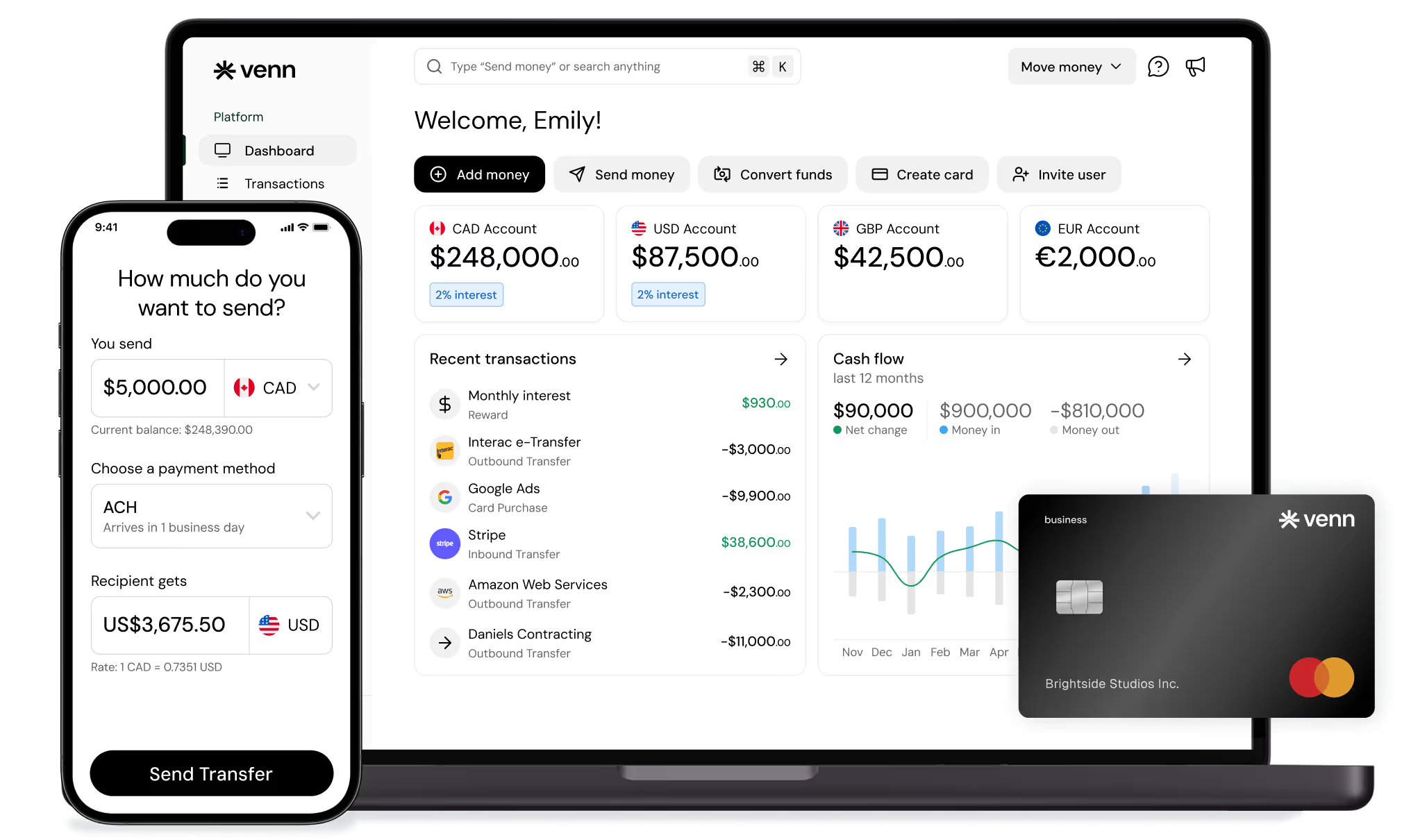
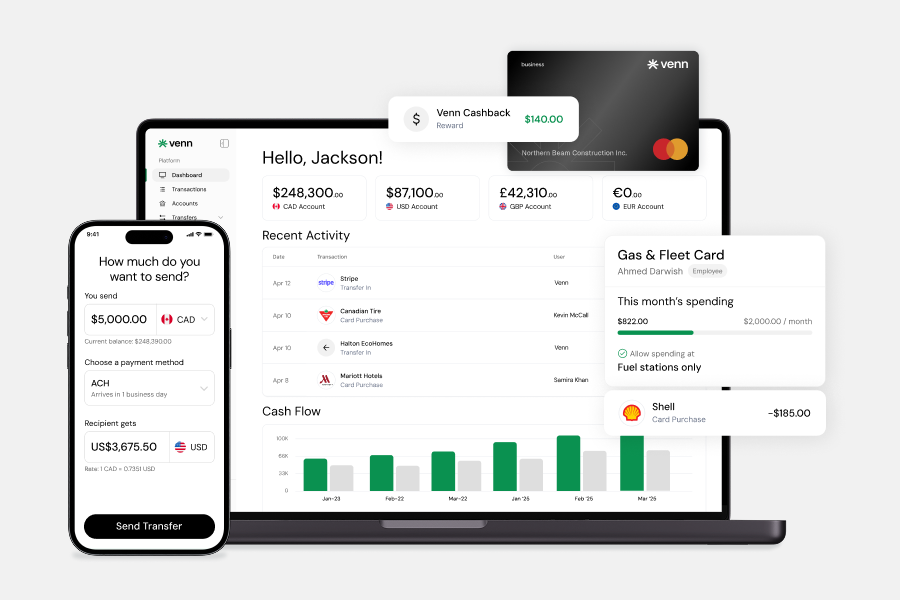
Venn is best for Canadian startups that want one platform for CAD operations, USD workflows, cards, payments, and accounting sync. For founders comparing Mercury alternatives for Canadian startups, it fits teams that need Canadian entity support plus cross-border finance workflows.
Eligibility
Venn supports Canadian corporations and sole proprietors, which makes it relevant for incorporated startups and owner-operated businesses in Canada. Venn is currently not available to businesses in Quebec.
Currency and Payments
Venn offers CAD, USD, GBP, and EUR account capabilities, with plan-based FX markups of 0.45%, 0.35%, and 0.25%. Startups can earn 2.75% interest on CAD balances and up to 3.5% interest on USD balances with no minimum balance requirement (learn more).
Payment support includes local rails such as EFT, ACH, and SEPA depending on plan, plus free unlimited Interac e-Transfer® for vendor payments. This mix can suit Canadian businesses with U.S. operations, global suppliers, or customers paying in multiple currencies.
Cards and Controls
Venn offers a 1% cashback card. Unlimited cashback applies on the Pro plan, while other plans include monthly cashback caps.
Teams can issue virtual and physical cards, set spend controls, manage expenses, and use approval workflows. OCR receipt capture helps reduce manual follow-up across employee spend.
If this article includes a Venn card image or Mastercard branding, add the required footer: “Venn Mastercard Charge Card is issued by Peoples Trust Company under licence from Mastercard International Incorporated. Mastercard is a registered trademark, and the circles design is a trademark of Mastercard International Incorporated.”
Accounting and Operations
Venn includes invoicing, direct QuickBooks and Xero integrations, and finance workflows designed for operators who want fewer disconnected tools. That can help teams keep payments, card spend, and reconciliation closer to their accounting process.
Tradeoffs
Venn is a technology company, not a bank. Eligible deposits with Venn are covered by CDIC insurance protection up to applicable limits, with balances held at Bank of Montreal, a CDIC member institution.
Plan tradeoffs matter, especially for FX pricing, transfer rails, and cashback caps. Venn may also be more platform than a startup needs if it only wants simple CAD chequing.
Wealthsimple Business Chequing
Wealthsimple Business Chequing is best for incorporated Canadian businesses that want a simple, low-fee, CAD-first operating account. For founders comparing Mercury alternatives for Canadian startups, it fits companies that prioritize straightforward Canadian chequing over multi-currency finance operations.
On features, Wealthsimple’s current page markets $0 monthly fees, interest from 1.25% to 2.25% depending on combined assets, direct bill payments including corporate taxes, and integrations with QuickBooks or Wave. It also advertises a prepaid business Visa with 1% cash back and no FX fees on card purchases, so older claims that Wealthsimple has no business card no longer reflect the current offer.
Eligibility matters. Wealthsimple says non-incorporated businesses are not eligible, and the product targets eligible incorporated entities, charities, and associations. That makes it a practical Mercury alternative Canada option for incorporated startups, but not for sole proprietors or unincorporated side businesses.
The main strengths are simple pricing, direct CRA payment support, and a natural fit for founders already using Wealthsimple personally or through workplace products. The tradeoffs are equally clear: Wealthsimple positions the account around CAD-first operations, its current official page does not list Xero integration, and it will suit fewer startups that need multi-currency operating workflows or more advanced finance operations tooling. Broader operating needs may point readers back to the Venn section above.
Wise Business
Wise Business is best for Canadian startups that mainly need international transfers, multi-currency receiving details, and transparent FX while using another provider as their main operating account.
Wise positions its business product around international business payments, local receiving details in multiple currencies, and global payment functionality. For startups paid by customers outside Canada, that can make Wise useful as a specialist payments layer rather than a complete finance operating system. It gives founders a clearer view of conversion costs before sending money, which helps teams manage FX exposure when paying suppliers, contractors, or remote team members abroad.
Pricing in Canada includes a one-time setup fee. Transfer and conversion costs vary by currency, payment method, and destination, with conversion pricing that starts from 0.48% in some scenarios.
The main tradeoff is scope. Wise can be a practical part of a shortlist of Mercury alternatives for Canadian startups, but it should not be treated as a full Mercury replacement if your team needs corporate cards, approval workflows, Canadian operating-account workflows, or deeper finance controls. It fits best when cross-border payments and transparent FX matter more than all-in-one banking operations.
Traditional Canadian Banks
Traditional Canadian banks are best for startups that need branch access, cash handling, lending relationships, or a more conservative banking setup. For founders comparing Mercury alternatives for Canadian startups, RBC, TD, and Scotiabank remain practical options when in-person service and established banking relationships matter more than lightweight finance operations.
Their core strengths sit in traditional banking infrastructure. Branch networks can help teams that deposit cash, need certified cheques, manage complex signing authorities, or want face-to-face support. A startup preparing for a credit facility, commercial mortgage, or larger lending discussion may also value an existing relationship with a major Canadian bank.
Fees deserve close attention, especially for cross-border banking for startups. RBC’s business fee guide shows incoming wire fees over C$50/US$50 at C$17/US$17, with outgoing wires starting at C$15 online. TD’s business account guide lists incoming wires at $15, outgoing international wires at $50 plus exchange rate and other fees, and a 3% international transaction fee in some card contexts. Scotiabank’s fee schedule lists incoming wire payments at $15 and describes its U.S. Dollar Business Accounts as domiciled in Canada.
Those costs may be manageable for occasional international payments, but they can create friction for startups with frequent USD customers, suppliers, or contractor payouts. Traditional banks also tend to feel less startup-friendly when teams want faster setup, cleaner software workflows, and leaner day-to-day finance operations.
When Mercury Still Makes Sense
A Canadian founder with an existing U.S. parent company, Delaware C-corp, or another eligible U.S. entity may still find Mercury viable. For venture-backed startups that already operate through a U.S. structure, Mercury can fit neatly into a U.S.-centric finance stack, especially when customers, investors, and vendors expect U.S. banking workflows.
Mercury also supports accounting integrations with QuickBooks Online, Xero, and NetSuite, which matters for finance teams that want cleaner month-end reconciliation and fewer manual exports. That integration coverage helps explain why Mercury remains a serious option in many startup banking alternatives discussions, rather than simply a product to rule out.
The tradeoff is operational fit. Mercury may suit Canadian businesses with U.S. operations, but it can be less practical for teams that need frequent cash deposits, check-heavy workflows, or a purely Canadian operating setup. In those cases, Mercury alternatives for Canadian startups usually deserve a closer look.
How to Choose the Right Mercury Alternative
The right Mercury alternatives for Canadian startups depend less on brand preference and more on how your company operates. Start with entity eligibility. A Canadian corporation, sole proprietor, and U.S. entity may each need a different path, especially if your startup has investors, U.S. customers, or a cross-border structure.
Next, map your currency needs. A CAD-only local services company may value simple Canadian chequing, while a SaaS startup billing U.S. customers may need CAD plus USD workflows, and possibly other currencies. If you pay U.S. suppliers or collect from U.S. customers, confirm whether ACH matters. If your activity stays in Canada, local CAD rails may matter more than U.S. payment access.
FX exposure should shape the shortlist. Occasional conversions call for simplicity. Frequent conversions require closer review of spreads, timing, approval workflows, and reconciliation. The same logic applies to cards and controls. A founder-only team may need one card, while a growing team may need employee spend limits, virtual cards, approval rules, and cleaner month-end review.
Accounting and tax operations also narrow the field. Check whether your finance team uses QuickBooks, Xero, Wave, or an ERP, and whether direct CRA payments are part of your monthly process. Finally, assess operating complexity. If you need basic chequing, choose accordingly. If you manage payables, cards, multi-currency balances, and accounting workflows together, as covered above, Venn is more relevant when a Canadian startup needs a broader operating stack.
Conclusion
The strongest Mercury alternatives for Canadian startups depend on your entity structure, currency mix, and day-to-day operating needs. There is no one-size-fits-all answer, and the right platform should match how your team actually collects, spends, pays, and reconciles money.
For Canadian startups that need a broader operating stack, Venn can make sense as a finance-ops hub rather than a basic account. Wealthsimple fits incorporated businesses that want simple CAD chequing with minimal complexity. Wise works well as a specialist layer for international transfers and FX support, especially when global payments matter more than full operating workflows. Traditional banks remain practical for branch-first teams, cash handling, and lending-heavy relationships. Mercury can still suit eligible startups that operate through a U.S. entity and want a U.S.-first setup.
If your startup needs Canadian entity support, CAD and USD accounts, corporate cards, and accounting integrations in one place, sign up for a Venn account.
FAQ
Q: Can a Canadian startup open a Mercury account?
A: Mercury business accounts generally require a U.S.-formed entity. Canadian founders can apply if they operate through a U.S. company, but a Canadian-incorporated startup without that structure will usually need a Canada-focused alternative.
Q: What is the best Mercury alternative for a Canadian startup with U.S. customers?
A: It depends on whether the company needs a Canadian operating account, true USD workflows, or simply low-cost cross-border transfers. SaaS companies, ecommerce businesses, and agencies often have different requirements, even when they all receive payments from U.S. customers. Use the comparison table above to shortlist the best Mercury alternatives for Canadian startups based on entity eligibility, currency needs, and operational complexity.
Q: Which Mercury alternative is best for simple CAD business banking?
A: Wealthsimple or a traditional Canadian bank may suit simpler setups, especially if the business mainly needs CAD chequing and straightforward domestic payments. If your team needs broader finance operations, such as multi-currency workflows, cards, approvals, or accounting-ready controls, a more complete platform may be a better fit. The right Mercury alternative for Canadian businesses should match how the company collects, spends, and reconciles money.
Q: What should I look for beyond pricing?
A: Look at eligibility, payment rails, foreign exchange (FX) costs, integrations, and day-to-day workflow fit. A low headline price can lose value if your team spends extra time routing payments, converting currencies, or reconciling transactions manually. For Canadian founders, the best Mercury alternatives should support the company’s legal structure, customer geography, and finance processes without adding unnecessary work.
---
**Disclaimer:** This publication is provided for general information purposes only and does not constitute legal, tax, financial, or other professional advice from Venn Software Inc., its subsidiaries, or its affiliates, and is not a substitute for advice from a qualified professional. All comparisons and competitor information reflect publicly available information believed accurate as of June 1, 2026; features, pricing, rates, and terms referenced are subject to change and may differ at the time you read this. All product names, logos, and brands referenced are the property of their respective owners; their mention does not imply affiliation with or endorsement by Venn. Any comparative statements reflect Venn's views and are provided to help readers evaluate options. We make no representations, warranties, or guarantees, express or implied, that the content is accurate, complete, or up to date.

Venn is all-in-one business banking built for Canada
From free local CAD/USD accounts and team cards to the cheapest FX and global payments—Venn gives Canadian businesses everything they need to move money smarter. Join 15,000+ businesses today.
Frequently asked questions
Everything you need to know about the product and billing.
Join 15,000+ businesses banking with Venn today
Streamline your business banking and save on your spend and transfers today
No personal credit check or guarantee.