What are SEPA Payments? How To Send Money To The UK Guide
What are SEPA Payments? How To Send Money To The UK with fewer fees and delays. Learn when to use SEPA vs Faster Payments or wires and what details you need.

Ahmed Shafik
Co-founder
.png)
Trusted by 15,000+ Canadian businesses
Business banking for Canada
Local CAD and USD accounts, corporate cards with cashback, the lowest FX rates in Canada, free local transfers, and more.
Sending money from Canada to the UK should be straightforward. Yet many businesses discover their payments arrive late, cost more than expected, or get stuck in compliance limbo. The culprit is often choosing the wrong payment rail for the job.
Understanding SEPA payments, and when to use them versus alternatives, can save your business significant time and money on UK transactions. By the end of this guide, you'll know exactly what SEPA is, whether it applies to UK payments after Brexit, what details you need, and how to choose between SEPA, UK Faster Payments, and traditional wires.
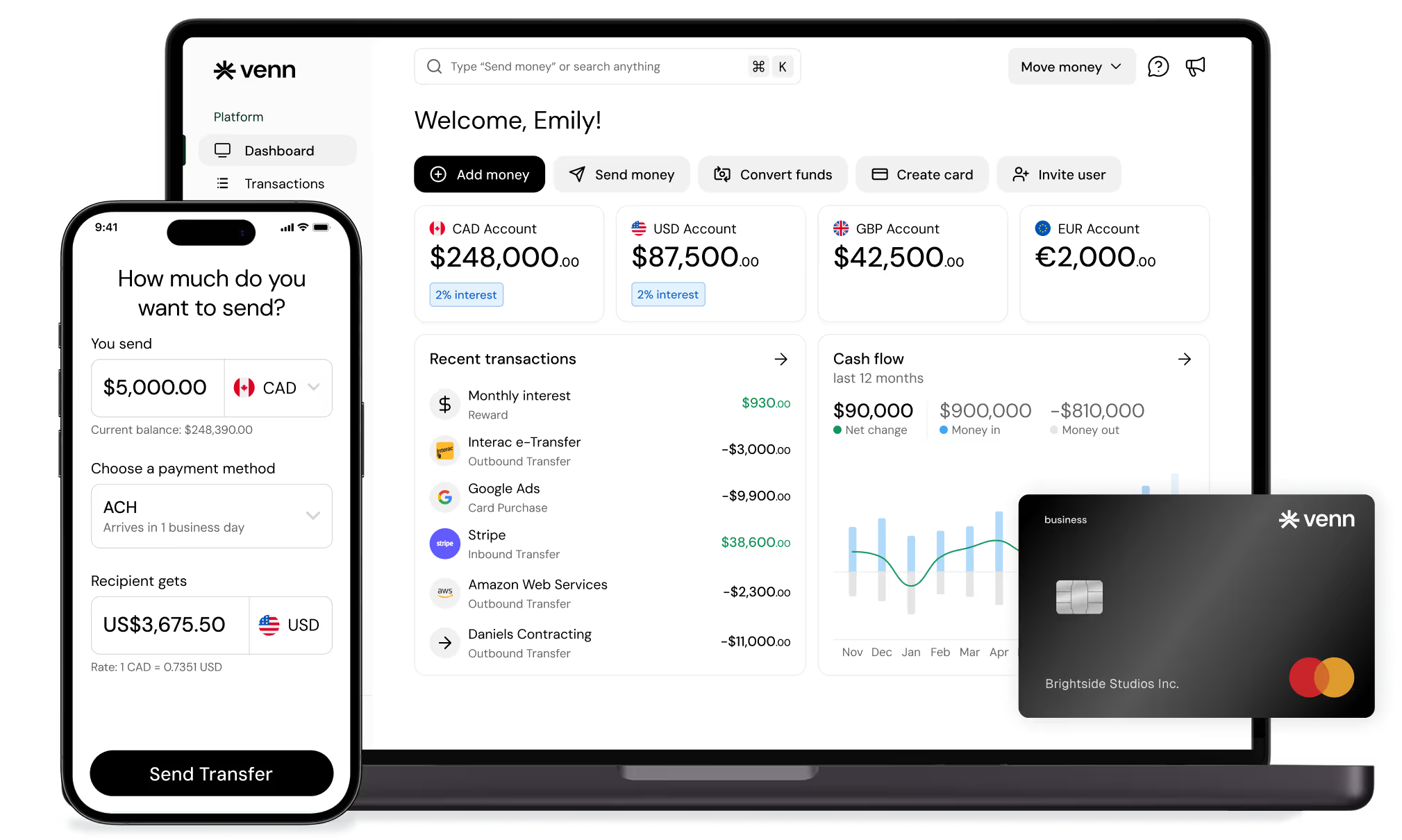
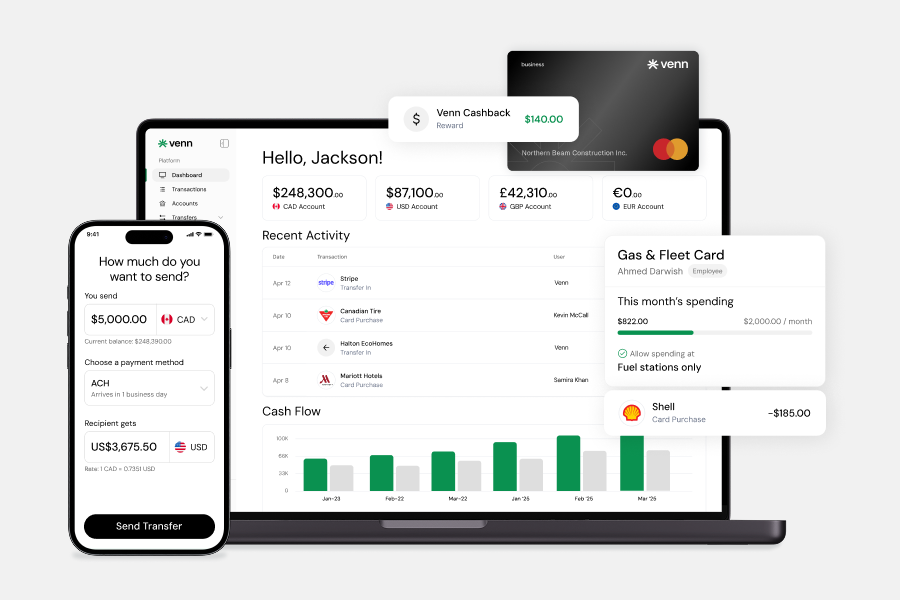
For Canadian businesses managing regular UK payables or receivables, the right approach often involves a multi-currency business banking platform like Venn that gives you access to the appropriate payment rails without operational headaches.
What Are SEPA Payments?
SEPA stands for Single Euro Payments Area. It's a payment integration initiative that standardizes euro-denominated cashless payments across participating countries. Think of it as a unified system that makes sending euros across borders as simple as domestic transfers.
The key point many businesses miss: SEPA is exclusively for euro transactions, not British pounds. When you're paying a UK beneficiary in euros, SEPA offers a streamlined, cost-effective option. When you're paying in GBP, you'll need different rails entirely.
SEPA encompasses three main payment types: credit transfers (you push money), direct debits (you pull money with authorization), and instant credit transfers (real-time processing). The schemes cover 41 countries and territories, creating a massive network for euro payments.
Is The UK In SEPA After Brexit?
Yes. Despite Brexit, the UK remains within the geographical scope of SEPA schemes. The European Payments Council's official list of SEPA scheme countries confirms UK participation continues.
What does this mean practically for Canadian businesses?
You can send a SEPA payment to the UK when the recipient has an EUR-capable account with an IBAN. This works well for UK suppliers who invoice in euros or maintain euro accounts.
However, if your invoice is in GBP, SEPA isn't the right choice. Using SEPA for a GBP payment means converting CAD to EUR, then the recipient converts EUR to GBP. That's two currency conversions when you only need one. For GBP payments, UK local rails like Faster Payments or CHAPS are typically more efficient.
SEPA Payment Types: SCT vs SDD vs Instant
SEPA offers different schemes for different business needs. Understanding which to use helps you optimize both cost and timing.
| SEPA Scheme | Best For | Currency | Typical Speed | Key Business Notes |
|---|---|---|---|---|
| SEPA Credit Transfer (SCT) | Paying invoices and suppliers | EUR | Same or next business day | Payer-initiated; standard for B2B payables |
| SEPA Direct Debit (SDD Core/B2B) | Recurring collections | EUR | Varies by submission timing | Pull-based; requires mandate management |
| SEPA Instant Credit Transfer (SCT Inst) | Urgent EUR payouts | EUR | Seconds (24/7 availability) | Not all providers participate; real-time processing |
SEPA Credit Transfer handles most business-to-business payments. You initiate the transfer, specify the amount and beneficiary, and funds typically arrive within one business day.
SEPA Direct Debit works in reverse. With proper authorization (a mandate), you can pull funds from customer accounts. The B2B variant offers stronger protection for business collections with shorter refund windows.
SEPA Instant delivers funds in seconds, operating around the clock including weekends and holidays. Availability depends on your provider and the recipient's bank both supporting the scheme.
SEPA vs SWIFT Wire vs UK Faster Payments: Which Should You Use?
Choosing the right payment rail depends on the currency, urgency, and amount. Here's a practical decision framework.
Paying a UK supplier in EUR? Consider SEPA Credit Transfer. It's standardized, often cheaper than wires, and processes quickly.
Paying a UK supplier in GBP? Use UK local GBP transfer methods like Faster Payments or CHAPS. This keeps you in one currency throughout.
Large amounts, complex routing, or bank-to-bank certainty required? SWIFT wires remain an option, though expect higher fees and longer settlement times.
| Method | Currency | Typical Use Case | Pros | Cons |
|---|---|---|---|---|
| SEPA Credit Transfer | EUR | UK/EU vendors billing in EUR | Standardized, often faster and cheaper than wires | EUR only; beneficiary must accept SEPA |
| UK Faster Payments | GBP | UK contractors and suppliers | Domestic-style speed for UK recipients | Requires GBP local capability |
| SWIFT Wire | Multi-currency | Large or complex transfers | Widely supported globally | Higher fees, less transparent FX |
For businesses with recurring international payables, maintaining multi-currency accounts eliminates the guesswork. With EUR and GBP accounts through a platform like Venn, you can choose the optimal rail for each payment rather than forcing everything through expensive wire transfers.
What Information Do You Need For A SEPA Payment?
Getting payment details right the first time prevents delays and rejection fees. Collect these details before initiating any SEPA transfer.
Required Details Checklist
• Beneficiary name (must match account registration exactly)
• Beneficiary address (as required by your provider)
• IBAN (International Bank Account Number)
• BIC/SWIFT code (sometimes optional, but often requested)
• Payment amount in EUR
• Payment reference or invoice number
• Purpose of payment (for compliance screening)
IBAN vs BIC: The Quick Explanation
IBAN identifies the specific account. It's an alphanumeric code up to 34 characters that includes country code, check digits, and the account number. Every SEPA payment requires an IBAN.
BIC (Bank Identifier Code, also called SWIFT code) identifies the financial institution. While some SEPA payments can route using IBAN alone, many providers still request the BIC for routing certainty.
Always verify beneficiary details against their invoice or official documentation. A single character error in the IBAN will cause rejection.
How Long Do SEPA Payments Take?
SEPA transfer timing varies based on several factors, making precise predictions difficult. Here's what influences delivery speed.
Standard SEPA Credit Transfers typically complete within one business day after submission. Some providers offer same-day processing if you submit before their cut-off time.
SEPA Instant Credit Transfers process in seconds when both the sending and receiving institutions participate. The scheme operates 24/7, including weekends and holidays.
Factors that extend timing:
• Submission after your provider's daily cut-off
• Weekends and bank holidays (for non-instant transfers)
• Compliance screening flags
• Beneficiary bank processing delays
• Incorrect or incomplete payment details
For time-sensitive payments, confirm your provider's cut-off times and consider SEPA Instant where available.
How To Send Money To The UK Using SEPA: Step-By-Step
Step 1: Confirm The Invoice Currency
Before selecting SEPA, verify whether you're paying in EUR or GBP. If the invoice is in GBP and you use SEPA, you'll force a double conversion: your CAD converts to EUR, then your supplier converts EUR to GBP. Both conversions carry costs.
If your UK supplier accepts EUR, SEPA makes sense. If they require GBP, explore UK local payment options instead.
Step 2: Collect And Verify Beneficiary Details
Request the IBAN, BIC, and exact legal name on the account. Cross-reference these against the invoice and any previous payment confirmations. Name mismatches cause the most frequent rejections.
Step 3: Choose Your Provider And Funding Method
Traditional banks offer SEPA but often with higher fees and less transparent FX rates. Business banking platforms can provide more competitive pricing and better visibility into total costs.
Consider: FX markup, flat transfer fees, transaction tracking, approval workflows, and user permissions for your team.
Step 4: Initiate The Transfer With Clear Reference
Include the invoice number or purchase order in the payment reference field. This simple step dramatically improves reconciliation on both ends.
Step 5: Reconcile In Your Accounting System
The payment isn't complete until it's properly recorded. Platforms like Venn integrate directly with QuickBooks and Xero, allowing multi-currency transfers to flow into your books with consistent references. This eliminates manual data entry and reduces month-end close time for teams managing frequent international payments.
Common SEPA Errors And How To Fix Them
Even experienced finance teams encounter SEPA payment issues. Here are the most common problems and their solutions.
Invalid IBAN format: IBANs follow country-specific structures. Use an IBAN validation tool before submitting. Most platforms validate automatically.
Missing or incorrect BIC: When required, the wrong BIC can route payments incorrectly or cause rejection. Verify against the beneficiary's official banking details.
Beneficiary name mismatch: Banks compare the name you provide against their account records. "John Smith Ltd" versus "John Smith Limited" can trigger a rejection.
Wrong scheme selected: Choosing SCT Inst when the recipient's bank doesn't support instant payments will fail. Confirm scheme availability before selecting.
Missed cut-off time: Submitting after your provider's daily deadline pushes processing to the next business day. Know your cut-off times.
Compliance screening delays: Certain names, countries, or amounts trigger additional review. Provide complete information upfront to minimize delays.
R-transactions (returns, rejects, recalls): Payments can be returned for various reasons. Track the R-transaction code to understand the specific issue and correct it.
Recipient bank cannot receive EUR via SEPA: Not all UK accounts accept SEPA payments. Confirm with your beneficiary that their account supports EUR SEPA receipts.
How Canadian Businesses Can Build A Better UK Payments Stack
Treating each UK payment as a one-off transaction creates unnecessary friction and cost. A systematic approach to UK payments reduces both.
The Modern Stack Model
Effective UK payment operations combine four layers:
Banking layer: Multi-currency accounts that let you hold CAD, USD, EUR, and GBP without forced conversions.
Payments layer: Access to local rails (SEPA for EUR, Faster Payments for GBP) alongside international wires when needed.
Spend layer: Corporate cards with multi-currency functionality and expense management.
Accounting layer: Direct integrations with QuickBooks and Xero for automated reconciliation.
How Venn Supports UK/EU Payment Operations
Venn provides the banking foundation that makes the rest of the stack work efficiently.
Multi-currency accounts in CAD, USD, EUR, and GBP let you receive and hold funds in the currencies you operate in. When a UK customer pays in GBP or an EU supplier invoices in EUR, you're not forced into immediate conversion.
Local EUR and GBP account capabilities support SEPA and UK Faster Payments workflows. This means your UK payments arrive like domestic transfers for recipients, not as slow international wires.
The Venn corporate card with 1% unlimited cashback optimizes business spend while providing multi-currency functionality. When you spend in EUR or GBP, you reduce unnecessary FX conversions that erode your margins.
QuickBooks and Xero integrations ensure every multi-currency transaction flows into your accounting system with proper categorization. No manual entry, no reconciliation headaches at month-end.
Real Business Scenarios
UK contractor payments: A Canadian marketing agency pays three UK-based freelancers monthly. With GBP local account capabilities through Venn, payments arrive same-day via Faster Payments, and each transaction syncs automatically to Xero.
EU supplier invoices: A Canadian e-commerce company sources products from a German manufacturer invoicing in EUR. SEPA Credit Transfers through their EUR account settle quickly with predictable costs, while the invoice reference carries through to QuickBooks.
UK SaaS subscriptions: A growing Canadian startup uses multiple UK-based software tools. The Venn card handles subscriptions in GBP without conversion fees eating into their software budget, plus the 1% cashback effectively discounts every payment.
UK marketplace collections: A Canadian seller on UK marketplaces receives GBP payouts. Rather than converting immediately to CAD, they hold GBP in their Venn account and use it for UK-related expenses, avoiding round-trip FX costs.
Conclusion
SEPA payments offer Canadian businesses an efficient way to send euros to the UK and across Europe. The UK remains within SEPA's scope post-Brexit, making euro payments to UK beneficiaries straightforward when they have EUR-capable accounts.
The best payment method depends on your specific situation. EUR invoices suit SEPA. GBP invoices call for UK local rails. Large or complex transfers may still warrant wires.
Building a proper UK payments stack, with multi-currency accounts, appropriate rail access, and integrated accounting, transforms international payments from a recurring headache into a streamlined operation.
Ready to simplify your UK payment operations? Sign up for a Venn account to access multi-currency accounts, local payment rails, and seamless accounting integrations.
FAQs
Q: What is a SEPA payment in simple terms?
A: SEPA is a standardized system for sending euros across 41 European countries and territories. It makes euro transfers between participating countries work like domestic payments, with consistent formatting and typically faster, cheaper processing than traditional international wires.
Q: Can I send a SEPA payment to the UK?
A: Yes. The UK remains within the SEPA schemes' geographical scope after Brexit. However, your UK recipient needs an EUR-capable account with an IBAN to receive SEPA payments. If they only have a GBP account, you'll need to use UK local payment methods instead.
Q: Is SEPA the same as SWIFT?
A: No. SEPA is a regional payment system specifically for euro transactions within participating European countries. SWIFT is a global messaging network that facilitates international wire transfers in multiple currencies. SEPA payments are typically faster and cheaper for euro transactions within the SEPA zone.
Q: Do SEPA payments have fees?
A: SEPA payments generally cost less than international wires, but fees vary by provider. You may encounter flat transaction fees, FX conversion costs (when sending from CAD), and potentially receiving fees charged by the beneficiary's bank. Compare total costs, not just the transfer fee.
Q: What details do I need, IBAN or SWIFT?
A: For SEPA payments, you always need the beneficiary's IBAN. The BIC (SWIFT code) is sometimes required depending on your provider and the routing specifics. Collect both to avoid delays, along with the exact beneficiary name as registered on the account.
---
**Disclaimer:** This publication is provided for general information purposes and does not constitute legal, tax or other professional advice from Venn Software Inc or its subsidiaries and its affiliates, and it is not intended as a substitute for obtaining advice from a financial advisor or any other professional. We make no representations, warranties or guarantees, whether expressed or implied, that the content in the publication is accurate, complete or up to date.
This publication is provided for general information purposes only and does not constitute legal, tax, financial, or other professional advice from Venn Software Inc., its subsidiaries, or its affiliates, and is not a substitute for advice from a qualified professional. All comparisons and competitor information reflect publicly available information believed accurate as of May 4, 2026; features, pricing, rates, and terms referenced are subject to change and may differ at the time you read this. All product names, logos, and brands referenced are the property of their respective owners; their mention does not imply affiliation with or endorsement by Venn. Any comparative statements reflect Venn's views and are provided to help readers evaluate options. We make no representations, warranties, or guarantees, express or implied, that the content is accurate, complete, or up to date.

Venn is all-in-one business banking built for Canada
From free local CAD/USD accounts and team cards to the cheapest FX and global payments—Venn gives Canadian businesses everything they need to move money smarter. Join 15,000+ businesses today.
Frequently asked questions
Everything you need to know about the product and billing.
Join 15,000+ businesses banking with Venn today
Streamline your business banking and save on your spend and transfers today
No personal credit check or guarantee.