Vendor Contract Management for 2026: Guide and Best Practices
Discover expert vendor contract management for 2026. Learn best practices to streamline workflows, reduce costs, and ensure compliance for Canadian businesses.

Trusted by 15,000+ Canadian businesses
Business banking for Canada
Local CAD and USD accounts, corporate cards with cashback, the lowest FX rates in Canada, free local transfers, and more.
Managing vendor relationships has become increasingly complex for Canadian businesses. From SaaS subscriptions to international suppliers, companies juggle dozens—sometimes hundreds—of vendor contracts, each with unique payment terms, compliance requirements, and renewal deadlines.
The cost of poor vendor contract management hits businesses hard. Missed renewal deadlines trigger unfavorable auto-renewals. Compliance failures lead to penalties. Inefficient payment processes strain vendor relationships and eliminate early payment discount opportunities. For Canadian businesses managing international vendors, currency conversion fees and cross-border payment delays compound these challenges.
In 2026, effective vendor contract management extends far beyond storing PDFs in shared drives. Modern businesses need integrated workflows that connect contract terms directly to payment execution, automate compliance monitoring, and inform financial planning decisions.
This comprehensive guide covers the complete vendor contract lifecycle, proven best practices tailored for Canadian businesses, emerging technology trends including AI and automation, and practical implementation strategies that bridge the gap between contract management and financial operations.
What Is Vendor Contract Management?
Vendor contract management is the systematic process of creating, executing, monitoring, and optimizing agreements with external suppliers and service providers. Unlike general contract management, which covers all agreement types, vendor contract management specifically focuses on the ongoing supplier relationship and its operational impact.
Core components include vendor selection and onboarding, contract creation and negotiation, terms and conditions management, payment terms and execution, performance monitoring and compliance, and renewal and termination management. Each component requires careful attention to ensure vendors deliver value while minimizing risk and administrative burden.
Why does this matter? Vendor contracts represent significant financial commitments and operational dependencies for any business. Poor management leads to budget overruns when unfavorable terms auto-renew, service disruptions when key vendors aren't properly monitored, compliance risks that expose the company to penalties, and missed opportunities to renegotiate based on performance data.
The modern business reality makes structured vendor management essential. With the proliferation of SaaS vendors, international suppliers, and complex service agreements, businesses can no longer rely on spreadsheets and calendar reminders. They need systematic approaches that scale with their vendor ecosystem while maintaining control and visibility.
The 6 Stages of the Vendor Contract Lifecycle
Understanding each stage of the vendor contract lifecycle helps businesses identify inefficiency hotspots and automation opportunities. Every vendor relationship progresses through these stages, and excellence at each phase compounds into significant operational advantages.
Stage 1: Vendor Selection and Contract Creation
The foundation of effective vendor management starts before any contract is signed. This initiation phase encompasses identifying business needs, evaluating potential vendors against clear criteria, and drafting agreements that protect your interests while enabling productive partnerships.
Key considerations include developing comprehensive requirements that go beyond price to include service levels, support quality, and scalability. For significant contracts, formal RFP or RFQ processes ensure competitive pricing and terms. The choice between standard contract templates and custom agreements depends on vendor type and strategic importance. Critical terms to negotiate upfront include payment schedules that align with cash flow, service level agreements with meaningful penalties, and termination clauses that provide flexibility without excessive penalties.
The common pitfall at this stage is rushing to get vendors onboard without proper evaluation or negotiation. This leads to unfavorable terms that become expensive or impossible to change later.
Best practice: Develop standardized vendor evaluation frameworks and contract templates for common vendor categories. This accelerates the process while ensuring consistency.
Stage 2: Negotiation and Collaboration
Contract negotiation involves multiple stakeholders with different priorities. Procurement focuses on cost, legal reviews risk, finance examines payment terms, and department heads care about service delivery. Managing this complexity requires structured processes.
Key challenges include maintaining version control as contracts pass between reviewers, tracking which negotiation points have been agreed upon versus those still under discussion, ensuring each stakeholder reviews relevant sections without creating bottlenecks, and documenting all agreed changes for future reference.
The 2026 trend toward collaborative contract platforms addresses these challenges. Real-time editing capabilities, comment tracking, and automated notifications keep negotiations moving while maintaining clear audit trails.
Best practice: Establish clear approval hierarchies based on contract value and type. Use centralized platforms that maintain version control and provide visibility into the negotiation status.
Stage 3: Approval and Execution
The final sign-off and contract activation phase often becomes a bottleneck. Contracts sit unsigned for weeks due to unclear approval processes or missing stakeholder availability.
Critical elements include multi-level approval workflows that route based on contract value, digital signature solutions that eliminate the need for physical meetings, proper storage procedures that ensure executed contracts are immediately accessible, and systematic notification of all relevant teams when contracts become active.
The common issue is assuming everyone knows their role in the approval process. Without clear workflows, contracts stall.
Best practice: Implement automated approval routing that assigns reviewers based on contract type and value thresholds. Set SLAs for each approval stage to maintain momentum.
Stage 4: Contract Storage and Administration
Executed contracts must be securely stored, easily searchable, and accessible to authorized personnel. This seemingly simple requirement becomes complex as organizations scale.
Key requirements include a centralized repository with robust search capabilities across contract text and metadata. Proper metadata tagging captures vendor name, contract type, value, key dates, and custom fields relevant to your business. Access controls ensure only authorized personnel can view sensitive agreements while maintaining complete audit trails. Integration with financial and procurement systems eliminates duplicate data entry and ensures contract terms flow into operational processes.
The 2026 reality for many businesses involves contracts scattered across email inboxes, shared drives, and filing cabinets. This fragmentation creates compliance risks and operational inefficiencies.
Best practice: Implement a centralized digital repository with automated metadata extraction and role-based access controls. Start with high-value contracts and expand systematically.
Stage 5: Ongoing Monitoring and Performance Management
Active contract management ensures vendors deliver according to agreed terms while identifying issues before they impact operations. This stage transforms contracts from static documents into dynamic management tools.
Critical activities span multiple dimensions. Track deliverables against contract milestones to ensure vendors meet commitments. Monitor actual spend against contract values to identify overages or underutilization. Manage contract amendments and change orders with the same rigor as original agreements. Maintain obligation tracking for both vendor deliverables and company responsibilities. Execute payments according to agreed terms, capturing early payment discounts where available.
The financial operations connection becomes critical here. Efficient vendor payment processes—whether ACH for domestic vendors or wire transfers for international suppliers—directly impact vendor relationships. For Canadian businesses managing global vendors, having local currency accounts (CAD, USD, EUR, GBP) eliminates conversion fees and enables payments in vendors' preferred currencies.
The common challenge is lack of visibility into contract obligations, leading to missed deadlines, payment errors, and strained vendor relationships.
Best practice: Integrate contract terms with financial systems to automate payment workflows and generate compliance alerts. This connection ensures payments align with contract terms while maintaining vendor satisfaction.
Stage 6: Renewal, Renegotiation, and Termination
The final stage determines whether vendor relationships continue, evolve, or end. Proactive management here separates companies that optimize vendor spend from those that passively accept increasing costs.
Key considerations include setting automated renewal alerts 60-90 days before contract expiration to provide adequate evaluation time. Conduct performance reviews using objective scorecards that measure SLA compliance, cost performance, and relationship quality. Research market alternatives to understand whether current terms remain competitive. Pay special attention to auto-renewal clauses and opt-out deadlines that could lock you into unwanted extensions. When terminating, follow proper procedures while planning smooth transitions to alternative vendors.
The financial impact of poor renewal management is substantial. Auto-renewals without review often lock businesses into outdated pricing or unnecessary services. Conversely, proactive renewal management creates negotiation leverage. Vendors are more flexible when they know you're actively evaluating alternatives.
The 2026 trend leverages AI-powered analytics to identify renewal risks and opportunities. These tools analyze contract terms, usage patterns, and market data to recommend optimal renewal strategies.
Best practice: Establish a renewal calendar with automated alerts and mandatory review processes. Treat every renewal as a fresh negotiation opportunity, using performance data and market intelligence to secure improved terms.
Vendor Contract Management Best Practices for Canadian Businesses
Implementing these best practices helps Canadian businesses optimize vendor relationships, reduce costs, and minimize compliance risks. Each practice builds upon the others, creating a comprehensive management system.
1. Centralize All Vendor Contracts in a Searchable Repository
You cannot manage what you cannot find. Centralized storage with robust search capabilities and comprehensive metadata enables quick access to contract terms when making business decisions.
Implementation tip: Start by digitizing existing contracts and establishing a single source of truth. Use consistent naming conventions and metadata tags to ensure contracts are easily discoverable.
2. Standardize Contract Templates and Approval Workflows
Standardization reduces negotiation time and ensures consistent terms across similar vendors. This practice particularly benefits growing businesses that onboard multiple vendors monthly.
Develop standard templates for common vendor types including SaaS subscriptions, professional services, and product suppliers. Create approval matrices that route based on contract value and risk level. For Canadian businesses, ensure templates address multi-currency payment terms and cross-border considerations.
3. Automate Renewal Tracking and Alerts
Missed renewal deadlines result in unfavorable auto-renewals or service disruptions. Manual tracking via spreadsheets inevitably fails as vendor counts grow.
Implement automated alerts at 90, 60, and 30 days before contract expiration. Assign renewal owners and track review status through completion. Treat renewals as opportunities to renegotiate terms based on performance data and current market conditions. Never let contracts auto-renew without conscious decision-making.
4. Integrate Contract Management with Financial Operations
Contract terms should automatically flow into payment workflows to ensure accuracy and compliance. This integration eliminates manual data entry while ensuring payments align with negotiated terms.
Connect your contract repository with accounts payable systems so payment terms, early payment discounts, and currency specifications automatically apply to vendor invoices. For Canadian businesses managing international vendors, having local CAD, USD, EUR, and GBP accounts through platforms like Venn eliminates cross-border fees and enables payments in vendors' preferred currencies at competitive FX rates.
5. Establish Vendor Performance Metrics and Regular Reviews
What gets measured gets managed. Track on-time delivery percentages, quality metrics, support responsiveness, and cost performance against contract terms.
Conduct formal vendor reviews quarterly for strategic vendors and annually for others. Use performance data to inform renewal decisions and identify renegotiation opportunities.
6. Implement Strong Compliance and Risk Management Controls
Regulatory compliance, data security, insurance requirements, and financial controls demand systematic attention. Maintain obligation tracking calendars that alert responsible parties before deadlines. Monitor compliance certificate expirations and insurance renewals. Document risk assessments for high-value vendors.
Maintain complete audit trails of contract changes, approvals, and communications. This documentation proves invaluable during compliance audits or vendor disputes.
7. Leverage Automation and AI for Contract Intelligence
AI-powered tools transform contract management efficiency. These platforms automatically extract key terms, identify unusual or risky clauses, flag contracts requiring attention, and provide portfolio-wide analytics.
Common use cases include automated metadata extraction that eliminates manual tagging, obligation identification that builds compliance calendars automatically, renewal risk scoring based on performance and market data, and spend analysis that identifies consolidation opportunities. ROI typically includes 60-80% reduction in manual contract review time while improving accuracy and consistency.
Common Vendor Contract Management Challenges and Solutions
Many of these challenges stem from using disconnected systems that don't communicate. Modern solutions integrate contract management with financial operations, creating seamless workflows from contract signing through payment execution. This integration eliminates duplicate data entry, reduces errors, and ensures contract terms automatically enforce throughout the vendor relationship.
How Technology Is Transforming Vendor Contract Management in 2026
Vendor contract management has evolved from manual, document-centric processes to automated, intelligence-driven workflows. This transformation enables businesses to manage larger vendor portfolios with greater precision and less administrative overhead.
AI and Machine Learning capabilities now automatically extract key terms from uploaded contracts, identify non-standard clauses that require legal review, flag risks based on historical patterns, and provide predictive analytics on renewal likelihood and vendor performance trends. These tools transform static documents into dynamic data sources.
Workflow Automation eliminates manual routing and approval tracking. Contracts automatically progress through review and approval stages based on predefined rules. Stakeholders receive notifications when action is required, and escalations trigger when approvals stall.
Integration Capabilities connect contract repositories with ERP, accounting, procurement, and payment systems. Contract terms automatically flow into downstream processes, ensuring payment schedules, discount terms, and compliance requirements are consistently applied.
Real-Time Collaboration through cloud-based platforms enables simultaneous review by multiple stakeholders. Version control, comment tracking, and audit trails maintain clarity even with complex multi-party negotiations.
Analytics and Reporting provide dashboard views of your complete contract portfolio. Monitor spend by vendor, upcoming renewals, compliance status, and vendor performance metrics. These insights enable data-driven decisions about vendor relationships.
Multi-Currency and Global Payment Support becomes essential for Canadian businesses managing international vendors. Integrated platforms that combine contract management with multi-currency payment capabilities eliminate friction and reduce costs significantly.
The shift from "set it and forget it" to active, data-driven vendor relationship management creates competitive advantages through cost optimization, risk reduction, and operational efficiency.
Streamlining Vendor Payments: The Missing Link in Contract Management
Most contract management guides focus on document management but overlook the critical connection to payment execution. The best negotiated terms mean nothing if payment processes are inefficient, expensive, or error-prone.
The payment challenge for Canadian businesses becomes acute when managing vendors across multiple countries. Traditional approaches force businesses to pay high FX markups—up to 3% at traditional banks—on international vendor payments. Wire transfers take 3-5 business days to complete, causing payment delays. Finance teams manually match payments to contract terms, introducing errors. Multiple banking relationships for different currencies create administrative complexity.
The integrated approach connects contract management directly to financial operations. When contract terms specify payment currency, schedule, and conditions, these should automatically flow into payment workflows. This integration ensures payments execute according to negotiated terms while minimizing manual intervention.
Key capabilities to look for include multi-currency account support (CAD, USD, EUR, GBP) to pay vendors in their preferred currency without conversion. Competitive FX rates of 0.25-0.45% versus 2-3% at traditional banks generate substantial savings. Fast payment execution—same or next business day instead of 3-5 days—improves vendor relationships. Automated payment scheduling based on contract terms ensures timely payment while capturing early payment discounts. Integration with accounting platforms like QuickBooks and Xero enables seamless reconciliation.
The ROI becomes clear when you calculate the savings. A business paying $500,000 annually to international vendors saves $10,000-12,500 per year on FX fees alone by using competitive rates. Add improved vendor relationships through timely payments and captured early payment discounts, and the financial impact multiplies.
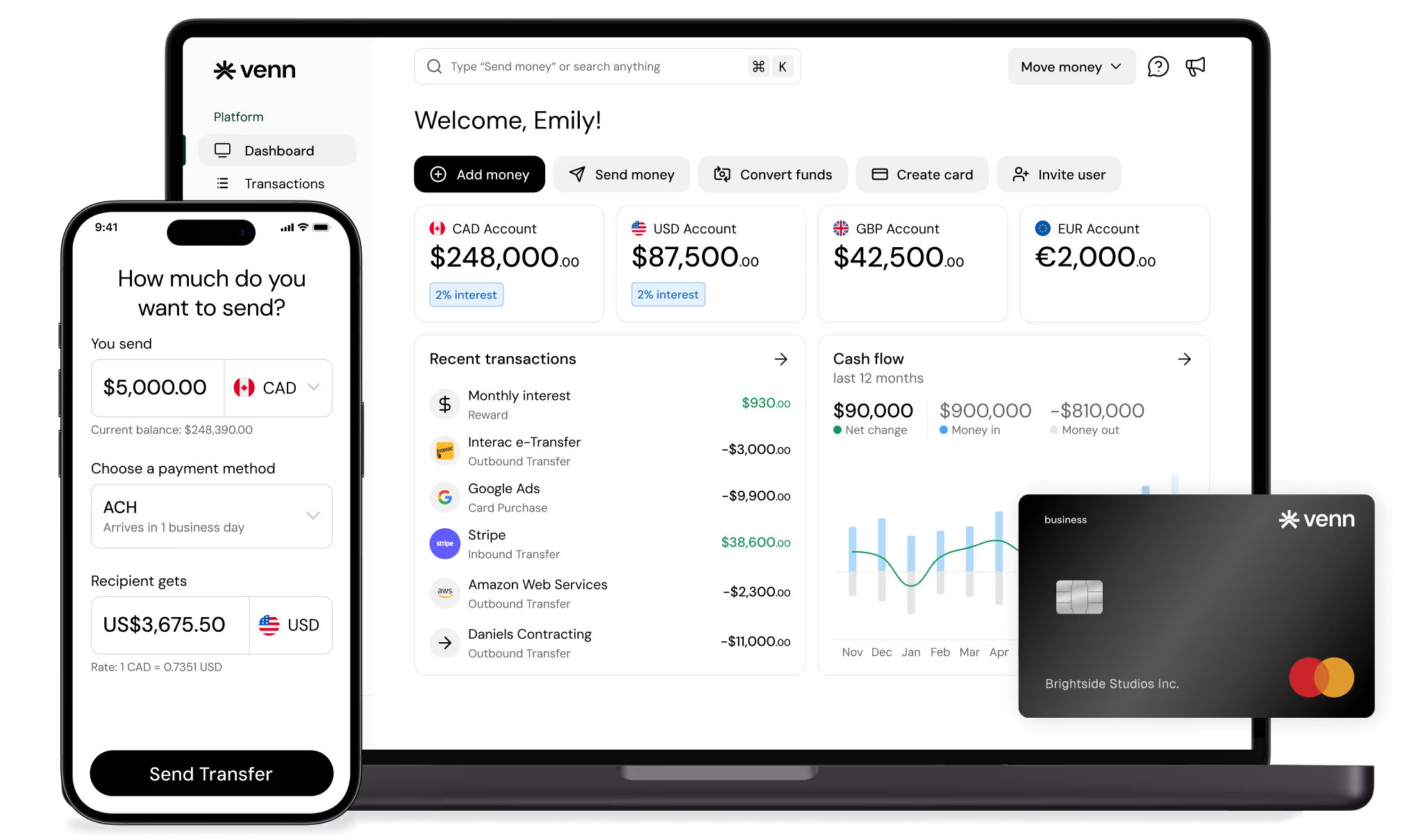
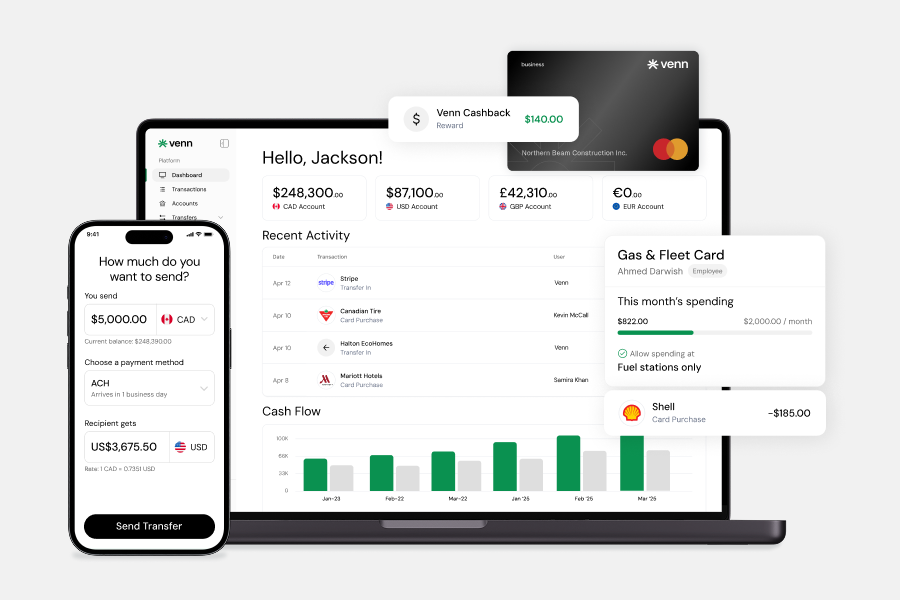
Platforms like Venn provide Canadian businesses with local CAD, USD, EUR, and GBP accounts, enabling efficient vendor payments at competitive rates while integrating with existing financial workflows.
Implementation doesn't require replacing all systems at once. Start with high-value vendors and expand systematically. Quick wins build momentum and stakeholder buy-in for broader transformation.
Frequently Asked Questions About Vendor Contract Management
Q: What is the difference between vendor contract management and general contract management?
A: Vendor contract management focuses specifically on agreements with external suppliers and service providers. It emphasizes ongoing vendor relationships, performance tracking, renewal management, and payment execution. General contract management covers a broader scope, including customer contracts, employment agreements, and partnership arrangements.
Q: How much can businesses save with effective vendor contract management?
A: Research shows businesses can reduce vendor-related costs by 10–20% through effective contract management. Savings come from negotiating better pricing, avoiding unwanted auto-renewals, capturing early payment discounts, eliminating duplicate vendors, and reducing FX fees on international payments.
Q: What are the most important contract terms to track for vendor agreements?
A: Key terms include payment schedules and terms, auto-renewal clauses and cancellation deadlines, service level agreements (SLAs), termination rights and notice periods, price escalation clauses, and compliance requirements such as insurance, certifications, and data security obligations.
Q: Should small businesses invest in vendor contract management systems?
A: Yes. Even small businesses benefit from centralized contract storage and renewal tracking. Missed renewals, unfavorable terms, or unmanaged vendors often cost more than the investment in basic contract management tools. As businesses grow, automation and integrations provide increasing value.
Q: How can Canadian businesses manage multi-currency vendor payments efficiently?
A: The most efficient approach is using a banking platform with real local CAD, USD, EUR, and GBP accounts. This allows businesses to pay vendors in their preferred currency at low FX rates (around 0.25–0.45%) and avoid the 2–3% FX markups and cross-border fees charged by traditional banks. Platforms like Venn are designed specifically for this use case.
---
**Disclaimer:** This publication is provided for general information purposes and does not constitute legal, tax or other professional advice from Venn Software Inc or its subsidiaries and its affiliates, and it is not intended as a substitute for obtaining advice from a financial advisor or any other professional. We make no representations, warranties or guarantees, whether expressed or implied, that the content in the publication is accurate, complete or up to date.

Venn is all-in-one business banking built for Canada
From free local CAD/USD accounts and team cards to the cheapest FX and global payments—Venn gives Canadian businesses everything they need to move money smarter. Join 15,000+ businesses today.
Frequently asked questions
Everything you need to know about the product and billing.
Join 15,000+ businesses banking with Venn today
Streamline your business banking and save on your spend and transfers today
No personal credit check or guarantee.