The First 30 Days After Incorporation: A Financial Checklist
The First 30 Days After Incorporation: A Financial Checklist for Canadian businesses to set up banking, cards, accounting, tax routines, and cash flow fast.
Trusted by 10,000+ Canadian businesses
Business banking for Canada
Local CAD and USD accounts, corporate cards with cashback, the lowest FX rates in Canada, free local transfers, and more.
The First 30 Days After Incorporation: A Financial Checklist
You just incorporated your Canadian business. The legal paperwork is filed, your business number is assigned, and you're ready to start operating. Now what?
Most "first 30 days" guides focus on legal and administrative tasks. This guide is different. It's a financial setup playbook designed to help you build the systems that will keep your books clean, your cash flow visible, and your tax obligations manageable from day one.
In the next 30 days, you'll establish separation between personal and business finances, open the right accounts, connect your accounting software, and create a repeatable monthly routine. These aren't optional nice-to-haves. They're the foundation that prevents expensive cleanup work later.
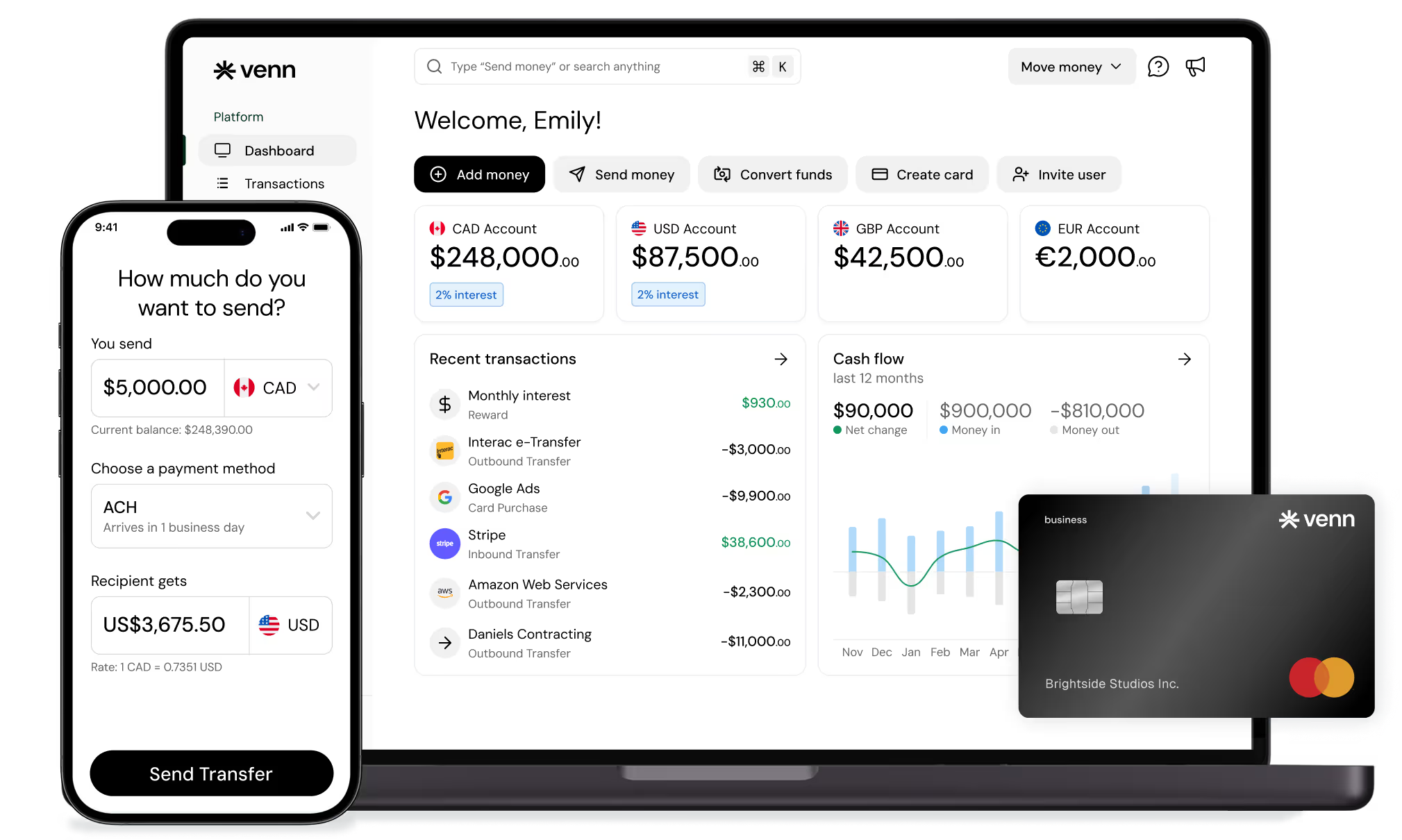
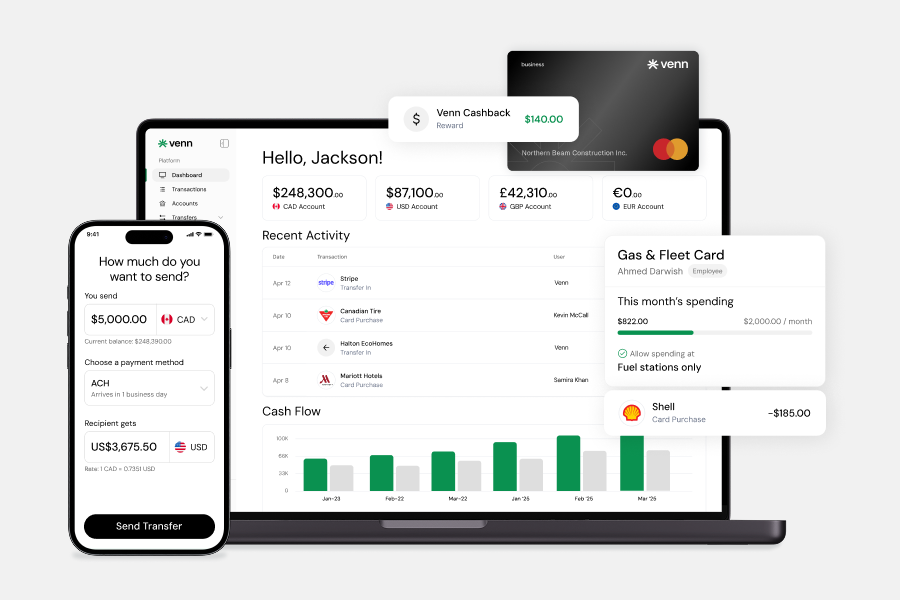
Venn serves as the banking and spend layer in this modern financial stack, connecting your accounts, cards, and accounting software into one cohesive system. Let's walk through exactly what to do and when.
30-Day Financial Setup Roadmap (Quick View)
| Timeline | Key Outcome | Time to Complete | Documents Needed |
|---|---|---|---|
| Day 1-3 | Financial foundation and spend rules established | 2-4 hours | Articles of incorporation, director IDs |
| Week 1 | Banking, cards, and accounting connected | 4-6 hours | CRA business number, ownership docs |
| Week 2 | Tax routines and controls in place | 2-3 hours | Provincial registration details |
| Week 3 | Invoicing and cash flow forecasting active | 3-4 hours | Payment processing details |
| Week 4 | Month-end close process and payroll readiness | 2-3 hours | Payroll provider credentials |
Day 1-3: Set Your Financial Foundation Before You Spend
Separate Business and Personal Money (and Avoid Commingling)
The single most important financial decision you'll make in these first days is establishing clear separation between your personal and business finances. Commingling funds creates bookkeeping nightmares, complicates tax filings, and can jeopardize your corporate liability protection.
Before you spend a single dollar, establish these ground rules:
• Decide who can spend company money and who approves purchases
• Set a receipt rule: same-day upload, no exceptions
• Define reimbursement policies (ideally, minimize them by using corporate cards)
• Document personal expense boundaries clearly
This separation isn't just about organization. It's about audit readiness, tax clarity, and building habits that scale. When you use a business banking platform like Venn with corporate cards, you centralize spend and reduce the messy reimbursement cycles that plague growing companies.
Gather the Documents You'll Need
Banking applications, accounting setup, and vendor onboarding all require similar documentation. Collect these now to avoid delays:
• Articles of incorporation
• Corporate registry documents (provincial)
• Director and beneficial owner information
• Business address verification
• Government-issued IDs for signing authorities
• CRA business number (if already assigned)
Keep digital copies organized in a shared folder. You'll reference these repeatedly over the next few weeks.
Create a Money Map for Your Business
Before opening accounts, map your financial flows. Understanding where money comes from and where it goes determines which accounts and currencies you need.
Document your expected sources of revenue:
• Client invoices (domestic vs. international)
• Payment processors (Stripe, Square, Shopify)
• Marketplace payouts (Amazon, Etsy)
Then map your outflows:
• Payroll and contractor payments
• Rent and utilities
• Software subscriptions (many bill in USD)
• Inventory and supplies
• Tax remittances
If you work with US clients, receive marketplace payouts in USD, or pay for software tools billed in foreign currencies, you'll benefit from multi-currency accounts. Venn offers CAD, USD, EUR, and GBP accounts with auto-currency matching on corporate cards, eliminating unnecessary conversion friction.
Week 1: Set Up Banking, Cards, and Your Accounting System
Open the Right Business Accounts
Your banking setup should match how you actually get paid and pay vendors. A single CAD account works for purely domestic businesses, but most companies today touch multiple currencies.
Essential checklist:
• Open a dedicated CAD operating account with EFT/PAD capability
• Evaluate whether you need USD, EUR, or GBP accounts
• Confirm your preferred payment rails: EFT, Interac e-Transfer®, wires
If you do cross-border business:
• US customers paying via ACH need you to have US-domiciled account details
• Marketplace payouts (Amazon, Stripe) often default to USD
• Many SaaS tools bill in USD, creating conversion costs on every charge
| Capability | Venn | Traditional Bank | Spend-Only Tools |
|---|---|---|---|
| CAD account on Canadian rails (EFT/PAD) | Yes | Yes | Often no |
| US-domiciled account for ACH | Yes | Often not ACH-native | Sometimes |
| Local EUR/GBP accounts | Yes | Rare | Rare |
| Interac e-Transfer® | Free, unlimited | Often limited or fees apply | Not applicable |
| Multi-currency card | Auto-currency matching | Often converts | Usually one card per currency |
| Accounting automation | QuickBooks/Xero integration | Varies | Varies |
Venn provides real CAD accounts on Canadian rails, US-domiciled accounts for ACH transactions, and local EUR and GBP accounts for European payments. Funds held through Venn are covered under CDIC insurance protection, and all plans include free, unlimited Interac e-Transfer®.
Add a Corporate Card and Define Spend Rules
Corporate cards eliminate the reimbursement cycle that creates bookkeeping delays and employee friction. Set one up now, even if you're the only person spending.
Card setup checklist:
• Activate a corporate card for recurring software, advertising, and travel
• Create a simple expense policy: approved categories, receipt requirements, approval thresholds
• Decide who gets cards immediately versus later
Venn's corporate card offers 1% cashback on all purchases, turning unavoidable operating expenses into working capital. For businesses operating internationally, the card's auto-currency matching reduces unnecessary conversions when you're spending in USD, EUR, or GBP.
Define your expense policy in writing, even if it's simple:
• All purchases require same-day receipt upload
• Purchases over $500 require pre-approval
• Personal expenses are never charged to corporate cards
Choose Accounting Software and Set It Up Correctly
Your accounting software is the financial record of your business. Setting it up correctly on day one saves weeks of cleanup later.
Setup checklist:
• Choose QuickBooks Online or Xero (both work well for Canadian businesses)
• Create your chart of accounts (start simple, expand as needed)
• Configure tax codes for GST/HST tracking
• Set your fiscal year end and bookkeeping cadence
• Connect your bank feeds
The connection between your banking platform and accounting software determines how much manual work you'll do each month. Venn integrates directly with QuickBooks and Xero, providing clean transaction feeds that reduce categorization time and improve reconciliation accuracy.
Set a weekly bookkeeping cadence. Fifteen minutes each Friday reviewing transactions prevents the month-end scramble that leads to errors and missed deductions.
Week 2: Tax, Compliance, and Future Protections
Build a Tax and Remittance Routine
You don't need to become a tax expert, but you do need systems that prevent surprises. Consider working with an accountant to confirm your specific obligations.
Tax routine checklist:
• Confirm CRA My Business Account access
• Set up mail forwarding if your registered address differs from your operating address
• Determine when GST/HST registration applies (generally required when revenue exceeds $30,000 in four consecutive quarters, though rules vary)
• Create calendar reminders for filing deadlines and instalment dates
• Establish a "tax set-aside" routine: transfer a percentage of revenue to a separate account automatically
The tax set-aside habit prevents the cash flow crunch that catches many new businesses off guard. Even setting aside 15-20% of revenue for taxes creates a buffer that smooths out quarterly obligations.
Put Basic Controls in Place
Controls aren't just for large companies. Even solo founders benefit from separation and verification habits that scale.
Control checklist:
• Define who can add new vendors to your payment system
• Establish verification procedures for new payees (confirm bank details independently)
• For teams: implement two-person review for transfers above a threshold
• Consider separate accounts for payroll, tax set-asides, and operating expenses
These controls become essential as you grow. Building them into your workflows now means you won't scramble to add them when you hire your first employee or bring on a bookkeeper.
Venn's centralized spend management and payment workflows make it easier to maintain visibility and control as your team expands. Clean accounting exports and automated reconciliation reduce the manual verification burden.
Week 3: Get Paid Faster and Stabilize Cash Flow
Set Up Invoicing, Collections, and Payment Processing
Getting paid quickly depends on making it easy for clients to pay you. Your invoicing setup should minimize friction and clearly communicate expectations.
Invoicing checklist:
• Create a professional invoice template with your business details and payment instructions
• Set clear payment terms (Net 15 or Net 30 are common)
• Include multiple payment options: EFT, Interac e-Transfer®, wire, or card
• Decide on late payment policies (interest charges, follow-up sequences)
If you sell online or receive marketplace payouts:
• Configure payout schedules from Stripe, Shopify, or Amazon
• Provide local currency account details to reduce forced conversions
• Review payout fees and timing for each platform
For US clients paying via ACH, having US-domiciled account details eliminates wire fees and delays. Venn provides real US account numbers that support both sending and receiving ACH transfers, simpler than the wire-based "US accounts" offered by many Canadian banks.
Build a Simple Cash Flow Forecast
Cash flow visibility is the difference between confident decision-making and constant anxiety. A simple forecast doesn't require complex modeling.
Forecast elements:
• Weekly expected inflows (client payments, recurring revenue)
• Weekly expected outflows (payroll, rent, subscriptions, variable costs)
• Running cash balance
• Runway calculation (months of operating expenses covered by current cash)
Build three scenarios: expected, optimistic, and conservative. Update weekly until you understand your business's cash rhythm, then shift to bi-weekly or monthly updates.
Your forecast should answer one question clearly: how many months can you operate at current burn rate with current cash? This runway number guides every major spending decision.
Week 4: Close Process, Payroll Readiness, and Scaling Your Stack
Create a Month-End Close Lite
Month-end close sounds intimidating, but for new businesses, it's a simple verification routine that keeps your books accurate.
Monthly close checklist:
• Reconcile all bank accounts (transactions match statements)
• Review accounts receivable (who owes you money, and is it overdue?)
• Review accounts payable (what do you owe, and when is it due?)
• Validate tax collected against expected amounts
• Lock the month in your accounting software
• Export key reports: P&L, balance sheet, cash flow summary
This routine takes 30-60 minutes monthly for most new businesses. The Venn and QuickBooks/Xero integration reduces reconciliation time by providing clean, categorized transaction data that matches your bank statements automatically.
Payroll and Contractors
If you plan to hire, set up your payroll infrastructure before you need it. Rushing payroll setup leads to compliance errors and unhappy team members.
Payroll readiness checklist:
• Determine whether you'll engage workers as contractors or employees (confirm with an accountant or employment lawyer)
• Research payroll providers (Wagepoint, Humi, and others serve Canadian businesses well)
• Create a payroll calendar with pay dates and processing deadlines
• Set up a separate payroll buffer account to ensure funds are always available
Most Canadian payroll providers use PAD (Pre-Authorized Debit) to pull funds for payroll runs. Your CAD account on Canadian rails, like those provided through Venn, supports these standard payroll workflows.
Your Next 60 Days Upgrade Path
Once your foundation is solid, consider these enhancements as your business grows:
• Add multi-currency accounts if cross-border activity increases
• Implement user access roles and spending approvals as you add team members
• Refine expense policies with category budgets
• Explore options for earning interest on operating balances while keeping funds accessible
Venn's platform scales with your business, adding capabilities as your financial complexity increases without requiring you to switch providers or rebuild integrations.
Building Your Financial Foundation
The first 30 days after incorporation aren't about perfection. They're about building systems that prevent problems and create visibility. Clean separation between personal and business finances, connected banking and accounting, and a repeatable monthly routine form the foundation that supports everything else.
You now have a roadmap: separate your finances, open the right accounts, connect your accounting software, establish tax routines, set up invoicing, and create a simple close process. Each step builds on the previous one.
Venn brings these pieces together as the banking and spend layer in your modern financial stack. With multi-currency accounts, corporate cards earning 1% cashback, free unlimited Interac e-Transfer®, and direct accounting integrations, you get the infrastructure that growing Canadian businesses need.
Sign up for a Venn account to start building your financial foundation today.
FAQs
Q: What should I do first after incorporating in Canada from a financial standpoint? A: Establish separation between personal and business finances immediately. This means deciding on spending rules, gathering your incorporation documents, and mapping your expected money flows before opening any accounts. This foundation prevents commingling issues and sets you up for clean bookkeeping from day one.
Q: Do I need a business bank account right after incorporation? A: Yes. Operating through personal accounts creates commingling that complicates taxes, makes bookkeeping difficult, and can jeopardize your corporate liability protection. A dedicated business account establishes the separation that protects you and simplifies everything from expense tracking to tax filing.
Q: When should I register for GST/HST? A: Registration is generally required when your revenue exceeds $30,000 in four consecutive calendar quarters, though specific rules vary by province and business type. Some businesses register voluntarily earlier to claim input tax credits. Confirm your specific situation with an accountant.
Q: How do I pay US vendors or get paid by US clients efficiently? A: Use a US-domiciled account that supports ACH transfers. This eliminates wire fees and reduces delays compared to international wire transfers. For receiving payments, provide your US account details so clients can pay via domestic ACH rather than expensive international wires.
Q: What is the simplest month-end close for a new corporation? A: Reconcile all bank accounts, review who owes you money and what you owe others, validate that tax collected matches expectations, then lock the month in your accounting software. Export a P&L, balance sheet, and cash flow summary. This takes 30-60 minutes monthly and prevents errors from compounding.
Venn Mastercard Charge Card is issued by Peoples Trust Company under licence from Mastercard International Incorporated. Mastercard is a registered trademark, and the circles design is a trademark of Mastercard International Incorporated.
--- **Disclaimer:** This publication is provided for general information purposes and does not constitute legal, tax or other professional advice from Venn Software Inc or its subsidiaries and its affiliates, and it is not intended as a substitute for obtaining advice from a financial advisor or any other professional. We make no representations, warranties or guarantees, whether expressed or implied, that the content in the publication is accurate, complete or up to date.
Venn is all-in-one business banking built for Canada
From free local CAD/USD accounts and team cards to the cheapest FX and global payments—Venn gives Canadian businesses everything they need to move money smarter. Join 10,000+ businesses today.
Frequently asked questions
Everything you need to know about the product and billing.
Join 10,000+ businesses banking with Venn today
Streamline your business banking and save on your spend and transfers today
No personal credit check or guarantee.