Starting a Business After Retirement in Canada Tips
Starting a Business After Retirement in Canada? Compare ideas, understand taxes, and set up modern banking with Venn to stay organized and maximize rewards.


Trusted by 15,000+ Canadian businesses
Business banking for Canada
Local CAD and USD accounts, corporate cards with cashback, the lowest FX rates in Canada, free local transfers, and more.
Starting a Business After Retirement in Canada: Ideas, Taxes, and Banking
Retirement doesn't mean the end of your working life. For many Canadians, it marks the beginning of something new: a business built on decades of experience, running on your schedule, and designed around your lifestyle rather than someone else's.
The good news? Starting a business after retirement in Canada can be remarkably low-risk when you structure it correctly. The key lies in choosing the right idea, understanding how taxes work for self-employed income, and building a modern financial stack that keeps operations simple from day one.
This guide walks you through the complete journey, from picking a retirement-friendly business idea to setting up your banking and expense management. You'll learn how to validate demand before investing, handle tax obligations confidently, and create systems that run smoothly without consuming your newfound freedom. At the centre of that system sits your banking layer, and Venn provides the business banking platform, expense management, and multi-currency capabilities that make day-to-day operations effortless.
Step 1: Choose a Retirement-Friendly Business Idea (Without Over-Risking Your Nest Egg)
A Quick Self-Assessment
Before browsing business ideas, answer four questions honestly:
Weekly hours available: How many hours do you actually want to work? Be realistic. A "10-hour side project" often becomes 25 hours once you factor in admin, marketing, and customer communication.
Physical demands: Can you stand for extended periods? Lift inventory? Drive regularly? Match your business to your current capabilities, not your 40-year-old self.
Startup costs: How much can you invest without touching retirement savings aggressively? The best retirement businesses require minimal upfront capital.
Income goals: Do you need $1,000 monthly to cover hobbies, or $4,000 to maintain your lifestyle? This shapes everything from pricing to time commitment.
Best Business Ideas After Retirement (Canada)
Low startup cost, high flexibility:
• Consulting or coaching in your former industry (leverage existing expertise)
• Bookkeeping or administrative services (steady demand, remote-friendly)
• Tutoring or education services (online platforms expand your reach)
• Pet services like walking or boarding (consistent local demand)
Creative and product-based:
• Etsy shop or digital products (low overhead, work from home)
• Home-based baking or catering (food business with controlled scale)
• Handmade goods or crafts (monetize hobbies you already enjoy)
Higher investment, higher potential:
• Food truck or pop-up restaurant (test concepts before committing to a lease)
• Small café or specialty food business (community-focused, relationship-driven)
• Property management or short-term rental support (leverage real estate knowledge)
• Micro-agency for marketing, content, or advertising (package professional skills)
The "Best Fit" Decision Matrix
Score each idea you're considering from 1 to 5 across these dimensions:
• Startup cost (1 = expensive, 5 = minimal)
• Time flexibility (1 = rigid schedule, 5 = work when you want)
• Physical demand (1 = intensive, 5 = minimal)
• Admin complexity (1 = heavy paperwork, 5 = simple operations)
• Cross-border payment needs (relevant if you'll have US suppliers or customers)
Ideas scoring 20 or higher typically suit retirement businesses best. A home-based catering operation, for example, might score high on flexibility and low startup cost while requiring moderate physical effort during events.
Step 2: Validate Demand Before You Register Anything
The 3 Fast Checks (One Weekend)
Talk to 10 potential customers. Not friends or family who'll politely encourage you. Find actual strangers who match your target market. Ask what they currently pay, what frustrates them about existing options, and whether they'd consider switching.
Run a price reality check. Research what competitors charge. If you plan to offer catering at $25 per person but local caterers charge $18, you need a clear differentiation story.
Create a simple offer page. A basic landing page or social media post describing your service can gauge real interest. Track how many people inquire, not just how many "like" the post.
A Simple One-Page Plan
Write down:
• Your specific offer (what exactly you're selling)
• Target customer (who specifically will buy)
• Price point (what you'll charge)
• Basic monthly costs (software, supplies, insurance)
• Weekly schedule (when you'll work)
• Stop-loss rule (the point at which you'll pause if things aren't working)
That last item matters most. Decide now that if you haven't earned $X after three months, you'll reassess rather than drain savings hoping things improve.
Step 3: Register and Set Up Your Business
Common Structures (Simplified)
Sole proprietorship works for most retirement businesses. It's simple to set up, has minimal ongoing paperwork, and lets you report business income on your personal tax return.
Incorporation adds administrative complexity but may suit certain income levels or liability situations. Consult a professional before incorporating, as the benefits depend heavily on your specific circumstances.
Partnership applies if you're starting with a spouse or friend. Both partners share responsibility for the business, which requires clear agreements upfront.
Setup Checklist
• Choose and register your business name (check provincial requirements for sole proprietorships)
• Determine which CRA program accounts you may need based on your situation
• Create basic contracts, especially for consulting or service businesses
• Arrange appropriate insurance (general liability at minimum; professional liability for consultants)
• Open a dedicated business banking account to separate finances from day one
Step 4: Understand Taxes When You Start a Business After Retirement
What Changes When You Go From Retired to Self-Employed
Your business income becomes taxable income, added to any pension, investment, or other retirement income you receive. This can push you into a higher tax bracket than you experienced while fully retired.
Unlike employment income where taxes are deducted automatically, self-employed income arrives without tax withheld. You're responsible for setting aside money for taxes throughout the year.
A practical approach: transfer 25-30% of each payment you receive into a separate savings account designated for taxes. This prevents the unpleasant surprise of owing a large sum at tax time.
Deductions to Know
Common categories that may apply to your situation:
• Home office expenses (if you use dedicated space regularly and exclusively for business)
• Vehicle and mileage (for business-related travel)
• Phone and internet (business portion)
• Software subscriptions (accounting, invoicing, point-of-sale systems)
• Professional fees (accountant, lawyer, business advisor)
• Supplies and inventory (particularly relevant for food businesses or product-based ventures)
Keep records of everything. The CRA requires documentation to support deduction claims.
GST/HST: When It Might Apply
Some businesses must register for and collect GST/HST once they exceed certain revenue thresholds. The rules depend on your specific situation, the type of goods or services you sell, and your province.
Consult a tax professional early. Understanding your obligations before you start collecting payments prevents compliance headaches later.
The Tax-Smooth Workflow
Build these habits from your first month in business:
• Keep business and personal accounts completely separate
• Categorize expenses weekly (takes 15 minutes if you stay current)
• Capture and store receipts automatically using expense management tools
• Connect your banking to accounting software like QuickBooks or Xero
• Review finances monthly and transfer your tax set-aside amount
This workflow transforms tax time from a scramble into a simple review of already-organized records.
Step 5: Banking and Financial Stack Setup
This is where most new retiree businesses struggle. They open a basic account, toss receipts in a drawer, and spend hours reconstructing transactions at year-end. A better approach takes the same effort upfront but saves countless hours later.
Why You Should Separate Business and Personal Finances Immediately
Mixing personal and business spending creates problems that compound over time. Your bookkeeping becomes a detective exercise. Tax time requires sorting through hundreds of transactions. Errors multiply. Stress increases.
Separate accounts from day one provide:
• Clean, audit-ready records
• Faster tax preparation
• Reduced accounting costs
• Better visibility into actual business profitability
• Credibility with vendors and customers who see professional invoices
The Modern Financial Stack
Think of your financial operations as three connected layers:
Banking + cards + expense management: Your operational backbone for receiving payments, paying suppliers, managing expenses, and tracking spending.
Accounting software: QuickBooks or Xero for categorizing transactions, generating reports, and preparing tax information.
Payment acceptance: Point-of-sale systems for in-person sales, invoicing tools for service businesses, or ecommerce platforms for online sales.
These layers should connect automatically. When you pay a supplier, the transaction flows into your accounting software without manual entry. When you receive a customer payment, it categorizes itself based on rules you've set.
Make Venn the Core Banking Layer
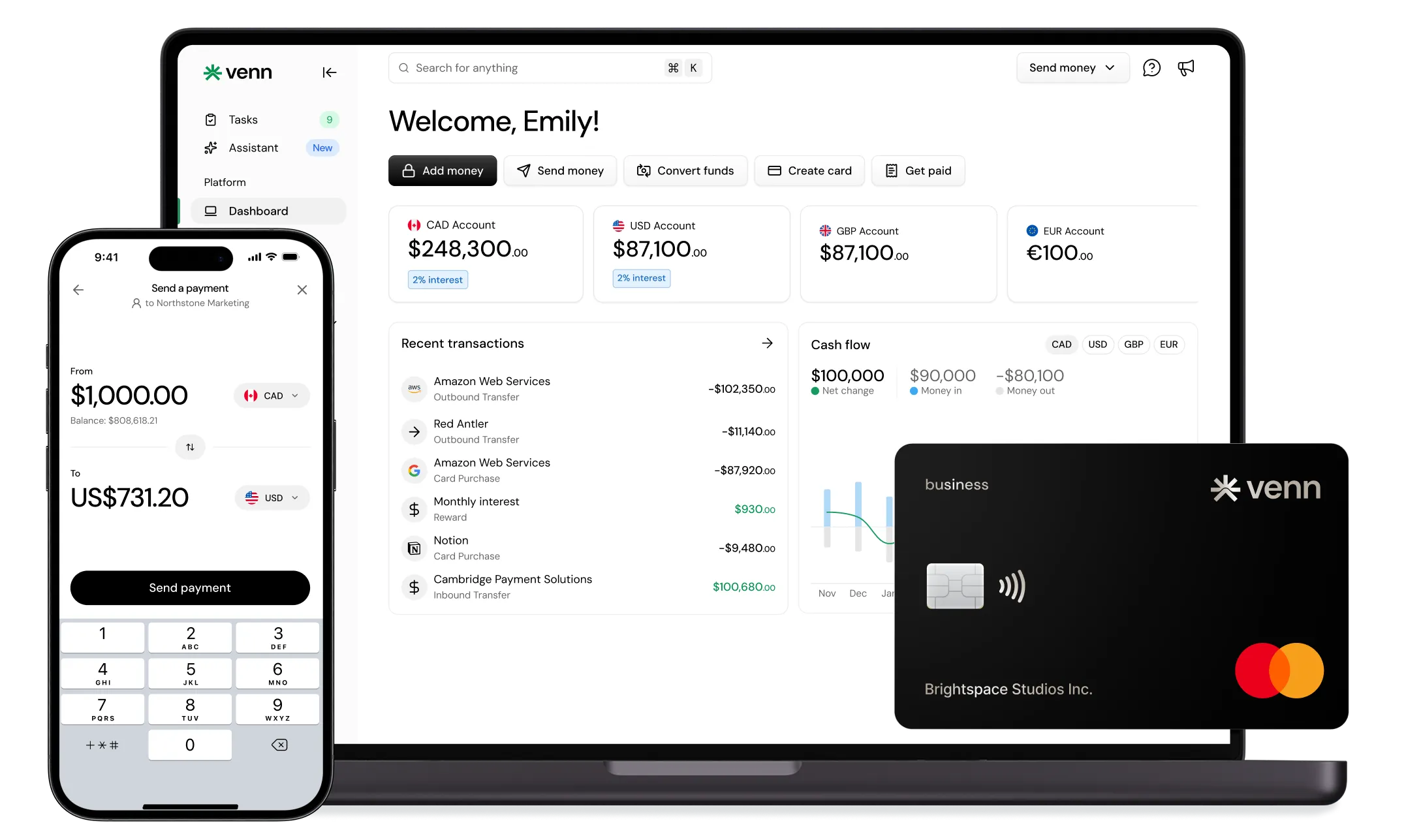
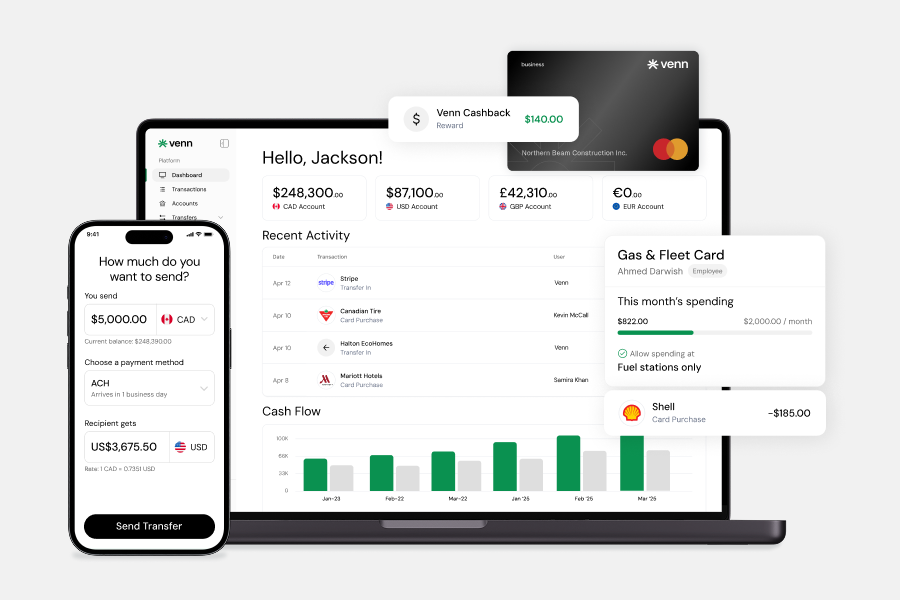
Venn provides the business banking platform that anchors this stack. Here's what makes it particularly suited for retirement businesses:
Local multi-currency accounts in CAD, USD, EUR, and GBP let you receive and send payments in the currency you operate in. If you're buying equipment from a US supplier or selling to American customers, you avoid unnecessary currency conversion fees.
Free, unlimited Interac e-Transfer® on all plans means you can pay Canadian suppliers and receive customer payments without transaction fees eating into margins.
Direct QuickBooks and Xero integration automates the connection between your banking and your books. Transactions sync automatically, reducing manual entries and the errors that come with them.
Pricing per account, not per user matters if you have a spouse or partner helping with the business. Add team members without increasing your monthly cost.
Expense Management and Corporate Cards
The Venn corporate card offers 1% unlimited cash back on all business spending. For a catering business spending $3,000 monthly on ingredients, supplies, and equipment, that's $360 back annually, effectively reducing your operating costs.
Beyond cash back, the expense management features solve real operational problems:
• Set spending controls for yourself or team members
• Capture receipts instantly when you make purchases
• Match invoices to payments automatically
• Reduce month-end reconciliation to minutes instead of hours
The multi-currency card behaviour proves particularly valuable when paying for online tools, software subscriptions, or international suppliers. You pay in the local currency rather than absorbing conversion markups.
Multi-Currency Capabilities
Even "local" businesses encounter multi-currency needs more often than expected:
• SaaS tools billed in USD (accounting software, email marketing, website hosting)
• Equipment or supplies from US or European vendors
• Ecommerce marketplace payouts in USD
• Travel expenses while running the business
Venn's multi-currency accounts let you hold, receive, and send funds in CAD, USD, EUR, and GBP using local payment rails. This reduces friction and cost compared to constantly converting currencies through traditional banking channels.
Payment Solutions Integration
For a catering or food business, the flow looks like this:
• Customer pays via your POS system or invoicing tool
• Funds arrive in your Venn account
• Transaction syncs automatically to QuickBooks or Xero
• Expense categorization happens based on your rules
• Month-end books are already clean
This automation compounds over time. By month six, you're spending 20 minutes monthly on financial admin instead of hours.
Sign up for a Venn account at venn.ca to build this foundation before your first customer transaction.
Feature Comparison
30-Day Launch Plan
Week 1: Pick and Validate
• Select your top business idea using the decision matrix
• Define your specific offer and target customer
• Talk to 10 potential customers about pricing and needs
Week 2: Set Up the Admin Core
• Register your business structure
• Open your Venn business account
• Connect QuickBooks or Xero
• Arrange basic insurance
Week 3: Get Paid and Get Organized
• Set up your invoicing or payment acceptance method
• Configure receipt capture and expense categories
• Create your first invoice template
• Test the full payment flow
Week 4: Repeatable Operations
• Establish your weekly money routine (15 minutes for categorization)
• Schedule monthly reviews
• Make your first tax set-aside transfer
• Serve your first paying customer
Common Mistakes Retirees Make (And How to Avoid Them)
Mixing personal and business spending. This creates tax headaches and obscures your actual profitability. Open a dedicated Venn account before your first transaction.
Underpricing services. Your experience has value. Research market rates and price accordingly, even if it feels uncomfortable initially.
Overcomplicating structure too early. Start as a sole proprietorship unless a professional advises otherwise. You can always incorporate later if circumstances warrant.
Ignoring receipt capture until tax time. Set up automated receipt capture from day one. The 10 seconds per transaction saves hours of reconstruction later.
Paying international suppliers expensively. If you're buying from US or European vendors, use Venn's multi-currency accounts to pay in local currency rather than absorbing conversion markups through traditional banking.
Conclusion
Starting a business after retirement in Canada offers the chance to build something meaningful on your own terms. The goal isn't to recreate a demanding career. It's to create income, purpose, and flexibility while protecting the financial stability you've worked decades to achieve.
Success comes from choosing an idea that matches your time and energy, validating demand before investing heavily, setting up proper structure and tax habits, and building a financial stack that runs smoothly without consuming your attention.
Venn provides the banking layer that makes this possible: business accounts, expense management, multi-currency capabilities, and the integrations that keep your books clean automatically.
FAQ
Q: Do I need a separate business bank account to start a small business after retirement in Canada?
While not legally required for sole proprietorships, separating business and personal finances dramatically simplifies bookkeeping, tax preparation, and financial tracking. A dedicated business account also creates a clear audit trail and makes working with accountants much easier. Platforms like Venn streamline this by integrating directly with accounting software such as QuickBooks and Xero.
Q: What’s the simplest business structure to start with after retirement?
Most retirement businesses start as sole proprietorships. This structure requires minimal paperwork, allows you to report business income on your personal tax return, and avoids the ongoing administrative requirements of incorporation. If you plan to bring on partners, take on liability risk, or retain earnings inside the business, incorporation may be worth discussing with a professional.
Q: How do I avoid getting surprised by taxes on self-employed income?
Set aside 25–30% of every payment into a separate tax savings account as soon as you receive it. Review your income and expenses monthly, keep everything categorized in accounting software, and speak with a tax professional early to understand instalment payment requirements before your first filing deadline.
Q: I’m starting a small catering or food business. What financial tools do I need?
You’ll want three core layers: a POS or payment acceptance system for customer transactions, a business banking platform like Venn for accounts, corporate cards, and expense management, and accounting software such as QuickBooks or Xero. This setup automates most financial admin and keeps records clean for GST/HST and income tax reporting.
Q: What if I have customers or suppliers in the US or Europe?
Multi-currency accounts are essential. Venn allows you to hold, receive, and send funds in CAD, USD, EUR, and GBP using local payment rails. This reduces FX costs and delays compared to traditional banks, which often force conversions and charge wire fees on international transactions.
Funds held with Venn are covered under CDIC insurance protection.
Venn Mastercard Charge Card is issued by Peoples Trust Company under licence from Mastercard International Incorporated. Mastercard is a registered trademark, and the circles design is a trademark of Mastercard International Incorporated.
---
**Disclaimer:** This publication is provided for general information purposes and does not constitute legal, tax or other professional advice from Venn Software Inc or its subsidiaries and its affiliates, and it is not intended as a substitute for obtaining advice from a financial advisor or any other professional. We make no representations, warranties or guarantees, whether expressed or implied, that the content in the publication is accurate, complete or up to date.

Venn is all-in-one business banking built for Canada
From free local CAD/USD accounts and team cards to the cheapest FX and global payments—Venn gives Canadian businesses everything they need to move money smarter. Join 15,000+ businesses today.
Frequently asked questions
Everything you need to know about the product and billing.
Join 15,000+ businesses banking with Venn today
Streamline your business banking and save on your spend and transfers today
No personal credit check or guarantee.