25 Best Business Ideas for 2026 in Canada: Profitable Options
Discover the best business ideas for 2026 in Canada. Explore 25 profitable ventures and learn how to build a strong financial foundation for your business growth.

Trusted by 15,000+ Canadian businesses
Business banking for Canada
Local CAD and USD accounts, corporate cards with cashback, the lowest FX rates in Canada, free local transfers, and more.
Best Business Ideas for 2026: Your Guide to Profitable Ventures
Canada's economy stands at an exciting crossroads as we approach 2026. With projected annual growth of 1.6% and sectors like clean technology experiencing unprecedented expansion, entrepreneurs face remarkable opportunities to build successful businesses. The key lies in choosing ventures that balance market demand, manageable startup costs, and your existing skills.
The most successful entrepreneurs understand that profitable businesses generate steady income while keeping expenses under control. Smart business models leverage technology, respond to changing consumer preferences, and scale efficiently without proportional cost increases.
This guide examines 25 business ideas with realistic startup costs, profit margins, and essential financial infrastructure requirements. From digital services to sustainable ventures, each opportunity includes practical insights for Canadian entrepreneurs ready to launch in 2026.
One critical factor often overlooked in business planning is proper banking infrastructure. Whether you're launching a cross-border e-commerce store or a local service business, having the right financial foundation determines how efficiently you can operate, accept payments, and manage growth.
What Makes a Business Idea Profitable in 2026?
A profitable business idea matches real customer demand with a model that can grow efficiently. Market demand reveals itself through long waiting lists for services, customers willing to pay premium prices, or search data showing people actively looking for solutions. The best opportunities solve genuine problems while maintaining healthy margins.
Key characteristics define profitable ventures in 2026:
• Market demand: Real, growing customer need
• Healthy margins: Ability to price above costs
• Low barriers to entry: Accessible startup requirements
• Scalability: Growth without proportional cost increases
• Sustainability: Alignment with long-term trends
The business landscape in 2026 centers on two major forces. AI and automation drive efficiency across industries, creating opportunities for businesses that help others implement these technologies. Companies seek AI-driven solutions for everything from customer service to supply chain optimization, opening doors for consultants and service providers.
Consumer preferences also shape profitable opportunities. Eco-conscious buyers drive demand for ethical, transparent, and sustainable products. Subscription box businesses focused on zero-waste beauty, plant-based snacks, or eco-friendly home goods align perfectly with these evolving values. Smart entrepreneurs position themselves at the intersection of technology and sustainability.
Key Trends Shaping Canadian Business in 2026
Understanding macro trends helps entrepreneurs choose ideas with longevity. The Canadian market presents unique opportunities shaped by geography, demographics, and policy priorities.
Digital Transformation and AI Integration
Digital transformation has become the standard for business creation and growth. The speed of digital adoption now defines competitive advantage across industries. Canadian SMEs increasingly seek partners who can help them implement AI solutions, automate repetitive tasks, and leverage data for better decision-making. This creates substantial opportunities for consultants and service providers who can bridge the technology gap.
Sustainability and Green Business
Canada's commitment to net-zero emissions by 2050 fuels explosive growth in energy efficiency sectors. The cleantech industry attracts $5.3 billion in federal climate finance by 2026, creating opportunities across the value chain. From home energy audits to sustainable product development, businesses that help others reduce environmental impact find eager markets and government support.
Cross-Border Commerce and Multi-Currency Operations
Canadian businesses increasingly serve US, UK, and European markets through digital channels. Online businesses offer low overhead costs and the ability to reach broad audiences quickly. Examples include dropshipping, digital products, and freelance services that transcend borders. Success in these ventures requires proper multi-currency banking infrastructure to avoid excessive foreign exchange fees and payment delays.
25 Best Business Ideas for Canadian Entrepreneurs in 2026
These opportunities are organized by category, with startup costs and profit margin estimates based on current market data. Each includes specific considerations for the Canadian market.
Online & Digital Business Ideas
1. Digital Marketing Agency
Digital marketing agencies help businesses manage their online advertising, social media, and website traffic. These agencies typically achieve net profit margins between 20% and 40%, with gross margins ranging from 50% to 75%.
2. AI Consulting and Automation Services
Small and medium-sized enterprises, clinics, and retailers often lack in-house AI talent. Tailored solutions such as automating patient scheduling or optimizing supply chains position businesses at the heart of technological transformation. These services feature low overhead, remote delivery, and high margins.
3. E-commerce and Dropshipping
Dropshipping allows entrepreneurs to sell products without managing inventory. A supplier handles storage and shipping, making it an excellent way to start a business on a budget. Success requires finding reliable suppliers and differentiating through marketing or niche selection.
4. Virtual Assistant Services
Virtual assistants provide remote administrative support including email management, scheduling, and customer service. The business model works well for organized individuals with strong communication skills.
5. Online Tutoring and Coaching
The digital education market continues expanding across age groups and professional development programs. The global e-learning market projects to reach nearly $400 billion by 2026, making online teaching a flexible and rewarding business idea.
6. Content Creation and Social Media Management
Social media remains essential for businesses, yet many small business owners and solopreneurs lack time, skill, or strategy to manage their presence effectively. Social media management stands out as one of the most practical low-cost business ideas with high profit for 2026.
7. Affiliate Marketing
Affiliate marketing offers one of the most beginner-friendly and scalable business models. You promote other companies' products using unique affiliate links and earn commissions on resulting purchases. Success requires building an audience and selecting products that align with their needs.
Service-Based Business Ideas
8. Bookkeeping and Tax Preparation
Small businesses need professionals to manage financial records and prepare annual tax returns. Margins of 30-55% are common, with year-round advisory work extending beyond tax season. Canadian certification requirements create barriers to entry that protect established practitioners.
9. Home Energy Efficiency Consulting
Canada's cleantech sector attracts $5.3 billion in federal climate finance by 2026. Trending businesses coordinate heat-pump installations and solar retrofits for homeowners, bundling audits, permits, and incentives into seamless packages. Knowledge of provincial rebate programs provides competitive advantage.
10. Cleaning Services
Most cleaning services charge between $25 and $50 per hour. Over 90 percent of commercial cleaning companies maintain a positive or neutral outlook, with more than half expecting profit or revenue growth. This reflects steady demand for professional cleaning across residential and commercial sectors.
11. IT Support and Cybersecurity Consulting
SMEs need endpoint security, backups, and helpdesk support. The business model uses per-seat pricing plus project fees for migrations, VoIP installations, and security camera systems. Growing cybersecurity concerns create additional revenue opportunities.
12. Appliance Repair Services
Quick diagnostics plus parts inventory equals high first-visit fix rates. The business model combines call-out fees, parts margins, and maintenance plans. The repair-over-replace trend drives consistent demand.
Health and Wellness Business Ideas
13. Telehealth and Virtual Wellness Services
An aging population drives healthcare's rapid expansion with 143,800 vacancies nationwide. Opportunities include developing telehealth services specializing in preventive checkups via AI chatbots for medication reminders and fall-risk assessments. Compliance and technology costs run approximately $8,000, with 65% margins possible through insurer partnerships.
14. Personal Fitness Coaching (Virtual and In-Person)
Businesses offering personalized fitness coaching, virtual wellness programs, supplements, and holistic health services boom as consumers prioritize preventive healthcare. The hybrid model combining virtual and in-person services maximizes revenue potential.
15. Mental Health and Wellness Apps
In a nation where 20% of workers face mental health challenges, AI-driven wellness apps emerge as cornerstones for 2026. Low startup costs around $5,000 for app development via no-code tools combine with 60-80% margins through subscription models. Demand spikes as remote work persists.
Sustainable and Green Business Ideas
16. Sustainable Fashion Resale Platform
Fashion resale popularity rises with projected 127% growth by 2026, eight times faster than overall apparel marketing in North America. The model works in both weaker and stronger economic conditions thanks to discounts and consumer desire for sustainable fashion.
17. Eco-Friendly Subscription Boxes
Eco-conscious consumers drive demand for ethical, transparent, and sustainable products. Curated subscription box businesses focused on zero-waste beauty, plant-based snacks, or eco-friendly home goods align perfectly with evolving consumer values.
18. Vertical Farming and Urban Agriculture
Agriculture evolves rapidly with hog farming revenues up 14% in 2025. Vertical farming kits powered by IoT sensors for soil monitoring and automated irrigation enable city dwellers to grow nutrient-dense produce year-round. This taps into Canada's position as North America's third-largest food manufacturing sector.
Creative and Media Business Ideas
19. Photography and Videography Services
The photography industry grows at a CAGR exceeding 6%. If you possess necessary skills and equipment, now presents an ideal time to launch a photography business. Earnings depend on skill level, type of work, and business ownership structure.
20. Podcast Production Services
Businesses increasingly use podcasts for content marketing and thought leadership. Production services include recording, editing, distribution, and promotion. The recurring nature of podcast production creates predictable revenue streams.
Technology and Software Business Ideas
21. Mobile App Development
The global mobile app market generated more than £935 billion in revenue in 2025. The market continues booming as apps deliver unmatched user experiences. Most companies increase their investments in mobile apps since customers spend significant time on mobile devices.
22. SaaS Product Development
The software industry projects to reach nearly $743 billion by the end of 2025. While big tech businesses rank among the most profitable companies globally, small software developers can gain footholds by solving specific problems for niche markets.
Local Service Business Ideas
23. Pet Care Services
The pet industry exceeds $259 billion in value and offers numerous opportunities. Pet businesses can be product- or service-based, selling accessories, food, or toys, or offering grooming, walking, or training expertise. Canadian pet ownership rates continue rising.
24. Translation and Localization Services
Translation offers profitable opportunities for those fluent in multiple languages. Companies need help translating documents, websites, marketing materials, and product descriptions. Global business connections drive continuous demand for translation and localization services.
25. Senior Care and Support Services
Many seniors need help with everyday tasks from errands to household repairs. With experience, services can expand to include helping seniors transition into assisted living, offering support with packing, transporting, setting up or storing belongings.
How to Choose the Right Business Idea for You
Selecting the right business idea requires honest assessment of your circumstances, skills, and goals. The best opportunity aligns with your strengths while meeting real market demand.
Start by evaluating these key factors:
• Assess your skills and interests: Begin with your strengths. Consider what you excel at and enjoy doing, whether coaching, crafting, or consulting. Match your abilities with genuine customer needs.
• Evaluate startup capital available: Match ideas to your budget
• Consider time commitment: Full-time vs. side hustle
• Research market demand: Validate demand through research to confirm your target market actively seeks what you're offering.
• Analyze competition: Identify gaps and differentiation opportunities
• Plan for scalability: Your business should grow without requiring proportional increases in time or funding.
• Assess financial infrastructure needs: Consider payment methods, currencies, and banking requirements
Many entrepreneurs overlook banking infrastructure until they face payment delays or high foreign exchange fees. Choosing the right financial partner from the start prevents costly disruptions as your business grows.
Setting Up Your Business Banking Infrastructure
Proper financial infrastructure forms the foundation of any successful business, yet entrepreneurs often treat it as an afterthought. Many business ideas in 2026 involve cross-border transactions, multiple currencies, or high payment volumes that traditional banking struggles to support efficiently.
What New Businesses Need from Their Banking Partner
Critical banking features for modern businesses include:
• Dedicated business accounts (CAD and USD)
• Low-cost international transfers
• Multi-currency capabilities
• Integration with accounting software
• Payment acceptance tools
• Expense management features
Common Banking Challenges for Canadian Startups
Most Canadian businesses work with US clients or suppliers but encounter significant friction with traditional banks. Common pain points include high foreign exchange conversion fees reaching up to 3% at major banks, limited or no access to real US accounts, expensive wire transfers costing $15-$45 per transaction, no integration with payment platforms like Stripe or PayPal, and separate accounts required for each currency.
How Venn Solves These Challenges
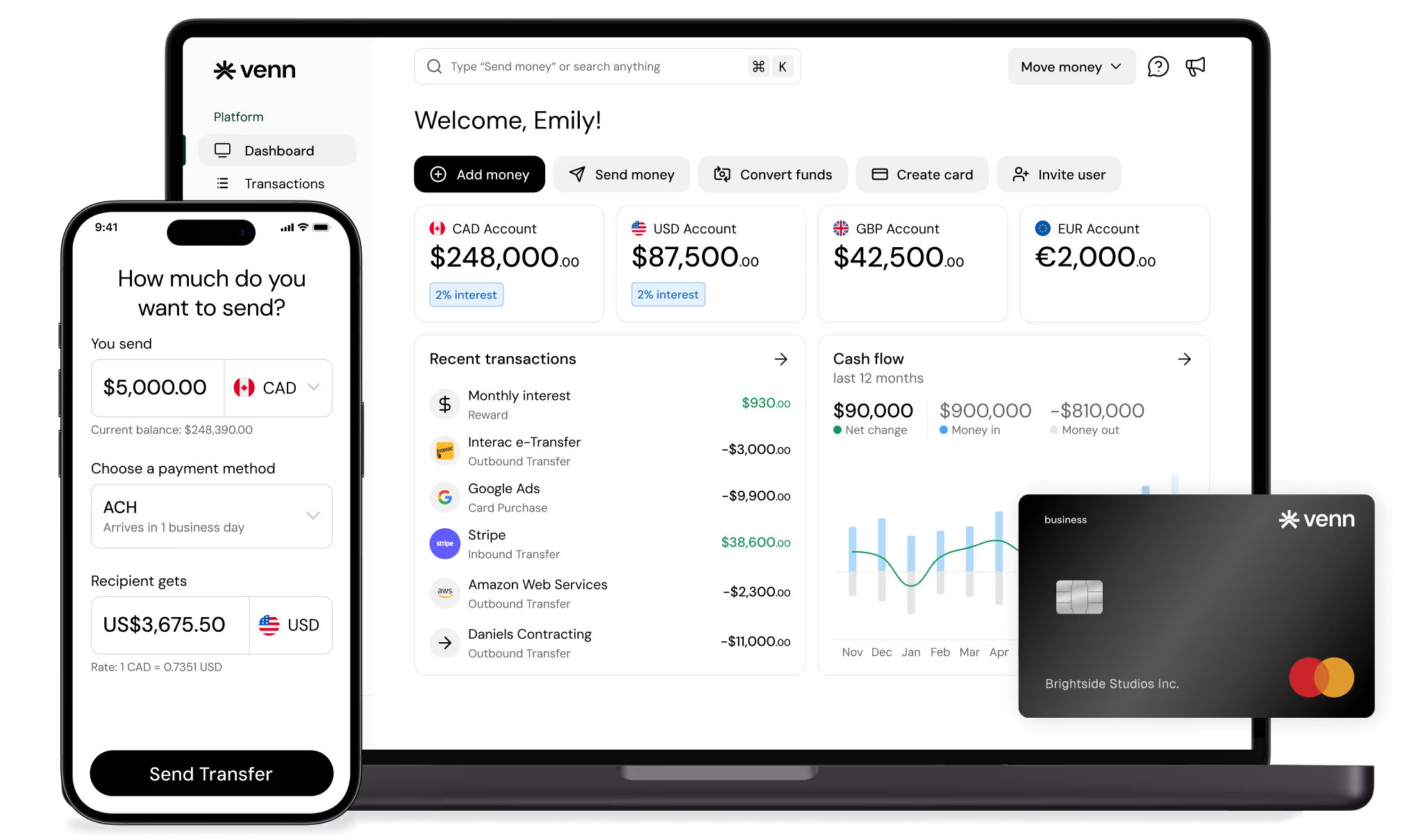
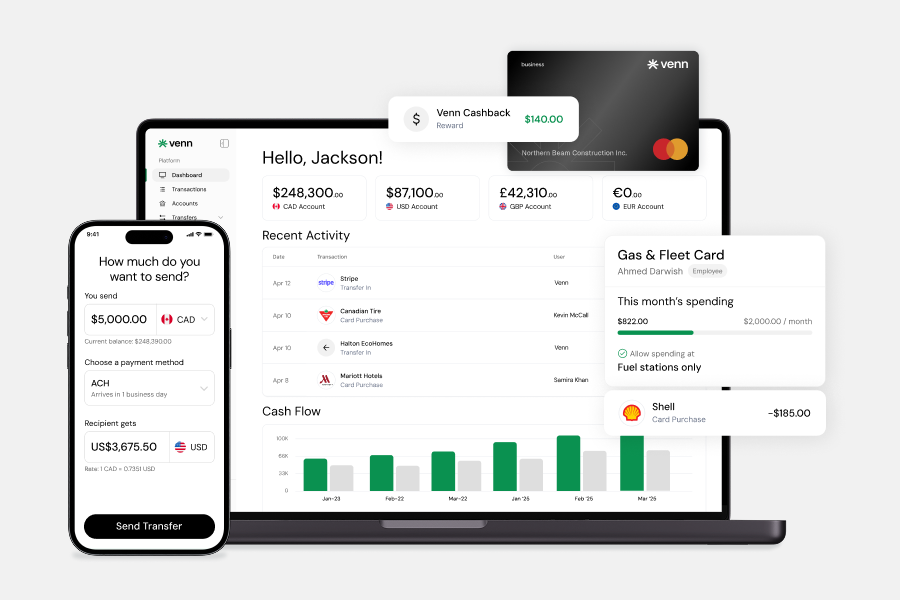
Venn provides Canadian businesses with real local CAD, USD, GBP, and EUR accounts, eliminating the cross-border fees that eat into profit margins. Unlike traditional banks, Venn offers true US accounts that can send and receive ACH transfers, meaning faster payments and no inbound wire fees.
For businesses using platforms like Stripe, Shopify, or PayPal, Venn eliminates the 1.5% cross-border fee by allowing you to receive funds directly into your USD account. With FX rates between 0.25%-0.45% (compared to up to 3% at banks), automated accounting integrations with QuickBooks and Xero, and free unlimited Interac e-Transfer®, Venn becomes your complete financial operations platform. Whether you're running a digital marketing agency invoicing US clients or an e-commerce business working with overseas suppliers, Venn ensures you keep more of what you earn.
5 Steps to Launch Your Business in 2026
Execution matters as much as the idea itself. These five steps provide a practical framework for turning your chosen business concept into reality.
Step 1: Validate Your Idea
Build a minimum viable product (MVP), create a landing page, or launch a pre-sale campaign to test real-world interest before committing significant resources. Validation saves time and money by confirming actual demand exists.
Step 2: Create a Simple Business Plan
Focus on essentials: target market definition, revenue model, realistic startup costs, and 12-month financial projections. Keep the plan simple but comprehensive enough to guide decisions and track progress.
Step 3: Register Your Business and Set Up Banking
Choose your legal structure (sole proprietorship, corporation, or partnership) and register with appropriate provincial authorities. Open a dedicated business bank account immediately. Selecting the right banking partner from day one prevents costly switching later when you discover limitations.
Step 4: Build Your Online Presence
Establish your website, claim social media profiles, and create basic marketing infrastructure. Even local service businesses need online visibility. Focus on platforms where your target customers spend time.
Step 5: Launch and Iterate
Start small with a focused offering. Gather customer feedback systematically and refine your products or services based on real data. Successful businesses evolve continuously in response to market signals.
FAQs: Starting a Business in 2026
Q: What is the most profitable business to start in 2026?
A: Profitability depends on your skills and market demand, but service-based businesses consistently perform best. Digital marketing agencies, AI consulting, and bookkeeping services often achieve margins of 30–60% with relatively low startup costs. Service businesses typically outperform product-based businesses due to lower overhead and faster paths to profitability.
Q: How much money do I need to start a business in 2026?
A: Startup costs vary widely. Online businesses like virtual assistance, freelancing, or affiliate marketing can start with $500–$2,000. Businesses requiring equipment, inventory, or physical space may need $10,000–$30,000. Many successful businesses launch with under $5,000 by starting lean and scaling gradually.
Q: Can I start a business as a side hustle in 2026?
A: Yes. Service businesses such as virtual assistance, bookkeeping, social media management, and online tutoring work especially well as side hustles. You can start with a few clients while employed full-time and scale your business as revenue becomes consistent.
Q: What kind of bank account do I need to start a business in 2026?
A: You’ll want a business account that offers low-cost transfers, accounting software integration, and multi-currency support if you work internationally. Platforms like Venn provide real CAD, USD, GBP, and EUR accounts, expense management, and automated reconciliation—making them well-suited for modern businesses.
Q: How long does it take for a new business to become profitable?
A: Service businesses often become profitable within 3–6 months, while product-based businesses usually take 6–12 months. Profitability depends on startup costs, pricing strategy, customer acquisition speed, and how quickly you control expenses.
---
**Disclaimer:** This publication is provided for general information purposes and does not constitute legal, tax or other professional advice from Venn Software Inc or its subsidiaries and its affiliates, and it is not intended as a substitute for obtaining advice from a financial advisor or any other professional. We make no representations, warranties or guarantees, whether expressed or implied, that the content in the publication is accurate, complete or up to date.

Venn is all-in-one business banking built for Canada
From free local CAD/USD accounts and team cards to the cheapest FX and global payments—Venn gives Canadian businesses everything they need to move money smarter. Join 15,000+ businesses today.
Frequently asked questions
Everything you need to know about the product and billing.
Join 15,000+ businesses banking with Venn today
Streamline your business banking and save on your spend and transfers today
No personal credit check or guarantee.