Pay for international business transactions as a Canadian
How to pay for international business transactions as a Canadian: compare wires, multi-currency accounts, transfer providers, and cards to cut FX costs.

Ahmed Shafik
Co-founder
Trusted by 15,000+ Canadian businesses
Business banking for Canada
Local CAD and USD accounts, corporate cards with cashback, the lowest FX rates in Canada, free local transfers, and more.
A low transfer fee can make an international payment look inexpensive—but Canadian businesses often feel the real cost after the payment leaves their account. If your team is deciding how to pay for international business transactions as a Canadian company, the advertised fee is only one part of the picture.
Foreign exchange markup can add meaningful cost to business foreign exchange payments, especially when paying overseas suppliers in USD, EUR, GBP, or other currencies. Wire fees may apply on the sending side, and additional charges can appear along the payment path. Settlement speed matters too, since delays can affect supplier relationships, inventory timing, and project delivery.
Operational friction adds another layer. Finance teams need clear payment tracking, reliable records for international invoice payments, and clean reconciliation when transactions land in accounting systems. This guide explains the main international payment methods for business, compares practical provider types, and helps you evaluate total cost alongside operational fit.
Why International Payments Are More Complex Than Domestic Payments
Sending CAD to another Canadian account is usually straightforward. Cross-border business payments introduce more variables: which currency the supplier wants, how the payment will travel, whether conversion happens before or after sending, and how your team will record the transaction.
The visible transfer fee is only one part of the cost. International business payments can also include an FX spread or markup, receiving bank deductions, intermediary charges, and internal admin time spent collecting banking details, checking statuses, and reconciling invoices. For business foreign exchange payments, the exchange rate often matters more than the stated transfer fee.
Secure international business payments also involve standard compliance steps. Providers may request business payment compliance information, ownership details, or KYC documentation to confirm who sends and receives funds. Those checks help protect cross-border business payments—and set up the practical choices covered next.
The Four Main International Payment Routes
If your business needs to pay overseas suppliers from Canada, the right route usually depends on payment size, currency, frequency, and how much control your finance team needs.
Traditional bank wires
An international wire transfer for business can suit larger or occasional payments, especially when a supplier expects funds directly to a foreign bank account. This route is familiar and widely accepted, but it may involve SWIFT routing, intermediary banks, and receiving bank deductions. FX rates for business payments can also include a spread that affects the final amount your supplier receives—so the visible transfer fee is only part of the story.
Multi-currency business accounts
A multi-currency business account can help when you pay recurring invoices in USD, EUR, GBP, or other supplier currencies. Instead of converting CAD every time, your business can operate closer to the currency of the invoice—reducing unnecessary conversions, simplifying international invoice payments, and making cross-border transactions easier to track.
International transfer specialists
Transfer specialists can be useful for simple outbound transfers and business foreign exchange payments. They often focus on currency conversion, payment setup, and delivery tracking. For teams that mainly need to move money internationally, this can be a practical route without adopting a broader finance workflow.
Business cards for smaller international spend
Cards fit software subscriptions, travel, online advertising, and smaller recurring vendor expenses. They can also help separate employee or team spend from invoice payments. For large supplier invoices, cards are usually less suitable—vendors may not accept them, or card processing costs may outweigh the convenience.
What to Compare Before Choosing a Payment Option
Start with the payment job, not the provider name. Whether you need to pay overseas suppliers from Canada, settle software bills, or manage recurring international invoice payments, the right option depends on cost, control, and how cleanly the transaction flows through finance.
Assess each option across five areas:
- Total cost: Look beyond the visible transfer fee. Compare FX rates for business payments, the exchange rate shown before approval, and any account or platform costs that may apply. For larger business foreign exchange payments, even a small rate difference can matter.
- Payment speed and reliability: A SWIFT payment business transfer typically moves through correspondent banking networks, while local rails route payments through domestic systems in the recipient country. SWIFT can support broad reach; local rails may suit certain currencies or routine supplier payments. Settlement speed, cut-off times, and tracking visibility can vary by rail and provider.
- Supported currencies and account details: If your suppliers invoice in USD, EUR, GBP, or other currencies, check whether you can pay in the supplier's currency. A multi-currency business account may also help if you receive funds internationally or want to manage balances before converting.
- Finance controls: For secure international business payments, review approval controls before money moves. User permissions should match roles on your team, spend policies help standardize payment decisions, and audit trails give finance leaders a record of who created, reviewed, and approved each transaction.
- Reconciliation workflows: Cross-border business payments can create extra accounting work. Check whether exports are clean enough for your bookkeeper, whether transaction categorization is consistent, and whether workflows support QuickBooks or Xero. Better reconciliation starts before the payment is sent.
Common International Payment Options for Canadian Businesses
When comparing business international transfers in Canada, look beyond the transfer screen. The right fit depends on currencies, approval needs, payment tracking, and how cleanly international invoice payments reconcile after settlement.
Provider Options for Canadian Businesses
The right provider depends less on a single fee and more on how your business actually sends money. If you pay overseas suppliers from Canada every month, supported currencies and repeatable workflows matter. If you send occasional large payments, branch access and relationship support may carry more weight. Finance teams should also weigh control needs—approvals, audit trails, and reconciliation for international invoice payments.
Digital-first workflows can simplify cross-border business payments, while branch-based banking may suit businesses that prefer in-person support. Explore whether Venn fits your international payment workflow.
Traditional Business Banks
If your company already works closely with a major Canadian bank, traditional business banks can be a practical place to start. RBC, TD Business Banking, BMO, and Scotiabank Business Banking all serve companies that value branch access, relationship managers, and established legacy banking services alongside day-to-day operating accounts.
This route often fits businesses making occasional international wire transfers, paying larger overseas invoices, or working through more complex banking needs that benefit from human support. For teams learning how to pay for international business transactions as a Canadian company, that familiarity can reduce internal friction—especially when owners or finance leads already know their bank's processes.
The tradeoff is workflow. International business payments through traditional banks may involve more manual steps when collecting beneficiary details, initiating wires, or tracking a SWIFT payment business transfer. FX rates for business payments can also be harder to evaluate upfront if the exchange rate, transfer fee, and potential intermediary charges appear in separate places. Companies with recurring cross-border business payments may also need different products or account setups for different currency needs.
Venn
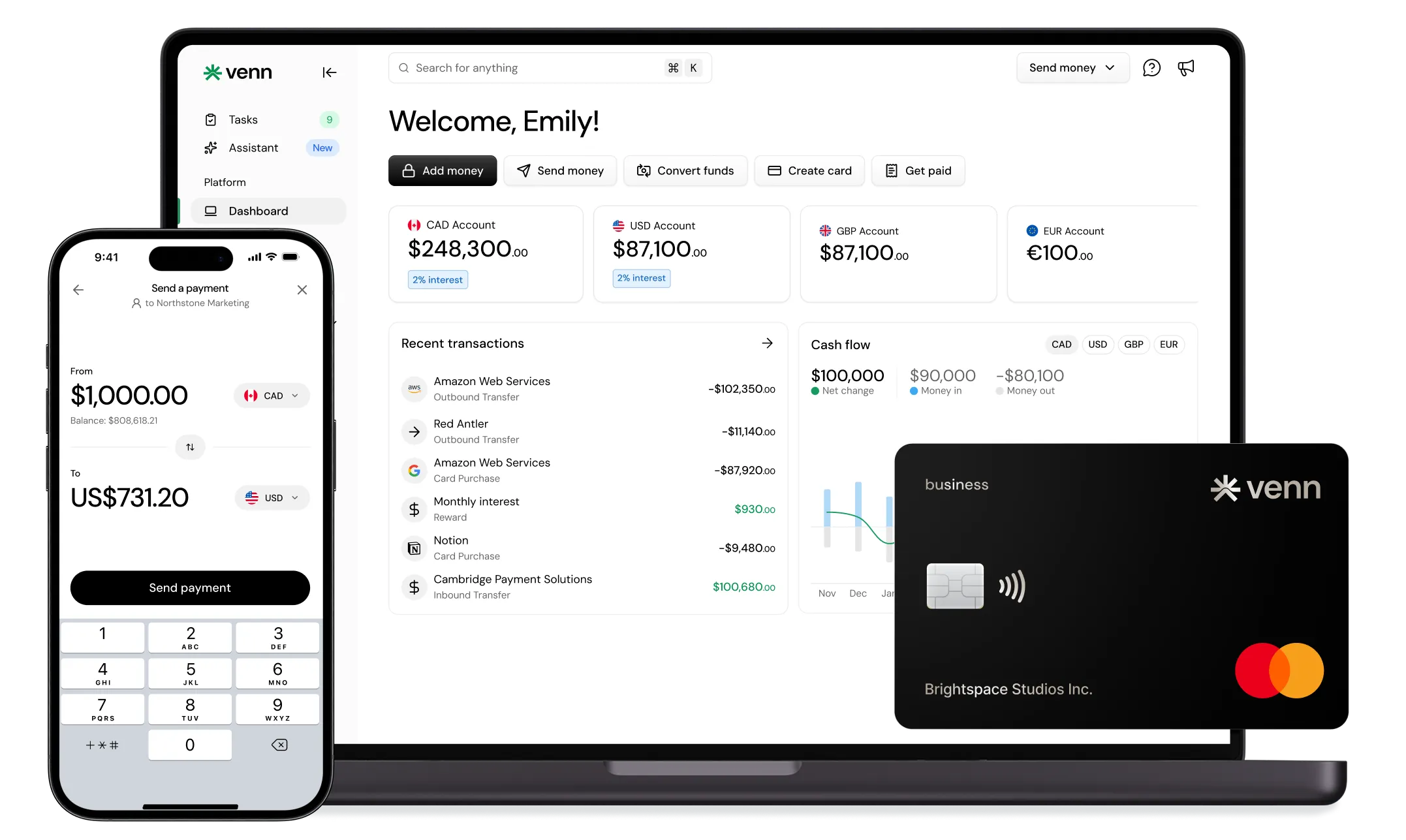
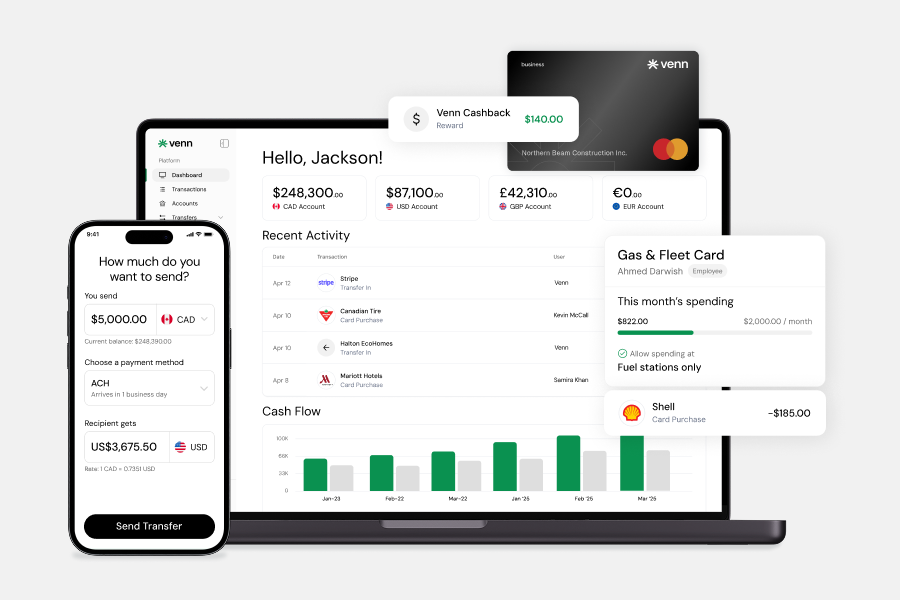
If your finance team needs international business payments and day-to-day controls in one workflow, Venn is a Canadian business banking platform and technology company built for modern operating teams. Businesses can use CAD, USD, GBP, and EUR account capabilities to manage common cross-border currencies, with local account capabilities where relevant for receiving and paying in supplier currencies.
For outbound payments, Venn supports transfers to 200+ countries in 30+ currencies, with competitive FX rates for business foreign exchange payments—helping Canadian companies pay overseas suppliers from Canada while reducing the manual work that often comes with separate payment tools.
The platform connects directly with QuickBooks and Xero, which matters when international invoice payments need clean reconciliation. Expense management features support policy enforcement, and approval workflows help finance teams review spend before money moves. Virtual and physical cards support online purchases, travel, and recurring software costs, while OCR receipt capture helps match receipts to transactions.
For card spend, Venn offers a corporate charge card with 1% cashback from the first dollar, capped by plan, with unlimited cashback available on Pro. Vendor payments can also be made through free unlimited Interac e-Transfer®.
Venn can suit e-commerce teams and importers with recurring supplier payments, as well as agencies and professional services firms managing cross-border contractors, software spend, and accounting close. Businesses that want branch-based support may prefer traditional banks. Eligible Venn Account balances are held at Bank of Montreal, a CDIC member, with CDIC insurance protection up to applicable limits. Sign up for Venn
Wise
If your main question is how to move money from Canada to an overseas supplier, contractor, or vendor, Wise is a useful reference point. It specializes in international business payments and currency conversion, which can make it practical for teams focused on outbound transfers rather than broader finance operations.
For a Canadian business comparing international payment methods, this type of specialist platform may fit when the workflow is simple: convert funds, send the payment, and track the transfer. It can also help businesses evaluate the impact of FX rates and international transfer fees before choosing a provider.
If your team also needs approval controls, business cards, and accounting workflows, compare Wise against the broader platforms covered above. The right fit depends on whether international transfers are the core need or one part of a larger cross-border business payments process.
When Each Option Makes Sense
If you pay one large overseas supplier a few times a year, an international wire transfer for business through your existing bank may fit well. A Canadian e-commerce company placing a seasonal inventory order, for example, may value a familiar approval path and relationship support more than building a new workflow for infrequent payments.
For recurring USD or EUR vendor payments, a multi-currency business account or transfer-focused provider is worth a close look. Importers with monthly international invoice payments often need repeatable processes, clear FX rates, and fewer unnecessary currency conversions—which is where the question of how to pay for international business transactions as a Canadian becomes less about a single transfer and more about operating rhythm.
For software tools, ad platforms, travel, and smaller foreign expenses, business cards usually make more sense than wires. Agencies paying for design tools, cloud subscriptions, and international ad spend can keep card-based spend separate from supplier payments, which makes reconciliation cleaner.
When multiple team members request payments, approve bills, and reconcile transactions, choose a provider built around controls and accounting sync. Professional services firms paying international contractors need clean records as much as secure international business payments.
If your business still relies on in-person service for treasury questions, documentation, or relationship banking, branch-based support may remain the practical choice.
Common Mistakes to Avoid With International Payments
Avoid choosing a method on headline cost alone. Small process decisions can create avoidable FX costs, delays, or accounting work.
- Comparing only transfer fees: A low international transfer fee can still come with an unfavourable FX rate. For business foreign exchange payments, compare the total amount your supplier receives, not just the fee shown at checkout.
- Paying everything by wire: An international wire transfer for business can suit large or one-off payments, but recurring USD or EUR invoices may work better through a local-currency setup.
- Using cards for the wrong invoices: Cards fit software, travel, and smaller recurring spend. For larger international invoice payments, a transfer often gives cleaner documentation and better supplier acceptance.
- Ignoring reconciliation workload: Cross-border business payments need clear references, approval records, and accounting exports. If your finance team must manually match every payment, the admin cost grows quickly.
- Choosing only by brand familiarity: Familiarity matters, but it should not replace a fit check across currencies, controls, settlement speed, and supplier preferences.
Final Considerations for Canadian Businesses
For Canadian businesses deciding how to pay for international business transactions, the right choice depends on how money actually moves through your company. A team sending one large supplier payment each quarter may need a very different setup than a company managing recurring USD invoices, multi-step approvals, and accounting reconciliation.
Look beyond the advertised transfer fee. Total cost can include FX rates, intermediary charges, monthly platform costs, and the staff time required to track and match transactions. Operational fit matters just as much—consider payment volume, supported currencies, workflow complexity, controls, and reconciliation needs before committing to any international business payments process.
See how Venn supports Canadian businesses with multi-currency payments. Sign up for Venn
Frequently Asked Questions
Q: What is the cheapest way to pay international suppliers from Canada?
A: The cheapest option depends on the full cost of the payment, not just the advertised transfer fee. Compare the transfer fee, FX markup, receiving bank deductions, payment amount, currency, and the workflow your team needs. For business international transfers in Canada, the right choice can change depending on whether you are sending one large invoice payment or recurring supplier payments.
Q: Are international wire transfers always the fastest option?
A: Not always. An international wire transfer for business can work well for larger payments, but speed depends on routing, intermediary banks, SWIFT processing, compliance checks, local payment rails, and provider cut-off times. If timing matters, check the expected settlement window and tracking options before you send.
Q: What is the difference between FX markup and a transfer fee?
A: A transfer fee is the visible charge you pay to send money. FX markup is the spread built into the exchange rate when your CAD converts into another currency, such as USD, GBP, or EUR. For business foreign exchange payments, the FX markup can materially affect total cost, especially on larger international invoice payments.
Q: Should a Canadian business use a card or a bank transfer for overseas payments?
A: Cards often fit software subscriptions, travel, digital ad spend, and smaller recurring international expenses. Bank transfers usually fit supplier invoices, contractor payments, and larger cross-border business payments where the recipient expects direct settlement. If your team uses both, keeping card spend separate from invoice payments makes reconciliation cleaner.
Q: Do I need a multi-currency business account to pay international invoices?
A: You do not always need a multi-currency business account to pay overseas suppliers from Canada. It may help if your business frequently pays or receives in currencies such as USD, GBP, or EUR and wants to reduce unnecessary conversions. For recurring vendor payments, holding and paying in the relevant currency can also simplify planning.
Q: What should I look for in an international payment platform for business?
A: Start with total cost, including FX rates for business payments, transfer fees, and possible receiving deductions. Then compare supported currencies, local account details, payment tracking, approval controls, accounting integrations, security, and how well the platform fits your reconciliation process. The comparison table and provider sections above can help you match international payment methods for business to your operating needs.
---
**Disclaimer:** This publication is provided for general information purposes only and does not constitute legal, tax, financial, or other professional advice from Venn Software Inc., its subsidiaries, or its affiliates, and is not a substitute for advice from a qualified professional. All comparisons and competitor information reflect publicly available information believed accurate as of September 24, 2026; features, pricing, rates, and terms referenced are subject to change and may differ at the time you read this. All product names, logos, and brands referenced are the property of their respective owners; their mention does not imply affiliation with or endorsement by Venn. Any comparative statements reflect Venn's views and are provided to help readers evaluate options. We make no representations, warranties, or guarantees, express or implied, that the content is accurate, complete, or up to date.

Venn is all-in-one business banking built for Canada
From free local CAD/USD accounts and team cards to the cheapest FX and global payments—Venn gives Canadian businesses everything they need to move money smarter. Join 15,000+ businesses today.
Frequently asked questions
Everything you need to know about the product and billing.
Join 15,000+ businesses banking with Venn today
Streamline your business banking and save on your spend and transfers today
No personal credit check or guarantee.