OFX Bank Account Alternatives for Canadian Businesses 2026
Compare OFX Bank Account Alternatives for Canadian Businesses for CAD and USD accounts, transparent FX costs, EFT ACH payments, cards, and QuickBooks Xero.

Ahmed Shafik
Co-founder
.png)
Trusted by 15,000+ Canadian businesses
Business banking for Canada
Local CAD and USD accounts, corporate cards with cashback, the lowest FX rates in Canada, free local transfers, and more.
OFX bank account alternatives for Canadian businesses have become a serious consideration for finance teams that need more than a currency exchange tool. OFX handles international transfers well, and for businesses focused purely on moving money across borders, it can be a practical starting point. But as Canadian companies grow, their needs often expand: local USD receiving accounts, day-to-day operating cash management, corporate cards, approval workflows, and accounting integrations with QuickBooks or Xero.
This guide compares several options across those dimensions, with Canada-specific factors front and centre, including CAD account support, local payment rails like EFT and ACH, FX cost transparency, and eligibility for both incorporated businesses and sole proprietors. No single provider wins for every use case. The right fit depends on whether your priority is low-cost FX, a fuller operating account, or a traditional banking relationship with lending and branch access.
What This Guide Covers
This guide compares credible alternatives to OFX across the decisions that matter most to Canadian businesses: low-cost FX, local currency accounts, vendor payments, accounting workflows, business cards, and operating cash management. Each option is evaluated on its own merits, with guidance on which use cases it fits best.
Canada-specific factors shape every recommendation here. That includes CAD account support, access to local payment rails like EFT, USD receiving capabilities, FX markup transparency, and whether a provider serves sole proprietors, incorporated businesses, or both. If you need a simple transfer tool, a multi-currency operating account, or a traditional banking relationship, this guide helps you identify which direction fits your business.
Why Canadian Businesses Look for OFX Alternatives
OFX works well for businesses focused on currency exchange and international transfers. But payment needs grow. In 2026, Canadian businesses increasingly need more than a transfer platform: they want local currency accounts, vendor payment workflows, expense controls, and accounting integrations that connect directly to QuickBooks or Xero.
The right alternative depends on what the business actually needs. A company receiving USD from US clients has different requirements than an importer paying foreign suppliers or a SaaS team managing multi-currency operating cash. Some businesses need a dedicated international business account in Canada. Others need a full financial operating stack that handles CAD and foreign currencies alongside day-to-day spend management.
Choosing well means understanding the difference between a transfer tool, a multi-currency business account, and a broader business banking platform before comparing options.
Common Reasons Businesses Switch
Most Canadian businesses start looking for alternatives when a transfer-only tool stops covering their actual operating needs. Agencies billing US clients need a real USD account to receive and hold funds, not just convert them on arrival. Importers paying foreign suppliers want visibility into the full FX cost, including the markup built into the exchange rate, not just the transfer fee listed at checkout. Those two numbers together determine what a payment actually costs.
SaaS companies and retailers often need local payment rails. Sending ACH payments to US vendors or receiving EFT settlements in CAD requires account infrastructure that pure FX platforms rarely provide. Finance teams at growing service firms also flag the absence of approval workflows, corporate cards, and expense controls as friction points that slow down month-end close.
Accounting integrations matter too. When a platform does not connect to QuickBooks or Xero, reconciliation becomes a manual task. For businesses managing both CAD and USD cash flow daily, that overhead adds up quickly. The switch often comes down to one realization: a transfer tool and a business operating account are different products, and many businesses need both functions in one place.
Important Clarification for Readers
Not all OFX alternatives belong in the same category. Some are FX and payment platforms built primarily for transfers. Others are broader business banking platforms that combine operating accounts, cards, and accounting integrations. A third group includes low-cost Canadian business accounts suited to simpler CAD cash management needs.
Traditional Canadian banks remain a legitimate option for many businesses. If your company needs branch access, credit facilities, or bundled treasury services, the Big Five still offer real advantages that fintech platforms do not always match. The right choice depends on what your business actually needs, not on which category sounds most modern.
Quick Comparison Table
The table below gives a high-level snapshot of how OFX compares to leading alternatives across the criteria that matter most to Canadian businesses. Verify current product details directly with each provider before making a final decision, as features and pricing change regularly.
Best OFX Bank Account Alternatives for Canadian Businesses
Finding the right OFX bank account alternative for Canadian businesses depends almost entirely on what your business actually needs from a financial platform. A company sending occasional supplier payments abroad has different priorities than a SaaS firm collecting USD from US clients, an importer managing multi-currency cash flow, or a finance team that needs accounting integrations and spend controls built into their daily workflow.
This guide evaluates each option according to operational fit, FX and payment needs, accounting workflows, business eligibility, and total cost. No single provider is the universal best choice. The goal is to give you enough clarity to match the right platform to your specific situation, whether that means a business banking platform with an integrated financial stack, a focused international payments tool, or a traditional Canadian bank with branch access and lending relationships.
Venn
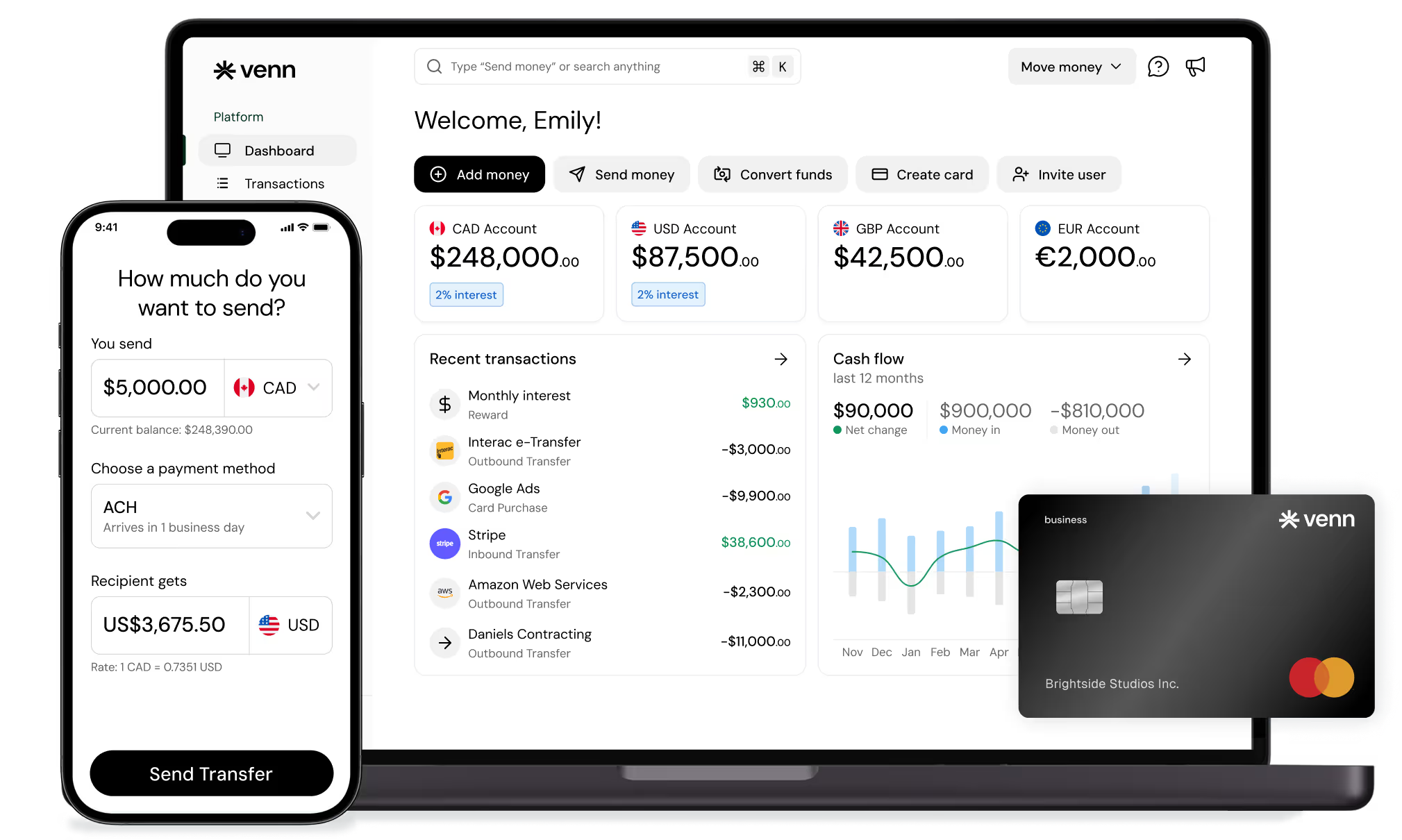
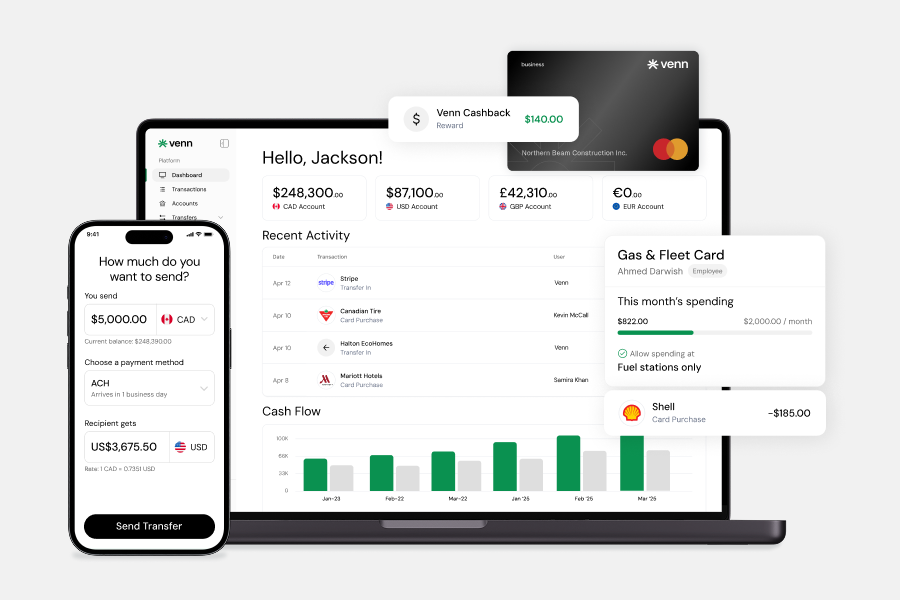
Venn is a Canadian business banking platform built for companies that want operating accounts, payments, spend management, and finance workflows in one setup. It supports both corporations and sole proprietorships registered in Canadian provinces outside Quebec.
Businesses get local CAD and USD accounts alongside multi-currency capabilities, which makes it practical for agencies billing US clients, importers paying foreign suppliers, or SaaS companies collecting USD revenue. These accounts offer 2.75% interest on CAD balances and up to 3.5% interest on USD balances (learn more), among the best rates in Canada. Competitive FX rates apply when converting between currencies, and free unlimited Interac e-Transfer® covers everyday vendor payments without adding per-transaction costs.
On the accounting side, Venn connects directly with QuickBooks and Xero, reducing manual reconciliation for finance teams. Expense management features include OCR receipt capture, which lets team members photograph receipts and match them to transactions automatically. The Venn mobile app lets users view balances, send transfers, and issue cards directly from their phone. The Venn card earns 1% unlimited cashback on eligible purchases, which contributes meaningfully to cash flow for businesses with consistent operating spend. Funds are covered under CDIC insurance protection.
One honest fit note: if your business only needs occasional cross-border transfers and already has a working banking setup elsewhere, Venn's full feature set may exceed what you actually use day to day.
Traditional Canadian Business Banks
The Big Five, including RBC, TD, and Scotiabank, remain a practical choice for many established Canadian businesses. These institutions offer branch access, in-person support, and a broad suite of products that fintech platforms typically do not match, including business lending, lines of credit, commercial mortgages, and bundled treasury services. For companies that rely on relationship banking or need credit products alongside their operating accounts, a traditional bank can be a sensible fit.
Where traditional banks tend to fall short is cross-border activity. International wire fees, foreign exchange costs, and the overall transparency of FX pricing can vary significantly depending on the account tier and service agreement. Businesses that send frequent international payments or need to hold foreign currencies may find the process less flexible compared to platforms built specifically for cross-border payments.
Fee structures and FX terms differ across institutions and account types, so verify current pricing directly with each bank before making a decision. What works well for a company managing domestic cash flow may not suit one with regular international supplier payments or USD receivables.
Wise Business
Wise Business is commonly considered by Canadian companies focused on transparent international payments and multi-currency needs. Its fee structure is visible upfront, which appeals to businesses that want clarity on what they pay per transfer.
For global invoicing and payouts, Wise Business can be a practical option. Businesses that regularly send or receive payments in multiple currencies may find its local account details useful for collecting funds from international clients.
That said, Wise Business may not consolidate every workflow a growing Canadian business needs in one place. If your team also requires operating account features, corporate cards, approval workflows, or accounting integrations with QuickBooks or Xero, you may find yourself managing those needs through separate tools. For businesses that want international payment capability alongside day-to-day cash management and expense controls, a more integrated business banking platform may be a better fit.
Wealthsimple Business Chequing
Wealthsimple Business Chequing positions itself as a low-cost CAD account option for Canadian businesses that want straightforward cash management without a heavy monthly fee structure. For small teams operating primarily in Canadian dollars, it can serve as a practical starting point.
That said, businesses with more complex financial needs will likely find it limited. If your operations involve multi-currency accounts, regular international supplier payments, FX management, or structured payables workflows, Wealthsimple Business Chequing is not built for that scope. It functions more as a simplified operating account than a cross-border payments platform.
For a sole proprietor or a very early-stage team managing basic CAD inflows and outflows, it may be a reasonable fit. But Canadian businesses that need to receive USD from clients, pay foreign vendors, or manage FX costs as part of their financial stack will need to look at platforms with dedicated international payment capabilities and multi-currency support.
Note: Product features and account terms may change. Verify current details on Wealthsimple's public product pages before making a final decision.
Which Type of Alternative Is Best for Your Business?
Choosing among OFX alternatives in Canada comes down to operational fit, not brand recognition. The right provider depends on what your business actually does day to day.
If your primary need is frequent FX and international supplier payments, prioritize total FX cost, supported currencies, and local payment rails over everything else. Speed and the ability to hold foreign currency matter more than a full feature set.
If you need day-to-day business banking alongside global payments, look for a platform that combines operating accounts, team cards, approval workflows, and accounting integrations in one place. Businesses managing both cash flow and cross-border activity benefit most from this type of integrated setup.
If your business values traditional banking relationships, branch access, lending, and bundled services, a Big Five bank may still be the most practical fit, even if cross-border fees run higher.
For smaller teams with straightforward cash management needs, a lighter solution with low monthly costs and basic transfer capability may be all that is required. Match the tool to the complexity of your workflow, not the other way around.
Best For Frequent FX And International Supplier Payments
Importers and businesses paying contractors or vendors abroad need to look beyond the headline transfer fee. The total FX cost matters most: that means combining the exchange rate markup with any separate transfer or service fees to get a true cost per transaction. Speed and supported currencies follow closely, since a platform that covers 30 currencies but takes five business days to settle can disrupt supplier relationships.
Local payment rails also matter. The ability to send funds via ACH, EFT, or local bank transfers in the recipient's country reduces intermediary fees and speeds up delivery. Equally important is whether the platform lets you receive and hold foreign currency, so you can pay USD invoices from a USD balance rather than converting CAD each time. Payment tracking and confirmation visibility round out the criteria, giving finance teams confidence that funds have arrived without chasing confirmations manually.
No single provider wins across every one of these factors. Evaluate each option against your actual payment volume, the currencies you use most, and whether you need a dedicated operating account alongside your transfer capability.
Best For Day-To-Day Business Banking Plus Global Payments
Some Canadian businesses need more than a transfer tool. If your team manages vendor payments, tracks expenses across departments, reconciles transactions in QuickBooks or Xero, and needs visibility into cash across currencies, a dedicated business banking platform fits better than a standalone FX service.
Venn is one option worth evaluating in this category. It combines CAD and USD operating accounts with a corporate card that earns 1% unlimited cashback, OCR receipt capture, and approval workflows for spend management. Free unlimited Interac e-Transfer® makes it practical for paying Canadian vendors without per-transaction costs. QuickBooks and Xero integrations connect payment activity directly to your accounting workflows, which reduces manual reconciliation for finance teams. Its mobile app also lets users access funds, send transfers, and create cards directly from their phone. Funds are covered under CDIC insurance protection.
This setup suits agencies billing US clients, importers paying foreign suppliers, or SaaS businesses collecting USD that also want expense controls and accounting visibility in one place. That said, if your needs are limited to occasional international transfers and you already have operating accounts elsewhere, a more integrated platform may offer more than you currently need.
Best for Businesses That Prefer Traditional Banking Relationships
For some Canadian businesses, a traditional bank remains the right anchor for their financial operations. Branch access, in-person relationship management, bundled lending products, and established treasury support are genuine advantages that fintech platforms do not replicate. Businesses with significant cash handling needs, complex credit facilities, or long-standing banking relationships often find that a Big Five institution fits their operating model well.
That said, businesses running frequent cross-border payments should still examine the full cost picture. Traditional banks typically apply FX markups on international transfers, charge separate wire fees, and may offer limited support for local payment rails such as ACH. Comparing those costs against supported currencies, transfer speed, and accounting integrations helps ensure the banking relationship that works for lending and cash management also works for international payments.
Best for Small Teams With Simpler Needs
Smaller businesses and sole proprietors often need straightforward CAD cash management, basic domestic or international transfers, and a low monthly cost. A full operating stack with multi-currency workflows, corporate cards, and approval hierarchies adds complexity that many simple operations simply do not require.
If your business rarely sends cross-border payments and has no immediate need for expense controls or accounting integrations, a lighter solution may serve you better. Prioritize easy setup, transparent fees, and a provider that supports your business structure. Sole proprietors in particular should verify eligibility before signing up, since some platforms restrict access to incorporated entities only.
How To Choose an OFX Alternative in Canada
Headline pricing rarely tells the full story. When comparing options for cross-border payments for Canadian businesses, the real cost includes FX markup, transfer fees, receiving account limitations, and the time your finance team spends reconciling transactions manually.
Use this checklist to evaluate any provider before committing:
• Canadian business eligibility: Does it support incorporated businesses, sole proprietors, or both?
• CAD and foreign currency accounts: Can you hold and receive funds in CAD, USD, GBP, or EUR with real local account details?
• Actual FX cost: What is the markup above the mid-market rate, and are transfer fees charged separately?
• Payment rails: Does it support ACH, EFT, wire, or local payment methods relevant to your suppliers and clients?
• Accounting integrations: Does it connect directly to QuickBooks or Xero to reduce manual reconciliation?
• Spend controls: Are business cards, approval workflows, and expense tracking available within the same platform?
• Support for your use case: A business managing international payments for Canadian businesses across multiple currencies needs different tools than one making occasional transfers.
For businesses that need a multi-currency business account in Canada with operating features built in, these criteria matter as much as the FX rate itself. For teams that only need periodic transfers, a lighter setup may be sufficient. Matching the platform to your actual workflow prevents paying for features you will not use, or missing ones you will.
Selection Criteria
Choosing the right OFX alternative requires evaluating more than a headline transfer fee. Use this checklist to assess each provider against your actual business needs:
• Canadian business eligibility: Does the provider support both sole proprietors and incorporated businesses registered in Canada?
• CAD and foreign currency support: Can you hold and transact in CAD alongside USD, EUR, GBP, or other currencies your business uses?
• Local account details: Does the provider give you real local account numbers for receiving payments from clients or platforms abroad?
• FX markup: What is the actual spread applied to the mid-market rate, not just the advertised transfer fee?
• Separate transfer fees: Are wire, ACH, EFT, or local payment fees charged on top of the FX cost?
• Payment rail coverage: Can you send and receive via ACH, EFT, wire, and local payment networks relevant to your suppliers and clients?
• Accounting integrations: Does it connect directly with QuickBooks or Xero to reduce manual reconciliation?
• Business cards and spend controls: Are corporate cards, spending limits, and approval workflows available for your team?
• Support quality: Can you reach a knowledgeable person when a payment stalls or an account issue arises?
• Finance workflow fit: Does the platform support your broader payables, receivables, and reporting needs, or only point-to-point transfers?
Total cost is rarely just the transfer fee. FX spread, per-transaction charges, reconciliation time, and operational friction all contribute to what a provider actually costs your business. Verify current pricing and feature availability directly with each provider before making a final decision.
When OFX Still Makes Sense
OFX remains a strong choice for Canadian businesses whose primary need is foreign exchange and international transfers. If your company already has a full operating account at a traditional bank, cards through another provider, and accounting workflows handled in QuickBooks or Xero, adding OFX purely for competitive FX rates and cross-border payments is a practical, low-friction decision. Businesses that send occasional large transfers rather than managing day-to-day cash flow through a single platform may find OFX fits that specific need well without requiring a broader switch.
Conclusion
The best OFX alternative for your Canadian business depends on what you actually need from your financial setup. A business focused on occasional international supplier payments has different priorities than one managing multi-currency cash flow, team spend, and accounting workflows under one platform.
Before choosing, compare total FX cost rather than headline transfer fees alone, confirm whether local payment rails like EFT or ACH are supported, check eligibility for your business structure, and evaluate how well each option connects to your accounting software. Operational fit matters as much as price.
If you need a more integrated Canadian business banking platform that combines international payments, multi-currency accounts, expense controls, and QuickBooks or Xero compatibility, Venn is worth evaluating alongside the other options in this guide.
FAQ
Q: What is the best OFX alternative for a Canadian business?
A: The right choice depends on what your business actually needs. If you primarily send international transfers and want competitive FX rates, a dedicated transfer platform may be sufficient. If you need local CAD and USD accounts, corporate cards, accounting integrations, and approval workflows, a broader business banking platform will serve you better.
Q: Are there OFX alternatives with multi-currency business accounts in Canada?
A: Yes. Some providers offer true multi-currency business accounts where you can hold, receive, and pay in foreign currencies directly. Others focus mainly on executing transfers without providing local account details or the ability to hold balances, so it is worth confirming which model a provider uses before signing up.
Q: What should Canadian businesses compare besides FX rates?
A: Look beyond the headline exchange rate and evaluate local account details for receiving foreign payments, supported payment rails such as ACH and EFT, transfer fees, accounting integrations with tools like QuickBooks or Xero, business card availability, approval workflows, and whether the provider supports your business structure, whether incorporated or a sole proprietorship.
Q: Is a traditional bank better than an OFX alternative?
A: For some businesses, yes. Traditional Canadian banks offer branch access, lending products, and bundled services that fintech platforms typically do not. However, businesses with active cross-border payment needs should still compare foreign exchange costs and international transfer workflows, since traditional banks often charge more for those specific functions.
Legal / Compliance Notes
Venn is a business banking platform, not a bank. Funds held through Venn are covered under CDIC insurance protection.
All product features, fees, and availability described in this guide reflect publicly available information at the time of publication. Verify current terms directly with each provider before making financial decisions. Interac e-Transfer® is a registered trademark of Interac Corp.
Venn Mastercard Charge Card is issued by Peoples Trust Company under licence from Mastercard International Incorporated. Mastercard is a registered trademark, and the circles design is a trademark of Mastercard International Incorporated.
---
**Disclaimer:** This publication is provided for general information purposes only and does not constitute legal, tax, financial, or other professional advice from Venn Software Inc., its subsidiaries, or its affiliates, and is not a substitute for advice from a qualified professional. All comparisons and competitor information reflect publicly available information believed accurate as of June 1, 2026; features, pricing, rates, and terms referenced are subject to change and may differ at the time you read this. All product names, logos, and brands referenced are the property of their respective owners; their mention does not imply affiliation with or endorsement by Venn. Any comparative statements reflect Venn's views and are provided to help readers evaluate options. We make no representations, warranties, or guarantees, express or implied, that the content is accurate, complete, or up to date.

Venn is all-in-one business banking built for Canada
From free local CAD/USD accounts and team cards to the cheapest FX and global payments—Venn gives Canadian businesses everything they need to move money smarter. Join 15,000+ businesses today.
Frequently asked questions
Everything you need to know about the product and billing.
Join 15,000+ businesses banking with Venn today
Streamline your business banking and save on your spend and transfers today
No personal credit check or guarantee.