How Much Are Hidden FX Fees Costing Your Canadian Business
How Much Are Hidden FX Fees Actually Costing Your Canadian Business Learn to spot FX spreads, calculate all-in costs, and reduce leakage with USD accounts.

Ahmed Shafik
Co-founder

Trusted by 15,000+ Canadian businesses
Business banking for Canada
Local CAD and USD accounts, corporate cards with cashback, the lowest FX rates in Canada, free local transfers, and more.
A Canadian marketing agency pays a US software vendor US$15,000. The bank confirms a wire fee of $18. The finance manager logs the transaction, notes the modest charge, and moves on. What the bank statement never shows is the 2.5% markup embedded in the exchange rate, a cost that quietly added another $375 to that single payment.
This is how hidden FX fees work. They rarely appear as a separate line item. Instead, they sit inside the quoted exchange rate, the gap between the mid-market rate and the rate your bank or payment provider actually applies to your transaction. For Canadian businesses making regular USD payments to suppliers, converting USD revenue back to CAD, or processing foreign currency invoices, that gap compounds quickly across every transaction.
A 1% to 3% markup may sound minor in isolation. Across a year of supplier payments, converted marketplace payouts, and cross-border operating expenses, the total cost can reach tens of thousands of dollars, often without a single fee ever appearing on a statement.
This guide helps Canadian businesses identify where these costs hide, calculate the true cost of currency conversion using real numbers, and evaluate which payment approaches can reduce unnecessary FX leakage.
What Hidden FX Fees Actually Are
Most businesses focus on the wire fee or transfer charge shown on a payment confirmation. That number is visible, easy to track, and often modest. The real cost frequently sits somewhere else entirely: inside the exchange rate itself.
When a bank or payment provider converts your Canadian dollars to US dollars, they rarely offer you the mid-market exchange rate. The mid-market rate is the benchmark rate you see on Google or XE.com, the midpoint between global buy and sell prices for a currency pair. What providers actually quote is a marked-up version of that rate. The difference between the mid-market rate and the rate you receive is the bank FX spread, and it represents a direct cost to your business on every conversion.
This is where "zero transfer fee" messaging can mislead. A provider can waive the visible transfer charge entirely while still building a 2% to 3% exchange rate markup into the quoted rate. The hidden currency conversion fee disappears from the fee line and reappears in the rate. The effective exchange rate, meaning the all-in rate your business actually receives after markup, tells the true story.
For consumers making occasional transfers, a 1% to 2% markup is a minor inconvenience. For Canadian businesses converting larger amounts on a regular cycle, the true cost of FX compounds quickly. A company converting CAD $500,000 annually at a 2.5% markup pays roughly $12,500 more than a business accessing rates close to mid-market. That figure comes directly off the bottom line, not from a fee schedule anyone handed you upfront.
Where Canadian Businesses Commonly Lose Money On FX
FX leakage rarely comes from a single source. It accumulates quietly across everyday payment workflows, and most finance teams only notice it when they reconcile at month-end, if they notice it at all.
Paying international suppliers is the most obvious exposure point. A Canadian importer paying USD invoices monthly converts CAD to USD on every cycle. At a bank with a 2.5% FX spread, a $30,000 USD payment costs roughly $750 more than it would at the mid-market rate. Multiply that across twelve months and the annual drag becomes material.
Receiving USD revenue and converting back to CAD creates a mirror problem for exporters, agencies, and SaaS companies billing US clients. Every conversion event eats into margin. A company receiving US$40,000 monthly from American clients and converting it all to CAD at a 2% markup loses approximately $800 per month before a single wire fee appears on the statement.
Marketplace and processor payouts add another layer. Stripe, Shopify, and PayPal all route payouts based on account configuration. When a Canadian ecommerce brand routes USD sales revenue into a CAD-only account, the processor converts USD to CAD automatically, often at an unfavourable rate. If that same business then needs USD to pay a US ad platform or supplier, it converts CAD back to USD again. Two conversion events where zero were necessary.
Employee and operating spend compounds the problem further. Software subscriptions billed in USD, Google or Meta ad platforms, cross-border card transactions, and travel expenses all trigger currency conversion. For a SaaS company or agency with a distributed team, these costs accumulate across dozens of transactions each month, none of them large enough to flag individually, but significant in aggregate.
The common thread across all of these scenarios is that the cost is embedded in the exchange rate, not surfaced as a visible fee. That makes it easy to overlook and difficult to track without deliberate attention to the effective exchange rate on each transaction.
How To Calculate The True Cost Of FX
Most businesses focus on the wire fee line item and stop there. That number is visible, predictable, and easy to budget. The exchange rate markup is neither. It sits quietly inside the quoted rate, and for many Canadian businesses, it costs significantly more than the stated fee ever will.
Here is the formula to find your true all-in conversion cost:
True FX Cost = (Mid-Market Rate - Offered Rate) x Transaction Amount + Any Stated Fees
To apply this, pull the mid-market rate at the moment your provider quotes you. Google, XE.com, or Bloomberg all show the live mid-market benchmark. Compare that rate against what your bank or payment provider is actually offering. The difference is the implied spread, and multiplying it by your transaction amount tells you exactly what that markup costs in real dollars.
When converting between USD and CAD, express the result in CAD so the number reflects your actual business cost.
Calculator-style example:
The wire fee here is $25. The exchange rate markup costs $600. That ratio is common, and it is why comparing providers on headline fees alone produces a misleading picture of your foreign exchange fees for business.
Your effective exchange rate, meaning the rate you actually receive after all costs are applied, is the only number that reflects your true all-in conversion cost. Always ask for it before confirming any transaction, and always benchmark it against the mid-market rate at that moment. Currency conversion fees in Canada vary widely across provider types, and the spread is where most of that variation hides.
Example Scenarios: What Hidden FX Fees Can Cost In A Year
Three scenarios below use rounded numbers and straightforward assumptions. The goal is to show the scale of the problem, not to predict exact outcomes for your business.
Scenario 1: Importer Paying US Suppliers
A Canadian manufacturer pays US$25,000 per month to US-based suppliers. Their bank quotes a rate that includes a 2% embedded markup over the mid-market rate, plus a $25 wire fee per transaction.
• Annual USD payments: US$300,000
• FX markup cost at 2%: approximately CAD $8,400 per year (assuming a rough 1.40 USD/CAD rate)
• Wire fees: $25 x 12 = $300
Total estimated annual cost: roughly CAD $8,700
The wire fee looks like the cost. The exchange rate markup is the actual cost.
Scenario 2: Agency or SaaS Company Receiving USD Revenue
A Canadian agency bills US clients and converts US$40,000 per month back into CAD. Their payment processor applies a 2.5% conversion spread on every payout.
• Annual USD converted: US$480,000
• Spread cost at 2.5%: approximately CAD $16,800 per year
That figure comes directly off margin. For a business running at 20% net margin, it represents a meaningful reduction in take-home profit on that revenue.
Scenario 3: Ecommerce Business With Mixed USD Flows
A Canadian ecommerce brand receives USD from Shopify payouts, converts it to CAD, then pays US ad platforms and suppliers back in USD. Each round-trip conversion carries a 2% spread.
• Monthly USD received: US$30,000
• Monthly USD spent on ads and suppliers: US$20,000
• Unnecessary conversion cost on the US$20,000 that never needed to leave USD: approximately CAD $5,600 per year
Holding USD and paying USD expenses directly from a USD balance eliminates that cost entirely.
The Bigger Picture
Across all three scenarios, the pattern is consistent: the exchange rate markup generates far more cost than any visible transfer fee. Businesses that reduce their FX markup, use local currency accounts to hold USD before converting, and build multi-currency workflows that match inflows with same-currency outflows can cut a significant portion of these costs. Fewer conversion events, at a lower markup per event, compounds into real savings over a full fiscal year.
How To Compare FX Options For A Canadian Business
Start your evaluation with the effective exchange rate, not the headline fee. A provider advertising zero transfer fees can still cost you significantly more than one charging a flat wire fee, because the markup built into the quoted rate is where the real cost sits. Ask every provider: what rate will you apply to this transaction right now, and how does that compare to the current mid-market rate?
Beyond the rate itself, several operational factors shape which provider actually fits your business:
Local account availability. Can you receive USD payments into a US-domiciled account, or does every inbound payment trigger an automatic conversion? Businesses that regularly receive USD revenue benefit from holding that balance and converting on their own schedule.
Payment rails. Check whether the provider supports ACH for US payments, not just wire transfers. ACH is typically cheaper and sufficient for many supplier and vendor payments. Confirm inbound and outbound capabilities separately, since some providers handle one direction better than the other.
Wire costs. Flat wire fees vary widely. At higher transaction volumes, even a $15 to $25 difference per wire compounds quickly across a year.
Accounting integrations and reconciliation. If your team uses QuickBooks or Xero, a provider that syncs transactions directly reduces manual reconciliation work. This matters more as transaction volume grows.
Spend controls and card functionality. For businesses managing employee expenses across currencies, a multi-currency corporate card that draws from the correct currency balance avoids unnecessary conversion at the point of purchase.
Support model. High-volume or complex cross-border operations often need responsive business support, not a consumer help queue.
Different business models call for different solutions. A business with a single US supplier and low monthly volume has different needs than a SaaS company converting US$50,000 in monthly revenue or an importer managing multiple vendor currencies. Frame your comparison around your transaction volume, the currencies you actually use, and how much operational complexity you want to manage.
Four broad provider categories serve Canadian businesses:
• Traditional Canadian banks suit businesses that prioritize existing relationships, branch access, or bundled treasury services. FX spreads tend to be wider, and wire fees add up, but the integration with existing accounts can simplify cash management for some operators.
• Multi-currency business banking platforms work well for businesses with recurring cross-border payments. Features like local currency accounts, lower FX markups, and accounting integrations reduce both cost and administrative overhead.
• FX specialists and money transfer providers offer transparent rate pricing and are worth considering for businesses focused primarily on conversions and transfers, though they may not replace a full banking workflow.
• CAD-first business accounts serve businesses with minimal foreign currency exposure. They offer simplicity but provide limited utility once cross-border activity becomes regular.
Compare the all-in conversion cost across each option using a consistent transaction size. Take your most common payment amount, apply each provider's quoted rate against the mid-market rate at the same moment, add any stated fees, and calculate the total cost. That single exercise will tell you more than any fee schedule.
Balanced Comparison Table
Each provider category carries different tradeoffs for Canadian businesses managing cross-border payments, foreign currency revenue, or international supplier costs. Use this table to identify which option aligns with your operating model before comparing specific rates and fees.
No single category suits every business. A high-volume importer paying USD invoices monthly has different priorities than a SaaS company occasionally converting USD revenue back to CAD. Matching your provider to your actual payment volume, currency mix, and workflow requirements will reduce unnecessary FX costs more reliably than chasing a headline rate alone.
Where Venn Fits Among FX Options
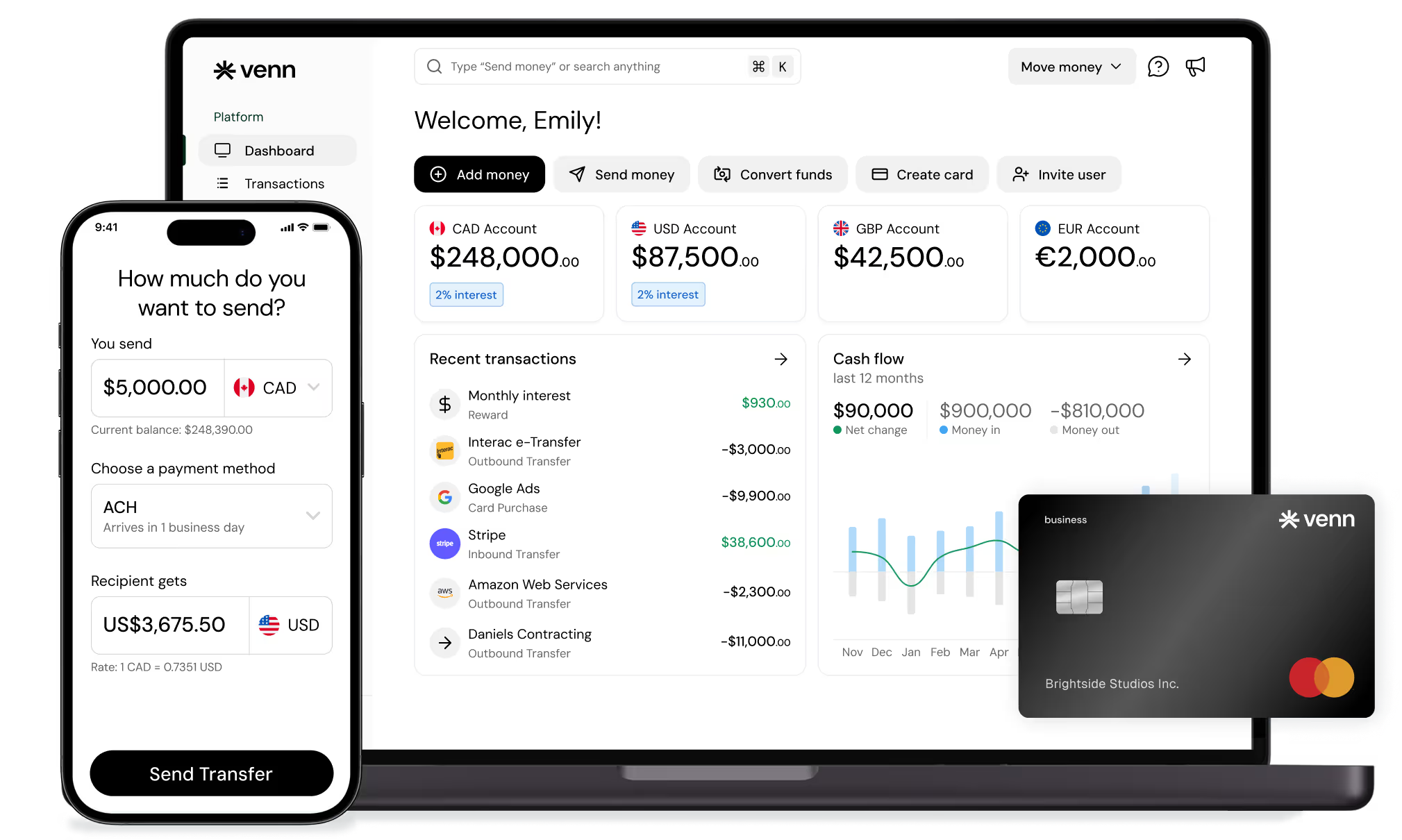
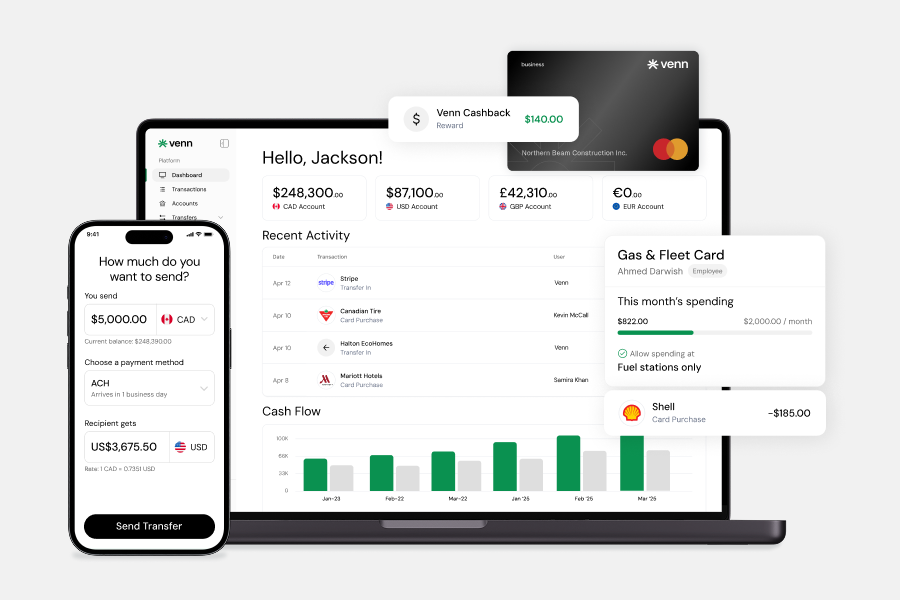
Venn is a Canadian business banking platform, not a bank, and it positions itself as a practical option for businesses that regularly earn, spend, or convert foreign currencies. If FX leakage and fragmented payment workflows are real operational problems for your business, Venn is worth evaluating alongside other options.
The platform supports multi-currency accounts in CAD, USD, GBP, and EUR, with a real US-domiciled account that includes ACH capabilities. This matters because receiving USD payments directly into a local US account avoids the automatic conversion that many Canadian businesses trigger by default. FX markup ranges from 0.25% to 0.45% depending on your plan, which sits meaningfully below what most traditional Canadian banks charge on business conversions.
Other features that reduce friction for cross-border operations include a multi-currency corporate card that auto-matches supported currency balances, direct integrations with QuickBooks and Xero, and OCR receipt capture for expense management. Free unlimited Interac e-Transfer® is available on applicable plans for vendor payments. Cashback on the card runs at 1%, with plan-based caps: up to $5,000 per month on Essentials, up to $25,000 per month on Plus, and uncapped on Pro. Eligible deposits are covered by CDIC insurance protection through Venn's banking partner. Note that Venn is not currently available to businesses in Quebec.
That said, Venn is not the right fit for every business. If your business needs branch-led treasury support or has an existing relationship with a major bank that handles complex financing, a traditional bank likely serves you better. If your primary need is standalone international transfers with maximum rate transparency, a specialist FX provider may offer a simpler solution. And if your cross-border activity is minimal, a straightforward CAD-first business account may be all you need. Sign up for Venn
Practical Ways To Reduce Hidden FX Costs
Start by auditing where currency conversion actually happens in your business. Many Canadian businesses discover that FX leakage occurs across four or five separate workflows simultaneously: supplier payments, processor payouts from platforms like Stripe or Shopify, software subscriptions billed in USD, corporate card spend, and ad platforms like Google or Meta. Each conversion point carries its own markup. Fixing one while ignoring the others leaves most of the cost in place.
Hold Foreign Currency Rather Than Converting Immediately
If your business receives USD revenue, avoid converting it to CAD the moment it arrives. Holding USD in a foreign currency account lets you pay USD-denominated expenses directly, skipping the round-trip conversion entirely. For businesses with both USD inflows and USD outflows, this single change can eliminate a meaningful portion of annual FX costs.
Match Revenue and Expenses in the Same Currency
Pair USD income with USD expenses wherever possible. A Canadian agency billing US clients and paying US contractors or software vendors in USD has a natural hedge. Converting USD to CAD and then back to USD to pay a vendor is an avoidable cost that compounds over time.
Compare the Effective Exchange Rate, Not Just the Fee Line
Ask every provider for the all-in rate on a specific transaction amount, then compare that rate to the mid-market rate at the same moment. The difference, multiplied by your transaction volume, is your true FX cost. A provider advertising zero transfer fees may still apply a 2% to 3% spread, which on a $50,000 CAD monthly payment volume adds up to $12,000 to $18,000 CAD per year in unnecessary conversion costs.
Review Your Full Payment Workflow
Map every payment that crosses a currency boundary in a given month. Include wire transfers to international suppliers, payouts from marketplaces, recurring SaaS subscriptions, and card transactions in foreign currencies. Finance managers often find that the largest FX exposure sits not in wire transfers but in card spend and processor payouts that nobody has reviewed in months.
Choose Tools That Fit Your Operating Model
A business with high USD volume and recurring cross-border payments benefits from a multi-currency account that supports local USD rails, competitive FX markup, and accounting integrations with tools like QuickBooks or Xero. Venn, for example, offers CAD and USD accounts with ACH capabilities and FX markup ranging from 0.25% to 0.45% depending on plan, which suits businesses that want to consolidate cross-border payments and expense management in one place. A business with minimal FX exposure may find a simpler CAD-first account sufficient. Match the tool to your actual transaction profile rather than defaulting to your existing provider out of habit.
Conclusion
Hidden FX fees rarely appear as a line item on your bank statement, but they quietly reduce margins every time your business converts currency. The exchange rate markup is typically the larger cost, not the wire fee you can see. For Canadian businesses paying US suppliers, converting USD revenue, or running cross-border operating expenses month after month, even a 1% to 2% spread compounds into a material annual loss.
Start by reviewing your recent FX transactions. Compare the rates your current provider quoted against the mid-market rate at the time of each conversion. That gap is money leaving your business unnecessarily.
If the review reveals consistent leakage, evaluate whether multi-currency accounts, better payment workflows, or a platform built for cross-border operations could reduce those costs. Venn is one option worth considering for Canadian businesses that need multi-currency accounts in CAD, USD, GBP, and EUR, cross-border payments with ACH capabilities, corporate cards, expense management, and QuickBooks or Xero integrations. Note that Venn is not currently available to businesses in Quebec.
Reducing avoidable FX costs does not require a complex overhaul. It starts with knowing what you are actually paying. Sign up for a Venn account to see how the platform can support your cross-border payment workflows.
FAQ
Q: What Counts As A Hidden FX Fee?
A: A hidden FX fee is the markup a provider builds into the exchange rate it quotes you, rather than charging as a separate line item. The gap between the mid-market rate and the rate you actually receive is called the spread, and it represents a real cost even when the provider advertises zero transfer fees. For Canadian businesses, this embedded conversion cost often exceeds any visible wire or transaction charge.
Q: Are Bank Wire Fees The Main Cost In Foreign Exchange?
A: Usually not. A typical wire fee might run $15 to $25 per transaction, but a 2% to 3% exchange rate markup on a $50,000 CAD payment costs $1,000 to $1,500 in that single conversion alone. The rate markup is frequently the larger expense, and it scales directly with transaction size, which makes it especially significant for businesses with high payment volumes.
Q: How Can I Compare FX Providers Fairly?
A: Check the mid-market rate at the time of your quote using a source like Google or XE.com, then compare it to the rate your provider offers. The difference, expressed as a percentage, is the effective markup. Add any stated transfer fees to that figure to calculate your all-in conversion cost. This approach lets you compare providers on a consistent basis, regardless of how they structure their pricing.
Q: Should A Canadian Business Use A Multi-Currency Account?
A: A multi-currency account makes practical sense for businesses that regularly earn revenue or pay expenses in USD, GBP, EUR, or other foreign currencies. Holding funds in the currency you received them in avoids unnecessary conversions and gives you more control over when and at what rate you convert. Whether the fit is right depends on your transaction volume, the currencies involved, and how your payment workflows are set up.
Q: Can Holding USD Help Reduce FX Costs?
A: Yes, particularly if your business both earns and spends in USD. When you receive USD from a US client and can pay a US supplier directly from that balance, you eliminate a round-trip conversion entirely. For Canadian businesses with recurring cross-border payments, matching USD inflows to USD outflows is one of the most straightforward ways to reduce currency conversion fees over time.
---
**Disclaimer:** This publication is provided for general information purposes only and does not constitute legal, tax, financial, or other professional advice from Venn Software Inc., its subsidiaries, or its affiliates, and is not a substitute for advice from a qualified professional. All comparisons and competitor information reflect publicly available information believed accurate as of June 1, 2026; features, pricing, rates, and terms referenced are subject to change and may differ at the time you read this. All product names, logos, and brands referenced are the property of their respective owners; their mention does not imply affiliation with or endorsement by Venn. Any comparative statements reflect Venn's views and are provided to help readers evaluate options. We make no representations, warranties, or guarantees, express or implied, that the content is accurate, complete, or up to date.

Venn is all-in-one business banking built for Canada
From free local CAD/USD accounts and team cards to the cheapest FX and global payments—Venn gives Canadian businesses everything they need to move money smarter. Join 15,000+ businesses today.
Frequently asked questions
Everything you need to know about the product and billing.
Join 15,000+ businesses banking with Venn today
Streamline your business banking and save on your spend and transfers today
No personal credit check or guarantee.