Mercury Alternatives for Canadian Startups 2026 Guide
Mercury Alternatives for Canadian Startups 2026 compares Venn, Wise and top banks for CAD and USD needs, FX costs, cards, and accounting integrations.

Trusted by 15,000+ Canadian businesses
Business banking for Canada
Local CAD and USD accounts, corporate cards with cashback, the lowest FX rates in Canada, free local transfers, and more.
Mercury Alternatives for Canadian Startups 2026
Updated June 2026
Introduction: Why Canadian Startups Look for Mercury Alternatives
Best Mercury Alternatives for Canadian Startups in 2026 starts with a practical question: does your company need a U.S.-registered finance setup, or a Canada-first operating structure? Many searches for Mercury Alternatives for Canadian Startups 2026 come from founders who like Mercury’s startup-focused experience, but need a platform that fits how their Canadian business actually operates.
Mercury can support founders outside the U.S., which makes it attractive to international teams. The key limitation for Canadian readers is the entity requirement: the business itself must be formed and registered in the U.S. or a U.S. territory. If your startup is incorporated in Canada and wants day-to-day CAD operations, that requirement changes the comparison quickly.
The gap becomes clear when you serve U.S. customers, pay U.S. vendors, or manage contractors across borders while still running payroll, taxes, and operating expenses in Canada. In that case, the right startup banking alternative in Canada depends on your entity structure and currency mix. It also depends on how your team manages spending, how finance work flows into accounting, and whether you prefer a digital-first platform or a branch-backed relationship with a major Canadian bank.
What to Compare in a Mercury Alternative
For Mercury alternatives for Canadian startups in 2026, start with fit, not brand recognition. If your company operates as a Canadian corporation or sole proprietor, confirm the platform can onboard that entity type before you compare cards or app design. As noted earlier, cross-border structure can affect eligibility, but day-to-day operations matter just as much.
For Canadian operating needs, look at how cleanly the account handles CAD inflows and outflows. A business bank account for a Canada startup should support payroll and vendor payments while making local collections straightforward. If you bill U.S. customers or pay American contractors, evaluate USD receiving and payment routing. A USD business account Canada setup should reduce conversion friction, not add another workaround.
FX deserves close attention. Small spreads can become meaningful when you convert revenue or manage recurring currency needs. If your company operates across markets, a multi-currency business account may also reduce extra transfers and reconciliation work.
For growing teams, compare corporate cards for startups by user permissions and spend limits. Approval workflows matter when spending moves beyond the founder. Strong accounting integrations help transactions sync cleanly into your books. Finally, weigh monthly fees against operational complexity. Useful startup banking alternatives Canada founders consider should support business banking and expense management without adding another disconnected workflow.
Mercury Alternatives for Canadian Startups 2026: Quick Comparison
If your company operates as a Canadian entity, compare startup banking alternatives Canada-first rather than treating every provider as a direct Mercury substitute. This shortlist focuses on practical use cases for Canadian startups: local CAD operations, USD business account Canada needs, cross-border banking for startups, team cards, and accounting workflows. It is not ranked as a single winner. A SaaS startup billing U.S. customers may value a multi-currency business account, while a founder who wants branch access may prefer a major bank. Use the table to narrow the field, then assess each platform against your entity structure, transaction volume, and finance stack.
Venn
Best for startups that want Canadian operations, multicurrency accounts, and spend management in one platform.
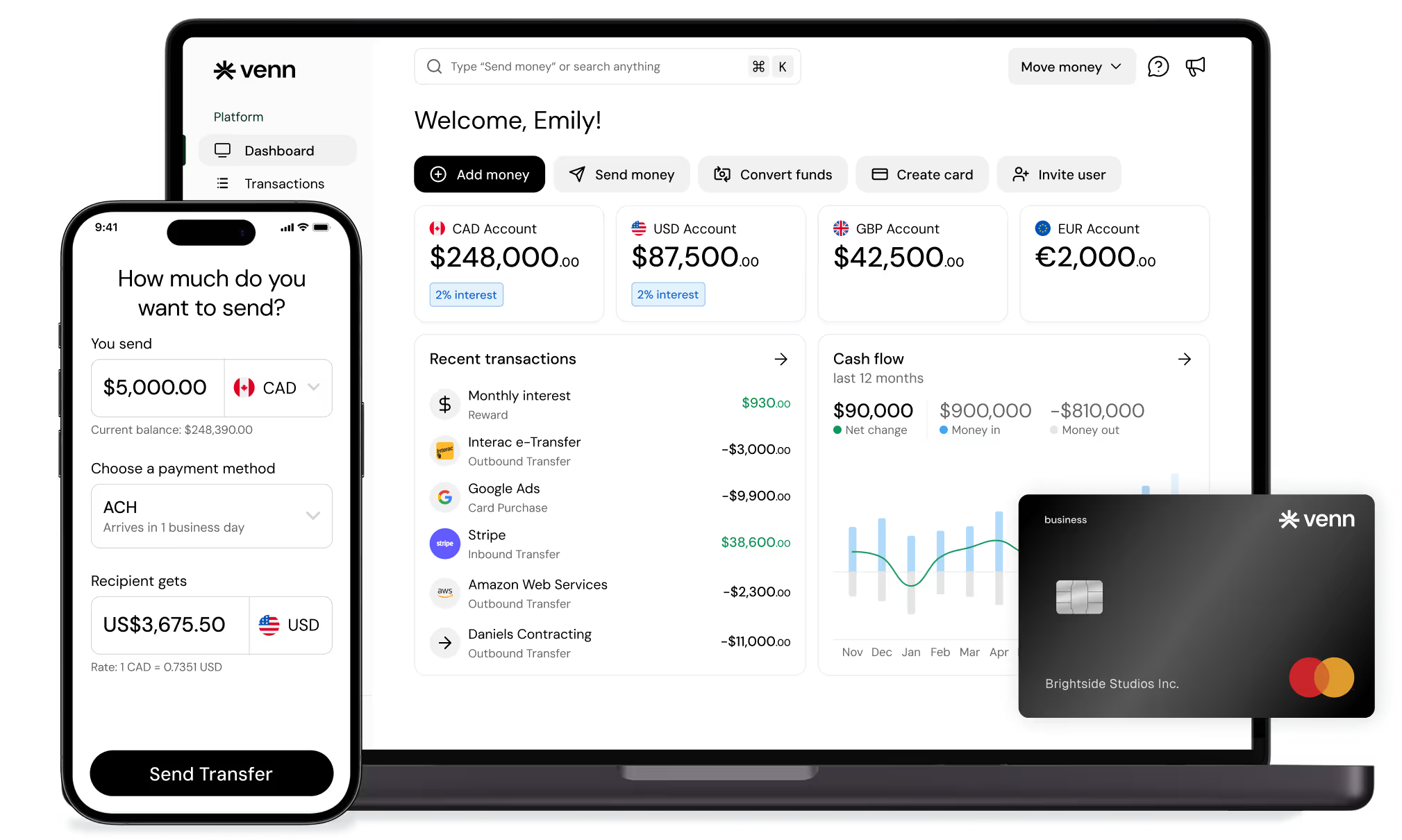
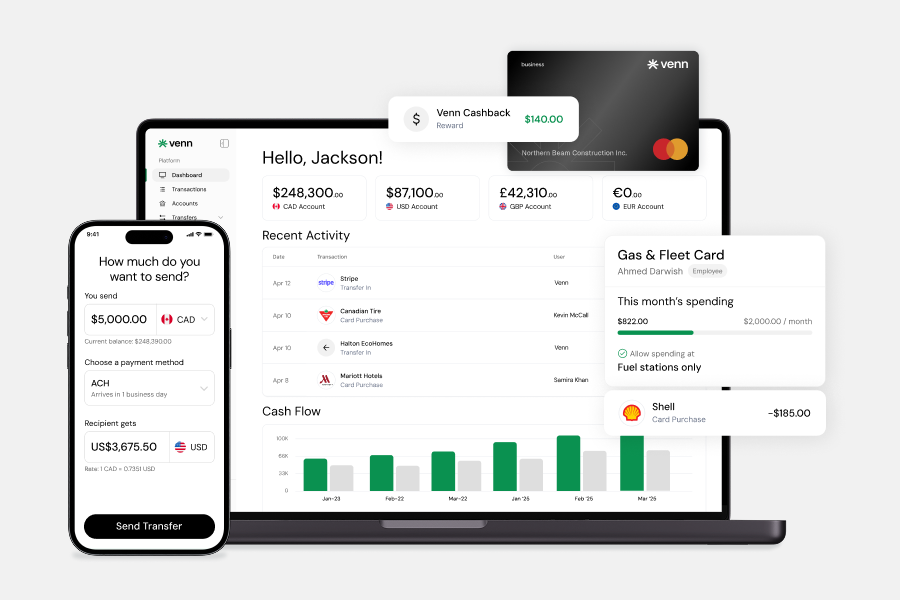
If your Canadian startup needs a local operating setup plus cross-border flexibility, Venn gives you CAD, USD, GBP, and EUR accounts in one workspace. For U.S. revenue or vendor payments, its US-domiciled account can send and receive ACH, which makes it a practical USD business account Canada option for teams with American customers, contractors, or software suppliers. For domestic workflows, Venn supports local CAD payments and free unlimited Interac e-Transfer® for vendor payments.
Pricing depends on plan. FX markups are 0.45%, 0.35%, and 0.25% across Essentials, Plus, and Pro. Local transfers are free on Plus and Pro, while international wires are priced by plan. Card spend earns 1% cashback from the first dollar, with monthly caps on lower tiers and unlimited cashback on Pro.
For teams comparing Mercury alternatives Canada, Venn also combines multicurrency cards with spend controls and expense management. OCR receipt capture helps reduce manual follow-up, and direct QuickBooks and Xero integrations support cleaner reconciliation. Eligible deposits with Venn are covered by CDIC insurance protection, and eligible CAD and USD balances earn a standard 2% interest rate.
The trade-offs are clear. Venn is not available to businesses in Quebec, and more advanced capabilities require higher-tier plans.
Wise Business
Best for startups that mainly care about international payments, currency conversion, and global team spending.
If your Canadian startup pays contractors abroad, invoices customers in other markets, or has team members travelling often, Wise Business can be a practical Mercury alternative Canada founders should understand. Wise Business is available in Canada for eligible businesses and positions itself as a global business account for paying, getting paid, and spending in different currencies.
For day-to-day cross-border use, the Wise business debit card is the main draw. Teams can use it in 40+ currencies and 160+ countries, which helps reduce friction when employees spend outside Canada or when founders need a simple way to manage international operating costs. Wise also emphasizes mid-market exchange rates, giving finance teams clearer visibility into conversion costs when moving money between currencies.
From a pricing perspective, Wise highlights no subscription fee for the first business card. That can make it appealing for early-stage companies that want global payment functionality without committing to a heavier monthly platform cost.
The trade-off is fit. Wise can be strong for FX and global payments, but it may not match every startup’s need for a full Canada-first operating workflow. For companies comparing startup banking alternatives Canada-wide, Wise works best when international money movement matters more than local operating depth.
RBC Business Accounts
Best for startups that want a major Canadian bank relationship with digital basics and branch access.
If your team wants a familiar institution behind its operating account, RBC is one of the most recognizable choices among startup banking alternatives in Canada. It offers several business account packages, including the RBC Digital Choice Business account package, which is designed for companies that handle most activity electronically.
For early-stage teams watching fixed costs, the Digital Choice package has a $6 monthly fee, no minimum balance requirement, and unlimited electronic debits and credits. That structure can work well when a startup mainly needs a CAD operating account, standard transaction handling, and access to a national branch network when questions or more complex banking needs come up.
Day-to-day banking can also happen through RBC’s online and mobile business banking tools, giving founders a practical baseline for account management without relying only on branch visits. The trade-off is workflow depth. Compared with digital-first platforms, RBC may feel less streamlined when a startup needs integrated FX workflows, team spend controls, or software-led finance operations across its finance stack.
TD Business Accounts
Best for startups that want low-cost digital business banking from a major Canadian bank.
For day-to-day online banking, TD’s Business Digital Account focuses on founders who expect most activity to happen through digital channels. TD lists the account at $6 per month. It includes unlimited electronic transactions. Deposit items are also unlimited. Each month, the account includes 10 Interac e-Transfer® transactions, which can help early teams manage routine Canadian payments without moving into a higher-fee package too soon.
If your startup earns or spends in U.S. dollars, TD also offers U.S. dollar business accounts. That can make TD relevant in a shortlist of Mercury alternatives Canada founders may consider when they want a business bank account Canada startup teams can use with a recognized domestic institution.
Account opening still includes a human step. TD describes the process as an online application followed by a conversation with a business banking specialist, and states that it currently has no fully online account-opening option. TD can work well for founders who want bank familiarity and digital self-serve tools, but it may feel less aligned for teams seeking a highly integrated all-in-one spend management workflow.
Scotiabank Business Accounts
Best for startups that want traditional business banking plus foreign-currency account options.
If your startup wants a familiar Canadian bank relationship, Scotiabank offers business operating accounts, including Right Size and Select Account for business. For teams with suppliers or revenue outside CAD, it also highlights an Online Foreign Currency Account that can support GBP, Euro, or Yen. Eligible applicants may be able to open online in less than 10 minutes, which can help when a new company needs a business bank account in Canada without a long branch process.
On pricing, Right Size is advertised from $6 per month. Select starts at $20 per month, giving startups a clear entry point into a major Canadian bank relationship.
The trade-off is scope. A foreign-currency account can reduce friction for specific currencies, but it does not necessarily create a full multi-currency business account or software-led finance workflow. You may still need separate processes for approvals, spend policy, reporting, or cross-border operations.
Scotiabank can fit founders comparing Mercury alternatives for Canadian startups in 2026 who value bank familiarity, established infrastructure, and some foreign-currency flexibility.
How to Choose the Right Mercury Alternative
Start with how your company actually moves money. A Canadian SaaS startup billing customers in Canada will make a different choice than a remote-first team paying contractors overseas or a founder preparing for a bank-led credit facility.
If you want local operations to anchor the finance workflow, a Canada-first finance platform may be the better fit. This is especially true when your team needs a business bank account in Canada for startup operations, while also managing currency exposure as you grow. Add expense controls to that same workflow, and founders can reduce the handoffs between banking, spend management, and finance approvals. See the platform sections above for how this model compares across providers.
When foreign currency drives the decision, look at an FX-first platform instead. This path often suits startups with international vendors, overseas contractors, or revenue that arrives in multiple currencies. If the main pain point is conversion friction rather than domestic operating structure, compare the table against your payment patterns before choosing.
A major Canadian bank can still make sense. Branch access matters for some companies, especially when founders value in-person service or a traditional operating setup. If lending relationships, account manager access, or established treasury processes sit high on your priority list, a bank-led setup may fit your stage better than a digital-first platform.
For teams comparing Mercury alternatives Canada-wide, avoid choosing based on brand familiarity alone. Map each option against entity structure, CAD workflow needs, cross-border banking requirements, approval controls, and the finance tasks your team handles every week.
Conclusion
The right Mercury replacement depends on how your startup actually operates. A Canadian corporation selling mostly in Canada will assess startup banking alternatives Canada differently than a U.S.-incorporated company with Canadian founders, U.S. customers, and recurring cross-border payments.
For that reason, there is no single perfect answer in the search for Mercury Alternatives for Canadian Startups 2026. Your entity structure matters. So does your CAD and USD mix, your exposure to currency conversion, and the way your team approves spend. Finance teams should also weigh how each option fits their accounting tools, reporting habits, and preference for digital-first workflows versus a traditional branch-backed relationship.
Before choosing, compare your shortlist against your actual payment flows and finance operating model. The best fit should reduce friction in the way your business already moves money, not force your team into a workflow that looks better on paper than it works in practice.
FAQ
Q: Can a Canadian startup use Mercury?
A: Mercury supports founders outside the U.S., but the business
Q: What matters most in a Mercury alternative for Canadian startups?
A: Start with entity eligibility, since the right platform must support your company structure without forcing a U.S. incorporation path. From there, compare CAD rails, USD receiving, FX costs, team spending controls, and accounting integrations based on how your startup actually gets paid and pays others. The table and platform sections above give you the clearest way to compare Mercury alternatives Canada founders are likely to evaluate in 2026.
Q: Is a traditional bank or a fintech platform better for a startup?
A: The better fit depends on how your team prefers to operate. If you value branch access and established banking relationships, a traditional Canadian bank may feel more familiar. If your finance workflow depends on speed, automation, and cross-border banking for startups, a fintech platform may align better with day-to-day operations.
---
**Disclaimer:** This publication is provided for general information purposes only and does not constitute legal, tax, financial, or other professional advice from Venn Software Inc., its subsidiaries, or its affiliates, and is not a substitute for advice from a qualified professional. All comparisons and competitor information reflect publicly available information believed accurate as of June 1, 2026; features, pricing, rates, and terms referenced are subject to change and may differ at the time you read this. All product names, logos, and brands referenced are the property of their respective owners; their mention does not imply affiliation with or endorsement by Venn. Any comparative statements reflect Venn's views and are provided to help readers evaluate options. We make no representations, warranties, or guarantees, express or implied, that the content is accurate, complete, or up to date.

Venn is all-in-one business banking built for Canada
From free local CAD/USD accounts and team cards to the cheapest FX and global payments—Venn gives Canadian businesses everything they need to move money smarter. Join 15,000+ businesses today.
Frequently asked questions
Everything you need to know about the product and billing.
Join 15,000+ businesses banking with Venn today
Streamline your business banking and save on your spend and transfers today
No personal credit check or guarantee.