How to start a business in Canada with no money in 4 weeks
How to start a business in Canada with no money using a lean 4-week timeline. Validate demand, register when needed, and set up Venn for clean cash flow.

Ahmed Shafik
Co-founder

Trusted by 15,000+ Canadian businesses
Business banking for Canada
Local CAD and USD accounts, corporate cards with cashback, the lowest FX rates in Canada, free local transfers, and more.
Starting a business in Canada does not require a pile of cash. Thousands of Canadian entrepreneurs launch successful ventures using nothing more than their skills, time, and a clear plan. The myth that you need significant capital to start keeps too many would-be founders on the sidelines.
This guide provides a practical roadmap for launching your Canadian business with minimal upfront investment. You will learn what steps to take this week, what can wait until you generate revenue, and how to build a lean financial stack that keeps you organized from day one. By the end, you will have a clear 4-week timeline to move from idea to paying customers.
The secret to starting with no money lies in choosing the right business model, validating demand before spending, and setting up simple systems that grow with you. A proper financial foundation, including a dedicated business banking platform like Venn, makes the difference between chaotic growth and sustainable success.
Step 1: Pick A Business Model You Can Start Without Cash
The fastest path to your first dollar comes from selling services, not products. Service businesses require no inventory, no manufacturing, and minimal startup costs.
High-potential service models for Canadian founders:
• Freelance writing, design, or development
• Virtual assistant services
• Bookkeeping and administrative support
• Consulting in your area of expertise
• Tutoring or coaching
• Home services (cleaning, organizing, pet care)
Productized services offer even better cash flow stability. Package your expertise into fixed-scope offerings with clear pricing. A social media manager might offer a "Monthly Content Package" rather than hourly rates. This creates predictable revenue and simplifies client conversations.
Digital products like templates, courses, or guides can work, but recognize they require significant time investment before generating income. For true "no money" starts, prioritize services that let you get paid quickly.
If you plan to work with US clients or purchase tools from American companies, you will encounter foreign exchange costs. Setting up multi-currency capabilities early, through a platform like Venn that lets you hold both CAD and USD, prevents unnecessary conversion fees from eating into your margins.
Step 2: Validate Demand Before You Spend
The biggest mistake new founders make is building before selling. Reverse this pattern by validating demand first.
Talk to 10 to 20 potential customers before creating anything elaborate. Ask about their challenges, current solutions, and what they would pay for a better option. These conversations cost nothing and reveal whether your idea has legs.
Practical validation tactics:
• Offer a paid discovery call or pilot project
• Create a simple one-page offer document
• Post in community groups and LinkedIn
• Reach out to your existing network
• Propose a deposit-based arrangement
The goal is simple: get paid before you build. A service business can start with a single client who pays upfront for a defined engagement. This proves demand and generates working capital simultaneously.
Once money starts flowing in, you need somewhere to put it. Opening a dedicated business account through Venn at this stage establishes clean financial separation from day one, making tax time straightforward and giving you clear visibility into your business cash flow.
Step 3: Choose A Business Structure
Canadian businesses typically operate under three main structures: sole proprietorship, partnership, or corporation.
Sole proprietorship is the default for most "no money" founders. You operate under your own name or a registered business name. Income flows directly to your personal tax return. Setup is simple and inexpensive.
Partnership works when two or more people start together. Each partner reports their share of income on personal taxes. A written partnership agreement is strongly recommended.
Corporation creates a separate legal entity. This involves more paperwork, higher costs, and ongoing compliance requirements. However, it offers liability protection and potential tax advantages at higher income levels.
Most founders starting with no money begin as sole proprietors. Consider incorporating later when you face situations involving significant liability exposure, outside investors, employees, or substantial profits. Speak with an accountant to determine the right timing for your specific situation.
Step 4: Register Your Business
What you must register depends on your province and business structure.
If operating as a sole proprietor under your own legal name, you may not need to register at all. Using a business name typically requires provincial registration. Incorporation involves a formal process through either provincial or federal authorities.
Before registering, gather:
• Two or three potential business name options
• Your business address
• Owner identification information
• Description of business activities
• Industry codes (NAICS) if required
Registration fees vary by province but typically range from $60 to $200 for sole proprietor business name registration. Incorporation costs more, often $200 to $400 provincially or $200 federally, plus potential legal fees.
The key insight: you can often delay registration until you have validated your idea and generated initial revenue. Operating under your own name while testing your concept is perfectly legal in most cases.
Step 5: Set Up CRA Accounts
The Canada Revenue Agency (CRA) Business Number (BN) serves as your business identifier for tax purposes. You need one if you must register for GST/HST, have employees, or import goods.
GST/HST registration becomes mandatory once your revenue exceeds the small supplier threshold. Below that threshold, registration is voluntary. Some businesses register voluntarily to claim input tax credits on purchases. Consult with an accountant to determine what makes sense for your situation.
Payroll accounts are only necessary if you hire employees. Contractors do not require payroll registration.
For most "no money" founders, CRA registration can wait until you approach the GST/HST threshold or plan to hire. Focus on generating revenue first.
Step 6: Open A Business Bank Account And Start Tracking Every Dollar
This step is non-negotiable, even when starting with zero capital. Mixing personal and business finances creates headaches at tax time, obscures your true cash position, and looks unprofessional to clients.
What to look for in a business banking setup:
• Low or no monthly fees
• Simple transfers and payments
• Built-in expense tracking
• Ability to receive and send payments efficiently
• Competitive foreign exchange rates
Recommended Lean Financial Stack With Venn As The Foundation
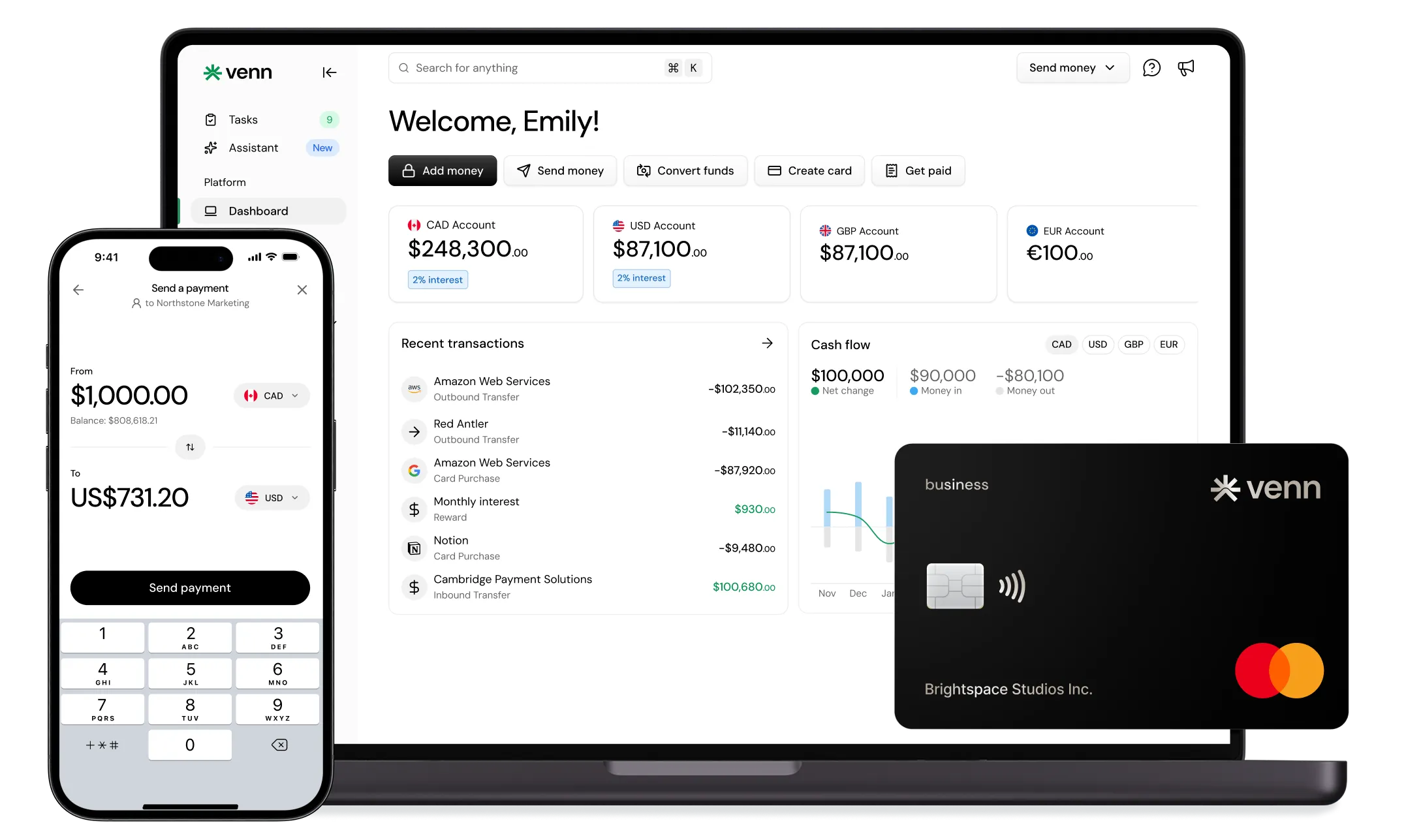
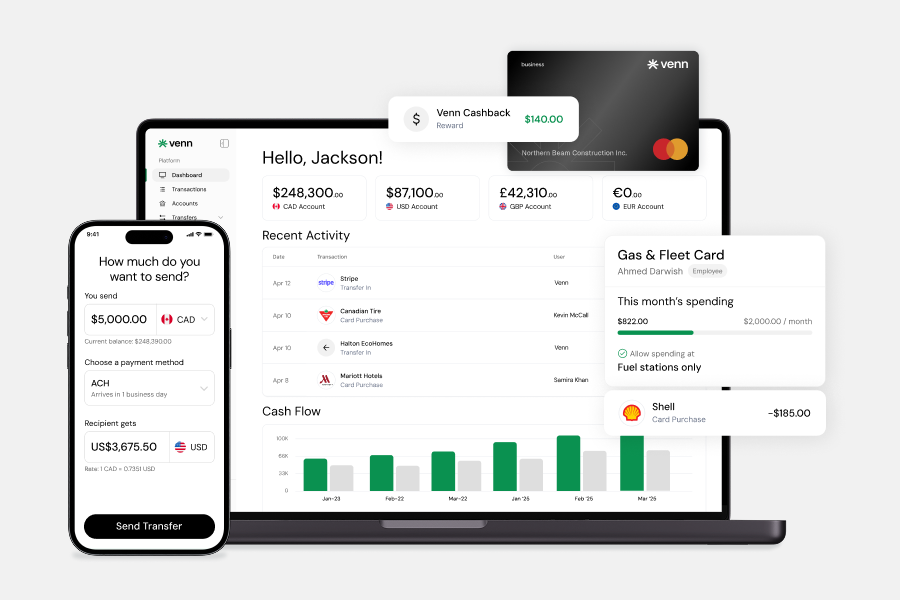
Banking layer: Venn business accounts provide both CAD and USD capabilities, letting you hold funds in the currency you receive them and pay from matching balances. This eliminates forced conversions that quietly drain your margins. Funds are covered under CDIC insurance protection.
Spend layer: The Venn card offers 1% unlimited cashback on business purchases. When every dollar counts, that cashback stretches your budget on unavoidable expenses like software subscriptions, advertising, and supplies. As you grow, spend controls help manage employee expenses.
Transfer capabilities: Free, unlimited Interac e-Transfer® through Venn handles day-to-day movement of funds without transaction fees eating into your tight margins.
Accounting layer: Connect Venn directly to QuickBooks or Xero. This integration reduces manual data entry and keeps your books current with minimal effort.
Optional additions: Invoicing tools, receipt capture workflows, and basic payroll can layer in as your business grows.
Venn supports businesses in all Canadian provinces other than Quebec, with an Essentials plan available at no cost to get you started. Sign up for a Venn account
Step 7: Build A Zero-Dollar Operating System
You do not need expensive software to run a professional operation. Free tools handle most early-stage needs.
Communication: Gmail or Outlook for email, Google Calendar for scheduling, Calendly free tier for meeting links.
Marketing: Carrd or Google Sites for a simple landing page, social media profiles, Google Business Profile for local visibility.
Sales: Google Docs templates for proposals, spreadsheet CRM to track prospects, PDF invoices.
Operations: Notion or Trello free tiers for project management, Google Drive for file storage.
Bookkeeping habits: Weekly reconciliation of transactions, consistent receipt capture, basic expense categorization.
The key is establishing systems early, even simple ones. When your transaction data flows cleanly from Venn into QuickBooks or Xero, you save hours monthly and reduce costly errors.
Step 8: Price For Cash Flow When You Are Bootstrapping
Profitability matters, but cash flow keeps you alive. Structure your pricing to bring money in faster.
Cash flow pricing strategies:
• Require deposits before starting work (25% to 50%)
• Bill at project milestones rather than completion
• Offer retainer arrangements with monthly payments
• Avoid net-60 payment terms with new clients
• Build in a buffer for taxes and unexpected costs
Calculate your pricing floor: the minimum you need to cover your time, tools, and tax obligations. Never go below this number, regardless of how badly you want the work.
A dedicated Venn account makes cash flow visible at a glance. You see exactly what is coming in, what is going out, and what remains for growth or emergencies.
Step 9: Launch A Simple 4-Week Timeline
Week 1: Pick your business model, define your core offer, and talk to 10 potential customers. No spending required.
Week 2: Pre-sell your offer, deliver a pilot project, and collect your first testimonial. Focus on proving demand.
Week 3: Register your business if needed, set up Venn as your financial foundation, connect your accounting software, and establish your basic brand presence online.
Week 4: Refine your offer based on feedback, adjust pricing upward slightly, systematize referral requests, and track your key metrics.
This timeline assumes you are starting a service business. Product-based models may require additional time for sourcing and setup.
Costs Breakdown: What You Can Do For $0 Vs What Might Cost Money
| Activity | Option | Potential Cost | Can Delay Until Revenue? |
|---|---|---|---|
| Market validation | Conversations, social posts | None needed | N/A |
| Landing page | Carrd free, Google Sites | $50 – $150/year for custom domain | Yes |
| Business registration | Operate under legal name | $60 – $200 depending on province | Often yes |
| Business banking | Venn Essentials plan | Paid plans available as you scale | No, start immediately |
| Accounting software | Wave (free) | QuickBooks/Xero $20 – $50/month | Yes, but start tracking early |
| Business insurance | None initially | $500 – $2,000/year depending on type | Depends on risk level |
| Professional advice | Government resources | $150 – $300/hour for accountant | Partially, but valuable early |
Common Mistakes When Starting A Business With No Money
Spending on branding before validation. A logo and fancy website mean nothing without customers. Validate first, polish later.
Choosing a complex structure too early. Incorporation costs money and adds compliance burden. Start simple unless you have specific reasons not to.
Mixing personal and business spending. This creates tax nightmares and obscures your true financial position. Use a Venn account and card from day one to maintain clean separation.
Underpricing and offering unlimited scope. Desperation pricing attracts difficult clients and burns you out. Know your floor and stick to it.
Ignoring taxes and receipts. The CRA does not care that you were busy. Track everything from the start using Venn's expense tracking and accounting integrations.
Conclusion
Starting a business in Canada with no money is entirely achievable when you approach it strategically. Choose a service model that generates quick revenue, validate before building, keep your structure simple initially, and establish a clean financial foundation from day one.
The founders who succeed with minimal capital share common traits: they prioritize getting paid over perfection, they separate business finances immediately, and they build systems that scale.
Your next step is straightforward. Follow the 4-week timeline, set up your financial stack with Venn at the center, and start talking to potential customers this week. Sign up for a Venn account
FAQ
Q: Do I need to register a business to start selling in Canada?
A: Not always. If you operate as a sole proprietor under your own legal name, registration may not be required. Using a separate business name typically requires provincial registration. Check your specific provincial requirements.
Q: How much does it cost to start a business in Canada?
A: You can start for $0 by choosing a service model, operating under your legal name, and using free tools. Optional costs like business name registration ($60 to $200), domain names ($15 to $50/year), and software subscriptions add up but can often wait until you generate revenue.
Q: Do I need a business license if I work from home in Canada?
A: Requirements vary by municipality and business type. Many home-based service businesses do not require special licenses, but check your local bylaws. Certain regulated professions require specific licensing regardless of location.
Q: When do I need to register for GST/HST?
A: Registration becomes mandatory when your revenue exceeds the small supplier threshold. Below that threshold, registration is voluntary. Consult an accountant to determine the optimal timing for your situation.
Q: Do I need to incorporate to open a business bank account?
A: No. Sole proprietors can open business accounts with platforms like Venn using their personal identification and business registration documents if applicable.
Q: Can I start a business while employed full-time in Canada?
A: Generally yes, but review your employment contract for non-compete clauses or restrictions on outside business activities. Many Canadians successfully run side businesses alongside employment.
Q: How do I accept payments from US customers as a Canadian business?
A: Open a USD account through a platform like Venn to receive payments in US dollars without immediate conversion. This lets you hold USD and pay USD expenses from the same balance, avoiding unnecessary foreign exchange costs.
Venn Mastercard Charge Card is issued by Peoples Trust Company under licence from Mastercard International Incorporated. Mastercard is a registered trademark, and the circles design is a trademark of Mastercard International Incorporated.
---
**Disclaimer:** This publication is provided for general information purposes and does not constitute legal, tax or other professional advice from Venn Software Inc or its subsidiaries and its affiliates, and it is not intended as a substitute for obtaining advice from a financial advisor or any other professional. We make no representations, warranties or guarantees, whether expressed or implied, that the content in the publication is accurate, complete or up to date.
This publication is provided for general information purposes only and does not constitute legal, tax, financial, or other professional advice from Venn Software Inc., its subsidiaries, or its affiliates, and is not a substitute for advice from a qualified professional. All comparisons and competitor information reflect publicly available information believed accurate as of May 30, 2026; features, pricing, rates, and terms referenced are subject to change and may differ at the time you read this. All product names, logos, and brands referenced are the property of their respective owners; their mention does not imply affiliation with or endorsement by Venn. Any comparative statements reflect Venn's views and are provided to help readers evaluate options. We make no representations, warranties, or guarantees, express or implied, that the content is accurate, complete, or up to date.

Venn is all-in-one business banking built for Canada
From free local CAD/USD accounts and team cards to the cheapest FX and global payments—Venn gives Canadian businesses everything they need to move money smarter. Join 15,000+ businesses today.
Frequently asked questions
Everything you need to know about the product and billing.
Join 15,000+ businesses banking with Venn today
Streamline your business banking and save on your spend and transfers today
No personal credit check or guarantee.