How to Save Money on Tariffs for a Canadian Business
How to Save Money on Tariffs for a Canadian Business. Cut landed costs with HS codes, origin proof, value for duty, plus CBSA relief and drawback options.

Ahmed Shafik
Co-founder
Trusted by 15,000+ Canadian businesses
Business banking for Canada
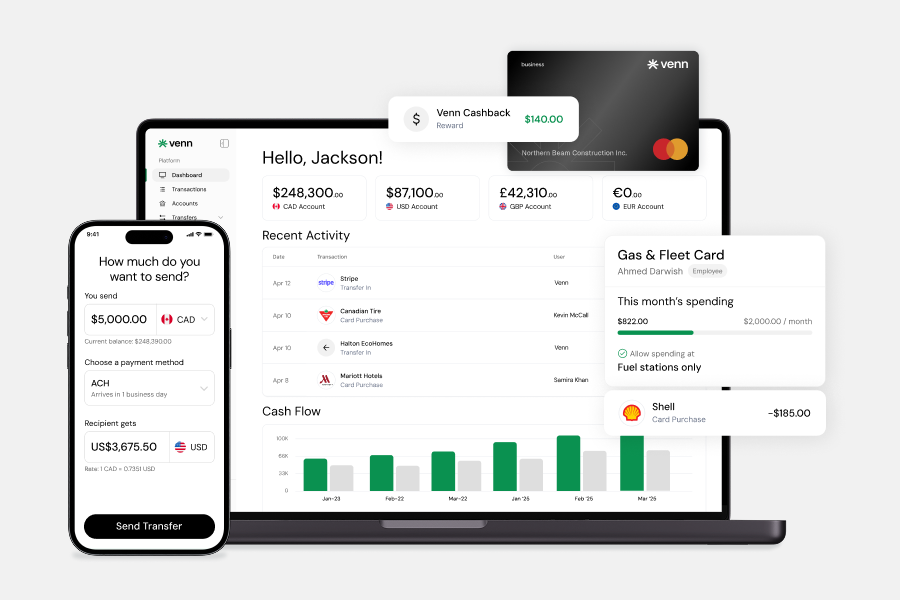
Local CAD and USD accounts, corporate cards with cashback, the lowest FX rates in Canada, free local transfers, and more.
What Tariffs Are, and Who Actually Pays Them
Tariffs are taxes or surtaxes applied to imported goods. In Canada, they sit alongside other import costs — GST/HST, excise tax where applicable, freight, brokerage, and foreign exchange costs — but they are separate charges.
For a Canadian business, the importer of record typically pays tariffs when goods enter Canada, often through a customs broker. Economically, that cost can move through the business in several ways: it may increase the landed cost of each unit, compress gross margin, raise customer prices, or trigger a review of suppliers and sourcing locations. That is why understanding how tariffs work matters before taking action. Import tariffs are not just a border charge — they influence pricing decisions, cash-flow timing, and the true cost of bringing inventory into Canada.
Tariffs in Plain English
Tariffs are taxes or surtaxes applied to imported goods.
In day-to-day business, tariffs and customs duties often refer to the government charges tied to bringing products into Canada, but they are only one layer of your total import costs. GST/HST may apply separately. Excise tax can apply to specific goods. Freight, brokerage, insurance, storage, and FX costs also add to landed cost, even though they are not tariffs themselves.
Who Pays Tariffs in Canada
The importer of record typically pays Canadian import duties when goods enter Canada, often with a customs broker handling the transaction at the border. That does not transfer responsibility away from your business. According to CBSA import guidance, importers remain responsible for the accuracy of declarations — including tariff classification, origin, value for duty, corrections, and duties owed. If you are unsure who acts as importer of record in your supply chain, confirm the details with your customs broker or a qualified trade advisor before shipping.
Why Tariffs Matter for Canadian Businesses
Tariffs flow directly into landed cost, which means they affect more than the customs line on an import file. A higher landed cost can change when cash leaves the business, how much working capital sits in inventory, and how confidently you can quote customers.
If your team imports goods regularly, tariff costs also shape supplier negotiations. Some businesses pass increases through to customers; others protect margin by revisiting sourcing decisions, adjusting operations, and tightening import processes. BDC has reported that 91% of Canadian SMEs had acted or planned to act to reduce tariff impacts — which shows how quickly this becomes a finance and pricing issue, not just a logistics one.
How Tariff Costs Are Calculated
Tariff costs usually come down to three inputs: the tariff classification for the goods, the tariff treatment based on origin, and the value for duty. If your team gets any of these wrong, you may overpay customs duties upfront or face corrections, reassessments, and interest later.
CBSA guidance makes importers responsible for proper classification, origin, and valuation, even when a customs broker files on their behalf. That means Canadian businesses should treat tariff calculations as a finance and compliance control, not just a border paperwork step. Small errors in product details, proof of origin, or invoice values can materially change the final duty bill.
The Three Inputs That Drive Duty Cost
Most customs duty Canada calculations start with three inputs. If any one is wrong, your business may overpay tariffs or face corrections later.
- Tariff classification: The category assigned to the goods, which determines the duty rate that may apply.
- Tariff treatment or origin: The rate category based on where the goods qualify as originating, not just where they shipped from.
- Value for duty: The customs value used to calculate duty, usually tied to the transaction value and supported by commercial records.
For many importers, tariff savings begin by reviewing these inputs before goods cross the border.
Tariff Classification and HS Codes
HS codes are the product classification numbers used to identify imported goods for customs duty purposes. The right code determines which tariff line applies, and a small classification error can create overpayment, underpayment, or later correction risk — even when the mistake was unintentional.
If your product sits in a grey area, ask your broker or trade advisor whether an advance ruling makes sense. CBSA provides guidance on tariff classification and advance rulings so businesses can seek greater certainty before importing.
Origin and Proof of Origin
The country your goods ship from may differ from their country of origin. A U.S. warehouse, for example, may ship goods manufactured elsewhere. Under CUSMA or another free trade agreement, preferential tariff treatment can reduce customs duties only when the goods meet the agreement's origin rules. CBSA import guidance states that importers must have acceptable proof of origin at the time of import to claim that treatment.
Value for Duty
Value for duty often starts with the price paid or payable for the imported goods, but CBSA uses six valuation methods that must be considered in sequence where applicable. Small details can change customs duties: how the invoice separates charges, whether the buyer provided assists, which costs are bundled into the sale, and how related parties set prices. If your import tariffs feel higher than expected, review valuation assumptions with a customs broker or trade advisor before filing or correcting entries.
A Simple Landed-Cost Example
Say you buy $10,000 USD of inventory and your all-in exchange rate turns that into $13,500 CAD. If the customs duty rate is 8%, duty adds $1,080. GST at 5% on the taxable import value adds about $729. Add $150 for brokerage and $203 in FX spread or payment costs.
Your landed cost is now roughly $15,662 CAD, before freight or warehousing. The duty rate matters, but it is only one part of total import costs.
9 Legal Ways to Save Money on Tariffs
Tariff mitigation starts with paying the correct amount, not finding shortcuts. For Canadian businesses, the biggest savings often come from reducing overpayment, improving eligibility for preferential treatment, using CBSA programs where available, and lowering the surrounding import costs that pressure margins.
- Classify your goods correctly. Confirm the HS code for each SKU using product specs, material composition, and end use. If a product sits in a grey area, consider requesting an advance ruling before you scale imports.
- Claim the right tariff treatment. Under CUSMA or another free trade agreement, eligible goods may qualify for lower customs duties. Shipping from the U.S. does not automatically mean U.S. origin, so keep valid proof of origin on file.
- Review value for duty. Check invoice structure, assists, bundled charges, related-party pricing, and currency conversions with a customs broker or trade advisor. Small valuation errors can compound across every shipment.
- Use the Duties Relief Program when goods will be re-exported. If you import commercial goods that will later leave Canada — either unchanged or after processing — this program may help you avoid paying duties upfront where eligibility requirements are met.
- Apply for duty drawback when duties were already paid. If imported goods were later exported, drawback may provide a refund path for eligible Canadian import duties already paid.
- Explore tariff remission for exceptional cases. Remission is not routine planning, but it may apply where official criteria are met, such as severe adverse impacts or limited sourcing alternatives. Confirm current guidance before applying.
- Renegotiate suppliers, Incoterms, and order design. Ask suppliers about alternate inputs, production locations, or shipment structures. Keep the focus on commercial substance, not artificial rerouting.
- Diversify sourcing and product design where practical. A second supplier, substitute component, or light redesign can reduce tariff exposure while improving supply chain resilience.
- Cut non-tariff import costs. FX markups, slow cross-border payments, weak spend visibility, and manual reconciliation do not change the tariff rate, but they can make tariff costs significantly harder to absorb.
Classify Your Goods Correctly
Before you import, build a clear file for each SKU. Include product specifications, intended use, materials, composition, diagrams, lab reports, and any technical details your broker or trade advisor can verify. Accurate classification helps prevent overpayment of customs duties and reduces the risk of later corrections, penalties, or delays. If a product sits in a grey area, consider requesting an advance ruling from CBSA before the shipment moves.
Claim the Right Tariff Treatment
Many Canadian importers overpay customs duties simply because they never confirm whether goods qualify for preferential treatment under CUSMA or another free trade agreement. Eligibility depends on the agreement's origin rules — not assumptions or supplier shorthand. If your team claims preferential tariff treatment, keep proof-of-origin records that support the claim, such as certifications, supplier declarations, and product-level documentation. Claim only the treatment you can substantiate if CBSA reviews the entry.
Review Value-for-Duty Assumptions
If your declared value includes the wrong charges, you may overpay customs duties on every shipment. Ask your customs broker or trade advisor to review assists, bundled supplier charges, freight and insurance treatment, related-party pricing, royalties, and invoice structure — small valuation errors can compound quickly across high-volume SKUs.
Keep support files clean and consistent. Invoices, purchase orders, contracts, and import records should tell the same story about what you bought, what you paid, and which costs belong in the value for duty.
Use the Duties Relief Program
If your business imports commercial goods that will later leave Canada, you may qualify for CBSA's Duties Relief Program. The program can allow eligible companies to import goods without paying customs duties upfront when those goods will be re-exported, either unchanged or after being used to process other goods. Confirm eligibility before relying on this strategy, and keep records that support the planned re-export.
Use Duty Drawback for Re-Exported Goods
If your business paid customs duties on imported goods and later exported those goods, you may be able to recover the duty through duty drawback. CBSA guidance describes drawback as a refund pathway for qualifying duties already paid on goods that are exported from Canada. This differs from duties relief, which can prevent payment upfront — drawback helps reduce tariff costs after payment has already occurred.
Explore Tariff Remission
Tariff remission can reduce customs duties in limited situations, but treat it as exceptional relief rather than routine tariff mitigation. Finance Canada's remission guidance indicates the federal government may consider requests where required inputs cannot reasonably be sourced from Canadian or non-U.S. suppliers, or where other exceptional circumstances create severe adverse impacts for a business. If this may apply, document supplier searches, cost impacts, contracts, and operational constraints before applying. Confirm the current criteria directly with Finance Canada's remission guidance and a qualified trade advisor.
Renegotiate Suppliers, Incoterms, and Order Design
If tariff costs are pressuring margin, review the commercial design behind each import. Ask suppliers whether they can source from a different qualified country, use commercially acceptable alternate inputs, or produce in another facility with proper documentation. For larger orders, split shipments only where it reflects real purchasing, inventory, or delivery needs.
Contract terms matter too. Review Incoterms to confirm who controls freight, insurance, customs brokerage, and risk transfer — this is cost allocation and operating discipline, not a customs shortcut. Avoid artificial rerouting, unsupported origin claims, or classification choices that do not match the goods.
Diversify Supply Chains and Product Design
If one country or input drives most of your tariff exposure, build options before the next cost shock hits. Consider qualifying suppliers in Canada, Europe, Asia, or other non-U.S. markets where product standards, lead times, and customs duty treatment still work for your business. For manufactured goods, review whether a substitute input or light redesign could change the tariff profile without compromising quality.
Dual sourcing can also reduce dependency on a single trade lane, even if you keep your primary supplier. BDC has noted that supply chain diversification is a common response among Canadian SMEs facing tariffs, making it a practical long-term strategy rather than a one-time procurement exercise.
Cut the Non-Tariff Costs Around Importing
Once your customs fundamentals are sound, turn your attention to the costs that sit around import tariffs. FX markups can quietly raise supplier invoices, especially when you pay in USD. Slow cross-border payments may trigger rush fees or strain vendor terms. Without clear spend visibility, tariff costs become harder to separate from freight, brokerage, and operating expenses — and disconnected reconciliation adds manual work at month-end that compounds the problem.
Financial Tools That Can Help Offset Tariff Pressure
Treat financial tools as a secondary lever after you confirm the customs fundamentals. Banking platforms, payment workflows, customs brokers, and FX tools do not lower the statutory import tariffs or customs duties your business owes. They can, however, reduce adjacent import costs and give you tighter control over cash flow.
If your team pays suppliers in USD or other currencies, FX spreads and slow reconciliation can quietly add to tariff pressure. A business banking platform such as Venn can help manage the payment and operating-cost side, while a customs broker or trade advisor can help keep filings organized and reduce avoidable friction. The goal is margin control, not tariff avoidance.
Tools for Managing Tariff-Related Cash Flow
Banking and payment tools do not lower customs duties or change CBSA requirements. They can, however, help your team manage the cash-flow pressure around import tariffs, supplier payments, FX, spend controls, and reconciliation.
Common Mistakes That Make Businesses Overpay
- Treating the shipping country as origin: A product shipped from the U.S. may still originate elsewhere for customs duty Canada purposes. Confirm origin before claiming tariff treatment.
- Guessing the HS code: Small classification errors can change import tariffs, trigger corrections, or cause missed savings.
- Accepting supplier paperwork without review: Invoices and proof of origin need a second look, especially for high-value SKUs.
- Ignoring value-for-duty details: Freight terms, assists, royalties, and related-party pricing can all affect Canadian import duties.
- Assuming the broker owns the risk: Your broker can help, but the importer remains responsible for declarations.
- Missing refund windows: Drawback, relief, and correction timelines matter.
- Focusing only on the tariff rate: FX spreads, payment fees, and working-capital timing can quietly raise total import costs.
Practical Tariff-Savings Checklist
- Confirm HS classification for each imported SKU, especially if product materials, specs, or use cases have changed.
- Confirm origin and proof of origin before claiming preferential tariff treatment. Do not rely on shipping country alone.
- Review value for duty against your invoices, supplier charges, and customs broker assumptions.
- Ask whether goods may qualify for relief, duty drawback, or remission before treating customs duties as a fixed cost.
- Recalculate landed cost before repricing so tariffs, freight, brokerage, GST/HST, and FX all appear in one view.
- Review supplier terms and payment currency to see where import costs or currency risk can be reduced.
- Audit FX and cash-flow tools if tariff costs are creating margin pressure or payment timing issues.
- Keep supporting records organized so your team can defend classifications, origin claims, valuation decisions, and refund requests.
How Canadian Businesses Can Lower Tariff-Related Costs
The cheapest tariff is often the one your business never overpays. Before looking for financial offsets or supplier workarounds, get the customs fundamentals right: classification, proof of origin, value for duty, and eligibility for any duty relief, drawback, or remission pathway. Those inputs drive customs duties and landed cost, and small errors can quietly erode margin across hundreds of shipments.
For Canadian importers, the practical answer to how to save money on tariffs is disciplined review, not shortcuts. Start with your highest-value imported SKUs. Validate origin paperwork against the actual rules, not just the shipping route. Run a landed-cost audit that includes duties, brokerage, freight, FX, and payment timing. Where the rules are complex or the dollar value is material, consult a qualified customs broker or trade advisor before you file, correct, or claim.
Frequently Asked Questions
Q: What is the difference between a tariff and a customs duty?
A: “Tariff” is often used as a broad term for import charges or trade measures. In practice, Canadian businesses may face customs duties, surtaxes, GST/HST, excise taxes, brokerage fees, and other import costs that all affect landed cost.
Q: Who pays tariffs when importing into Canada?
A: The importer of record typically pays tariffs and Canadian import duties when goods enter Canada, often through a customs broker. Even when a broker files on your behalf, your business remains responsible for accurate classification, origin, valuation, records, and any required corrections.
Q: Can a customs broker lower my tariffs?
A: A customs broker can help reduce tariff costs by preventing overpayment through correct classification, origin review, value-for-duty checks, and awareness of programs such as duty drawback or duties relief. A broker cannot create eligibility where the goods, documentation, or transaction facts do not support it.
Q: What is the difference between duty drawback and duties relief?
A: Duties relief can prevent customs duty from being paid upfront on qualifying imported goods that will later be re-exported. Duty drawback is different because it provides a refund after eligible duties were already paid and the goods were subsequently exported.
Q: Can I get tariff relief if my U.S. supplier is the only viable source?
A: Possibly, but only in limited cases. Tariff remission may be available if official criteria are met, current guidance supports the request, and your business can document why domestic or non-U.S. sourcing is not reasonable.
Q: Do banking or FX tools reduce tariffs?
A: No. Banking and FX tools do not lower the legal tariff rate, customs duty, or surtax owed to the government. They may still help reduce related import costs, improve payment timing, and ease cash-flow pressure when supplier invoices, foreign exchange, and landed-cost planning are putting pressure on margins.
---
**Disclaimer:** This publication is provided for general information purposes only and does not constitute legal, tax, financial, or other professional advice from Venn Software Inc., its subsidiaries, or its affiliates, and is not a substitute for advice from a qualified professional. All comparisons and competitor information reflect publicly available information believed accurate as of June 1, 2026; features, pricing, rates, and terms referenced are subject to change and may differ at the time you read this. All product names, logos, and brands referenced are the property of their respective owners; their mention does not imply affiliation with or endorsement by Venn. Any comparative statements reflect Venn's views and are provided to help readers evaluate options. We make no representations, warranties, or guarantees, express or implied, that the content is accurate, complete, or up to date.

Venn is all-in-one business banking built for Canada
From free local CAD/USD accounts and team cards to the cheapest FX and global payments—Venn gives Canadian businesses everything they need to move money smarter. Join 15,000+ businesses today.
Frequently asked questions
Everything you need to know about the product and billing.
Join 15,000+ businesses banking with Venn today
Streamline your business banking and save on your spend and transfers today
No personal credit check or guarantee.