How to Receive USD Payments in Canada from a US Company
Canadian remote worker getting paid by a US company? Learn how to set up ACH payments, incorporate your business, avoid FX fees, and save on taxes with Venn.

Ahmed Shafik
Co-founder
.png)
Trusted by 15,000+ Canadian businesses
Business banking for Canada
Local CAD and USD accounts, corporate cards with cashback, the lowest FX rates in Canada, free local transfers, and more.
If you want to receive USD payments in Canada from a US company, you'll hit a paycheck problem nobody warns you about.
Your employer sends money via wire. Your bank converts USD to CAD at a 2% to 3.5% spread. You pay an inbound wire fee. They pay an outbound wire fee. On a $10,000 USD monthly income, that's $200–$300 gone before you see a dollar, every single month.
There's a cleaner setup. Here's exactly how it works.
Why Getting Paid by a US Company Is Harder Than It Should Be
The problem isn't cross-border payments, it's that most Canadians are using the wrong rails.
ACH is the US domestic payments network. It's how US companies pay employees, contractors, and vendors based in the US. It's free or near-free, settles in 1 to 3 business days (often same-day or next-day for payroll), and it's the default for anyone getting paid by a US company.
The catch: ACH only works with a genuine US-domiciled account, one with a real US routing number and a real US account number. If you're a Canadian individual with a personal Canadian bank account, you don't have one.
Here's where most people hit a wall: most Canadian banks that offer "USD accounts" don't actually have a US-domiciled account to give you. Their USD accounts are physically based in Canada and route through SWIFT, the international wire network.
When your US employer's finance team sends an ACH, it either bounces or auto-converts to a costly wire, often without anyone realizing what happened.
The second problem is on your employer's side. US companies typically won't pay foreign individuals directly via payroll. They need a business entity to pay you as a contractor for their own compliance and 1099 tax reporting purposes.
The fix requires two things: a Canadian business entity and a genuine US-domiciled account. Both are easier to get than most people think.
Your Options to Receive USD Payments in Canada
Before diving into the setup, here's how the main options compare:
Only a US-domiciled account with ACH lets a Canadian receive USD payments in Canada as USD, with no forced conversion.
The Setup: Incorporate → Open a Venn Account → Receive ACH
Step 1: Incorporate a Canadian Business
You need a legal entity to receive payments through.
Two options:
- Sole proprietorship: simplest structure. Income flows directly to your personal tax return. You can deduct legitimate business expenses. No separate corporate tax filing required. Good starting point if you want minimal admin overhead.
- Corporation (federal or provincial): more setup and annual filing requirements, but unlocks meaningful tax planning advantages at higher income levels (more on this below).
You can incorporate directly through Venn at venn.ca/incorporate. The tool covers both structures and gets you a business number, which you'll need to open your business account.
Step 2: Open a Venn Business Account
With a business registered, open a Venn account.
You'll get:
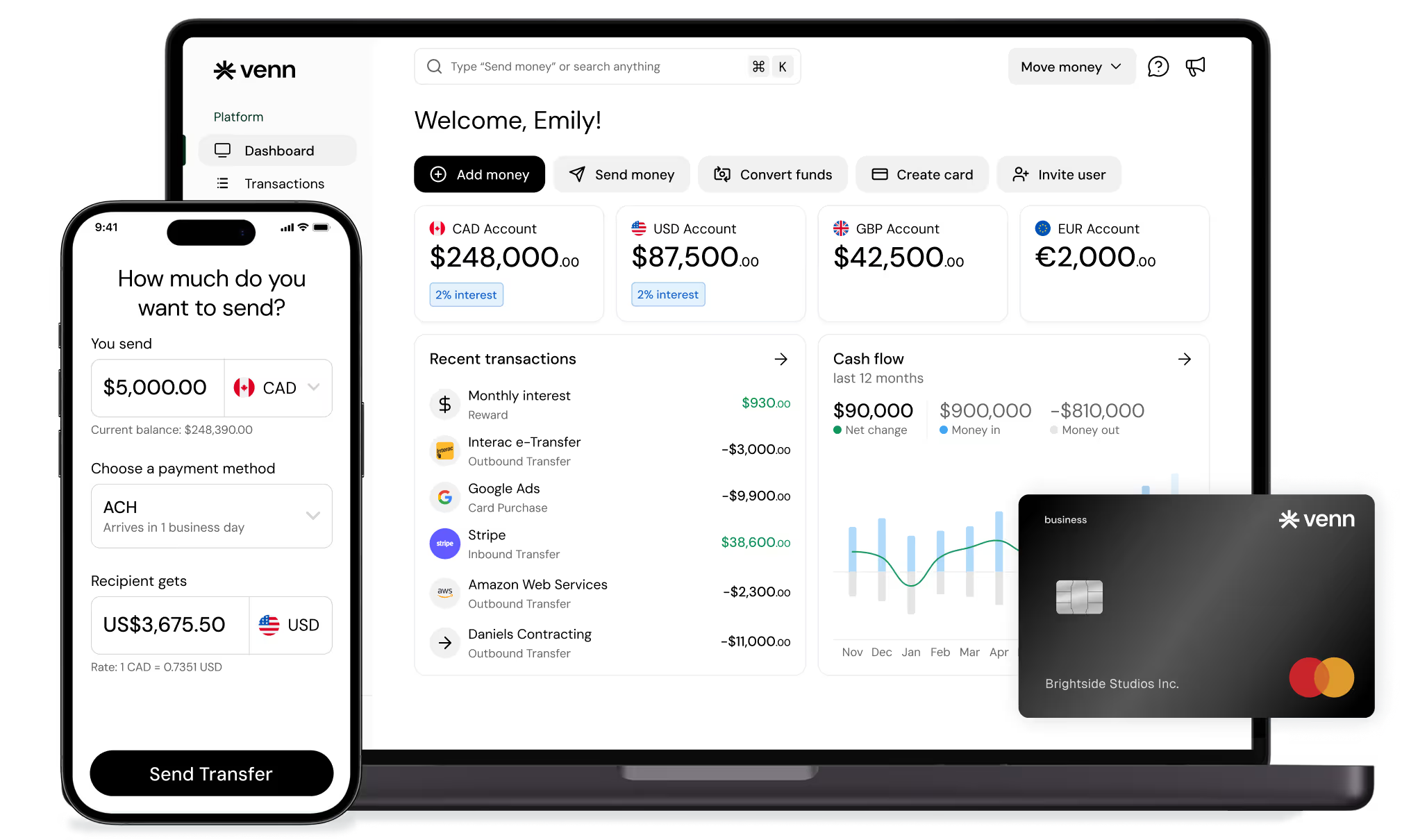
- A genuine US-domiciled USD account with a real US routing number and account number, the only thing standing between you and ACH payments
- A Canadian CAD account for converting and spending locally
- Balances held at Bank of Montreal (BMO), a CDIC member, and CDIC-protected up to $100,000 per deposit category
Signup takes about five minutes. Most accounts are live within 24 hours.
Step 3: Send Your Employer Your Venn USD Account Details
Share your Venn USD routing number and account number with your employer's AP or payroll team. They add you as a vendor or contractor and pay via ACH, the same process they use for any US-based contractor. No wires, no SWIFT, no intermediary fees for either party.
Step 4: Convert on Your Schedule
USD lands in your Venn USD account. It earns up to 3.5% interest with a limited-time interest boost (learn more) while it sits there. When you're ready to move funds to CAD:
- Venn's FX markup is 0.25% to 0.45% depending on your plan
- Canadian banks charge 2% to 3.5% on the same conversion
- On $120,000 USD converted over a year, that's roughly $2,000 to $3,900 in savings at the higher end
You're not forced to convert on receipt. You hold USD and convert when the timing works for you.
The Tax Angle
This is worth knowing, and worth modelling with a CPA for your specific situation. But here's the framework.
Business Expense Deductions
Whether you're a sole prop or incorporated, you can deduct legitimate business expenses against your income:
- Home office (proportional square footage of your primary workspace)
- Computer, monitors, and peripherals
- Internet and phone (business portion)
- Software subscriptions (project management tools, design software, communication tools)
- Accounting and legal fees
- Professional development and courses
These deductions reduce your net income before tax.
The Corporate Rate Advantage for Higher Earners
This is where incorporation earns its setup cost.
In most Canadian provinces, the first $500,000 of active business income in a Canadian-controlled private corporation (CCPC) is taxed at the small business rate, typically 9% to 12.2% combined federal/provincial, depending on your province.
Personal income tax rates, by contrast, can exceed 50% in the top bracket in provinces like Ontario and BC, where the top combined marginal rate is roughly 53.5%.
Income retained in the corporation is taxed at the lower corporate rate. You pay personal tax only when you withdraw it as salary or dividends, but you control the timing.
That planning opportunity is the real advantage: match withdrawals to lower-income years, use dividend income strategically, or build retained earnings inside the corporation.
The short version: if your effective personal tax rate is 40%+ and you don't need to draw out all your income every year, incorporating can significantly reduce what you owe. Talk to a CPA who works with incorporated contractors. Many specialize in exactly this structure and can model it against your income.
Reporting USD Income to the CRA
USD income must be reported in Canadian dollars. The CRA generally accepts the Bank of Canada exchange rate on the day the income arises, or an annual average rate. US payers typically ask a Canadian contractor to complete IRS Form W-8BEN (individuals) or W-8BEN-E (corporations) to establish foreign status and avoid default US withholding. Consult a CPA for specifics on your situation.
The Bottom Line
If you're a Canadian trying to receive USD payments in Canada, the default setup costs you thousands per year in wire fees and FX spread. The fix is straightforward.
Incorporate your business at venn.ca/incorporate. Open a Venn account and get your US-domiciled USD account details. Give your employer your ACH routing and account numbers. Receive USD, earn up to 3.5% interest with a limited-time interest boost on the USD balance (learn more), and convert at 0.25% to 0.45% when you're ready.
Frequently Asked Questions
Q: What's the difference between ACH and a wire transfer for receiving USD from a US company?
A: ACH uses the US domestic payments network, is free or near-free, typically takes 1 to 3 business days (often same-day or next-day for payroll), and requires a genuine US-domiciled account on the receiving end. A wire transfer uses SWIFT, works internationally, but carries fees (often $15 to $80 per transfer, plus intermediary fees) and takes 1 to 5 business days. For Canadian remote workers, ACH is the right option: it's cheaper and faster for both parties, with no forced conversion at receipt.
Q: Do I need to incorporate to receive USD from a US company in Canada?
A: You need a business entity; most US companies require one to pay you as a contractor rather than as an employee. A sole proprietorship qualifies; full incorporation isn't required. But you also need a genuine US-domiciled USD account to receive via ACH. Venn's incorporation tool handles both structures, and a Venn business account provides the US-domiciled account.
Q: Can I keep my money in USD and not convert right away?
A: Yes. USD lands in your Venn USD account and stays there until you choose to convert. While it sits, it earns up to 3.5% interest with a limited-time interest boost on your USD balance. You convert on your own schedule using Venn's FX rate, so you're never forced to convert on receipt.
Q: What's the cheapest way to convert USD to CAD as a Canadian business?
A: Venn's FX markup is 0.25% to 0.45% depending on plan, among the lowest available to Canadian businesses. Traditional banks charge 2% to 3.5%. For higher volumes, the Pro plan at $100/month typically pays for itself in FX savings alone.
Q: Should I set up as a sole proprietor or a corporation to receive USD from a US company?
A: Both work. A sole proprietorship is simpler, requires less administration, has no corporate tax filing, and has income flowing to your personal tax return. A corporation has more setup but allows you to retain income taxed at the lower small business rate (typically 9% to 12.2%), giving you significant tax-planning flexibility at higher income levels. Use Venn's incorporation tool to get started, and talk to a CPA to model which structure makes sense for your income.
Q: What do I actually tell my US employer when setting up payment?
A: Give them your Venn USD routing number and account number. Tell their AP or payroll team you're a contractor and want to be paid via ACH. They'll add you as a vendor, the same process they use for any US-based contractor. Most US finance teams can set this up in minutes.
This article is for informational purposes only and does not constitute tax or legal advice. Consult a qualified accountant or tax professional for advice specific to your situation.
This publication is provided for general information purposes only and does not constitute legal, tax, financial, or other professional advice from Venn Software Inc., its subsidiaries, or its affiliates, and is not a substitute for advice from a qualified professional. All comparisons and competitor information reflect publicly available information believed accurate as of March 31, 2026; features, pricing, rates, and terms referenced are subject to change and may differ at the time you read this. All product names, logos, and brands referenced are the property of their respective owners; their mention does not imply affiliation with or endorsement by Venn. Any comparative statements reflect Venn's views and are provided to help readers evaluate options. We make no representations, warranties, or guarantees, express or implied, that the content is accurate, complete, or up to date.

Venn is all-in-one business banking built for Canada
From free local CAD/USD accounts and team cards to the cheapest FX and global payments—Venn gives Canadian businesses everything they need to move money smarter. Join 15,000+ businesses today.
Frequently asked questions
Everything you need to know about the product and billing.
Join 15,000+ businesses banking with Venn today
Streamline your business banking and save on your spend and transfers today
No personal credit check or guarantee.