How to Hire International Employees: Complete Guide for Canadian Businesses
Learn how to hire international employees, manage compliance, streamline payments, and reduce costs. Essential strategies for Canadian business banking success.


Trusted by 15,000+ Canadian businesses
Business banking for Canada
Local CAD and USD accounts, corporate cards with cashback, the lowest FX rates in Canada, free local transfers, and more.
Accessing global talent has become essential for Canadian businesses seeking specialized skills, cost optimization, and market expansion. Whether you need a software developer in Eastern Europe, a marketing specialist in Southeast Asia, or a customer success team operating across time zones, hiring international employees opens doors to capabilities that may be scarce or expensive domestically.
The complexity lies in navigating compliance requirements, payment infrastructure, and currency management across multiple jurisdictions. Each country has unique employment laws, tax obligations, and regulatory frameworks that Canadian businesses must understand and follow. This guide covers your hiring options, step-by-step processes, compliance requirements, and the financial infrastructure needed to pay international teams efficiently. We'll show you how modern payment platforms like Venn eliminate the traditional banking obstacles that make international hiring expensive and complicated.
Why Canadian Businesses Hire International Employees
The shift toward international hiring reflects both opportunity and necessity in today's global economy. Canadian companies increasingly recognize that talent knows no borders, and the best person for a role might be halfway around the world.
Access to specialized skills drives many international hiring decisions. Technology companies struggle to find enough AI specialists, blockchain developers, or cybersecurity experts locally. The global talent pool offers both depth and diversity of expertise.
Cost advantages make international hiring attractive for certain roles. A skilled developer in Poland or Argentina may command half the salary of their Toronto counterpart while delivering equal quality. This cost efficiency allows startups to extend their runway and established companies to optimize their budgets.
Building diverse, global teams brings fresh perspectives and cultural insights. International employees help companies understand new markets, adapt products for different regions, and avoid the blind spots that come from homogeneous thinking.
Operating across time zones enables 24/7 business operations. Customer support teams in Asia can handle overnight tickets. Development teams can maintain continuous deployment cycles with engineers in different regions passing work across shifts.
Market expansion becomes easier with local expertise. Employees who understand their home markets provide invaluable insights about customer preferences, regulatory requirements, and cultural nuances that outsiders might miss.
For an overview of international transfers for Canadian businesses, read our guide here.
Your Options for Hiring International Employees from Canada
Each method of hiring international employees carries different legal, financial, and operational implications. Your choice depends on factors like team size, budget, timeline, and long-term commitment to specific markets.
Option 1: Hire Through an Employer of Record (EOR)
An Employer of Record acts as the legal employer for your international workers while you maintain day-to-day management. The EOR handles payroll, benefits, tax withholding, and compliance with local employment laws. You get the benefit of having employees in a country without establishing your own legal entity there.
This approach makes sense when testing new markets or building small international teams quickly. You can have employees on the ground within days rather than months, allowing rapid response to opportunities.
Pros:
• Fast setup (days, not months)
• EOR handles compliance and payroll
• No need to establish legal entity
• Lower upfront costs
Cons:
• Ongoing per-employee fees ($400-$800/month)
• Less control over employment terms
• Can become expensive at scale
• May limit employer branding
Best for: Companies hiring 1-5 international employees or testing new markets
Option 2: Set Up a Legal Entity Abroad
Establishing a subsidiary or branch office gives you complete control over employment relationships and operations in a foreign country. This involves registering a company, opening local bank accounts, setting up payroll systems, and maintaining ongoing compliance with corporate and employment regulations.
Companies choose this route when making long-term commitments to specific markets with larger teams. The control and cost savings at scale offset the significant upfront investment and ongoing administrative burden.
Pros:
• Full control over employment and operations
• Better for large teams (10+ employees)
• Stronger local market presence
• More cost-effective at scale
Cons:
• Significant setup time (3-6 months)
• High upfront costs ($10,000-$50,000+)
• Ongoing compliance and accounting burden
• Requires local expertise
Best for: Established companies making long-term commitments to specific markets
Option 3: Hire International Contractors
Working with independent contractors offers maximum flexibility with minimal administrative overhead. Contractors operate as independent businesses, invoice for their services, and handle their own taxes and benefits. You avoid employment law compliance in their country but must ensure the relationship genuinely qualifies as contractor rather than employment.
Misclassification represents the primary risk with this approach. Tax authorities worldwide increasingly scrutinize contractor relationships, and penalties for treating employees as contractors can be severe. This method works best for truly independent work with clear deliverables and minimal day-to-day supervision.
Pros:
• Simplest and fastest option
• No visa or work permit requirements
• Flexible engagement terms
• Lower administrative burden
Cons:
• Risk of worker misclassification (significant penalties)
• Less control over work schedule and methods
• Contractors may work for competitors
• Limited integration with company culture
Best for: Project-based work, specialized consultants, or roles with clear deliverables and autonomy
Misclassification Warning: Treating employees as contractors can result in back pay, benefits liability, and penalties ranging from $1,000-$12,000 in Canada, with similar or higher penalties internationally. Since June 2024, Canadian employers must prove a worker is genuinely an independent contractor.
Option 4: Sponsor a Work Permit or Visa (Bring Talent to Canada)
Bringing international talent to Canada requires navigating the immigration system, typically through the Temporary Foreign Worker Program. This involves obtaining a Labour Market Impact Assessment (LMIA) to prove no Canadian workers are available for the role.
The LMIA process requires advertising the position to Canadian workers, demonstrating recruitment efforts, and meeting prevailing wage requirements. Processing times vary significantly by stream, from 7 business days for the Global Talent Stream to over 250 days for permanent residence applications.
Key requirements:
• Labour Market Impact Assessment (LMIA) in most cases
• Proof that no Canadian workers are available
• Compliance with provincial employment standards
• Processing times: 2-6 months average
Best for: Companies wanting to build their Canadian team with international talent, or roles requiring on-site presence
Step-by-Step Process for Hiring International Employees
The specific steps vary based on your chosen hiring method, but the core process remains similar. Following a structured approach helps avoid compliance issues and ensures smooth onboarding of your international team members.
Step 1: Define the Role and Determine Your Hiring Method
Start by assessing whether the role truly needs international hiring or if Canadian talent could fill it. Consider whether remote work is feasible or if you need someone in a specific location for market presence or time zone coverage.
Evaluate your budget for both setup and ongoing costs. EOR services charge monthly fees per employee, while establishing an entity requires significant upfront investment. Factor in payment processing costs, currency conversion fees, and compliance management.
Consider your timeline and urgency. Contractor relationships can start within days, while entity establishment takes months. LMIA processing for bringing someone to Canada varies from 7 business days for tech roles to nearly a year for permanent residence streams.
Determine the level of control you need over the employment relationship. Contractors offer flexibility but limit your ability to direct how work gets done. Employees through an EOR or your own entity provide more control but come with greater compliance obligations.
Step 2: Understand Compliance Requirements in the Target Country
Research local employment laws before making any commitments. Each country has specific requirements for employment contracts, minimum wages, working hours, termination procedures, and mandatory benefits. What seems like a minor oversight can lead to significant penalties.
Understand tax obligations for both corporate and payroll taxes. Some countries require tax registration even for a single employee. Others have treaties with Canada that affect withholding requirements. Double taxation agreements may provide relief but require proper documentation.
Identify required registrations and licenses. Beyond tax registration, you may need to register with social security systems, workplace safety boards, or industry-specific regulators. Some countries require local directors or registered addresses.
Consult with local legal and HR experts or leverage an EOR's expertise. The cost of professional advice pales compared to potential penalties for non-compliance. Local experts understand nuances that online research might miss.
Step 3: Set Up Your Payment and Currency Infrastructure
Traditional Canadian business banking creates immediate problems when hiring internationally. Banks charge 2.5-3% markups on foreign exchange, $25-50 for each wire transfer, and take 3-5 business days to process payments. These costs and delays make it expensive and frustrating to pay international team members.
Key challenges:
• High FX fees (2.5-3% at traditional banks vs 0.25% at Venn)
• Expensive wire transfers ($25-$50 per payment)
• Lack of local currency accounts
• Slow payment processing (3-5 business days)
• Complex reconciliation and accounting
Modern payment platforms solve these problems with multi-currency capabilities designed for international business. You need infrastructure that handles multiple currencies efficiently, processes payments quickly, and integrates with your accounting systems.
What you need:
• Multi-currency accounts (USD, EUR, GBP at minimum)
• Low-cost international transfers
• Fast payment processing (same or next-day)
• Integration with accounting software
• Transparent FX rates
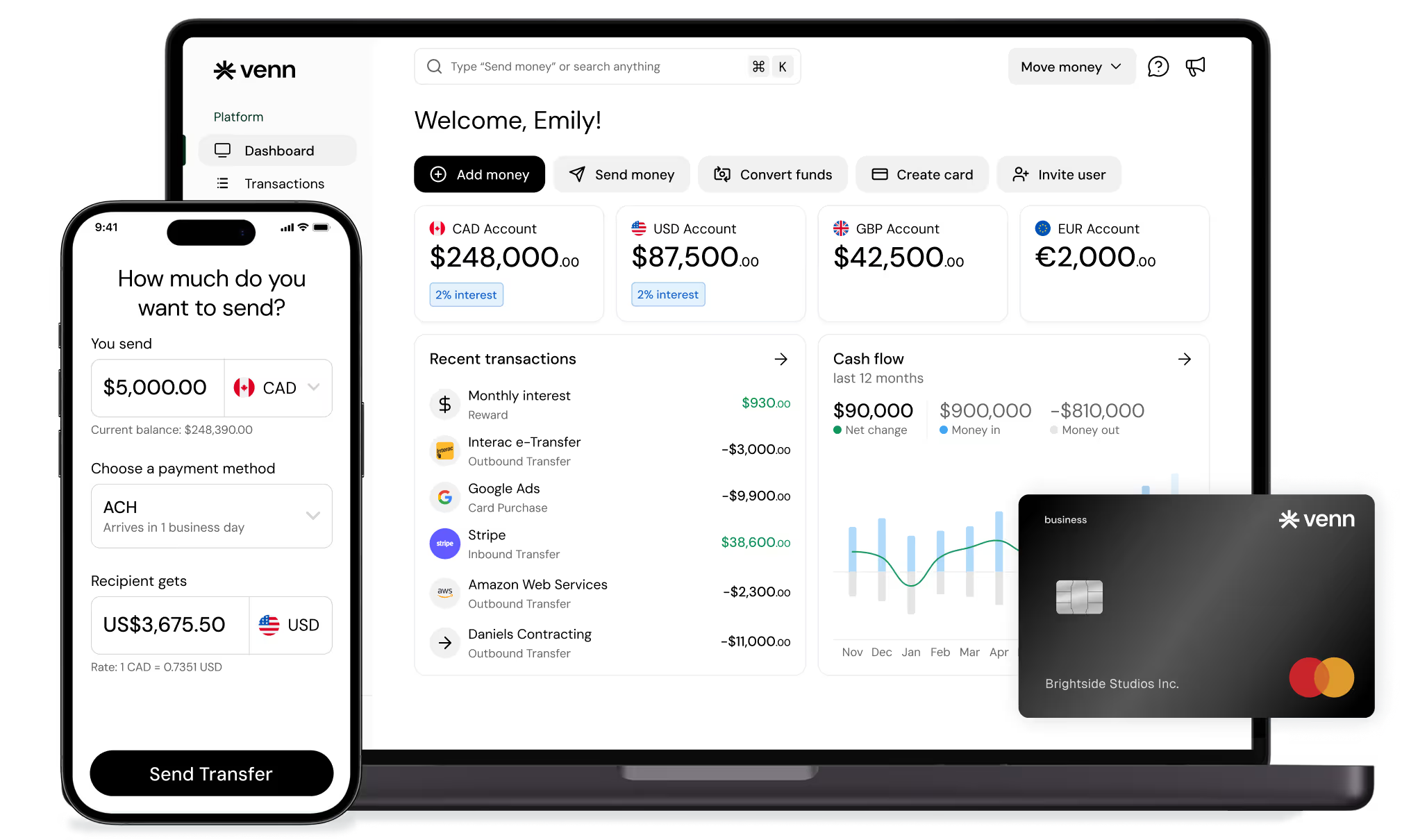
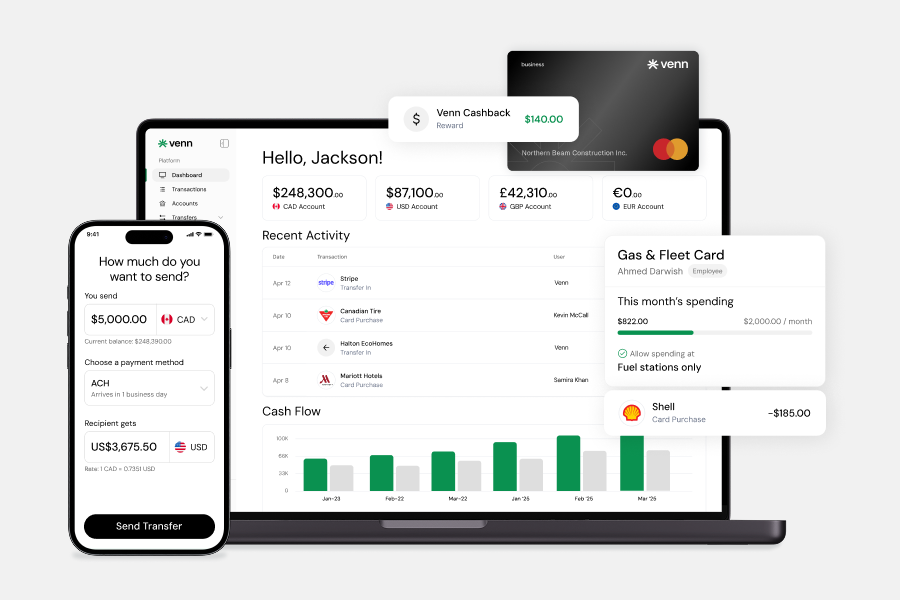
Venn provides real CAD, USD, EUR, and GBP accounts, allowing you to hold and pay in the currencies your team needs. With 0.25% foreign exchange rates and wire transfers at $6-10 to 180+ countries, you significantly reduce the cost of paying international employees. QuickBooks and Xero integration ensures your accounting stays clean despite the complexity of multi-currency operations.
Step 4: Draft Compliant Employment or Contractor Agreements
Use country-specific templates or work with legal counsel familiar with local requirements. Generic agreements downloaded from the internet rarely meet specific jurisdictional requirements and may leave you exposed to disputes.
Include clear payment terms and specify the currency. Ambiguity about payment amounts, schedules, or currency can lead to disputes. State whether you'll cover currency conversion costs or if the recipient bears that risk.
Address intellectual property ownership and confidentiality explicitly. Default IP rules vary by country, and you need clear assignment of any work product created. Confidentiality provisions must be enforceable under local law.
Specify termination terms that comply with local law. Many countries mandate notice periods, severance payments, or specific procedures for ending employment. Contractor agreements need clear end dates or termination clauses.
Include data protection and privacy clauses. GDPR in Europe, PIPEDA in Canada, and similar regulations worldwide require specific provisions about handling personal data. Cross-border data transfers need particular attention.
Step 5: Onboard and Set Up Payroll
Collect required documentation promptly, including tax forms, banking details, and work authorization documents. Each country has specific forms for tax withholding and social security registration. Missing documentation delays payments and may result in penalties.
Set up payroll schedules aligned with local requirements. Some countries mandate monthly payment, others allow bi-weekly. Payment dates may be regulated, requiring payment by specific days of the month.
Establish communication and collaboration tools that work across time zones. Asynchronous communication becomes essential when team members work in different time zones. Document processes clearly so work can continue smoothly despite schedule differences.
Provide equipment and system access securely. Shipping equipment internationally involves customs considerations. Cloud-based systems simplify access but require attention to security and data protection regulations.
Schedule regular check-ins that accommodate time zone differences. Building relationships with remote international team members requires intentional effort. Video calls help maintain connection but need scheduling flexibility.
Learn more about the best business bank for payroll in our 2025 guide.
Step 6: Maintain Ongoing Compliance
File required tax documents in both countries according to prescribed schedules. Year-end reporting includes various forms for different jurisdictions. Keep detailed records to support filings and respond to any queries.
Monitor employment law changes that affect your obligations. Minimum wages, benefit requirements, and termination rules change regularly. Subscribe to updates from local employment law firms or rely on your EOR for compliance updates.
Keep accurate records of payments, hours worked, and leave taken. Documentation requirements vary but err on the side of maintaining comprehensive records. Digital systems simplify record-keeping across multiple jurisdictions.
Review contractor relationships annually for misclassification risk. Relationships evolve over time, and what started as legitimate contractor engagement might drift toward employment. Regular reviews help identify and address risks proactively.
Stay current on visa and work permit renewals if applicable. Set reminders well in advance of expiration dates. Immigration applications often take longer than expected, and lapses can force valuable team members to stop working.
Key Compliance Considerations for Canadian Businesses
Compliance isn't optional when hiring internationally. Penalties for violations can be severe, and ignorance of local laws provides no defence.
Tax Obligations and Permanent Establishment Risk
Creating a permanent establishment (PE) in another country triggers corporate tax obligations there. PE rules vary but generally consider factors like having employees, an office, or significant business activities in a country. Even one employee might create PE in some jurisdictions.
Tax withholding and reporting requirements apply regardless of PE status. You must withhold and remit income tax and social security contributions according to local rules. Tax treaties between Canada and other countries may modify these obligations but require careful documentation to claim benefits.
Employment Law and Worker Classification
Employment laws vary dramatically between countries. What's standard in Canada might be illegal elsewhere. Notice periods, severance requirements, vacation entitlements, and working hour restrictions all differ by jurisdiction.
The contractor versus employee distinction causes particular challenges. Tests for employment status differ by country, but common factors include control over work, integration into the business, and economic dependence. Misclassification can result in back pay, benefits liability, and substantial penalties.
Data Protection and Privacy Regulations
GDPR in Europe sets the global standard for data protection, but many countries have their own requirements. These regulations affect how you collect, store, and transfer employee data across borders. Violations can result in fines up to 4% of global revenue.
Practical compliance steps include updating privacy policies, obtaining explicit consent for data processing, implementing data security measures, and establishing procedures for data subject requests. Cross-border data transfers require particular attention, often needing specific contractual clauses or adequacy determinations.
The Financial Infrastructure You Need to Hire Internationally
Traditional Canadian business banking falls short when paying international teams. Banks built their systems for domestic transactions, treating international payments as exceptional rather than routine. This creates friction, delays, and excessive costs that compound with each international team member you hire.
What to look for in a global payment platform:
• Real local accounts in multiple currencies
• Competitive FX rates (under 0.5%)
• Fast, low-cost international transfers
• Payroll integration capabilities
• Accounting software sync
• Multi-user access and approval workflows
Venn solves international payment challenges by providing real CAD, USD, EUR, and GBP accounts, not just currency conversion. This means you can receive client payments in USD and pay your US team members without converting to CAD and back. With foreign exchange at just 0.25% compared to 2.5-3% at traditional banks, you save thousands annually. Wire transfers cost $6-10 instead of $25-50, and payments process same or next-day to 180+ countries in 36+ currencies.
Beyond basic payments, Venn handles the operational complexity of international teams. Two-way sync with QuickBooks and Xero means your multi-currency transactions automatically reconcile in your accounting system. You can issue corporate cards to international team members, manage expenses across currencies, and generate invoices in the currency your clients prefer. For Canadian businesses building global teams, Venn becomes the single platform managing all cross-border financial operations.
Common Challenges When Hiring International Employees (and How to Solve Them)
Understanding potential challenges helps you prepare solutions before problems arise. Here are the most common issues Canadian businesses face when building international teams.
Challenge 1: Managing Cross-Border Payments and Currency Exchange
The cost and complexity of paying international workers surprises many businesses. Traditional banks charge 2.5-3% for currency conversion, meaning a $5,000 USD salary costs an extra $125-150 monthly in FX fees alone. Wire transfer fees of $25-50 per payment add another layer of cost.
Payment delays frustrate international team members who depend on timely salary payments. Banks taking 3-5 business days for international wires means initiating payroll a week early. Currency fluctuations between initiation and receipt can affect the amount received.
Complex reconciliation across multiple currencies creates accounting headaches. Matching payments to invoices, tracking FX gains and losses, and maintaining clean books requires significant manual effort with traditional banking.
Solution: Use a multi-currency platform like Venn with real local accounts, 0.25% FX rates, and fast transfers to 180+ countries.
Challenge 2: Navigating Complex Compliance and Legal Requirements
Each country has unique immigration laws, employment eligibility criteria, and regulations that vary significantly, making compliance overwhelming for businesses. Employment contracts that work in Canada may be invalid elsewhere. Tax treaties affect withholding obligations but require proper documentation.
Key compliance areas:
• Employment contracts that meet local standards
• Tax withholding and reporting in multiple jurisdictions
• Work permit and visa requirements
• Data protection regulations (GDPR, PIPEDA)
• Permanent establishment risk
Staying current with changing regulations across multiple countries challenges even large corporations. Small businesses often lack the resources for comprehensive compliance monitoring.
Solution: Partner with local legal experts or use an EOR for countries where you're hiring 1-5 people.
Challenge 3: Avoiding Worker Misclassification
Monetary penalties for misclassification can range from $1,000 to $12,000 and escalate with repeat non-compliance in Canada, with additional liability for back pay and benefits. International penalties can be even more severe.
Misclassification risks:
• Back pay for wages, overtime, and benefits
• Penalties of 10% to 20% on unpaid income tax, EI and CPP premiums, plus interest
• Legal disputes and reputational damage
• Increased scrutiny from CRA and provincial agencies
Since June 2024, Canadian regulations have shifted the burden of proof to employers, who must now demonstrate a worker is truly an independent contractor. This change reflects a global trend toward protecting worker rights and ensuring proper classification.
Solution: Document the working relationship carefully, ensure genuine independence, and conduct regular classification audits.
Challenge 4: Long Processing Times for Work Permits and Visas
LMIA processing times stretch from 7 business days to nearly a full year depending on the stream and position type. These delays can derail hiring plans and frustrate both employers and prospective employees.
Current LMIA processing times (2025):
• Global Talent Stream: 7 business days
• Agricultural Stream: 14 business days
• High-wage and low-wage streams: 50 business days
• Permanent residence stream: 254+ business days
Immigration applications require extensive documentation and precise completion. Small errors can result in rejections and restart the clock on processing times.
Solution: Plan hiring timelines well in advance, consider fast-track options like Global Talent Stream for tech roles, and ensure complete applications to avoid delays.
Challenge 5: Time Zone and Cultural Differences
Managing teams across multiple time zones challenges traditional management approaches. Finding meeting times that work for team members in Vancouver, London, and Singapore requires compromise and flexibility.
Communication style differences can lead to misunderstandings. Direct feedback normal in North American business culture might be perceived as rude elsewhere. Indirect communication styles can frustrate Canadian managers expecting clear answers.
Varying workplace norms and expectations affect productivity and satisfaction. Work-life balance expectations, holiday schedules, and professional development approaches differ significantly across cultures.
Solution: Establish clear communication protocols, use asynchronous work practices, provide cultural training, and leverage collaboration tools designed for distributed teams.
How to Choose the Right International Hiring Method for Your Business
Selecting the optimal approach requires honest assessment of your business needs, resources, and growth plans. No single method works for every situation.
Consider these factors:
• Number of employees in each country (1-5 = EOR, 10+ = entity)
• Timeline urgency (contractors fastest, entity slowest)
• Budget for setup and ongoing costs
• Level of control needed over employment terms
• Long-term commitment to the market
• Compliance risk tolerance
• Administrative capacity of your team
Start with contractors or an EOR when testing new markets or hiring your first international team members. These options provide flexibility and minimize upfront investment while you validate the business case for international expansion. Move to entity establishment as you scale beyond 10 employees in a single country and commit to long-term presence. The setup costs and administrative burden become worthwhile when spread across larger teams.
Use work permit sponsorship when you need talent physically present in Canada. Despite longer processing times, bringing key team members to Canada strengthens company culture and enables closer collaboration. The Global Talent Stream offers expedited processing for technology roles, making it viable for urgent needs.
Why Venn Is Essential for Canadian Businesses Hiring Internationally
Modern business banking should enable, not hinder, your international growth. Venn provides the financial infrastructure that makes hiring and paying global teams as simple as domestic operations.
When you hire internationally, you immediately face the challenge of paying people in different currencies, across different countries, with varying payment methods. Traditional Canadian banks charge 2.5-3% FX markups, $25-$50 wire fees, and take 3-5 business days to process payments. These costs add up quickly when you're paying multiple international team members monthly.
Venn provides real local accounts in CAD, USD, EUR, and GBP, meaning you can hold and pay from the currency you need without constant conversion. With FX rates at just 0.25%, wire transfers at $6-10, and same or next-day payment processing to 180+ countries, Venn reduces your international payroll costs significantly. You can pay contractors, EOR-managed employees, or your own international entity employees all from the same platform.
Venn integrates directly with QuickBooks and Xero, automatically categorizing and reconciling international payments so your books stay clean. You can issue corporate cards to international team members, manage expenses across currencies, and generate invoices in multiple currencies. For Canadian businesses building global teams, Venn becomes the single platform managing all cross-border financial operations.
Conclusion
Hiring international employees opens your Canadian business to global talent, specialized skills, and new market opportunities. Whether you choose to work with an EOR, establish a legal entity, hire contractors, or sponsor work permits, each method has specific compliance requirements, cost structures, and timelines that must be carefully managed.
The financial infrastructure you choose matters as much as the hiring method itself. With the right multi-currency accounts, low FX rates, and fast international payment capabilities, you can pay your global team efficiently while maintaining clean books and full compliance. Explore how Venn can support your international hiring strategy at venn.ca.
Frequently Asked Questions About Hiring International Employees
Q: Can a Canadian business hire someone who lives in another country?
A: Yes. Canadian businesses can legally hire international workers through methods such as independent contracting, using an Employer of Record (EOR), establishing a foreign legal entity, or sponsoring work permits. Each option has different compliance requirements and cost implications.
Q: Do I need to set up a legal entity in another country to hire someone there?
A: No. You can hire internationally without establishing a legal entity by using an Employer of Record (EOR), which becomes the legal employer on your behalf. This is typically the fastest and most cost-effective method for small or growing teams.
Q: What’s the difference between hiring an international employee and an international contractor?
A: Employees work under your control, receive benefits, and require tax withholding. Contractors operate independently, set their own hours, may work for multiple clients, and handle their own taxes. Misclassifying contractors as employees can lead to penalties, back taxes, and legal liability.
Q: How much does it cost to hire international employees?
A: Costs depend on your hiring method. EOR services usually charge $400–$800 per employee monthly. Setting up a foreign entity costs $10,000–$50,000 upfront plus ongoing compliance. Contractors cost less but carry misclassification risk. Additional expenses include FX fees, international payments, and global payroll compliance.
Q: How do I pay international employees in different currencies?
A: You’ll need a multi-currency account or a global payment platform. Traditional banks charge 2.5–3% FX markup and $25–$50 wire fees. Platforms like Venn offer real local accounts in CAD, USD, GBP, and EUR with 0.25% FX fees and low-cost international transfers, dramatically reducing payment costs.
---
**Disclaimer:** This publication is provided for general information purposes and does not constitute legal, tax or other professional advice from Venn Software Inc or its subsidiaries and its affiliates, and it is not intended as a substitute for obtaining advice from a financial advisor or any other professional. We make no representations, warranties or guarantees, whether expressed or implied, that the content in the publication is accurate, complete or up to date.

Venn is all-in-one business banking built for Canada
From free local CAD/USD accounts and team cards to the cheapest FX and global payments—Venn gives Canadian businesses everything they need to move money smarter. Join 15,000+ businesses today.
Frequently asked questions
Everything you need to know about the product and billing.
Join 15,000+ businesses banking with Venn today
Streamline your business banking and save on your spend and transfers today
No personal credit check or guarantee.