How to Create a Custom Invoice for Canadian Businesses
How to Create a Custom Invoice with free templates, GST HST tips, clear payment terms, and multi currency guidance to get paid faster for Canadian businesses.

Ahmed Shafik
Co-founder

Trusted by 15,000+ Canadian businesses
Business banking for Canada
Local CAD and USD accounts, corporate cards with cashback, the lowest FX rates in Canada, free local transfers, and more.
A custom invoice does more than request payment. It reinforces your brand, clarifies exactly what you delivered, and tells clients precisely how and when to pay. For Canadian businesses, that means getting tax lines right, setting clear payment terms, and making the payment process as frictionless as possible.
The good news: creating a professional custom invoice takes minutes, not hours. Whether you're a freelance consultant, a contractor billing for materials and labour, or an agency managing retainer clients, the right template and workflow will save you time and reduce payment delays.
This guide walks you through everything you need to create, customize, and send invoices that get paid faster. You'll also learn how invoicing connects to your broader financial operations, because the real efficiency gains come when your
invoicing, banking, and accounting systems work together seamlessly.
Create Your Custom Invoice (Use the Invoice Generator)
Building a custom invoice follows three simple steps:
• Choose a template that matches your business type
• Add your details: business info, client info, line items, taxes, and payment instructions
• Preview, download, and send as a professional PDF
The key is selecting a template that fits how you sell. A service-based consultant needs different fields than a contractor billing for materials, or an ecommerce business shipping products.
What to Include on a Custom Invoice (Checklist)
Required invoice fields (for most Canadian businesses)
Every invoice you send should include these essential elements:
• Your business name, address, and contact information
• Client name and billing address
• Invoice number (unique and sequential)
• Invoice date and payment due date
• Line items with description, quantity, and rate
• Subtotal, taxes (GST/HST/PST as applicable), and total due
• Payment instructions (how to pay and accepted methods)
Optional fields that make an invoice truly "custom"
These additions improve professionalism and reduce payment friction:
• Logo and brand colours (keep contrast high for readability)
• Purchase order (PO) number for clients who require it
• Shipping or service address when different from billing
• Notes or scope clarifications to prevent disputes
• Late fee terms (if you apply them)
• Deposit or retainer line for projects requiring upfront payment
• Discounts clearly itemized
• Custom fields like project codes, engagement IDs, or reference numbers
Step-by-Step: How to Create a Custom Invoice (In 10 Minutes)
Step 1: Pick the right invoice template for your business type
Your template should match how you deliver value:
• Freelancer or consultant: Service-based layout with hourly rates or project fees, clear deliverable descriptions
• Contractor or trades: Separate sections for materials and labour, with itemized costs
• Agency or retainer: Monthly recurring structure with scope summary and hours breakdown
• Ecommerce or wholesale: SKU-style line items, shipping costs, and quantity-based pricing
Starting with the right template means less customization and fewer errors.
Step 2: Add your branding (without hurting clarity)
Your invoice represents your business, but clarity trumps creativity:
• Place your logo in the header, sized appropriately (not overwhelming)
• Use brand colours sparingly, ensuring totals and due dates remain highly visible
• Maintain adequate white space so the document scans easily
• Keep fonts professional and readable at standard sizes
The goal is recognition without confusion. Your client should immediately identify who sent the invoice and what they owe.
Step 3: Enter line items that reduce disputes
Vague descriptions create questions. Specific descriptions get paid:
• Use "what + when + deliverable" format: "Website redesign, homepage and 4 subpages, delivered March 15"
• Separate labour from expenses when billing both
• Show hours and rates clearly for time-based work
• Add taxes as distinct line items, not buried in totals
When clients understand exactly what they're paying for, they approve invoices faster.
Step 4: Set payment terms that match your cash flow
Payment terms signal expectations. Choose based on your relationship and cash flow needs:
| Term | When to Use |
|---|---|
| Due on Receipt | Small projects, new clients, or when you need immediate payment |
| Net 15 | Standard for smaller invoices or ongoing relationships |
| Net 30 | Common for larger projects or established clients |
| Net 45/60 | Enterprise clients (negotiate carefully) |
Include deposit or partial payment language for larger projects: "50% due upon contract signing, 50% upon delivery."
If you apply late fees, state them clearly: "Invoices unpaid after 30 days may incur a 2% monthly service charge." Note that late fee enforceability varies, so consult your agreements and applicable regulations.
Step 5: Review, download, and send
Before sending, verify:
• Client name and address are correct
• Dates, totals, and tax calculations are accurate
• Currency is clearly displayed
• Payment instructions are complete
Download as PDF for the most professional, universally viewable format. Word and Excel files work for editable templates but look less polished when sent to clients.
When emailing, use a clear subject line: "Invoice #1047 from [Your Business] - Due April 15." Include a brief message and attach the PDF directly.
Canadian Tax Basics for Invoices (GST/HST/PST—High Level)
When to show GST/HST
If your business is registered for GST/HST, you must charge and display it on invoices for taxable supplies. Your invoice should show:
• Your GST/HST registration number
• Tax amounts as separate line items
• Clear labeling (GST, HST, or both where applicable)
The specific rate depends on where your client is located and the nature of what you're selling. For businesses operating across multiple provinces, confirm the correct approach with your accountant.
Handling multiple tax lines
Structure your invoice clearly:
• Subtotal (before tax)
• GST/HST line (with rate and amount)
• PST line (if applicable in your province)
• Total due
Consistent tax presentation across all invoices simplifies your bookkeeping and builds client confidence.
Note for Quebec businesses: Venn supports businesses in most provinces, currently excluding Quebec. If you operate in Quebec, ensure your invoicing approach meets provincial requirements.
Multi-Currency Invoicing: How to Invoice Clients in USD (or EUR/GBP) Without Extra Headaches
What to include on a multi-currency invoice
When billing international clients, currency clarity prevents confusion:
• Display the currency prominently (USD, EUR, GBP) next to all amounts
• Align payment instructions to that currency (your USD account details for USD invoices)
• Avoid mixing currencies on a single invoice unless absolutely necessary
The payment collection challenge
Here's where many Canadian businesses lose money: they invoice in USD but receive payments into a CAD account, triggering conversion fees on every transaction. Or they maintain separate accounts at multiple institutions, complicating reconciliation.
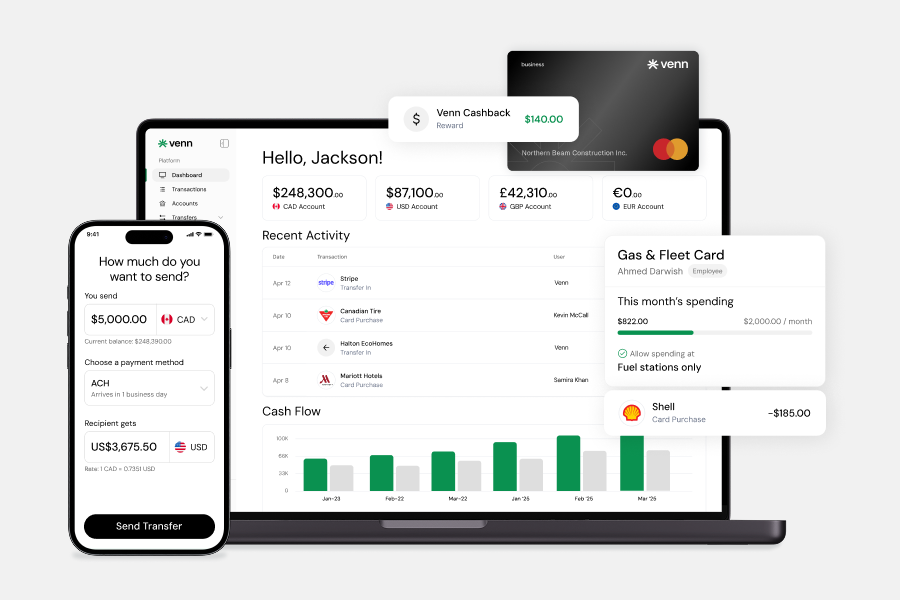
Venn solves this with multi-currency accounts in CAD, USD, EUR, and GBP. When you invoice a US client in USD, you receive USD directly into your Venn USD account. No forced conversions, no unnecessary fees. You control when and how to convert funds, or use them directly to pay USD-denominated suppliers.
This approach keeps your international operations clean: invoice in the client's preferred currency, receive in that same currency, and maintain clear records for accounting.
Ready to streamline your business finances? Sign up for a Venn account and access multi-currency accounts, competitive FX rates, and seamless accounting integrations.
How Venn Fits Into a Modern Invoicing + Accounting + Banking Stack
The workflow: invoicing → deposits → reconciliation
Creating invoices is just one piece of getting paid. The full cycle includes:
• Send invoice
• Receive payment
• Match payment to invoice
• Reconcile in accounting software
• Manage cash flow across currencies and expenses
When these systems don't talk to each other, you spend hours on manual data entry and reconciliation. When they integrate properly, month-end closes faster and errors drop dramatically.
Venn: The banking layer that ties it together
Venn functions as the central banking component of a modern business finance stack:
For receiving payments: Multi-currency accounts let you accept CAD, USD, EUR, and GBP payments directly. Funds are covered under CDIC insurance protection, giving you confidence in your business deposits.
For managing expenses: The Venn card offers 1% unlimited cashback on all purchases. Issue cards to team members with spending controls, and use OCR receipt capture to eliminate manual expense tracking.
For paying suppliers: Send unlimited free Interac e-Transfer® payments to Canadian vendors, or use competitive FX rates for international supplier payments.
For accounting integration: Venn connects directly with QuickBooks and Xero, feeding transactions automatically for cleaner reconciliation. No more downloading CSV files or manually entering banking data.
The result: fewer manual steps between "invoice sent" and "books closed."
Common Custom Invoice Mistakes (And How to Fix Them)
Avoid these errors that delay payment or create disputes:
Missing or vague due date: "Payment due upon receipt" is less effective than "Payment due: April 30, 2026." Be specific.
Unclear line item descriptions: "Consulting services - $5,000" invites questions. "Strategic planning sessions (8 hours) + competitive analysis report, delivered March 2026 - $5,000" gets approved.
Incorrect tax presentation: Showing the wrong rate or forgetting to include your registration number creates compliance issues and client confusion.
Duplicate invoice numbers: Sequential, unique numbering prevents accounting headaches. Use a consistent format like "INV-2026-001."
No payment instructions: Tell clients exactly how to pay. Include bank details, accepted payment methods, and any reference numbers they should include.
Currency ambiguity: For international invoices, display currency symbols prominently. "$5,000" could mean CAD or USD. "USD $5,000" is clear.
Understand different types of invoices: You need to understand the proper type of invoice to send. Learn more about Proforma vs commercial invoices in our article here.
Conclusion
Creating a custom invoice takes minutes when you have the right template and process. Start with a layout that matches your business type, add your branding without sacrificing clarity, write line items that prevent disputes, and set payment terms that support your cash flow.
For Canadian businesses, that also means handling GST/HST correctly and, increasingly, managing multi-currency invoicing for international clients.
But invoicing is just the first step in getting paid efficiently. The real gains come when your invoicing connects seamlessly to your banking and accounting systems. That's where Venn fits in: multi-currency accounts to receive payments in the currency you bill, 1% unlimited cashback on business expenses, free Interac e-Transfer® for vendor payments, and direct integrations with QuickBooks and Xero.
Ready to build a more efficient financial stack? Sign up for a Venn account and see how modern business banking connects to everything else.
FAQ
Q: What makes an invoice "custom" vs a standard invoice?
A: A custom invoice includes your branding (logo, colours), fields specific to your business (PO numbers, project codes, deposit lines), and payment terms tailored to how you work with clients. Standard templates are generic; custom invoices reflect your business identity and operational needs.
Q: Do invoices need to be in a specific format in Canada?
A: Canada does not mandate a specific invoice format. However, invoices should include your business information, client details, a unique invoice number, invoice and service dates, itemized charges, applicable taxes with your registration number, and clear payment instructions. Consistency helps with both client relationships and CRA compliance.
Q: What should I put for payment terms (Net 30 vs due on receipt)?
A: Choose payment terms based on your cash flow needs and client relationship. "Due on receipt" works well for smaller projects or new clients. Net 15 or Net 30 is standard for ongoing relationships. For larger projects, consider requiring a deposit upfront with the balance due upon completion.
Q: Should I invoice in CAD or USD for international clients?
A: Invoice in the currency your client prefers to pay, typically their local currency. This reduces friction and can speed up payment. With a multi-currency account, you can receive USD, EUR, or GBP directly without forced conversion.
Q: Can I add late fees to an invoice?
A: You can include late fee terms on your invoice, such as "Invoices unpaid after 30 days may incur a 2% monthly service charge." However, enforceability depends on your contract terms and applicable laws. State your policy clearly upfront and include it in your client agreements.
Q: What's the best file format to send an invoice?
A: PDF is the standard format. It preserves formatting across devices, looks professional, and prevents accidental edits. Word or Excel files work for internal templates but may appear less polished when sent to clients.
Q: How do I number invoices?
A: Use a sequential, unique numbering system. Common formats include simple sequences (001, 002, 003), date-based codes (2026-001), or prefixed systems (INV-001). The key is consistency: never duplicate a number and make it easy to reference specific invoices later.
Venn Mastercard Charge Card is issued by Peoples Trust Company under licence from Mastercard International Incorporated. Mastercard is a registered trademark, and the circles design is a trademark of Mastercard International Incorporated.
---
**Disclaimer:** This publication is provided for general information purposes and does not constitute legal, tax or other professional advice from Venn Software Inc or its subsidiaries and its affiliates, and it is not intended as a substitute for obtaining advice from a financial advisor or any other professional. We make no representations, warranties or guarantees, whether expressed or implied, that the content in the publication is accurate, complete or up to date.
This publication is provided for general information purposes only and does not constitute legal, tax, financial, or other professional advice from Venn Software Inc., its subsidiaries, or its affiliates, and is not a substitute for advice from a qualified professional. All comparisons and competitor information reflect publicly available information believed accurate as of March 3, 2026; features, pricing, rates, and terms referenced are subject to change and may differ at the time you read this. All product names, logos, and brands referenced are the property of their respective owners; their mention does not imply affiliation with or endorsement by Venn. Any comparative statements reflect Venn's views and are provided to help readers evaluate options. We make no representations, warranties, or guarantees, express or implied, that the content is accurate, complete, or up to date.

Venn is all-in-one business banking built for Canada
From free local CAD/USD accounts and team cards to the cheapest FX and global payments—Venn gives Canadian businesses everything they need to move money smarter. Join 15,000+ businesses today.
Frequently asked questions
Everything you need to know about the product and billing.
Join 15,000+ businesses banking with Venn today
Streamline your business banking and save on your spend and transfers today
No personal credit check or guarantee.