Credit Score Needed for a Business Credit Card in Canada
What credit score do you need for a business credit card in Canada? Learn typical score bands, what issuers check, and options if your credit is fair.

Ahmed Shafik
Co-founder

Trusted by 15,000+ Canadian businesses
Business banking for Canada
Local CAD and USD accounts, corporate cards with cashback, the lowest FX rates in Canada, free local transfers, and more.
The Approval Question Most Owners Ask First
There is no universal minimum score for a business credit card in Canada because each issuer sets its own underwriting rules. So if you are asking what credit score you need for a business credit card in Canada, the most accurate answer is that stronger personal credit usually improves your odds, especially for bank-issued rewards and premium products.
Canadian credit scores generally range from 300 to 900, and most issuers review personal credit when assessing sole proprietors, freelancers, and newer businesses. If your file shows fair credit, limited history, or recent credit issues, you may have better results starting with entry-level products, secured options, or non-revolving spend-management tools rather than a traditional card with a high limit.
Your score matters, but it rarely works alone. Issuers may also assess income, existing debt, time in business, revenue, and the documents that support your application.
Credit Score Expectations For Canadian Business Cards
A stronger personal credit profile generally gives you better odds for traditional bank-issued business cards, while a fair or limited file may point you toward simpler products with lower limits or more basic eligibility. There is no single cutoff that applies across the board.
Each issuer sets its own rules, and a business credit card credit score review may include more than the number itself. Personal credit is often part of the picture, especially for smaller or newer businesses, alongside income, existing debt, business type, and operating history.
If your business has several years of financial history, that track record may carry more weight. If it is new, issuers may rely more heavily on the owner's personal financial profile.
Canadian Credit Score Bands And Approval Signals
RBC's educational guidance uses a helpful score-band framework: 300 to 559 is poor, 560 to 659 is fair, 660 to 724 is good, 725 to 759 is very good, and 760 plus is excellent. Treat these bands as orientation, not approval rules. A good credit score in Canada, or better, can support stronger approval odds for business credit cards, but it does not guarantee approval. Each issuer makes its own decision based on the full profile.
How Approval Works In Canada
Canadian issuers typically assess business credit card applications through three connected lenses: your personal profile, your business profile, and the details you provide on the application. For small business credit cards in Canada, owner information often carries more weight than it would in a large corporate card program. The sections below break down how issuers look at personal and business credit, business structure, and liability.
Personal Credit And Business Credit
For many small-business credit card applications in Canada, the owner's personal credit profile carries the most weight — particularly when the company is new or has limited financial history. Lenders use that personal record to understand how you manage borrowing and repayment before the business has its own track record.
As the company grows, business financial history becomes more important. CIBC illustrates this split clearly: some business card options rely primarily on personal financial history, while its Business Plus path focuses more on business financial history. If you are weighing personal credit against business credit, start by asking how established your company is and which approval path the issuer uses.
Sole Proprietors And Incorporated Businesses
Freelancers, consultants, and other sole proprietors can apply for business credit cards in Canada. TD, for example, states that sole proprietors are eligible for its business credit cards — reassuring if your business operates under your own name rather than a corporation.
Incorporation does not remove personal review from the process. If you run a corporation, an issuer may still ask for owner details, business registration information, a personal guarantee, or supporting documents. For newer companies, your personal credit profile can carry significant weight while the business builds its own financial history.
Personal Guarantees And Liability
A personal guarantee means the owner or another guarantor agrees to repay the balance if the business does not. For newer firms, sole proprietors, and smaller incorporated businesses, this creates a personal-liability path where the issuer looks beyond the company and can hold the guarantor responsible.
More established companies may qualify for business-liability or corporate-style programs, where approval relies more on the company's financial history and obligations sit primarily with the business. CIBC is a useful reference point here, as it separates certain business cards tied mainly to personal financial history from programs assessed primarily on business financial history.
Approval Factors Beyond The Score
Your score helps issuers assess risk, but it rarely tells the whole story. Two applicants with the same credit score can receive different decisions — a stable financial profile may support approval, while strained cash flow or inconsistent application details can raise concerns. The sections below break down the main approval factors one by one.
Income And Debt Load
Lenders want to see that you can repay what you borrow. RBC's educational guidance notes that approval can depend on your credit score, income, and overall financial profile — not score alone. For a business card application, that may include your personal income and, when available, business income.
Existing debts also matter. Loan payments, leases, tax balances, and other obligations create debt pressure. Even with a good credit score in Canada, high monthly commitments may reduce perceived repayment capacity.
Time In Business
An established operating history gives issuers a longer record to assess, which can strengthen your application. If your company has operated consistently and shows disciplined financial management, the file looks less uncertain than one from a brand-new business.
For startups, limited business history shifts the weight of the review. Issuers may rely more on the owner's overall profile when the company has not yet built a meaningful financial track record.
Business Revenue And Expenses
Issuers often use revenue and spending details to understand the business behind the application. BMO, for example, notes that business credit card applicants may be asked about company size and annual revenue or expenses. You may also need to provide expected monthly card spend, regular expenses, or business type.
Revenue does not replace a credit review, it helps issuers assess your business profile alongside personal credit, business credit history, income, and other approval factors.
Application Documents
Before you apply, gather the records that confirm your business structure and operating history. TD lists the following among common business-card application documents, and other Canadian issuers may request similar support:
- Incorporation documents, if your business is incorporated
- Partnership agreement, if partners own the business
- Master business licence for registered trade names or sole proprietorships
- Recent financial statements, when available
- Notice of assessment, when applicable to your application file
Recent Applications And Credit Behaviour
Too many recent applications can reduce your approval odds because full applications often add hard inquiries to your credit file. RBC notes that a formal credit card application can involve a hard credit check, so it pays to apply selectively.
Recent serious credit issues can also affect the review. CIBC identifies prior bankruptcy as a factor that may matter in business card eligibility. If this applies to your situation, focus on products that match your current profile rather than stacking applications.
Personal Credit Checks In Business Applications
Yes, business card issuers in Canada often check personal credit when you apply. TD states that it checks personal credit for the applicant and any guarantors on its business credit card applications.
This can surprise owners who expect the company alone to be reviewed, especially if the business has its own name, registration, or corporation number. In practice, issuers often want to understand who stands behind the application. For a newer or smaller company, your personal financial profile can become a key part of the review.
Hard Inquiries And Soft Checks
A soft check usually happens when you check your own credit or use some pre-qualification tools — it helps estimate fit without affecting your score. A hard inquiry typically happens when you submit a full business credit card application, because the issuer reviews your file for an actual credit decision.
RBC makes this distinction between pre-qualification and formal applications clear. Before applying, compare the card's stated requirements with your profile so you avoid sending multiple applications that were unlikely to fit in the first place.
Newer Businesses And Owner Profiles
If your company has limited operating history, issuers have less business financial history to assess — a common situation for startups, freelancers, sole proprietors, and recently incorporated companies. In those cases, the owner's personal credit profile often carries more weight, with income, existing obligations, and supporting documentation also shaping the review.
For many small business credit cards in Canada, the application connects the business to the person behind it, especially when the company has not yet built a separate credit file.
Paths For Fair, Poor, Or Limited Credit
If your score sits in the fair range, set realistic expectations. A fair-credit business card may mean an entry-level product, a simpler bank card, or a smaller starting limit while the issuer reviews your income, debt load, and business details.
For poor credit or a thin file, a secured business card can be a more practical starting point. You provide a security deposit, then use the card carefully to build payment history. TD notes that secured cards may help applicants build credit history if they lack personal credit. Keep balances low, pay on time, and avoid multiple applications close together.
No revenue yet? Some issuers may still let you apply. TD, for example, says applicants with no business revenue can apply if they provide personal income for review.
A 30, 60, And 90 Day Credit Improvement Timeline
In the first 30 days, pull your Canadian credit reports and check names, balances, limits, and missed-payment records for errors. Dispute anything inaccurate, and pause unnecessary card or loan applications while you stabilize your file.
By 60 days, make every payment on time and reduce credit utilization where possible — especially on personal cards that may affect a business credit card credit score review.
By 90 days, reassess product fit against your current profile. If a premium card looks premature, consider a simpler option. Prepare accurate income details, business registration information, and recent financial documents before applying.
Choosing Between Revolving Credit And Spend Controls
Approval is only one part of the decision. If your business needs short-term borrowing, a revolving business credit card may fit because it lets you carry a balance, subject to interest and repayment terms. If your team pays expenses from available cash, the better fit may be controlled team spending instead — where the focus is on who can spend, how transactions get reconciled, and whether you can see cash flow clearly before month end.
Traditional Bank-Issued Business Cards
For businesses that want revolving credit, traditional business credit cards from banks such as TD, RBC, CIBC, BMO, and Scotiabank remain a familiar option in Canada. You can make purchases up to an approved limit, pay the balance in full during the grace period, or carry a balance with interest. Many cards also offer rewards on business spending and allow employee cards for delegated purchasing.
For applicants asking what credit score they need for a business credit card in Canada, these products often favour stronger personal credit — particularly for smaller or newer businesses. Responsible use may support credit-building over time through on-time payments and controlled utilization. The tradeoff is stricter approval factors, including hard inquiries, possible personal guarantees, variable rates, annual fees, and other account charges.
Charge Cards And Business Banking Platforms
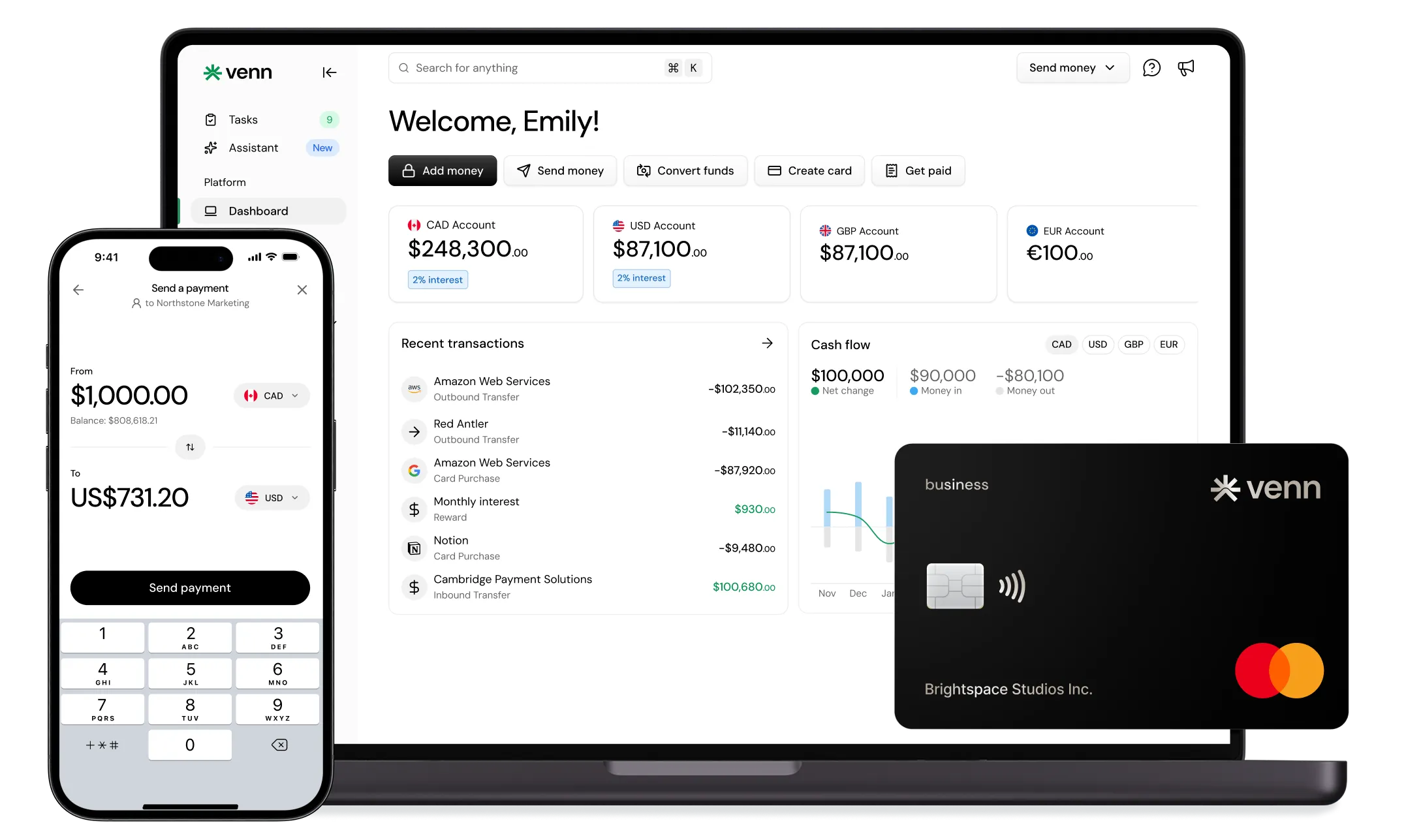
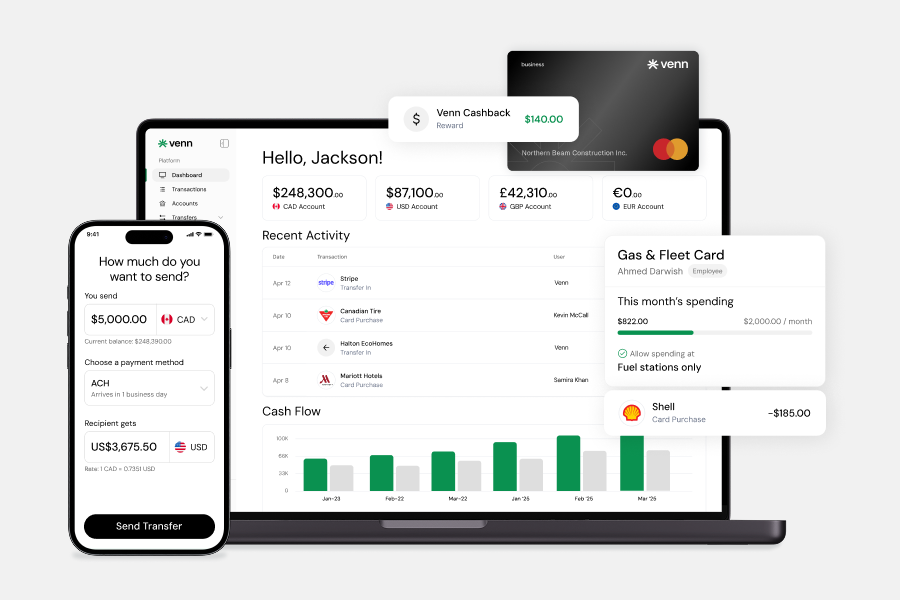
If your business wants tighter operational control rather than revolving borrowing, a charge-card and account platform may fit better than another credit application. Venn is one adjacent option: a Canadian business banking platform and banking alternative — not a bank — with a Mastercard charge card issued by Peoples Trust Company.
This structure suits teams that want cards for day-to-day spend but do not need to carry a balance. Venn supports corporations and sole proprietors, although it is not available in Quebec.
For businesses managing cross-border workflows, Venn offers CAD, USD, GBP, and EUR accounts along with competitive FX rates. Free unlimited Interac e-Transfer® can help simplify domestic vendor payments that would otherwise create administrative drag.
When multiple people spend on behalf of the company, controls matter. Venn includes expense management with spend controls and OCR receipt capture, then connects directly with QuickBooks and Xero to reduce manual reconciliation. On Pro, businesses can earn 1% cashback, with unlimited cashback available.
Eligible balances are held at Bank of Montreal with CDIC insurance protection up to applicable limits.
Business Spending Options Compared
If your approval path depends on credit profile, cash flow, or whether you need revolving credit, compare the main business spending options by fit.
How To Improve Approval Odds Before Applying
Before you apply, review your own credit score and credit report so you know where your profile stands. TransUnion notes that checking your own score does not hurt it, so use that information to choose wisely.
Match the card to your current profile. If your file is still developing, avoid premium products that typically suit stronger applicants. Then check the application details closely — your income, business name, business type, and supporting documents should align across every field, since inconsistencies can slow review or raise questions.
Space out applications where possible. Too many applications close together can make your file look less stable to Canadian issuers and work against your approval odds.
Conclusion: Matching The Product To Your Business Reality
There is no universal minimum credit score for business credit card approval in Canada. Good personal credit usually improves your odds — especially for traditional revolving business credit cards — but lenders also assess income, debt, business history, and overall financial stability.
The better question is not only what credit score you need for a business credit card in Canada, but what your business actually needs next. If you need flexible borrowing, a traditional card may fit. If your file needs work, a credit-building path may be more realistic. If your priority is tighter spend control and a broader business banking workflow, an option like Venn — discussed in the comparison section — may be worth considering.
Before applying, review your credit profile, cash-flow needs, and operating habits so you choose a product that matches your current business reality.
Frequently Asked Questions
Q: What credit score do you need for a business credit card in Canada?
A: There is no single minimum credit score for a business credit card in Canada. In practice, stronger personal credit usually improves your approval odds, especially with bank-issued business credit cards and premium products.
Q: Do business credit cards check personal credit in Canada?
A: Yes, often. Many issuers review the owner's personal credit, especially for small businesses, sole proprietors, newer companies, and anyone providing a personal guarantee.
Q: Can a sole proprietor get a business credit card in Canada?
A: Yes. Sole proprietors can apply for many small business credit cards in Canada, though approval may rely heavily on the owner's personal credit profile, income, and existing debt obligations.
Q: Can I get a business credit card with no revenue yet?
A: Sometimes. If your business has not generated revenue, an issuer may consider your personal income, credit history, business type, and overall application strength.
Q: Will applying hurt my credit score?
A: A full application can trigger a hard inquiry, which may affect your credit score. Checking your own score does not lower it, so review your file before applying.
Q: What if my credit score is too low right now?
A: Consider a secured business card, reduce credit utilization, and make every payment on time before reapplying. Avoid submitting several applications close together, since repeated hard inquiries can weaken your file.
---
**Disclaimer:** This publication is provided for general information purposes only and does not constitute legal, tax, financial, or other professional advice from Venn Software Inc., its subsidiaries, or its affiliates, and is not a substitute for advice from a qualified professional. All comparisons and competitor information reflect publicly available information believed accurate as of September 9th, 2026; features, pricing, rates, and terms referenced are subject to change and may differ at the time you read this. All product names, logos, and brands referenced are the property of their respective owners; their mention does not imply affiliation with or endorsement by Venn. Any comparative statements reflect Venn's views and are provided to help readers evaluate options. We make no representations, warranties, or guarantees, express or implied, that the content is accurate, complete, or up to date.

Venn is all-in-one business banking built for Canada
From free local CAD/USD accounts and team cards to the cheapest FX and global payments—Venn gives Canadian businesses everything they need to move money smarter. Join 15,000+ businesses today.
Frequently asked questions
Everything you need to know about the product and billing.
Join 15,000+ businesses banking with Venn today
Streamline your business banking and save on your spend and transfers today
No personal credit check or guarantee.