Canadian Auto Dealers: Next Steps When Bank Closes Account
Canadian Auto Dealers: What to Do When Your Bank Closes Your Account. Get a 24 hour checklist, replacement banking tips, and Canada escalation steps today.

Ahmed Shafik
Co-founder
Trusted by 15,000+ Canadian businesses
Business banking for Canada
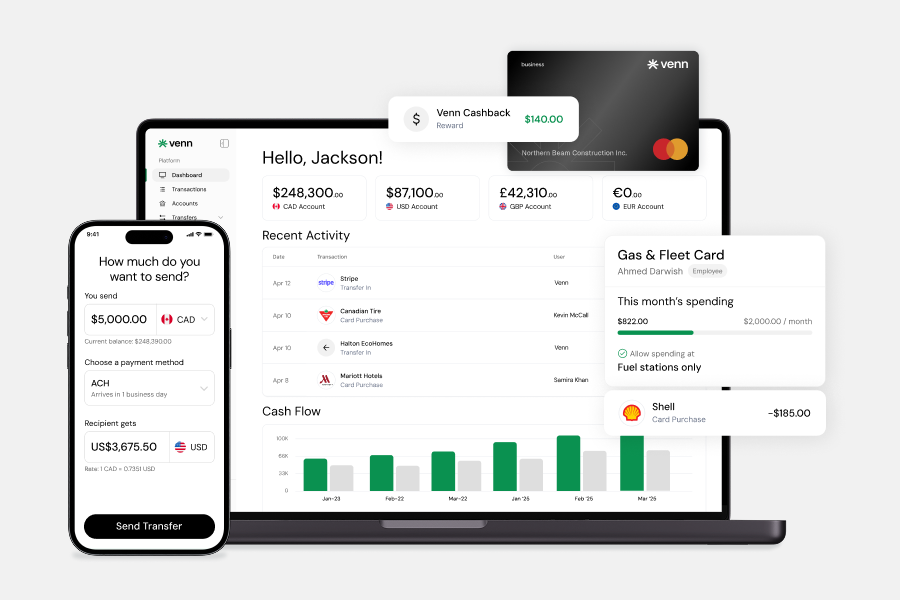
Local CAD and USD accounts, corporate cards with cashback, the lowest FX rates in Canada, free local transfers, and more.
Canadian Auto Dealers: What to Do When Your Bank Closes Your Account
When your dealership's bank account gets closed without warning, the clock starts ticking immediately. Payroll deadlines loom, floorplan payments come due, and customer refunds sit in limbo. For Canadian auto dealers, an account closure creates operational chaos that can damage supplier relationships, employee trust, and your reputation with customers.
Banks rarely explain the full reasoning behind closures, leaving you to piece together what went wrong while scrambling to keep the business running. The good news: this situation is survivable with a structured approach. This guide walks you through the critical first hours, helps you stabilize operations, and shows you how to build a more resilient financial foundation going forward.
Your action plan breaks down into five phases: stabilize cash and critical payments, gather documentation and records, open replacement banking quickly, update all payment flows and accounting connections, and escalate complaints through proper Canadian channels if warranted.
What Account Closure Actually Means for Your Dealership
Before taking action, confirm exactly what you're dealing with. Account closures exist on a spectrum, and the response differs based on your specific situation.
Possible scenarios include:
• Account fully closed with balance pending release
• Account temporarily frozen pending review (may be reversible)
• Specific services disabled (debit cards, online banking) while account remains open
• Outgoing payments blocked while incoming funds still accepted
• Complete freeze on all activity in both directions
Immediate confirmation checklist:
• Which specific accounts are affected (operating, payroll, tax remittance, trust, refund accounts)
• Can you still receive incoming EFTs, wires, or Interac e-Transfer® payments
• What happens to scheduled pre-authorized debits (PADs) and bill payments
• How and when will you receive your remaining balance (cheque, wire, hold period)
• Is there an internal review process or appeal option
Get these answers in writing when possible. Document every conversation with dates, times, and the names of bank representatives you speak with.
Why Banks Close Dealership Accounts: Understanding the Risk Triggers
Banks evaluate accounts against Know Your Customer (KYC) and Anti-Money Laundering (AML) compliance requirements. Dealerships often trigger risk flags simply due to the nature of their business model, not because of any wrongdoing.
Common triggers that raise compliance concerns:
• KYC information mismatches between your stated business model and actual transaction patterns
• Sudden volume spikes that differ significantly from historical patterns
• Rapid movement of funds (money in and out quickly)
• Third-party payments without clear invoice documentation
• Large or structured cash deposits
• High chargeback rates or unusual refund patterns
• Payments to or from flagged counterparties
Dealership-specific examples that often cause problems:
• Refunding a customer deposit to a different name or account than the original payer
• Wholesale transactions with inconsistent or missing documentation
• Auction payments, transport fees, or vendor payments that don't match your stated business purpose
• Multiple large deposits followed by immediate outbound transfers
• Payments to overseas vendors without clear business rationale
Understanding these triggers helps you build a cleaner profile when you establish new banking relationships.
The First 24 Hours: Dealer-Specific Triage Checklist
Time-sensitive priorities demand immediate attention. Work through this checklist systematically.
1. Protect Payroll and Staff Trust
Identify your next payroll date and the exact funding amount required. If payroll runs within the next 7-10 days, you need a contingency plan immediately. Options include funding payroll from an alternative business account, arranging manual payments through a payroll provider's emergency process, or using personal funds temporarily with proper documentation for repayment.
2. Protect Floorplan and Lender Obligations
Contact your floorplan lender immediately if any payment is at risk. Lenders generally prefer early communication over missed payments. Explain the situation factually and propose a specific timeline for resolution.
3. Protect Customer Experience
Create a controlled process for pending refunds, deposits, and deal unwinds. Assign one person to own this queue and communicate proactively with affected customers. A brief delay with clear communication beats silence followed by a bounced payment.
4. Stop Avoidable Returns
Pause non-essential PADs and scheduled EFTs if you still have any account access. Prepare vendor communication explaining the situation and providing new payment instructions as soon as available.
5. Capture Evidence Now
Download everything you can access: statements, payment confirmations, invoices, and processor reports. Document every bank interaction with dates, times, representative names, and reference numbers. This documentation proves essential if you need to escalate a complaint later.
Days 2-7: Stabilize Operations and Re-Route Payments
Once immediate fires are contained, focus on rebuilding your payment infrastructure.
Build Your Payments to Update Table
Track every payment relationship that needs new banking details:
| Payment Category | Typical Recipients | Priority Level |
|---|---|---|
| Payroll and CRA remittances | Employees, CRA | Critical |
| Rent, utilities, insurance | Landlord, utility companies, insurers | High |
| Floorplan and loan payments | Floor plan lender, term lenders | Critical |
| Auction and transport | Auction houses, carriers | High |
| Parts and reconditioning | Suppliers, detailers, mechanics | Medium |
| Software and marketing | DMS providers, ad platforms | Medium |
| Merchant processor settlement | Payment processor | High |
| Customer refunds | Individual customers | High |
Handling Pending Transactions and Returns
Returned payments create cascading problems. Watch for:
• PADs that bounce and trigger service interruptions
• Vendor EFTs that return, potentially damaging supplier relationships
• Incoming customer payments that fail to settle
Assign one person to own the "returns queue" and reconcile daily until your new banking setup stabilizes. Proactive communication with affected parties prevents most relationship damage.
Opening Replacement Banking: What Canadian Auto Dealers Need
When evaluating new banking options, prioritize capabilities that match dealership operations:
• Reliable CAD operating account with bill pay, EFT, and payroll support
• Clear user permissions and spending controls for staff
• Fast onboarding with transparent documentation requirements
• Multi-currency capabilities (USD especially) for cross-border purchases
• Strong accounting software integrations for cleaner record-keeping
Replacement Banking Capability Comparison
| Capability | Why It Matters for Dealers | Questions to Ask | How Venn Supports It |
|---|---|---|---|
| EFT/Wire capabilities | Vendor payments, floorplan settlements | What are daily/transaction limits? | Unlimited free Interac e-Transfer®, domestic and international wires |
| Multi-currency accounts | US auction purchases, cross-border software, parts suppliers | Can I hold and pay in USD directly? | Local CAD, USD, EUR, and GBP accounts |
| Card controls | Employee spend on parts, travel, advertising | Can I set per-card limits and categories? | Customizable spending policies per card |
| Accounting integrations | Clean documentation reduces future risk flags | Which platforms connect directly? | Direct QuickBooks and Xero integration |
| Expense management | Receipt capture, coding, month-end reconciliation | How do employees submit receipts? | OCR receipt capture, real-time categorization |
| Pricing transparency | Predictable costs for budgeting | What are all the fees? | Transparent pricing, no hidden charges |
Where Venn Fits: Building a Resilient Dealership Finance Stack
Rebuilding after an account closure creates an opportunity to establish better financial infrastructure. Rather than simply replacing one bank with another, consider building redundancy and controls into your setup.
Core Banking Layer
Venn provides a Canadian business banking platform with local CAD and USD accounts, allowing you to separate funds by purpose. Many dealerships benefit from maintaining distinct accounts for operating expenses, payroll and tax remittances, customer refunds, and cross-border purchases. Funds held through Venn are covered under CDIC insurance protection.
Payables and Local Transfers
For vendor payments, recurring bills, and predictable cash movement, Venn offers unlimited free Interac e-Transfer® payments. This matters for dealerships making frequent payments to parts suppliers, service providers, and auction houses.
Corporate Card and Expense Management
Venn's corporate card with 1% unlimited cashback helps consolidate dealership spending across parts runs, reconditioning supplies, travel, and advertising. The expense management features simplify receipt capture and coding, reducing month-end reconciliation time. Each card can have customized spending limits and category restrictions, giving you control over employee purchases without micromanaging every transaction.
Accounting Integrations
Direct connections to QuickBooks and Xero mean transactions flow automatically into your accounting system with proper categorization. This cleaner documentation trail reduces the "unexplained activity" that can trigger compliance concerns at traditional banks. Better record-keeping also speeds up month-end closes and simplifies audit preparation.
Multi-Currency and FX: Reducing Cross-Border Friction
Canadian auto dealers frequently pay in USD for auction purchases, software subscriptions, marketing platforms, freight services, and US-based parts suppliers. Converting CAD to USD for each payment creates unpredictable costs and administrative overhead.
Venn's multi-currency accounts let you hold and pay directly in USD, EUR, and GBP. This approach reduces conversion frequency and eliminates surprise FX costs on recurring payments. For dealerships with regular cross-border activity, maintaining a USD balance simplifies budgeting and improves cost predictability.
How to Prevent Future Account Closures
Once your new banking setup is operational, implement practices that reduce future compliance risk.
Maintain current documentation:
• Keep corporate registry and beneficial ownership information updated
• Ensure your stated business model matches your actual transaction patterns
• Update your banking provider when business volumes change significantly
Create clear audit trails:
• Maintain invoice documentation for all significant payments
• Add clear memos to transfers explaining business purpose
• Match payer names to contracts and invoices when possible
Separate funds by purpose:
• Maintain distinct accounts for operating, refunds, and tax obligations
• Avoid commingling personal and business funds
• Document any intercompany transfers clearly
Build a monthly risk-ready package:
• Top counterparties list with business relationship explanations
• Source-of-funds documentation for any unusual deposits
• Processor statements and reconciliation summaries
• Brief explanations for any atypical transactions
This documentation proves invaluable if questions arise later.
Complaints and Escalation in Canada
If you believe your account closure was mishandled, Canadian regulations provide escalation paths.
Step 1: Internal Bank Process
Start with your branch or relationship manager, then escalate to the bank's internal complaints department. Banks must acknowledge complaints within specific timeframes and provide written responses.
Step 2: External Complaints Body
If the internal process doesn't resolve your concern, most major Canadian banks participate in the Ombudsman for Banking Services and Investments (OBSI). OBSI investigates complaints and can recommend remedies, though its decisions aren't binding on banks.
Step 3: Understanding FCAC's Role
The Financial Consumer Agency of Canada (FCAC) supervises federally regulated financial institutions but doesn't resolve individual disputes or reverse bank decisions. FCAC handles systemic compliance issues rather than individual account closures.
What to prepare for any escalation:
• Complete timeline of events with dates
• All statements and written communications
• Documentation of any financial harm suffered
• Specific remedy you're requesting
Conclusion
A bank account closure disrupts operations, but it doesn't have to derail your dealership. The key lies in moving quickly through triage, documenting everything, and rebuilding with better infrastructure.
Your path forward: stabilize critical payments in the first 24 hours, capture all available documentation, establish replacement banking with the right capabilities, update every payment relationship systematically, and implement practices that reduce future risk.
Building a resilient financial stack means more than just opening another bank account. It means establishing proper controls, maintaining clean documentation, and choosing partners who understand business operations.
Ready to build a more resilient dealership finance stack? Sign up for a Venn account and get banking, cards, and expense management designed for Canadian businesses.
Frequently Asked Questions
Q: Can a bank close my business account without notice in Canada?
A: Yes, banks in Canada generally have the right to close business accounts with limited notice, although most provide some advance warning. Account agreements typically include terms allowing closure at the bank’s discretion, so it’s important to review your original agreement for specific conditions.
Q: What happens to my money when the bank closes my business account?
A: Banks are required to return your remaining balance, but the timeline can vary. It may take anywhere from a few days to several weeks, especially if there are holds or compliance reviews. Request written confirmation of the timeline and method (cheque or transfer) for receiving your funds.
Q: How long does it typically take to get funds from a closed account?
A: Most timelines range from 5–30 business days depending on the bank and situation. If the closure involves a compliance review, the process may take longer. It’s important to document your requests and follow up if the stated timeline passes.
Q: Will a business account closure affect my credit?
A: A business account closure itself typically does not appear on credit reports. However, if it leads to missed payments to lenders or vendors, those late payments may negatively affect your credit. Maintaining timely payments during the transition is critical.
Q: How do I update my CRA payroll remittances to a new account?
A: Log into CRA My Business Account to update your direct debit details or contact the CRA directly. Allow processing time before your next remittance. To avoid delays, consider making your next payment manually while the update is being processed.
Venn Mastercard Charge Card is issued by Peoples Trust Company under licence from Mastercard International Incorporated. Mastercard is a registered trademark, and the circles design is a trademark of Mastercard International Incorporated.
---
**Disclaimer:** This publication is provided for general information purposes and does not constitute legal, tax or other professional advice from Venn Software Inc or its subsidiaries and its affiliates, and it is not intended as a substitute for obtaining advice from a financial advisor or any other professional. We make no representations, warranties or guarantees, whether expressed or implied, that the content in the publication is accurate, complete or up to date.
This publication is provided for general information purposes only and does not constitute legal, tax, financial, or other professional advice from Venn Software Inc., its subsidiaries, or its affiliates, and is not a substitute for advice from a qualified professional. All comparisons and competitor information reflect publicly available information believed accurate as of March 24, 2026; features, pricing, rates, and terms referenced are subject to change and may differ at the time you read this. All product names, logos, and brands referenced are the property of their respective owners; their mention does not imply affiliation with or endorsement by Venn. Any comparative statements reflect Venn's views and are provided to help readers evaluate options. We make no representations, warranties, or guarantees, express or implied, that the content is accurate, complete, or up to date.

Venn is all-in-one business banking built for Canada
From free local CAD/USD accounts and team cards to the cheapest FX and global payments—Venn gives Canadian businesses everything they need to move money smarter. Join 15,000+ businesses today.
Frequently asked questions
Everything you need to know about the product and billing.
Join 15,000+ businesses banking with Venn today
Streamline your business banking and save on your spend and transfers today
No personal credit check or guarantee.