Business credit card for a Canadian business with no revenue
Need a business credit card for a Canadian business with no revenue. Learn approval factors, what to enter for revenue, and charge card alternatives today.

Ahmed Shafik
Co-founder

Trusted by 15,000+ Canadian businesses
Business banking for Canada
Local CAD and USD accounts, corporate cards with cashback, the lowest FX rates in Canada, free local transfers, and more.
If you are a Canadian founder, freelancer, side hustler, or newly incorporated business applying before sales have started, the concern is practical: can you get approved at all? In 2026, a business credit card for a Canadian business with no revenue may still be possible, but approval usually depends on issuer policy, your personal credit, personal income, business activity, business structure, requested limit, and whether a personal guarantee is required.
Zero revenue does not always mean zero business. A sole proprietor may already have client outreach, startup costs, or early contracts. A corporation may be pre-revenue but actively operating. Lenders tend to look for a credible path to repayment, so the stronger your personal profile and the more realistic your limit request, the more straightforward the conversation becomes.
Business Activity Versus Revenue
RBC's published guidance frames eligibility around business income or activity, a useful distinction for anyone in this position. Revenue and activity are not the same thing, and issuers often recognize that.
A pre-revenue startup may already be building a product, paying suppliers, testing ads, or preparing a launch. A side hustle might have occasional business activity even if sales arrive irregularly. A newly incorporated business may be setting up operations before its first invoice goes out. A sole proprietor in consulting, creative work, or seasonal services may also be active without steady revenue.
By contrast, an inactive business with no clear operating plan presents a different picture. If there are no customers, no expenses, no launch timeline, and no evidence of current activity, an issuer has less to assess beyond the fact that revenue is currently zero.
Approval Signals That Can Help
Strong non-business signals can help your file make more sense to an underwriter. Solid personal credit, stable personal income, and a modest requested limit all reduce perceived risk. If you can explain the business purpose clearly and provide clean, consistent supporting information, you give underwriters fewer reasons to pause. Approval still depends on the issuer's case-by-case review.
Approval Risks That Can Hurt
Thin or damaged personal credit can make approval harder, especially when the owner must support the application personally. A recent bankruptcy may raise additional concerns. If you cannot show verifiable business activity, or your business purpose seems unclear, the issuer may struggle to assess repayment intent. Premium cards add another layer of difficulty because they often expect stronger income, revenue, or asset profiles. Applying selectively helps you avoid unnecessary hard inquiries.
Personal Credit And Underwriting
For a very new business, personal credit can carry more weight than early revenue because the issuer has limited business history to assess. The underwriter may look at how you manage personal borrowing, whether you pay on time, and whether your personal income supports the requested limit.
TD Business Banking notes that personal credit checks may form part of the process for applicants and guarantors. BMO similarly indicates that personal credit can be reviewed for business card applications. That means "no revenue" does not automatically end the review—but weak personal credit can make approval harder. For a startup, side hustle, or sole proprietor, a cleaner personal file and a realistic credit limit request often matter more than projected sales.
Personal Guarantees
A personal guarantee means you, as the owner, may have to repay the card balance personally if the business cannot. This is common with small business cards, particularly when a company has little operating history or no revenue yet. RBC's public guidance is a useful reference point here: some issuers consider personal credit during underwriting and may ask for a personal guarantee depending on the application.
Business Structure
Issuers often assess your application differently depending on how the business is organized. A sole proprietor may apply as an individual business owner, which can suit a freelancer, side hustle, or new business with no revenue yet. A corporation is a separate legal entity, so the application may focus more on the company's status and ownership. For partnerships, issuers may look at the partners involved and how the business operates.
Registration requirements can also vary. Canada.ca notes that some sole proprietors using their legal name may not need provincial registration, depending on the province. Not every unincorporated business needs a CRA business number immediately either, so confirm what applies before entering business identifiers on an application.
Time In Business And Revenue Bands
Some issuers draw a clearer line between newer businesses and established companies. CIBC, for example, frames certain personal-liability business cards around businesses operating for under three years and generating under $500,000 in annual revenue, while its business-liability products rely more on the company's financial strength and operating history.
This distinction matters because your stage can influence which product category fits your application. Other issuers may use different thresholds or underwriting models entirely.
The Business Revenue Field
If the application asks for current business revenue and your revenue is zero, enter $0 or the closest truthful option the form provides. Accuracy matters more than optimism here.
Follow the exact wording on the form. If it asks for annual business revenue, use actual revenue earned to date—or annualized only if the form clearly defines it that way. Do not enter a forecast, pipeline value, expected contract, or sales goal unless the issuer specifically asks for projected revenue. That is the safest answer to what to put for business revenue on a credit card application.
Personal Income On The Application
If the application asks for personal income, answer accurately using the figure the issuer requests, such as employment income or total personal income. CIBC distinguishes that some business cards are based primarily on personal financial credentials, so choose a product that fits your actual profile rather than stretching the application.
Business Name And Registration
If you are a freelancer or side hustler, you may not need a corporation or trade name to apply. Some sole proprietors can apply using their legal name, depending on the card issuer and the rules in their province or territory. Canada.ca advises business owners to confirm registration requirements before using a name publicly. For a sole proprietor application, use the name that accurately reflects how you operate today.
Documents Issuers May Request
When applying with no revenue, the issuer may ask for documents that confirm who owns the business and who can act on its behalf.
TD Business Banking and CIBC both point applicants toward practical documentation such as:
- Articles of incorporation, if incorporated
- A partnership agreement, if the business has partners
- Business registration records
- CRA business number, where applicable
- Director or beneficial ownership details
- Government-issued ID for the applicant or signing officers
Requirements vary by issuer and business structure, so prepare the documents that match your setup rather than assuming every item applies.
Sole Proprietors And Side Hustlers
If you earn little or no business revenue yet, your strongest path is likely a personal-liability business credit card rather than a premium product built for established companies. Issuers will look closely at your personal credit, personal income, and requested limit. A lower-fee card with a realistic limit makes more sense than reaching for high rewards and a larger credit line too early.
TD Business Banking allows sole proprietors to apply, which shows that side hustles and owner-operated businesses can fit within mainstream bank application paths. Approval still depends on the full file, not the business type alone.
Newly Incorporated Startups
If you have incorporated but have not generated sales yet, your best path is usually an issuer that will review the founder's overall profile alongside basic business details—what the company does, when it was incorporated, and how you plan to use the card. Mainstream banks and Amex can both be worth reviewing at a category level, though product-by-product requirements vary, so compare the dedicated sections before applying.
Businesses With Irregular Sales
If your revenue arrives in waves—consulting retainers, summer tourism, holiday retail, or early customer pilots—choose a low-fee business card and request a limit your current cash flow can repay. Issuers may look at both sales history and repayment capacity, so report revenue accurately rather than smoothing out weak months. Keep tax money separate, pay balances on schedule, and treat the card as a cash flow tool rather than a bridge for uncertain income.
Traditional Bank Business Cards
The major banks usually assess more than sales alone. RBC's eligibility framing refers to business income or activity, which matters for a new business that has started operating but has not yet produced meaningful revenue. In most cases, expect the bank to review your personal credit and require a personal guarantee.
TD Business Banking is relevant for sole proprietors and side-hustle operators because sole proprietors can apply directly. TD also reviews personal credit for applicants and guarantors, so a stronger personal profile can support a low-limit application.
BMO illustrates why card tier matters: entry-level or no-fee business cards may have lower barriers, while premium cards often ask for stronger income, revenue, or asset qualifications. CIBC makes a similar distinction clearly—some cards lean on personal financial credentials, while others rely more on business financials, which matters when revenue is zero. Scotiabank Business Banking offers another mainstream no-fee or low-cost path, though approval still depends on the full risk review, not the annual fee alone.
American Express Small Business Cards
American Express belongs in the comparison because it offers both small business credit cards and charge card structures in Canada. For a founder looking at a pre-revenue company or side hustle, that distinction matters.
A revolving business credit card lets you carry a balance, subject to interest and required minimum payments. A charge card works differently, you generally need to pay the balance in full on the due date, which may suit businesses that want purchasing power and payment discipline rather than ongoing borrowing.
For eligibility, Amex asks applicants to have a Canadian credit file and provide business details, including annual company revenue. If your business has no revenue yet, answer accurately and expect the issuer to assess the full application, not just one field. Product fit varies: acceptance can differ by merchant, annual fees range by card, and rewards only help if they match how your business actually spends.
Venn Business Banking And Charge Card Alternative
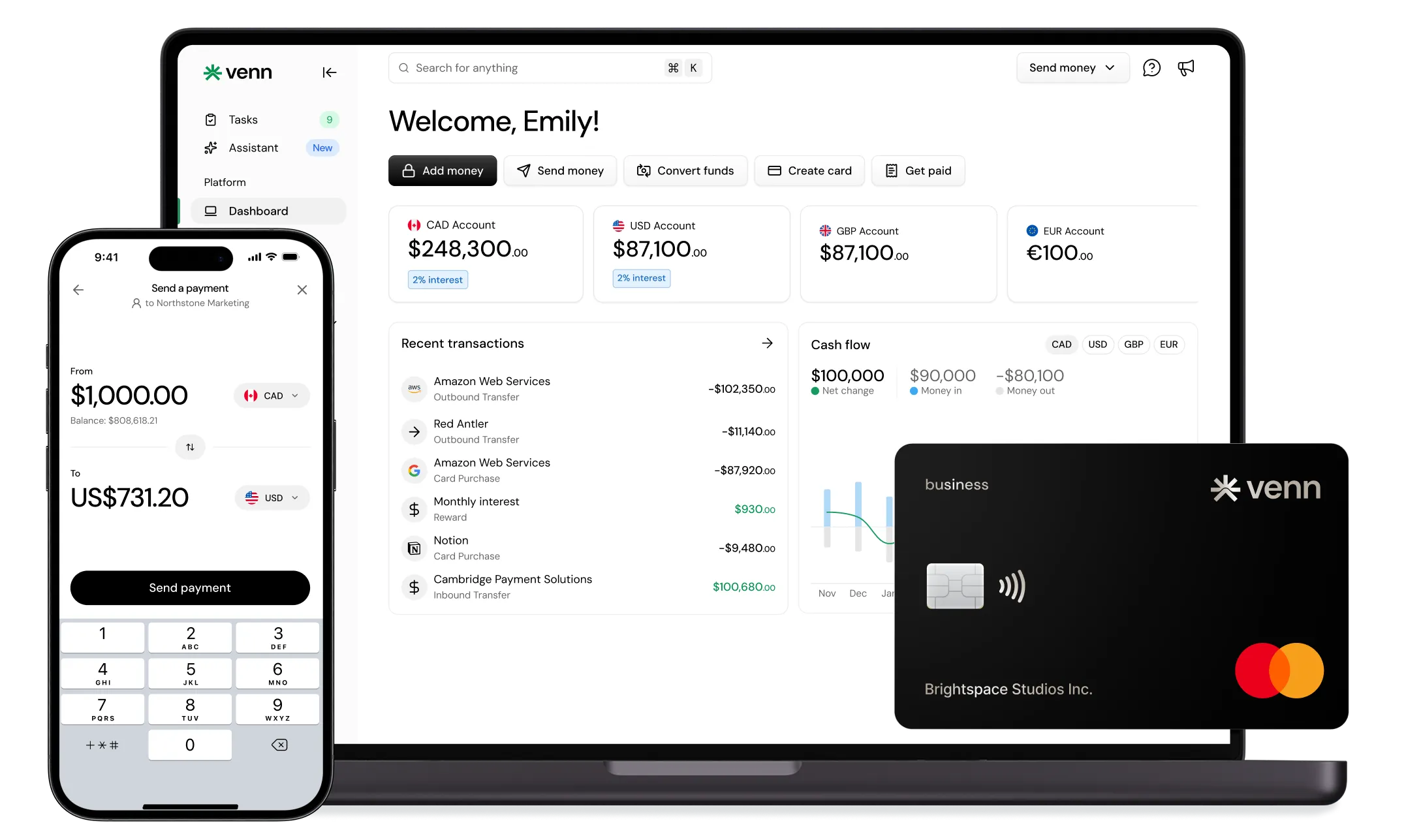
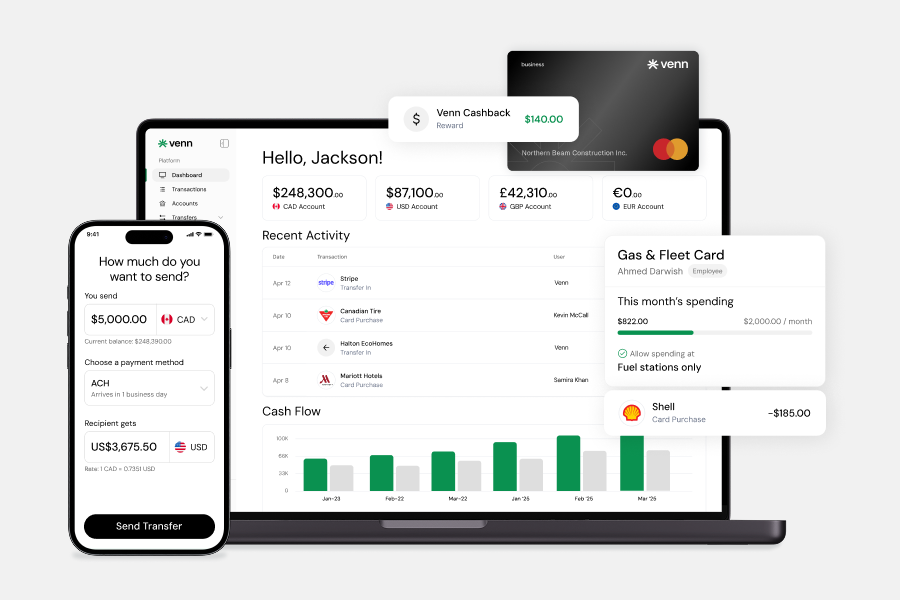
If you want a card for a Canadian business with no revenue mainly to organize spending, Venn may be worth reviewing as a different type of solution. Venn is not a bank, and the Venn card is a Mastercard charge card, not a credit card. It does not provide revolving credit, so it should not be treated as a guaranteed approval shortcut or a replacement for carrying a balance.
For early-stage teams, the fit comes from operational control. You can set spend controls, manage expenses, and use OCR receipt capture to reduce manual follow-up. Venn also supports approval workflows and free unlimited Interac e-Transfer® to keep vendor payments moving. Accounting teams can connect directly to QuickBooks and Xero, and businesses paying global suppliers or collecting in other currencies can use multi-currency accounts and competitive FX rates. Funds are covered under CDIC insurance protection. Venn includes 1% cashback, with unlimited cashback available on Pro.
Approval Path Comparison
Checking Your Personal Credit
Before applying, review your personal credit report and score. FCAC notes that payment history is the most important factor in credit scoring, so confirm recent payments show correctly and address any missed-payment errors. Resolve obvious issues before applying, and avoid sending several applications at once—multiple hard inquiries in a short period can hurt your score.
Applying Strategically
A stronger approach is to narrow your shortlist before you submit anything. Start by matching the product to your stage: sole proprietor, side hustle, incorporated startup, or operating business with early activity. Then consider the likely underwriting path—will the issuer focus mainly on your personal profile, business financials, or a personal guarantee? Finally, decide whether you truly need revolving credit or simply a card structure for controlled spending and cleaner expense management.
Lower-Risk Product Types
Sequence your applications around fit and repayment risk. A no-fee business card can make sense when you want to keep costs low while building operating history. For a sole proprietor or side hustle, a product underwritten mainly on personal liability is often more realistic than one built for established financials. If you do not need to carry a revolving balance, a charge-card alternative may support disciplined spending without applying for traditional credit.
If Your Application Is Declined
Ask the issuer why before you apply elsewhere. The reason may point to a simple fix—requesting a lower limit, clearing up a credit report issue, waiting until your first revenue arrives, or providing clearer proof that the business is active.
If you still need to separate expenses in the meantime, you could temporarily use a personal card strictly for business spend with careful bookkeeping, consider a charge card or business banking platform, or revisit secured business credit card options and other lower-risk products where available.
Practical Takeaway For Your Next Application
Zero revenue does not automatically rule out a business credit card for a Canadian business with no revenue, but it should shape how you apply. Choose a product type that fits your stage—whether you are a sole proprietor, side-hustle operator, or pre-revenue startup. Enter current revenue honestly, keep limit requests realistic, and expect the issuer to assess risk carefully.
If revolving credit is not essential yet, compare modern business banking platform and spend-management options at venn.ca to see if they fit your operating needs.
FAQs
Q: Can a sole proprietor get a business card for company expenses before earning revenue?
A: Yes, sometimes. Several issuers allow sole proprietors to apply, but approval usually depends on personal credit, the rest of the application, and issuer policy. See the sole proprietor and traditional bank sections above for how a business credit card in Canada with no revenue is typically assessed.
Q: Do I need to register my business before applying?
A: Not always. Some sole proprietors operating under their legal name may not need provincial registration, depending on where they operate. Check the business name and registration section above before applying, especially if your business operates under a trade name.
Q: What should I enter for business revenue if I have not launched yet?
A: Enter truthful current figures and follow the wording on the application carefully. If the form asks for current revenue, use your current revenue, even if that number is zero. Do not use projected revenue unless the application specifically asks for projections.
Q: Does personal income count on a business card application?
A: Often, yes. Personal income can matter when the issuer underwrites the card based on personal liability, which is common for sole proprietors and some early-stage businesses. See the personal income section above for how this may affect a new business credit card application.
Q: Is Venn a business credit card?
A: No. Venn is not a bank and offers a business banking platform with a Mastercard charge card, not a revolving credit card. See the Venn section above for when that structure may fit a Canadian business that wants a charge-card setup rather than ongoing credit.
---
**Disclaimer:** This publication is provided for general information purposes only and does not constitute legal, tax, financial, or other professional advice from Venn Software Inc., its subsidiaries, or its affiliates, and is not a substitute for advice from a qualified professional. All comparisons and competitor information reflect publicly available information believed accurate as of September 10, 2026; features, pricing, rates, and terms referenced are subject to change and may differ at the time you read this. All product names, logos, and brands referenced are the property of their respective owners; their mention does not imply affiliation with or endorsement by Venn. Any comparative statements reflect Venn's views and are provided to help readers evaluate options. We make no representations, warranties, or guarantees, express or implied, that the content is accurate, complete, or up to date.

Venn is all-in-one business banking built for Canada
From free local CAD/USD accounts and team cards to the cheapest FX and global payments—Venn gives Canadian businesses everything they need to move money smarter. Join 15,000+ businesses today.
Frequently asked questions
Everything you need to know about the product and billing.
Join 15,000+ businesses banking with Venn today
Streamline your business banking and save on your spend and transfers today
No personal credit check or guarantee.