Best Method to Pay Canadian Employees from The States Guide
Best Method to Pay Canadian Employees from The States with a compliance and cost checklist comparing EOR, Canadian payroll, contractors, and FX planning.

Ahmed Shafik
Co-founder
.png)
Trusted by 15,000+ Canadian businesses
Business banking for Canada
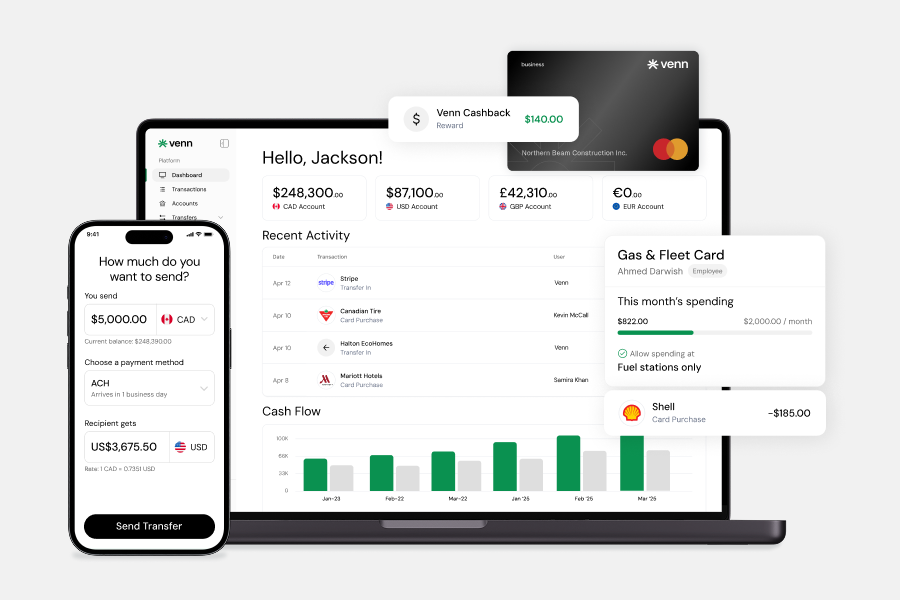
Local CAD and USD accounts, corporate cards with cashback, the lowest FX rates in Canada, free local transfers, and more.
Paying Canadian team members from the United States involves more than finding the right transfer service. Before you move a single dollar across the border, you need to address worker classification, payroll compliance, and operational workflows that keep your books clean and your business protected.
This guide walks you through the decision framework for choosing between a Canadian entity, an Employer of Record (EOR), or contractor arrangements. You'll also learn how to optimize the financial operations layer, including FX management, payment rails, and reconciliation, so recurring cross-border payments don't drain time or money.
Quick Answer: The "Best" Method Depends on Headcount, Permanence, and Risk Tolerance
The right approach for your business hinges on three factors: how many people you're hiring, how long you expect the relationship to last, and how much compliance risk you're willing to manage directly.
• 1–2 hires, need to start quickly → Employer of Record (EOR) handles compliance while you focus on the work
• Growing team of 3+ employees, long-term presence → Canadian entity with direct payroll gives you control and cost efficiency at scale
• Project-based or specialized work → Contractor arrangements work well, but classification must be airtight
• Testing the Canadian market → EOR lets you validate before committing to entity setup
Here's the critical insight most guides miss: "sending money" is the last step, not the first. The compliance model you choose determines everything else, from withholding requirements to year-end reporting. Get that right, then optimize how money moves.
Step 1: Confirm Whether You're Paying an Employee or a Contractor (And Why It Changes Everything)
Worker classification in Canada carries real consequences. The Canada Revenue Agency (CRA) examines the actual working relationship, not just what the contract says. Misclassifying an employee as a contractor can trigger back taxes, penalties, and interest for unpaid CPP, EI, and income tax withholdings.
Review these practical signals when assessing a working relationship:
• Control: Do you dictate how, when, and where the work gets done?
• Tools and equipment: Does the worker use your systems and software, or their own?
• Financial risk: Does the worker have opportunity for profit or risk of loss?
• Exclusivity: Is this person working primarily for you, or serving multiple clients?
• Integration: Does the worker function as part of your team or operate independently?
If the relationship looks like employment, treat it as employment. If you're engaging a true contractor, you still need a repeatable cross-border payment workflow with proper documentation.
Option A: Set Up a Canadian Entity and Run Canadian Payroll (Best for Long-Term Teams)
What This Option Is
Operating payroll through a Canadian entity means you become the direct employer. You handle withholdings, remittances, and reporting obligations under Canadian law.
When This Is Usually the Best Fit
This approach makes sense when you're building a lasting presence in Canada. If you're hiring three or more employees, plan to scale your Canadian team, or need direct control over the employment relationship, entity-based payroll typically delivers better cost efficiency than ongoing EOR fees.
High-Level Compliance and Admin Responsibilities
As a Canadian employer, you'll manage several ongoing obligations:
Payroll deductions and remittances: Withhold Canada Pension Plan (CPP) contributions, Employment Insurance (EI) premiums, and federal/provincial income tax from each pay. Remit these amounts to the CRA according to your remitter type and schedule. The CRA's Employer's Guide to Payroll Deductions and Remittances (T4001) provides detailed guidance.
Year-end reporting: Issue T4 slips to employees and file T4 information returns with the CRA by the last day of February following the calendar year.
Record of Employment (ROE): When an employee experiences an interruption of earnings (layoff, leave, termination, or resignation), you must issue an ROE within five calendar days. See the CRA's guidance on interruption of earnings for specific requirements.
Provincial employment standards, vacation pay rules, and benefits requirements add another layer of complexity that varies by location.
Setup Checklist
• Register for a business number and payroll program account with the CRA
• Select Canadian payroll software or a payroll service provider
• Define pay schedule (bi-weekly is common in Canada), vacation pay approach, and benefits
• Build a funding workflow: CAD funding source, FX strategy, and reconciliation process
• Document processes for ROE issuance and year-end reporting
Where Venn Fits
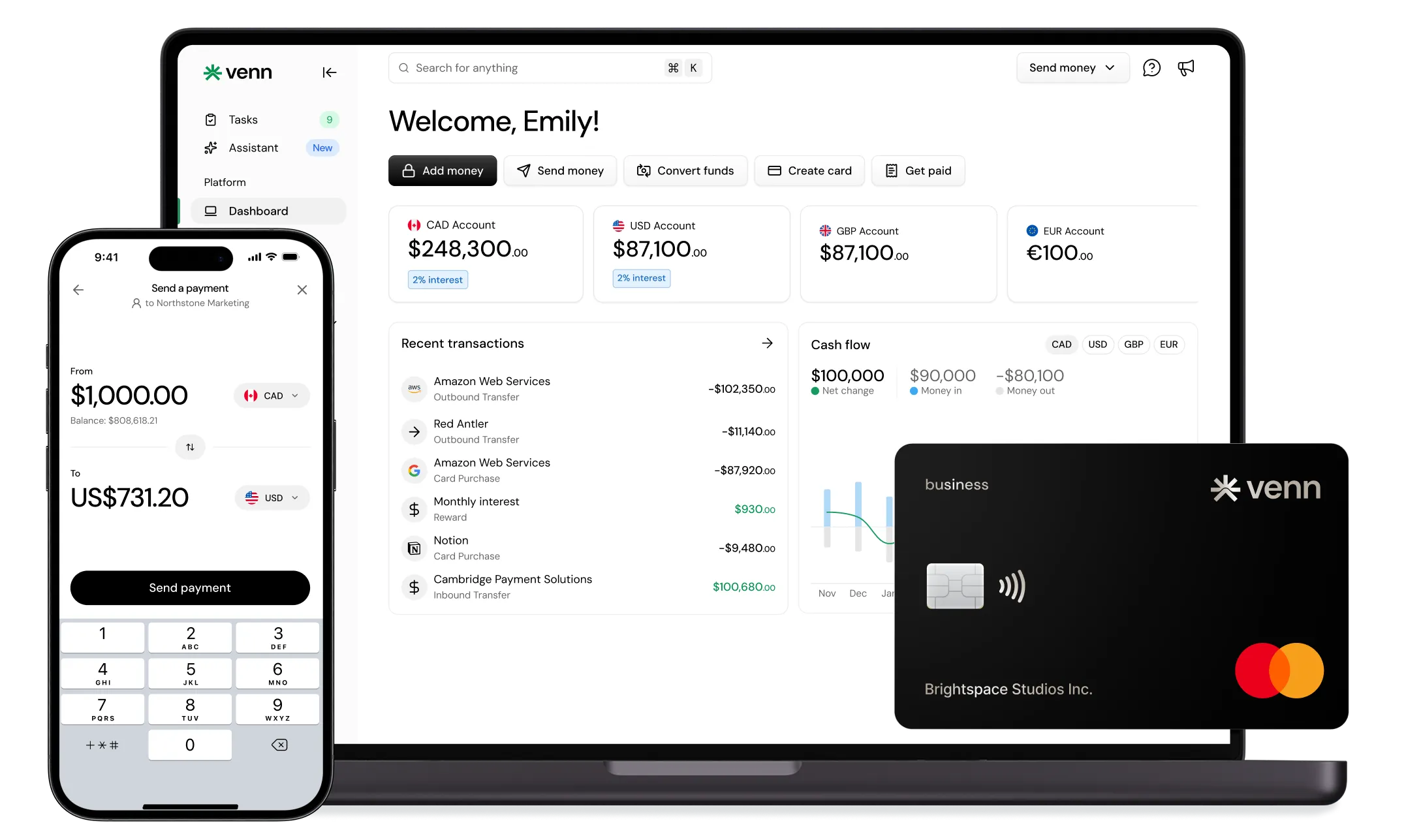
Managing cross-border payroll operations requires clean financial infrastructure. Venn's multi-currency accounts let you separate:
• Payroll funding (CAD): Hold Canadian dollars ready for each pay run without last-minute conversions
• Contractor payments (USD/CAD): Keep vendor payments organized in the appropriate currency
• Tax set-asides (CAD): Earmark funds for CRA remittances and avoid cash flow surprises
Venn's direct QuickBooks and Xero integrations sync payroll funding transfers automatically, reducing manual reconciliation. For Canada-based team expenses, the Venn corporate card with 1% unlimited cashback centralizes spend and captures receipts through OCR, eliminating the reimbursement chase.
Option B: Use an Employer of Record (EOR) in Canada (Best for Speed and Lower Setup Overhead)
What an EOR Does
An Employer of Record legally employs your Canadian workers on your behalf. The EOR handles payroll processing, tax withholdings, remittances, benefits administration, and compliance with Canadian employment law. You direct the day-to-day work while the EOR manages the employment relationship.
When This Is Usually the Best Fit
EOR arrangements work well when you're hiring one to five people in Canada, need to onboard quickly, or want to test the market before committing to entity formation. Many companies use EOR services to hire their first Canadian employees, then transition to direct employment once headcount justifies the setup investment.
Cost and Operations Considerations
EOR providers typically charge per-employee monthly fees ranging from $400 to $700 CAD or more, depending on services included. Some charge additional fees for benefits administration, equipment procurement, or off-cycle payments.
Even with an EOR handling compliance, you still own the financial operations: paying EOR invoices on time, managing FX costs on recurring payments, approving expenses, and reconciling everything in your accounting system.
Where Venn Fits
Pay EOR invoices from the right currency account to avoid unnecessary conversion fees. If your EOR bills in CAD, holding CAD in your Venn account eliminates the FX markup on every invoice.
Venn centralizes the operational side of EOR relationships:
• Vendor payments: Pay EOR invoices and benefits vendors from dedicated accounts
• Spend controls: Issue Venn cards to Canadian team members for travel, tools, and supplies
• Accounting sync: QuickBooks and Xero integrations reduce month-end close time
Option C: Pay Canadian Contractors From the US (Best for Project-Based Work, With Classification Caution)
When Contractors Make Sense
Contractor arrangements fit well for defined projects with clear deliverables, specialized expertise needed for a limited engagement, or work that doesn't require ongoing direction and control. The key is ensuring the relationship genuinely functions as an independent contractor arrangement.
What To Get Right Operationally
Solid contractor relationships require proper documentation and repeatable processes:
• Written agreement: Define scope, deliverables, payment terms, intellectual property ownership, and termination provisions
• Invoice process: Require invoices before payment, and maintain records for tax and audit purposes
• Currency decision: Agree upfront whether you'll pay in CAD or USD, and who bears FX risk
• Payment workflow: Establish approvals, payment timing, and reconciliation procedures
Where Venn Fits
Venn's local currency accounts streamline contractor payments. Pay Canadian contractors in CAD from your Venn CAD account, avoiding the FX markup that comes with converting from USD on each transaction. Vendor records stay clean, and payment history syncs directly to your accounting software.
For contractors who incur expenses on your behalf, Venn's expense management and receipt capture reduces the back-and-forth of reimbursement requests.
Comparison Table: Methods to Pay Canadian Workers From the US
Paying in CAD vs USD: What US Companies Should Decide Up Front
Most Canadian workers expect to be paid in Canadian dollars. Paying in CAD matches their local expenses, eliminates their personal FX risk, and aligns with standard Canadian employment practices.
For US companies, the decision comes down to FX planning. If you convert USD to CAD on every pay run, those conversion costs compound quickly. A better approach: hold CAD in a multi-currency account and convert in larger batches when rates are favorable.
Separate the employment model decision (compliance) from the payment execution decision (operations). The compliance choice determines your legal obligations. The payment execution choice determines how efficiently you fulfill those obligations.
Payment Rails and Practical Timing: What Finance Teams Should Know
Cross-border payments move through different rails, each with trade-offs for cost, speed, and operational complexity.
Cutoff times and banking holidays affect when funds arrive. Canadian statutory holidays differ from US holidays, so payroll funding calendars need to account for both. Build buffer time into your payment schedule to avoid missed pay dates.
The Modern Cross-Border Payroll Stack
The Three Layers
A well-designed cross-border payroll operation has three distinct layers:
• Hiring and compliance layer: Your Canadian entity payroll system or EOR platform
• Money movement and treasury layer: Where you hold currencies, execute payments, and manage FX
• Accounting and reporting layer: QuickBooks or Xero for books, reconciliation, and financial reporting
Where Venn Fits
Venn serves as the money movement and treasury layer that connects your hiring model to your accounting system:
• Multi-currency accounts (CAD/USD/EUR/GBP): Hold the currencies you need without maintaining relationships at multiple banks
• Competitive FX rates: Reduce the drag on recurring cross-border payments
• Corporate card with 1% unlimited cashback: Centralize team spend and eliminate reimbursement delays
• QuickBooks and Xero integrations: Bank feeds, categorization, and receipt capture sync automatically
• Free unlimited Interac e-Transfer®: Pay Canadian vendors and contractors without per-transaction fees
Conclusion: Pick the Compliant Model First, Then Optimize the Money Movement
The best method to pay Canadian employees from the US depends on your headcount, how long you expect to operate in Canada, and how much compliance complexity you want to manage directly. Entity-based payroll gives you control and cost efficiency at scale. EOR services provide speed and simplicity for smaller teams. Contractor arrangements work for project-based engagements when classification is clear.
Once you've chosen the right compliance model, focus on building a repeatable financial workflow that minimizes FX costs and administrative drag. Hold the currencies you need, pay from the right accounts, and keep your accounting clean.
FAQs
Q: Do I need a Canadian entity to pay Canadian employees from the US?
A: Not necessarily. An Employer of Record (EOR) can legally employ workers on your behalf without requiring you to establish a Canadian entity. However, if you plan to build a long-term team of several employees, forming a Canadian entity may become more cost-effective than paying ongoing EOR service fees. It’s best to consult legal and tax advisors to determine the right structure for your situation.
Q: Can I pay a Canadian employee in USD?
A: Technically yes, but most Canadian employees prefer to be paid in CAD so their income aligns with local expenses and avoids personal foreign exchange risk. When employees are paid in USD, they typically bear the currency conversion costs and exposure to exchange-rate fluctuations. This can create friction and may impact recruiting or retention. Consult legal and tax advisors regarding the implications for your specific arrangement.
Q: What payroll amounts are typically withheld in Canada?
A: Canadian employers are generally required to withhold Canada Pension Plan (CPP) contributions, Employment Insurance (EI) premiums, and federal and provincial income tax from employee pay. The exact amounts depend on the employee’s income level, province or territory of residence, and their personal tax credit claims.
Q: When do I need to issue a Record of Employment (ROE)?
A: A Record of Employment (ROE) must typically be issued within five calendar days after the first day of an interruption of earnings, or within five calendar days after the employer becomes aware of the interruption. This requirement applies to situations such as layoffs, resignations, terminations, or extended leaves of absence.
Q: What's the simplest way to reduce FX costs for recurring cross-border payments?
A: Holding funds in the currency you need to pay can reduce foreign exchange costs. For example, if you regularly pay Canadian employees or contractors in CAD, maintaining a CAD balance and converting larger amounts from USD periodically—rather than converting for each individual payment—can reduce transaction fees and provide more control over timing.
This article is for informational purposes only and does not constitute legal, tax, or accounting advice. Consult qualified professionals for guidance specific to your circumstances.
---
**Disclaimer:** This publication is provided for general information purposes and does not constitute legal, tax or other professional advice from Venn Software Inc or its subsidiaries and its affiliates, and it is not intended as a substitute for obtaining advice from a financial advisor or any other professional. We make no representations, warranties or guarantees, whether expressed or implied, that the content in the publication is accurate, complete or up to date.
This publication is provided for general information purposes only and does not constitute legal, tax, financial, or other professional advice from Venn Software Inc., its subsidiaries, or its affiliates, and is not a substitute for advice from a qualified professional. All comparisons and competitor information reflect publicly available information believed accurate as of March 5, 2026; features, pricing, rates, and terms referenced are subject to change and may differ at the time you read this. All product names, logos, and brands referenced are the property of their respective owners; their mention does not imply affiliation with or endorsement by Venn. Any comparative statements reflect Venn's views and are provided to help readers evaluate options. We make no representations, warranties, or guarantees, express or implied, that the content is accurate, complete, or up to date.

Venn is all-in-one business banking built for Canada
From free local CAD/USD accounts and team cards to the cheapest FX and global payments—Venn gives Canadian businesses everything they need to move money smarter. Join 15,000+ businesses today.
Frequently asked questions
Everything you need to know about the product and billing.
Join 15,000+ businesses banking with Venn today
Streamline your business banking and save on your spend and transfers today
No personal credit check or guarantee.