Best Bank Account for Non-Profits in Canada 2026 Guide
Best Bank Account for Non-Profits in Canada 2026 compares Big 5 and modern options like Venn. Cut fees, simplify approvals, manage multi-currency, automate books.

.png)
Trusted by 15,000+ Canadian businesses
Business banking for Canada
Local CAD and USD accounts, corporate cards with cashback, the lowest FX rates in Canada, free local transfers, and more.
Running a non-profit in 2026 means stretching every donor dollar while maintaining the transparency boards and auditors demand. The right bank account does more than hold funds. It reduces fees, simplifies multi-signer approvals, and keeps your books audit-ready without consuming volunteer hours.
This guide compares the best non-profit bank accounts in Canada for 2026, from traditional Big 5 options to modern digital platforms. Whether your organization needs branch access for cash deposits or multi-currency accounts for international grants, you'll find a clear recommendation.
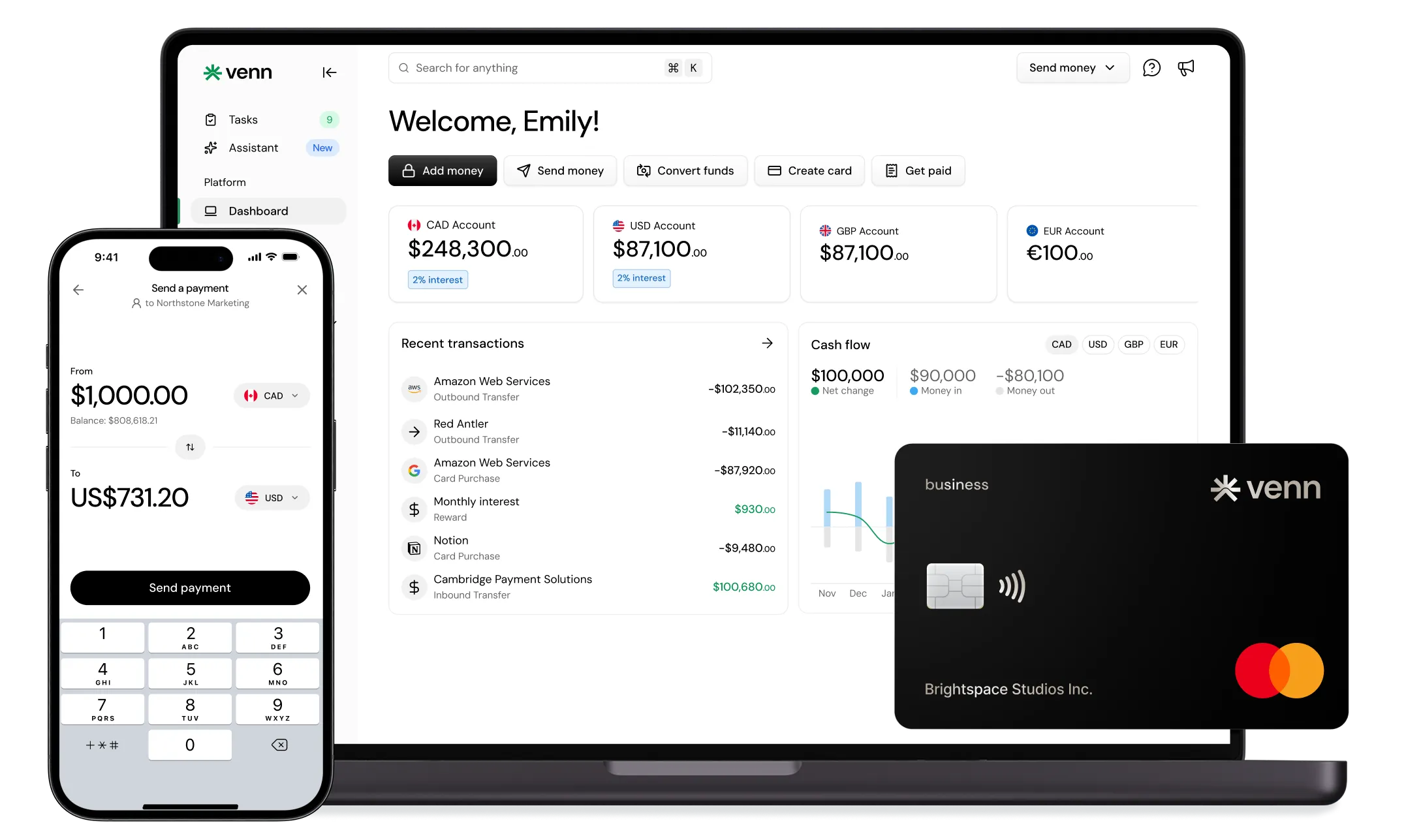
For non-profits seeking a complete finance stack with multi-currency accounts, 1% cashback from the first dollar on operational spending, and direct QuickBooks or Xero integration, Venn combines all three in a single platform designed to reduce fees and manual work for non-profit finance teams.
Quick Picks: The Best Non-Profit Bank Accounts in Canada (2026)
• Best Overall (Modern Digital Stack): Venn.* Local CAD, USD, EUR, and GBP accounts with 1% cashback from the first dollar, free Interac e-Transfer®, and accounting automation that eliminates manual reconciliation.
• Best for In-Person Branch Banking: RBC Royal Business Community Account. Extensive branch network and familiar service model for organizations requiring regular in-person transactions.
• Best for Lowest Big-Bank Community Fees: Scotiabank Scotia Community Account Plan. Competitive monthly fees with bundled transactions designed specifically for registered non-profits.
• Best for Registered Charities: CIBC Not-for-Profit Operating Account. Dedicated non-profit pricing with fee waiver for qualifying registered charities maintaining a $5,000 minimum balance.
• Best for Ontario Regional Non-Profits: Meridian Community Account. Credit union values with lower fees and local decision-making for community organizations.
• Best for BC Regional Non-Profits: Vancity Community Service Package. Strong social mission alignment and community-focused banking for BC-based charities.
• Best for Big 5 Simplicity: BMO Community Account. Designed for locally based not-for-profit groups, the BMO Community Account charges $2.50/mo (waived with a $5,000 minimum balance) and includes 12 electronic transactions per month.
Compare The Best Non-Profit Bank Accounts in Canada (2026)
| Provider | Best For | Monthly Fee | Included Transactions | Branch Access | Local CAD | Local USD + ACH | FX & International | Controls & Accounting | Key Watch-Out |
|---|---|---|---|---|---|---|---|---|---|
| Venn | Modern digital finance stack | $0-99 | Unlimited on most plans | No | Yes | Yes (real ACH) | 0.25-0.45% FX; $6-10 wires | Cards, OCR receipts, QuickBooks/Xero | No Quebec; no branch cash deposits |
| RBC Community Account | Branch banking + familiarity | $6-15 | 20-50 | Yes | Yes | Limited (no ACH) | 2.5%+ FX; $17+ wires | Basic online banking | High FX costs; wire fees add up |
| Scotiabank Community Plan | Low Big-Bank fees | $0-10 | 25-40 | Yes | Yes | Limited | 2%+ FX; $15+ wires | Standard online tools | Transaction overages; FX markup |
| CIBC Not-for-Profit Account | Registered charities | $4 (waived with $5,000 balance) | 25 | Yes | Yes | Limited (no ACH) | 2.5%+ FX; $15+ wires | Standard online banking | $5,000 balance to waive fee; overage fees |
| TD Business Account | Existing TD relationships | $10-25 | 25-60 | Yes | Yes | Limited | 2.5%+ FX; $20+ wires | Basic digital banking | Verify correct plan; higher fees |
| Meridian (ON) | Ontario local non-profits | $0-8 | 30-50 | Yes (ON) | Yes | No | Limited FX options | Standard credit union tools | Ontario only; limited digital features |
| Vancity (BC) | BC community organizations | $0-10 | 25-40 | Yes (BC) | Yes | No | Limited FX options | Basic online banking | BC only; regional constraints |
Pricing and features as of April 2026. Verify current details directly with providers before opening an account.
How We Chose These Accounts (Methodology for 2026)
Our evaluation prioritizes what actually matters for non-profit financial operations:
Total Cost of Ownership (30%) — Monthly fees tell only part of the story. We examined per-transaction overages, cash deposit fees, wire costs, and hidden FX markups that quietly drain donor dollars.
Governance and Controls (25%) — Non-profits need multiple signers, role-based access, and clear audit trails. We evaluated how each platform handles board-level oversight and treasurer workflows.
Payment Rails Coverage (20%) — Can you pay rent, utilities, and vendors efficiently? We assessed bill pay, EFT/ACH capabilities, wire transfers, and Interac e-Transfer® availability.
Multi-Currency and FX Transparency (15%) — Organizations receiving international grants or paying foreign vendors need clear, competitive exchange rates without surprise fees.
Setup Ease and Support (10%) — Non-profits often rely on volunteer finance committees. We considered how quickly organizations can open accounts and access help when needed.
What Non-Profits Should Look For in a Bank Account (2026 Checklist)
Fees That Quietly Drain Donor Dollars
Monthly fees represent the obvious cost, but the real budget impact often hides elsewhere. Per-transaction overages can surprise organizations with active payment schedules, especially those processing numerous vendor payments or donor acknowledgments monthly.
Cash deposit fees matter significantly for non-profits running fundraising events, accepting in-person donations, or handling membership dues. Some banks charge per-deposit or percentage-based fees that accumulate quickly during busy seasons.
Wire fees deserve particular scrutiny. Inbound international wires often carry $15-20 fees even for small grant payments. Outbound wires for international program work can cost $30-50 per transaction at traditional banks. FX markups compound these costs, with some institutions charging 2.5-3% above mid-market rates on currency conversions.
Governance, Auditability, and Finance Ops
Non-profit boards require visibility into organizational spending without micromanaging daily operations. Look for platforms offering role-based access that lets treasurers approve payments while giving executive directors spending authority within defined limits.
Clear statements and export capabilities matter during audit season. Your accountant or bookkeeper needs transaction data in formats that import cleanly into accounting software. Receipt capture and coding features reduce the manual work of matching expenses to budget categories. For a deeper comparison, see our guide to expense management platforms designed for non-profits.
Separating program funds from operating accounts helps organizations track restricted grants accurately. Some platforms offer sub-accounts or budgeting tools that maintain this separation without requiring multiple bank relationships.
Payments: What You Actually Need to Run Programs
Paying utilities, rent, and vendors should be straightforward. Bill pay features that schedule recurring payments reduce administrative burden. EFT capabilities for Canadian vendors and ACH for US-based suppliers keep payment costs low.
Payroll integration matters for organizations with staff. Verify that your banking platform works with your payroll provider or offers direct payroll capabilities.
Consider how your organization handles volunteer and staff reimbursements. Issuing cards with spending controls eliminates the reimbursement cycle entirely, reducing paperwork and improving expense visibility. This approach also prevents the common problem of volunteers fronting organizational expenses on personal cards. For more options, see our roundup of the best non-profit credit cards in Canada.
Accounting Software and Integrations
For non-profits that rely on volunteer treasurers or part-time bookkeepers, the connection between your bank account and your accounting software is a practical selection criterion that often gets overlooked.
Direct bank feeds, where transactions flow automatically into QuickBooks, Xero, or similar platforms, reduce manual data entry and lower the risk of reconciliation errors. This is especially valuable for organizations that need to track restricted funds, grant allocations, and program-specific budgets separately.
Most Big 5 bank accounts offer CSV or OFX file exports, which require manual downloads and imports on a regular schedule. Modern financial platforms increasingly provide direct two-way integrations that sync transactions, categorize expenses, and match payments in real time.
When evaluating accounts, ask whether the platform supports a direct feed to your accounting software, or whether your team will need to build a manual export workflow. For organizations with limited finance staff, that difference can save hours each month and reduce the chance of errors during audit season.
Registered Charities vs. Unregistered Non-Profits
CRA-registered charities (those with a registered charity number) often qualify for dedicated "community" or "not-for-profit" account tiers with reduced fees and fee waivers. Unregistered non-profits, community groups, sports teams, and parent councils typically need a standard business account or a community account that does not require CRA registration. Before choosing a provider, confirm whether your organization's status qualifies for non-profit pricing. If you haven't yet registered, the Government of Canada outlines how to apply for registered charity status with the CRA. Most Big 5 banks require proof of CRA registration for their lowest-fee community tiers.
Start banking smarter with Venn
Open a business account in minutes with no monthly fees, low FX rates, and corporate cards.
Get Started →
Provider Reviews
Venn (Best Overall for Modern Non-Profit Finance Ops)
Venn operates as a business banking platform that consolidates banking, corporate cards, payables, and expense management into one system. For non-profits managing complex funding sources and multiple spending categories, this integration eliminates the friction of coordinating separate tools.
Multi-Currency Capabilities
The platform provides local CAD, USD, EUR, and GBP accounts. The USD account functions as a real local US account with ACH capabilities, meaning organizations can receive US grant payments without paying international wire fees. This matters significantly for non-profits receiving funding from US foundations or paying American contractors.
When funds arrive from Stripe, Shopify, or PayPal, organizations can receive them directly in matching currency accounts without forced conversions. For non-profits accepting online donations internationally, this eliminates the 1.5% cross-border fees that typically apply.
Spending Controls and Cashback
The 1% unlimited cashback on card spending creates measurable budget relief on operational expenses like supplies, travel, and program costs. Unlike some competitors that require $25,000+ monthly spend to unlock rewards, Venn's cashback applies from the first dollar.
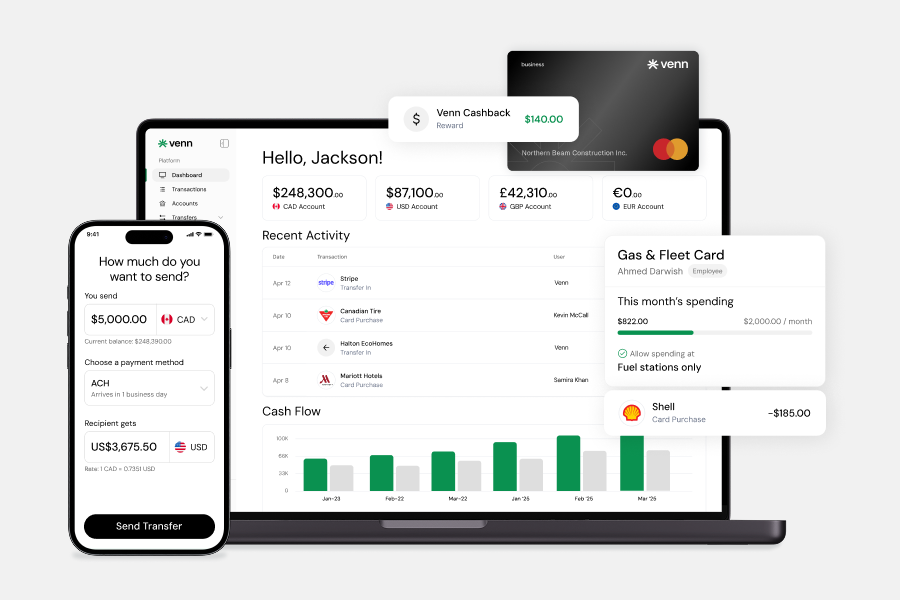
Cards can be issued to staff or program coordinators with spending limits and category controls. On their phone, staff can access funds, send transfers, and create new cards through Venn's mobile app, reducing the need for desktop admin. Finance committees gain visibility into spending patterns without requiring manual expense reports. OCR receipt capture and invoice matching streamline the accounting close process.
Accounting Integration
Direct QuickBooks and Xero integration automates transaction categorization and reconciliation. For organizations with volunteer treasurers or limited finance staff, this automation reduces manual data entry and improves accuracy.
Free, unlimited Interac e-Transfer® on all plans handles vendor payments and contractor reimbursements without per-transaction fees. Combined with $6-10 international wire fees and 0.25-0.45% FX rates, the platform significantly reduces payment costs compared to traditional banks.
Limitations
Venn is available in all Canadian provinces except Quebec. Organizations requiring daily branch cash deposits should pair Venn with a local branch institution for that specific need while using Venn for cards, payables, and digital banking.
Venn accounts are covered under CDIC insurance protection through Bank of Montreal, providing the same security as traditional banking relationships.
RBC Royal Business Community Account (Best for Traditional Branch Banking)
RBC's community account suits local charities and clubs that value in-person service and branch accessibility. The extensive branch network across Canada provides convenient access for organizations handling regular cash deposits or requiring face-to-face support.
The account includes a set number of monthly transactions with competitive pricing for registered non-profits. Staff familiarity with community organization needs can simplify account setup and ongoing support.
Watch for FX costs if your organization receives international donations or pays foreign vendors. RBC's exchange rate markup and wire fees can significantly exceed modern digital alternatives. Organizations with cross-border funding should calculate the true cost of international transactions before committing.
Scotiabank Scotia Community Account Plan (Best for Low Big-Bank Community Pricing)
Scotiabank offers one of the more competitive community account packages among major banks. The plan includes waived or reduced monthly fees for qualifying non-profits with bundled transaction limits designed for typical charity activity levels.
The account works well for organizations with straightforward banking needs: receiving domestic donations, paying local vendors, and maintaining clear financial records. Branch access throughout Canada provides flexibility for cash handling.
Verify the included transaction count and understand what counts as a "transaction" under the plan terms. Organizations with high payment volumes may face overage fees that erode the cost advantage. FX and international wire capabilities carry typical Big 5 pricing, making this less suitable for organizations with significant cross-border activity.
CIBC Not-for-Profit Operating Account (Best for Registered Charities)
CIBC's dedicated not-for-profit operating account serves CRA-registered charities and non-profit organizations with purpose-built pricing. The $4 monthly fee is waived when the account maintains a $5,000 minimum balance, making it effectively free for organizations that keep moderate operating funds on hand.
The account includes 25 monthly transactions with branch access across Canada. For charities with straightforward domestic banking needs (receiving donations, paying local vendors, maintaining clear records), CIBC provides a familiar and accessible option.
Watch for limitations on international activity. FX markups and wire fees follow typical Big 5 pricing, which can add up for organizations receiving cross-border grants or paying foreign contractors. The $5,000 balance requirement also ties up funds that smaller charities may prefer to keep liquid.
TD Business Account (Best for Existing TD Relationships)
Organizations with existing TD relationships may find value in consolidating their banking. TD's branch network and digital banking tools provide adequate functionality for basic non-profit needs.
Confirm the correct account type for your organization, as TD's business account lineup includes various tiers with different fee structures and included services. Some non-profits may qualify for community pricing while others may default to standard business rates.
TD's international capabilities carry premium pricing typical of major banks. Organizations receiving USD grants or paying international vendors should calculate the total cost including FX markup and wire fees before assuming TD offers the best value based on relationship convenience.
Meridian (Credit Union Option, Ontario)
Meridian serves Ontario-based non-profits with credit union values: member ownership, local decision-making, and community investment. Monthly fees typically run lower than Big 5 alternatives, with transaction limits appropriate for small to mid-sized charities.
The credit union model means surplus earnings return to members rather than shareholders, aligning with non-profit values. Local branch staff often develop genuine relationships with community organizations.
Digital banking capabilities may lag behind major banks and modern platforms. Organizations requiring sophisticated multi-currency operations or advanced expense management should evaluate whether Meridian's feature set meets their needs. Geographic limitation to Ontario restricts this option for organizations operating across provinces.
Vancity (Credit Union Option, BC)
Vancity's community service package aligns banking with social mission. The credit union prioritizes environmental and social impact, making it a natural fit for BC-based non-profits sharing those values.
Account pricing favors community organizations with reduced fees and transaction bundles. Local branches throughout BC provide accessible service for organizations preferring in-person banking.
Regional availability limits Vancity to BC operations only. International capabilities and digital features remain basic compared to modern platforms. Organizations with complex funding sources or multi-currency needs should supplement Vancity with additional tools.
BMO Community Account (Best for Big 5 Simplicity)
BMO offers a dedicated Community Account designed specifically for locally based not-for-profit organizations. For non-profits that want the familiarity and branch network of a Big 5 bank without a complex fee structure, it provides a straightforward entry point.
Key Features
The account charges $2.50 per month, waived when you maintain a $5,000 minimum balance. It includes 12 electronic transactions per month (Interac e-Transfer®, bill payments, EFTs) and full branch access across Canada for in-person banking needs. Deposits are CDIC-insured.
Limitations
The 12-transaction limit is the main constraint. Non-profits that process donor receipts, vendor payments, and payroll through the same account can exceed this cap quickly, and overage fees add up. BMO's foreign exchange rates follow standard Big 5 pricing, which typically runs 1.5% to 3% above mid-market. Digital tools are basic compared to fintech alternatives: there is no direct QuickBooks or Xero integration, so your team will need to export and import transaction files manually.
The BMO Community Account works best for very small, low-activity non-profits, such as local service clubs or neighbourhood associations, that value in-person branch service and process fewer than a dozen transactions per month.
Which Option Should You Choose?
If you need multi-currency accounts, corporate cards, and accounting automation → Venn provides the most comprehensive modern finance stack, reducing manual work while improving spending visibility and governance.
If you require daily branch cash deposits → Choose a Big 5 bank or local credit union for cash handling, then consider pairing with Venn for cards, payables, and digital banking.
If you receive USD grants or pay US vendors → Prioritize local USD account capability with ACH access. Venn's real US account eliminates the wire fees that traditional "US accounts" based in Canada still charge.
If you have a volunteer treasurer and minimal activity → A low-fee community plan from Scotiabank or your local credit union may provide sufficient functionality at the lowest cost.
If you operate in BC or Ontario and value credit union membership → Vancity or Meridian offer community-aligned banking with lower fees, though you may need supplementary tools for complex operations.
Conclusion
Non-profits in 2026 face increasing pressure to demonstrate financial stewardship while minimizing administrative overhead. The right bank account reduces fees, simplifies governance, and keeps your organization audit-ready without consuming volunteer hours.
For most modern non-profits, the optimal approach combines digital-first platforms for cards, payables, and accounting automation with traditional banking only where physical branch access is essential. This stack approach maximizes efficiency while maintaining the flexibility your organization needs.
Next step: Shortlist 2-3 options from this guide, verify current pricing on provider websites, and map each option against your organization's specific payment flows and governance requirements.
Ready to modernize your non-profit's financial operations? Sign up for a Venn account to explore multi-currency accounts, unlimited cashback, and accounting automation designed for how organizations actually work.
FAQ
Q: Can a non-profit open a business bank account in Canada?
Yes. Registered non-profits, charities, and community organizations can open business bank accounts in Canada. Most financial institutions offer dedicated non-profit or community account packages with reduced fees. You’ll typically need incorporation documents, a board resolution authorizing the account, and identification for signing officers.
Q: What documents do we need to open a non-profit bank account?
Requirements usually include articles of incorporation or letters patent, a CRA registration number (for registered charities), a board resolution authorizing account opening and naming signing officers, government-issued ID for all signers, and proof of the organization’s address. Requirements vary by institution, so confirm details in advance.
Q: What banking fees matter most for non-profits in 2026?
Beyond monthly account fees, non-profits should closely monitor per-transaction charges, cash deposit fees, wire transfer costs, and foreign exchange markups. For organizations with international funding or vendors, FX markups can exceed 2.5% at traditional banks and often represent the largest hidden cost.
Q: What's the best way to receive and hold USD as a Canadian non-profit?
The most efficient approach is a local USD account with ACH capabilities. This allows U.S. funders to send domestic transfers instead of international wires, avoiding $15–$20 inbound wire fees per payment. Platforms like Venn provide real U.S.-domiciled accounts with ACH access, unlike most Canadian bank USD accounts that rely on wire networks.
Q: How can we reduce reimbursements and improve spending controls?
Issuing corporate cards to staff and program coordinators with predefined limits and merchant category controls reduces reimbursement volume and improves oversight. This approach provides real-time visibility into spending and simplifies audits. Platforms like Venn also offer unlimited cashback on card spend, helping offset operational costs.
Q: What is a community bank account?
A community bank account is a bank account tier designed for non-profits, charities, clubs, and community organizations. These accounts typically offer lower monthly fees and bundled transactions compared to standard business accounts. Most Big 5 banks offer one.
Q: What is the best bank account for a sports team or club in Canada?
Unincorporated clubs and sports teams can open a community bank account at most Big 5 banks without CRA registration. Look for low monthly fees, enough included transactions for dues collection, and card access for equipment purchases.
Q: Do non-profit bank accounts integrate with accounting software like QuickBooks?
Most traditional bank accounts offer CSV or OFX export only, requiring manual imports. Modern platforms like Venn provide direct QuickBooks and Xero integration with automated transaction categorization, reducing manual data entry for volunteer treasurers.
Venn Mastercard Charge Card is issued by Peoples Trust Company under licence from Mastercard International Incorporated. Mastercard is a registered trademark, and the circles design is a trademark of Mastercard International Incorporated.
---
**Disclaimer:** This publication is provided for general information purposes and does not constitute legal, tax or other professional advice from Venn Software Inc or its subsidiaries and its affiliates, and it is not intended as a substitute for obtaining advice from a financial advisor or any other professional. We make no representations, warranties or guarantees, whether expressed or implied, that the content in the publication is accurate, complete or up to date.

Venn is all-in-one business banking built for Canada
From free local CAD/USD accounts and team cards to the cheapest FX and global payments—Venn gives Canadian businesses everything they need to move money smarter. Join 15,000+ businesses today.
Frequently asked questions
Everything you need to know about the product and billing.
Join 15,000+ businesses banking with Venn today
Streamline your business banking and save on your spend and transfers today
No personal credit check or guarantee.