Best Bank Account for Canadian Freelancers in 2026 Guide
Best Bank Account for Canadian Freelancers in 2026 compares Venn and top banks on fees, FX, branches, and QuickBooks Xero sync so you pick faster today.

Trusted by 15,000+ Canadian businesses
Business banking for Canada
Local CAD and USD accounts, corporate cards with cashback, the lowest FX rates in Canada, free local transfers, and more.
Best Bank Account for Canadian Freelancers in 2026
Updated June 2026
Introduction
Your first client payment lands in your personal chequing account, then your second, and suddenly your tax software is asking you to untangle groceries from software subscriptions and consulting fees. That's the moment most freelancers realize personal banking has stopped working for them—well before they're ready for the paperwork and minimum balances of a traditional business banking relationship. You need somewhere to hold tax set-asides, pay for the tools that run your practice, and receive client payments without second-guessing which dollars are yours to spend.
Canadian freelancers weighing their options in 2026 generally land in one of two camps. Some want domestic banking with branch access, useful if you deposit cheques or the occasional cash payment. Others need digital-first workflows built for invoicing, software integrations, and cross-border payments. This comparison covers business chequing accounts from established banks alongside digital business banking platforms, because that's genuinely how freelancers are shopping right now. The right fit depends on how you get paid, how you spend, and how much admin you're willing to manage yourself—so this article walks through several strong choices rather than declaring a universal winner.
Quick Comparison Table
Freelancers rarely have time to dig through five separate banking websites before choosing an account. This table lines up the five options covered in this guide side by side, so you can narrow your shortlist before reading further.
| Provider | Best For | Monthly Fee | Sole Proprietor Friendly | USD / Multi-Currency Support | Branch / Cash Deposit Access | Accounting Integrations | Main Tradeoff |
|---|---|---|---|---|---|---|---|
| Venn | International-facing freelancers wanting one connected workflow | $0 to $100/mo, plan-based | Yes, except Quebec | CAD, USD, GBP, EUR accounts plus multi-currency card | No physical branches | QuickBooks, Xero | No in-person cash deposits or teller service |
| RBC | Freelancers who want a large branch network | ~$22.50/mo, package-based | Yes | CAD only, USD via separate account | Extensive branch and ATM network | Limited native sync | Fees climb with transaction volume |
| TD | Freelancers who value familiar, in-person banking | ~$23/mo, package-based | Yes | CAD only, USD via separate account | Wide branch and ATM footprint | Limited native sync | Less efficient for USD or FX-heavy work |
| Scotiabank | Freelancers comparing flexible transaction bundles | ~$19-$25/mo, tiered | Yes | CAD only, USD via separate account | Solid branch access | Limited native sync | Pricing tied to usage, easy to overpay |
| BMO | Freelancers who want digital tools with a full-service bank backup | ~$19.50/mo, package-based | Yes | CAD only, USD via separate account | Established branch network | Limited native sync | Manual work still needed for invoicing and reconciliation |
Fees, transaction caps, and account minimums shift often, so confirm current pricing and limits directly with each provider before you apply. Note that Interac e-Transfer® availability and pricing also vary by plan and provider.
What Canadian Freelancers Should Compare First
A freelancer who invoices four clients a month has almost nothing in common, banking-wise, with one who processes fifty transactions across three currencies. Start with real usage, not the sticker price. A flat monthly fee package that includes 30 transactions looks generous until you realize you only need eight—in that case, a no-fee or pay-per-use structure often costs less over a year, even if the headline number seems higher. Watch for the charges that don't show up in the fee table: wire fees, FX markups, and add-on charges for extra users or paper statements can turn an affordable-looking account into an expensive one.
Eligibility matters just as much. Some providers only serve incorporated businesses, which shuts out sole proprietors before they even get to compare features. Confirm this early, and check for province-specific restrictions, since not every platform operates the same way across the country.
Think next about how clients actually pay you. Domestic invoicing through Interac e-Transfer® works fine for CAD-only work, but U.S. clients, marketplaces, or payment processors often demand wires, EFT, or ACH capability instead.
Cash needs vary too. Some freelancers never see a physical dollar; others still deposit cheques or need a nearby branch. Factor that in before narrowing your options.
Finally, weigh the admin side. Accounts that sync with QuickBooks or Xero and support receipt capture cut reconciliation time significantly for solo operators managing their own books.
Best Options For Canadian Freelancers In 2026
The five profiles below cover a digital-first platform and four traditional bank chequing options, each with a distinct fit. For every one, you'll find the use case it suits best, where it genuinely delivers, where it falls short, and the details worth confirming directly with the provider before you sign up.
Venn
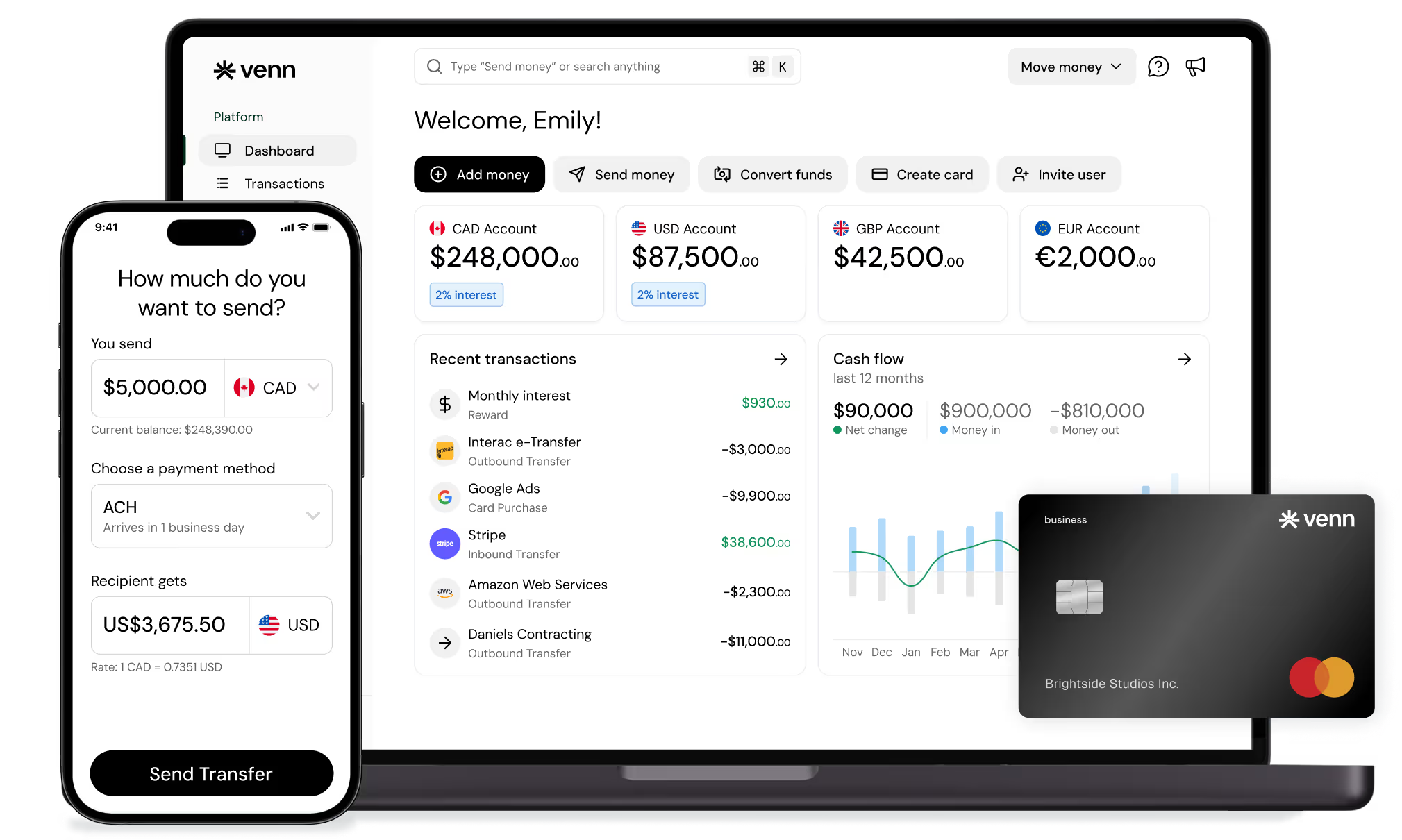
A freelancer invoicing clients in New York and London, then paying a contractor in Toronto, needs more than a chequing account. Venn is built as a business banking platform for exactly that scenario: sole proprietors and corporations juggling multiple currencies and software-driven admin, all outside Quebec, where Venn isn't currently available.
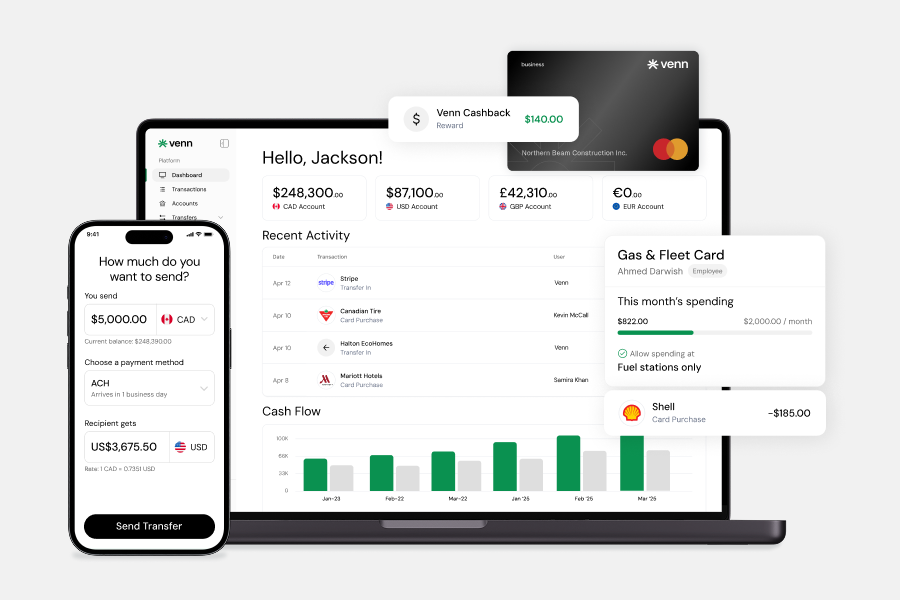
Money moves in CAD, USD, GBP, and EUR, with FX rates that improve as you move up plan tiers. The corporate card matches spend to the right currency automatically, so a USD vendor payment draws straight from your USD balance instead of triggering a conversion fee. Cashback starts at 1% from the first dollar—capped on entry-level plans but unlimited on Pro. Invoicing, bill pay, expense management, spend controls, and OCR receipt capture all live in one workflow, syncing directly with QuickBooks and Xero. Vendor payments move for free through unlimited Interac e-Transfer® sending and receiving.
Venn pays 2.75% interest on CAD and 3.00% on USD balances, with no minimum and no caps, plus up to 3.50% on larger USD balances (learn more). Eligible deposits carry CDIC insurance protection.
Freelancers who deposit cash regularly or want a teller relationship should look elsewhere, and CRA payments require setup outside the product.
RBC Business Chequing Option
Picture a freelancer who wants to walk into a branch, deposit a cheque from a longtime client, and speak with a real person about a line of credit down the road. That's the freelancer RBC serves well. With one of the largest branch and ATM networks in the country, RBC gives sole proprietors and incorporated freelancers a familiar business chequing structure backed by decades of institutional trust. For someone billing primarily in Canadian dollars and building toward services like equipment financing or a merchant account, this conventional setup offers a natural runway to grow the banking relationship over time.
That familiarity comes with tradeoffs. Package tiers determine your monthly fee, and costs climb fast once transaction volume or minimum balance requirements push you into a higher tier. Freelancers billing international clients often find the FX handling clunkier than currency-native alternatives, and the chequing account doesn't include invoicing or bookkeeping tools, so you'll likely pair it with separate software. Confirm the current package name, fee, transaction allowance, and cash deposit terms directly with RBC before opening an account, since these details shift periodically.
TD Business Chequing Option
If you already bank with TD personally and want your business account under the same roof, this is worth a serious look. TD suits a freelancer who does most work with domestic clients, occasionally deposits a cheque or cash, and prefers walking into a branch when a question comes up rather than troubleshooting through a chat window. Its network of branches and ATMs stretches across the country, so a writer in Halifax and a consultant in Victoria get the same teller access and in-person support. For freelancers whose income and expenses stay entirely in Canadian dollars, TD offers a banking relationship that feels familiar and requires little adjustment from personal banking habits.
The tradeoffs show up once work gets more complex. Receiving payments from American clients or running invoicing and reconciliation through connected software isn't where a traditional chequing setup shines, so freelancers with cross-border income often end up layering on separate tools. Low-volume freelancers should also scrutinize transaction limits and add-on fees closely—a modest monthly price can look appealing until per-transaction charges start adding up. Confirm the current business package name, fee structure, transaction caps, and branch specifics directly with TD before committing.
Scotiabank Business Chequing Option
A freelancer weighing package tiers against actual monthly transaction habits will find Scotiabank worth a close look. This option suits someone who wants a conventional bank account first, then plans to bolt on invoicing software, a bookkeeping tool, and expense tracking separately rather than expecting one platform to handle it all.
Scotiabank's business chequing lineup gives freelancers room to pick a package that roughly matches their transaction volume, and the branch network offers a familiar landing spot for anyone who still values in-person support. That flexibility becomes real value once you confirm which package fits your actual pay-in and pay-out counts.
The catch is fit. Invoicing, multi-currency handling, and automated bookkeeping sit outside the core account, so you'll assemble those pieces on your own. Transaction-based pricing also punishes a lean operation if your usage lands well below what you're paying for. Verify current pricing, package tiers, transaction inclusions, and cash-handling details directly with Scotiabank before committing.
BMO Business Chequing Option
A freelancer who wants a familiar bank name behind their business account, but still expects to manage most day-to-day work online, fits BMO well. It suits solo operators handling mostly domestic clients who still want a full banking relationship on hand for lending, credit, or in-person advice down the road.
BMO's appeal rests on its established infrastructure. Branch and ATM networks span the country, so a freelancer who occasionally needs to deposit a cheque or speak with someone face-to-face has options most digital platforms can't match. For straightforward Canadian business activity—invoicing domestic clients and moving money between personal and business accounts—that traditional setup works reliably.
The tradeoff shows up in daily admin. Freelancers will likely still need separate software for invoicing, expense tracking, and reconciliation, since the chequing account functions primarily as a place to hold and move money rather than run a finance workflow. And for freelancers who never set foot in a branch or handle cash, that physical footprint offers little practical value. Confirm current package names, monthly pricing, transaction allowances, and cash deposit terms directly with BMO before committing.
Best Match by Work Style
Picture five freelancers with five different Tuesdays. That's the real test—not a feature list.
If you invoice a handful of Canadian clients each month and just want your money separated from your grocery budget, skip the bells and whistles. A no-frills domestic chequing account with predictable fees handles that job well, especially if you rarely dip below the transaction cap.
Freelancers billing U.S. clients or managing contractors abroad face a different problem: currency conversion eats margin fast. That's where the Venn section above becomes relevant, particularly its multi-currency account structure and card built for cross-border spend.
If you still deposit cheques or cash, or want a teller to sort out a banking issue in person, lean on the traditional bank profiles covered earlier rather than a digital-first setup.
For bookkeeping automation, prioritize whichever option syncs cleanly with your accounting software—cutting reconciliation time to minutes instead of hours.
Incorporated freelancers hiring their first contractor should prioritize card controls and approval workflows, since spend visibility matters more once someone else is swiping a card. Interac e-Transfer® access still matters here too, particularly for one-off vendor or contractor payments outside a formal payables system.
How To Choose The Right Account
Five checks will get you to a decision faster than any feature list.
Start with your business structure. A sole proprietor and an incorporated freelancer don't always qualify for the same products, and province matters too, since not every provider serves Quebec. Confirm eligibility before you fall in love with a feature set.
Next, audit how money actually moves through your business each month. Count your transactions. Note whether payments arrive in CAD, USD, or both, and whether you rely on Interac e-Transfer® for most client payments or need wires and EFTs as well. A freelancer with three invoices a month has different needs than one juggling ten clients across two currencies.
Then look past the sticker price to the admin cost hiding underneath. Invoicing friction, bookkeeping cleanup, chasing lost receipts, and hours spent reconciling at month-end all cost real time—and time is the one expense freelancers chronically underprice.
Decide whether you need branch services. If cash deposits, certified cheques, teller help, or a wide ATM network matter to your workflow, weigh that heavily. Fully remote freelancers often don't need it at all (see the platform sections above).
Finally, match your card to your actual spend: recurring software subscriptions, travel, contractor payments, and assistant access all call for different controls.
Conclusion
Picking the right account comes down to three questions: how money reaches you, whether you need a branch nearby, and how much admin work you're willing to tolerate each month. A freelancer billing U.S. clients weekly has different priorities than one who deposits cheques at a teller twice a year. Rather than guessing, shortlist two accounts and test them against your next 12 months—expected client payments, the software you already use for invoicing and taxes, and how you plan to track spending. If that exercise points toward multi-currency accounts, accounting integrations, invoicing, and card-based expense management in one place, Venn is worth a look.
FAQs
Q: Do freelancers in Canada need a business bank account? A: Not always. Nothing in the law forces a sole proprietor to open one for every situation. That said, keeping business income separate from personal spending makes tax season far less painful, gives you cleaner records if the CRA ever asks questions, and signals professionalism to clients who pay you regularly.
Q: Can a sole proprietor open a business account in Canada? A: Yes, in most cases, but eligibility varies by provider and by province. Some platforms and banks impose restrictions depending on where you operate, so confirm the requirements directly with the provider before you apply.
Q: What matters more for freelancers, low fees or features? A: It depends on how complicated your payments are. A freelancer billing a handful of Canadian clients each month might prioritize a low or no monthly fee, while someone juggling foreign currency invoices, recurring software costs, and bookkeeping cleanup often saves more time and money through the right feature set than through the lowest sticker price.
Q: Are digital business banking platforms a real alternative to traditional banks? A: Yes, particularly for freelancers who operate entirely online. If you never need a teller, an ATM, or a cash deposit slot, a digital-first platform can handle everything from invoicing to card spend without the overhead of a branch relationship.
Q: What if I get paid by U.S. clients? A: Look for genuine USD receiving capability rather than a CAD account that simply displays U.S. dollars, since that distinction affects how much you lose to conversion. Lower FX friction and cleaner foreign-currency accounting matter here, so revisit the comparison table and platform breakdowns above to see which options handle U.S. income without forcing an unwanted conversion.
--- **Disclaimer:** This publication is provided for general information purposes only and does not constitute legal, tax, financial, or other professional advice from Venn Software Inc., its subsidiaries, or its affiliates, and is not a substitute for advice from a qualified professional. All comparisons and competitor information reflect publicly available information believed accurate as of June 1, 2026; features, pricing, rates, and terms referenced are subject to change and may differ at the time you read this. All product names, logos, and brands referenced are the property of their respective owners; their mention does not imply affiliation with or endorsement by Venn. Any comparative statements reflect Venn's views and are provided to help readers evaluate options. We make no representations, warranties, or guarantees, express or implied, that the content is accurate, complete, or up to date.
Venn is all-in-one business banking built for Canada
From free local CAD/USD accounts and team cards to the cheapest FX and global payments—Venn gives Canadian businesses everything they need to move money smarter. Join 15,000+ businesses today.
Frequently asked questions
Everything you need to know about the product and billing.
Join 15,000+ businesses banking with Venn today
Streamline your business banking and save on your spend and transfers today
No personal credit check or guarantee.