Starting a Business in Canada for Foreigners: A Guide for 2026
Starting a Business in Canada for Foreigners: A Guide covers legal steps, costs, banking, and FAQs—your expert roadmap to launching successfully in 2026.


Trusted by 15,000+ Canadian businesses
Business banking for Canada
Local CAD and USD accounts, corporate cards with cashback, the lowest FX rates in Canada, free local transfers, and more.
Yes, foreign nationals can start and own a business in Canada. Starting a business as a foreigner in Canada is more accessible than many entrepreneurs expect. With a stable economy, diverse markets, and a supportive business environment, the country offers international business owners real opportunities to establish and grow their ventures.
This guide covers what matters most: eligibility, immigration pathways, business structures, registration, costs, taxes, and banking. Whether you are relocating a company or launching a new one, understanding the Canadian business landscape and navigating its requirements sets your foundation for success.
Understanding Canada's Business Landscape for Foreign Entrepreneurs
The Canadian government actively encourages foreign investment and entrepreneurship through various programs designed specifically for international business owners. This openness stems from recognition that foreign entrepreneurs bring valuable skills, global connections, and innovative perspectives that strengthen Canada's economy. The country's multicultural business environment means you will find communities and networks that understand the unique challenges of building a business in a new country.
Canada's position as a G7 economy provides stability and credibility that many entrepreneurs seek. The country maintains strong trade relationships globally. These include the USMCA agreement with the United States and Mexico, CETA with the European Union, and CPTPP with Pacific nations.
These agreements create opportunities for businesses to access international markets while operating from a Canadian base.
Technology, clean energy, professional services, and advanced manufacturing represent particularly strong sectors for foreign-owned businesses. The technology sector, centered in hubs like Toronto, Vancouver, and Montreal, actively recruits international talent and welcomes innovative startups.
Clean energy initiatives receive substantial government support, creating opportunities for businesses focused on sustainability. Professional services benefit from Canada's educated workforce and business-friendly regulations, while manufacturing advantages include proximity to US markets and competitive operating costs.
If you are interested in learning more about incorporation in Canada, you can learn more about Venn's incorporation product here.
Essential Requirements for Foreigners to Start a Business in Canada
Before establishing your business, understanding the legal and practical requirements helps you plan effectively and avoid costly delays. Immigration status is the first consideration for most foreign entrepreneurs, and several pathways exist.
The Start-Up Visa Program offered a direct route for innovative entrepreneurs who secured support from a designated Canadian investor, incubator, or accelerator. The original program closed to new applicants on January 1, 2026, and IRCC is developing a replacement entrepreneur pilot, so check current IRCC guidance for the latest status.
The Intra-Company Transfer suits established business owners expanding into Canada through a branch, subsidiary, or affiliate. Provincial Nominee Programs fit entrepreneurs willing to commit to a specific province's business stream. The Entrepreneur Work Permit (C11) best fits founders who can show their business delivers a significant economic, social, or cultural benefit to Canada.
Foreign nationals can establish corporations, partnerships, or sole proprietorships. A corporation is best for liability protection and raising capital, and it allows foreign ownership while limiting personal exposure.
A sole proprietorship is best for the simplest, lowest-cost start, though it carries unlimited personal liability. A partnership is best for founders teaming up with a Canadian resident.
Province choice also affects how easily a non-resident can incorporate. Federally, at least 25% (one-quarter) of a corporation's directors must be resident Canadians. But Ontario, Alberta, British Columbia, and New Brunswick have removed this requirement, making them more flexible for non-resident founders.
Financial and banking requirements often present an unexpected hurdle. Traditional banks typically require Canadian credit history and extensive documentation, which creates barriers for newcomers and makes early banking decisions worth planning ahead.
Step-by-Step Process: How To Register a Business in Canada as a Foreigner
The registration process becomes manageable when broken into clear steps.
First, select and register your business name. Choose a name that reflects your brand while meeting Canadian requirements, including being distinctive and not misleading.
Search the Canadian Intellectual Property Office database to confirm availability. A separate NUANS name search report, valid for 90 days, is required for certain federal filings such as revival, amalgamation, and continuance, as well as for many provincial incorporations. The standard federal incorporation includes the name search within the filing process.
Second, obtain your Business Number from the Canada Revenue Agency. This nine-digit identifier is your primary account reference for corporate income tax, GST/HST, payroll deductions, and import/export activities. You can apply online, by phone, or by mail, and online applications process fastest.
Third, complete provincial or extra-provincial registration. While federal incorporation allows operation nationwide, you may need extra-provincial registration in provinces where you maintain a physical presence or conduct significant business.
Ontario requires registration within 60 days of commencing business, while British Columbia allows two months. Each province maintains its own registry, forms, and fees, and penalties for non-compliance can be substantial.
Financial Considerations: The Cost of Starting a Business as a Foreigner in Canada
Understanding the financial requirements helps you budget effectively and avoid surprises. Government filing fees are lower than many entrepreneurs assume. Federal incorporation costs $200 online through Corporations Canada, with one-day processing.
Provincial registration varies by province and is typically higher than the federal fee: Ontario runs around $300 and British Columbia around $350. Business licences and permits vary widely by industry and location.
A full professional setup usually costs more than the filing fees alone. Legal and accounting services for drafting articles, shareholder agreements, and initial bookkeeping typically fall between $1,500 and $3,000.
The federal corporate rate is 9% for small businesses on the first $500,000 of active business income. This 9% small-business rate applies to qualifying Canadian-controlled private corporations (CCPCs); corporations controlled by non-residents are generally subject to the general 15% federal rate, so confirm your situation with a tax advisor. It rises to 15% above that threshold, and combined federal-provincial rates vary by location and income. GST/HST registration becomes mandatory once your revenue exceeds $30,000 annually, requiring you to collect and remit sales tax.
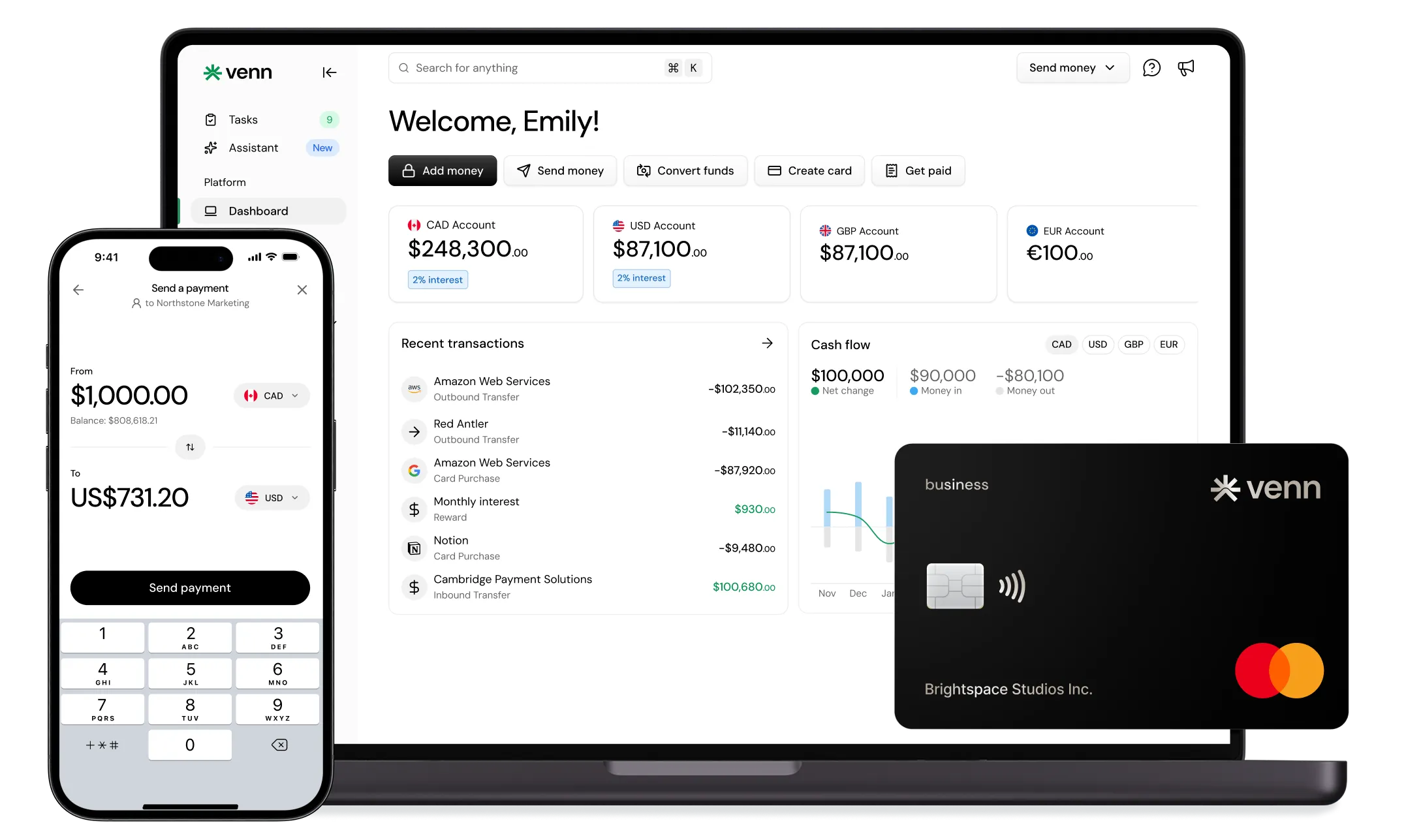
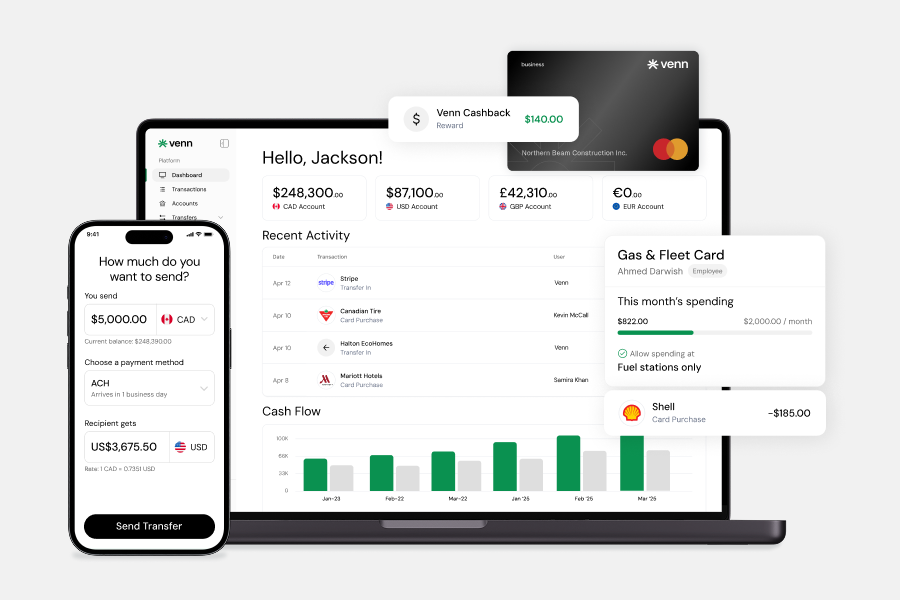
Modern banking platforms reduce much of this setup friction. Platforms like Venn offer Canadian business accounts with full functionality for tax payments, payroll, and daily operations. Multi-currency accounts help you receive payments from international clients and pay global suppliers without unnecessary conversion costs.
Opening a Business Bank Account in Canada as a Foreigner
For many newcomers, the biggest friction is not incorporation; it is opening a business bank account without Canadian credit history or a local address. Traditional banks often want an in-person visit and a track record you have not yet built in Canada.
You can prepare by gathering the standard documents in advance:
- Government-issued photo ID for each signatory.
- Articles of Incorporation or your business registration.
- Your CRA Business Number.
- Proof of business address.
Online platforms built for Canadian businesses remove much of this barrier. Venn lets foreign founders open real CAD and USD accounts online, often the same day, without a personal credit check. Deposit balances are held at Bank of Montreal, a CDIC member, so they are CDIC-eligible.
If you want the full list before you apply, review what documents you need to open a Canadian business bank account.
Navigating Challenges and Maximizing Success
Building Canadian business networks requires intentional effort but pays substantial dividends. Industry associations provide immediate connections to established businesses and potential partners.
Chambers of commerce offer networking events and advocacy support. Immigrant entrepreneur organizations understand your unique challenges and provide mentorship from those who have successfully navigated similar paths.
Canadian business culture values punctuality, direct communication, and collaborative decision-making. Meetings typically start on time with clear agendas. Email communication tends toward formality, especially in initial interactions.
Regulatory compliance receives serious attention, with businesses expected to maintain accurate records and meet all filing deadlines. Building trust through consistent, professional interactions opens doors that aggressive sales tactics might close.
Success comes from balancing your international perspective with local market understanding. Your global connections and different approaches to business challenges are valuable assets in Canada's multicultural economy. Combine these strengths with deep knowledge of Canadian customer preferences, regulatory requirements, and business practices to create competitive advantages.
Resources and Support for Foreign Entrepreneurs in Canada
Numerous organizations support foreign entrepreneurs throughout their journey. The Business Development Bank of Canada offers financing and advisory services for small and medium enterprises.
Innovation, Science and Economic Development Canada provides comprehensive guides on starting and growing businesses. Provincial economic development agencies offer location-specific support and, in some cases, funding programs.
With careful planning and the right financial tools, foreign entrepreneurs can build a strong foundation for a Canadian venture. Canada's openness turns that effort into a genuine advantage.
Frequently Asked Questions
Q: Can a Foreign National Start a Business in Canada, and Is a Canadian Partner Required?
A: Yes, a foreign national can start a business in Canada, and a Canadian partner is not required. Federally, at least 25% (one-quarter) of directors must be resident Canadians, though Ontario, Alberta, British Columbia, and New Brunswick have removed that rule.
Q: What Business Structure Should a Foreign Entrepreneur Choose?
A: A corporation is usually the best default because it protects personal assets and makes raising capital easier. A sole proprietorship is the simplest and lowest-cost option but carries unlimited personal liability, while a partnership may suit founders launching a business with a Canadian resident.
Q: How Much Does It Cost To Start a Business in Canada as a Foreigner?
A: Federal incorporation costs $200 online through Corporations Canada, and provincial registration is typically higher, at around $300 in Ontario and $350 in British Columbia. A full professional setup with legal and accounting help usually runs between $1,500 and $3,000.
Q: What Do You Need To Open a Canadian Business Bank Account as a Foreigner?
A: You need government-issued photo ID, your Articles of Incorporation or business registration, your CRA Business Number, and proof of business address. Online platforms like Venn accept these documents and can open CAD and USD accounts without requiring Canadian credit history.
Q: Does Starting a Business in Canada Give Me a Visa or Permanent Residency?
A: No, incorporating a company alone does not grant a visa or permanent residency. You still need an appropriate immigration pathway, such as a Provincial Nominee Program or an Entrepreneur Work Permit.
Disclaimer: This publication is provided for general information purposes and does not constitute legal, tax or other professional advice from Venn Software Inc or its subsidiaries and its affiliates, and it is not intended as a substitute for obtaining advice from a financial advisor or any other professional. We make no representations, warranties or guarantees, whether expressed or implied, that the content in the publication is accurate, complete or up to date.

Venn is all-in-one business banking built for Canada
From free local CAD/USD accounts and team cards to the cheapest FX and global payments—Venn gives Canadian businesses everything they need to move money smarter. Join 15,000+ businesses today.
Frequently asked questions
Everything you need to know about the product and billing.
Join 15,000+ businesses banking with Venn today
Streamline your business banking and save on your spend and transfers today
No personal credit check or guarantee.