Compare Venn's Financial Tools with Major Canadian Banks
Compare Venn's Financial Tools with Major Canadian Banks across fees, multi-currency accounts, cards, FX, and QuickBooks or Xero integrations for 2026.


Trusted by 10,000+ Canadian businesses
Business banking for Canada
Local CAD and USD accounts, corporate cards with cashback, the lowest FX rates in Canada, free local transfers, and more.
Canadian businesses in 2026 face a sharper version of a familiar question: does your company need the branch network, credit relationships, and institutional familiarity of a major bank, or does it need a financial operations platform built for digital workflows, cross-border payments, corporate cards, and accounting automation?
The honest answer is that no single option fits every business. A cash-heavy retailer with daily deposits and an existing lending relationship has different priorities than a software startup billing clients in USD, GBP, and EUR. Both deserve a clear, factual comparison rather than a pitch.
This guide compares Venn's financial tools with RBC, TD, Scotiabank, BMO, and CIBC across the criteria Canadian founders, operators, controllers, and finance leads actually use: monthly fees, transaction structure, branch access, multi-currency capabilities, corporate cards, accounting integrations, and cross-border payment support. The goal is to help you identify which option fits your operating model, not to pre-select a winner.
What Matters Most When Comparing Business Financial Tools In Canada
No single fee or feature determines the right fit. The better question is whether a platform matches how your business actually operates.
Start with the basics: monthly fees, fee-waiver thresholds, and transaction allowances. A $6/month account looks attractive until per-transaction fees accumulate. Then consider cash deposits and branch access, which matter significantly for retailers, hospitality operators, and any business handling physical currency daily.
Currency needs add another layer. A business billing exclusively in CAD has different requirements than one collecting USD from American clients or paying EUR invoices to European suppliers. Evaluate whether you need local CAD and USD accounts, and whether GBP or EUR support is relevant to your vendor or client base.
Cross-border payments and FX rates deserve close scrutiny. Wire fees and currency conversion markups compound quickly at volume. Corporate cards, spend controls, and employee card management matter to finance teams coordinating purchases across departments.
Accounting integrations with tools like QuickBooks and Xero reduce manual reconciliation and close time. Interest on operating balances can offset monthly fees for businesses holding meaningful cash reserves.
Digital-first businesses, including startups, agencies, and software companies, often prioritize automation, accounting connectivity, and multi-currency support. Branch-heavy or cash-intensive businesses typically need the physical infrastructure that traditional banks provide. Matching the platform to the operating model, rather than chasing a headline fee, produces the most useful comparison.
At-A-Glance Comparison Table
The table below summarizes key features across Venn and the Big 5 Canadian banks. Use it as a starting point, then review each platform's current pricing page before making a final decision, as fees and features change.
| Feature | Venn | RBC | TD | Scotiabank | BMO | CIBC |
|---|---|---|---|---|---|---|
| Starting Monthly Fee | $0 (Essentials) | $6 | $7 | $6 | $5 | $6 |
| Fee Waiver or Minimum Balance | Plan-based | Varies by account | Varies by account | Varies by account | Varies by account | Varies by account |
| Branch Access | No branches | Yes, nationwide | Yes, nationwide | Yes, nationwide | Yes, nationwide | Yes, nationwide |
| CAD Account | Yes | Yes | Yes | Yes | Yes | Yes |
| USD Account | Yes, local USD account | Yes | Varies by account | Yes | Varies by account | Varies by account |
| GBP and EUR Support | Yes, local GBP and EUR accounts | Limited | Limited | Limited | Limited | Limited |
| Interac e-Transfer® | Yes | Yes | Yes | Yes | Yes | Yes |
| Corporate Card and Cashback | Yes, 1% cashback (plan-based caps; unlimited on Pro) | Varies by account | Varies by account | Varies by account | Varies by account | Varies by account |
| Interest on Operating Balances | Yes, 2% on CAD and USD | Varies by account | Varies by account | Varies by account | Varies by account | Varies by account |
| FX and Cross-Border Tools | Yes, ACH, SEPA, UK Faster Payments; FX from 0.45% | Varies by account | Varies by account | Varies by account | Varies by account | Varies by account |
| QuickBooks and Xero Integration | Yes, both supported | Limited | Limited | Limited | Limited | Limited |
| Best For | Digital-first, cross-border, and multi-currency businesses | Full-service bank relationship | High transaction volume with branch access | Flexible fee structure with branch support | Low entry cost with branch access | Classic operating account tiers |
Eligible deposits with Venn are covered by CDIC insurance up to applicable limits. Venn is a technology company, not a bank. Venn is currently not available to businesses in Quebec.
Venn
Venn suits digital-first Canadian businesses that want banking, cards, FX, and accounting workflows consolidated in one platform. Startups, agencies, software companies, cross-border operators, and finance teams managing multi-currency operations are the clearest fit.
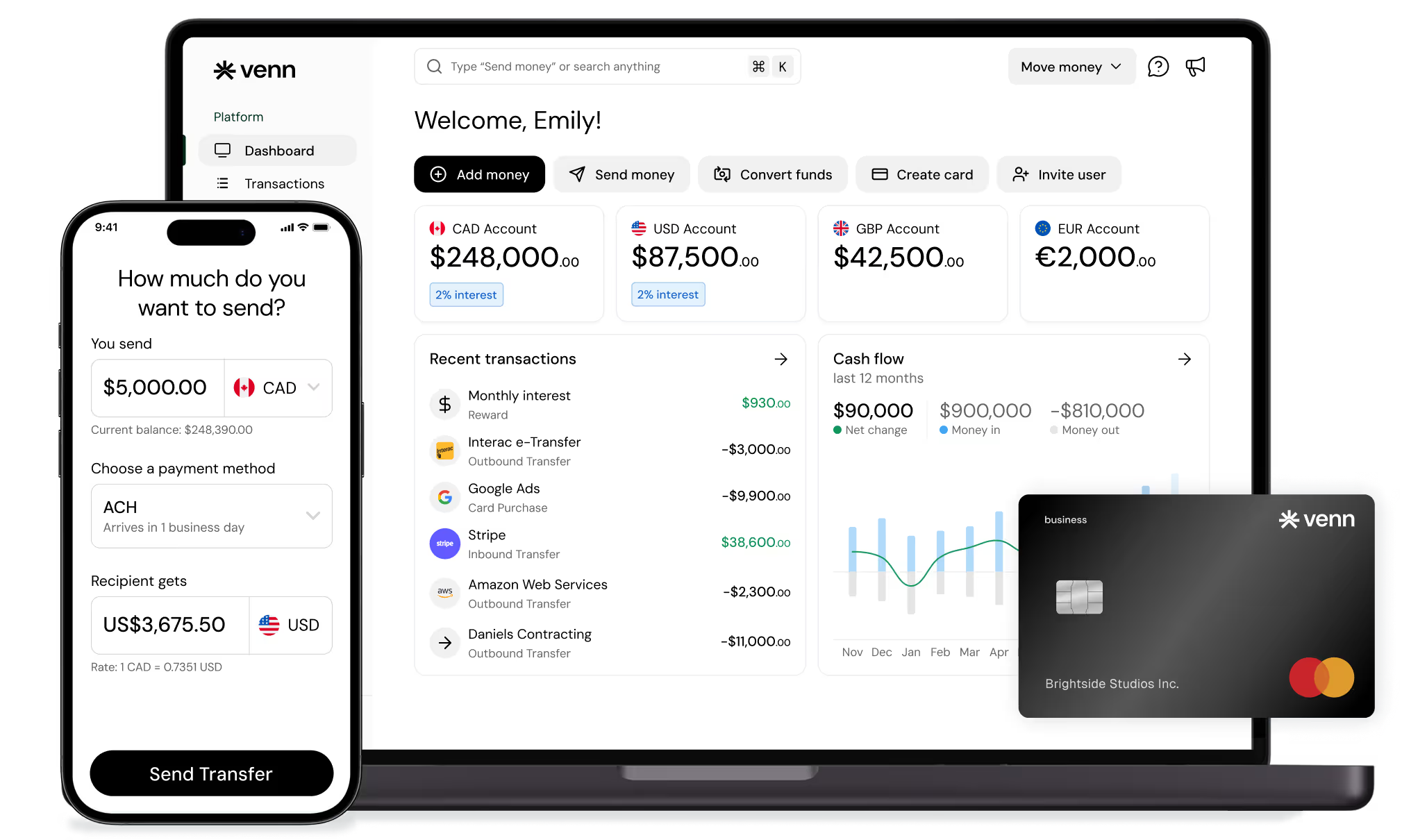
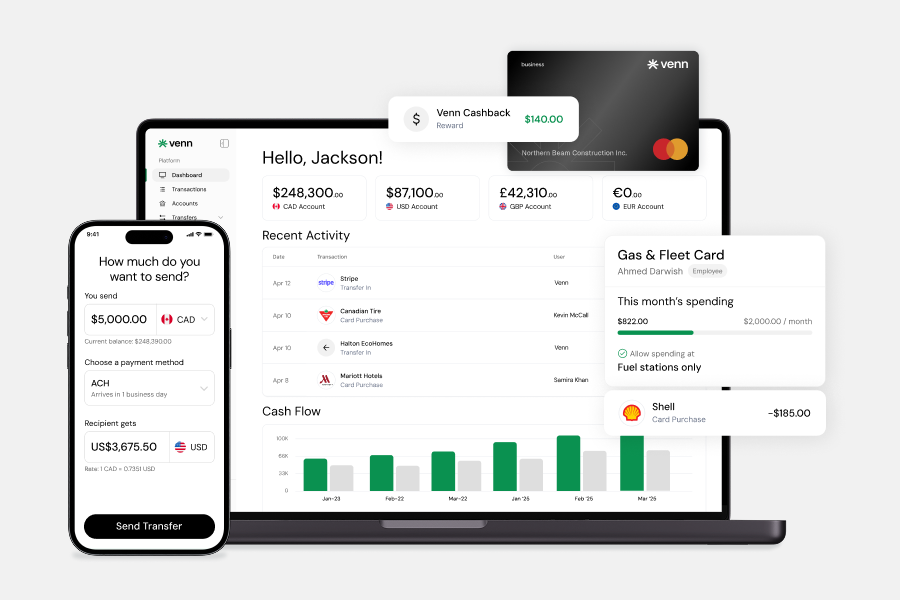
On the financial side, Venn pays 2% interest on both CAD and USD balances with no minimum balance requirement. Businesses get local accounts in CAD, USD, GBP, and EUR, with payment rail support that matches each currency: ACH for USD, SEPA for EUR, and UK Faster Payments for GBP. Interac e-Transfer® is included at no charge. International wire fees range from $10 on Essentials down to $6 on Pro, and plan-based FX rates run from 0.45% to 0.25%.
The Venn Mastercard charge card earns 1% cashback, though cashback is plan-dependent. Essentials and Plus carry caps, while Pro offers unlimited cashback. Expense management includes OCR receipt capture, and direct integrations with QuickBooks and Xero keep accounting workflows connected without manual exports. Through the Venn mobile app, users can view balances, send transfers, and issue cards directly from their phone.
Tradeoffs are real. Venn has no physical branch network, which makes it a poor fit for cash-heavy businesses. It is not a traditional bank. Venn is a technology company; account balances are held at Bank of Montreal, and eligible deposits are covered by CDIC insurance up to applicable limits. The Venn Mastercard charge card is issued by Peoples Trust Company. Businesses in Quebec are not currently eligible to open an account.
RBC
RBC suits businesses that want a major bank relationship backed by nationwide branch coverage, a recognized brand, and a broad lineup of business products. For companies already working with RBC on lending, merchant processing, or other financial services, consolidating into an RBC business account can simplify day-to-day banking.
The Digital Choice Business Account starts at $6 per month and includes unlimited electronic debits and credits, unlimited electronic cheque deposits, and a set of included outgoing Interac e-Transfer® transactions. It serves as a low-cost digital entry point for businesses with straightforward transaction needs. RBC also offers U.S. dollar business accounts and higher-tier plans, including the Ultimate Business Account, which targets larger operations with heavier transaction volumes and cash deposit requirements.
The tradeoffs are worth considering. Traditional account structures can become more expensive as transaction volumes grow, and businesses that need to manage cross-border payment workflows or connect their accounts directly to accounting software like QuickBooks or Xero will find those capabilities less central to the core RBC chequing-account experience than they are with software-led platforms like Venn. Verify current pricing and account terms directly with RBC before making a decision.
TD
TD suits businesses that want a recognizable national bank, a broad branch network, and a clear account structure that scales with transaction volume. The current lineup runs from the TD Business Basic Account at approximately $7/month, to the TD Business Essential Account at approximately $35/month with 40 included transactions and 10 Interac e-Transfer® transactions, up to the TD Business Unlimited Account at approximately $125/month with unlimited transactions and unlimited Interac e-Transfer® support. Verify all 2026 fees and plan inclusions directly on td.com before publishing, as pricing and bundled features are subject to change.
For businesses that rely on teller access, regular cash deposits, or an existing TD banking relationship, this tiered structure offers a familiar and well-supported path. The Unlimited plan can absorb heavier transaction volumes without per-item fees stacking up.
The tradeoffs are worth noting. Monthly costs rise quickly as transaction needs grow beyond the Basic tier. FX tools, corporate card controls, receipt capture, and accounting automation are not central to TD's business chequing experience, which makes it a less natural fit for finance teams prioritizing integrated software workflows or cross-border payment efficiency.
BMO
BMO may suit startups or SMBs that want a low starting monthly fee and a clear path to more comprehensive branch-backed business accounts as their needs grow.
The Essential Business Account starts at $5/month with unlimited electronic and ATM transactions, making it one of the more accessible entry points among the Big 5. From there, businesses can step up to the Everyday Business Account at $25/month, the Enhanced Business Account at $50/month, or the Elite Business Account at $75/month. Each tier adds transaction capacity, cash deposit allowances, and additional services. Verify current 2026 pricing and plan details directly with BMO before making any decisions.
BMO works well for businesses that still rely on branch access, in-person deposits, or advisor-led support. The step-up structure gives growing companies a natural upgrade path without switching institutions.
The tradeoff is that finding the right fit requires a close look at your transaction mix, average balance levels, and cash-handling volume. Businesses with heavier cash activity or irregular transaction patterns may find the tiered model less predictable than a flat-fee structure.
For businesses prioritizing multi-currency workflows, integrated card controls, or direct accounting sync with QuickBooks or Xero, those capabilities sit closer to the core of Venn's operating model than they do within BMO's standard business chequing lineup.
Scotiabank
Scotiabank suits businesses that want flexibility in how they pay for banking, with both pay-per-use and bundled account options available. The Right Size Account for business starts at $6 per month and charges per transaction, making it a practical fit for lower-volume operations that want to avoid paying for capacity they rarely use. The Select Account for business starts at $20 per month and scales through tiered plans up to $120 per month, bundling more transactions as the monthly fee increases. The Basic Business Account, available in both Canadian and U.S. dollars, gives businesses a straightforward option for managing cross-border cash flow within a traditional bank structure. Verify current fees and transaction limits against Scotiabank's 2026 public pages before publishing, as pricing can change.
The range of pricing models is a genuine advantage for businesses with predictable transaction volumes that want to match their plan to actual usage. The tradeoff is that comparing three distinct account structures takes more effort than evaluating a single tiered lineup. Scotiabank also fits businesses focused on optimizing a traditional bank-plan structure rather than those prioritizing integrated FX tools, corporate card controls, OCR receipt capture, or direct accounting software connectivity with platforms like QuickBooks or Xero.
CIBC
CIBC suits businesses that want a familiar, tiered operating account structure with predictable transaction bundles and fee-waiver options built in. The Basic Business Operating Account starts at $6 per month, making it accessible for lower-volume operations. From there, the Everyday Business Operating Account, Advanced Business Operating Account, and Unlimited Business Operating Account each step up in included transactions and service depth. Businesses that maintain higher balances may qualify for monthly fee waivers, which can meaningfully reduce the cost of banking at the mid-tier levels.
CIBC also supports Interac e-Transfer® for Business with sending limits up to $25,000, which works well for businesses that rely on Interac e-Transfer® as a primary payment method with clients or vendors.
Where CIBC fits best is with businesses that value a traditional banking relationship and operate primarily in Canadian dollars. The tradeoff is that extracting the best value from the account lineup depends on both your transaction volume and your ability to maintain qualifying balances. For businesses that prioritize integrated FX tools, multi-currency accounts, corporate card spend controls, or direct QuickBooks and Xero connectivity, Venn addresses those needs more directly within its core platform. Verify current CIBC fees and waiver thresholds at cibc.com before making any account decision, as terms are subject to change.
Which Option Fits Different Business Types?
No single platform wins across every business model. The strongest choice depends on how your business receives money, pays vendors, handles cash, manages currencies, and coordinates finance tasks across your team.
A retailer processing daily cash deposits needs something fundamentally different from a software agency billing U.S. clients in USD. A founder running a lean startup has different priorities than a controller managing multi-entity approvals and accounting sync.
The four subsections below break down practical guidance by business type: digital-first startups and agencies, cash-heavy or retail operations, cross-border businesses with U.S. or international exposure, and finance teams that need spend controls with accounting connectivity.
One pattern worth noting before you read on: many Canadian businesses find that Venn and a traditional bank serve different functions within the same operation. Venn handles cross-border payments, FX, cards, and accounting workflows, while a Big 5 account manages cash deposits, branch-based services, or existing lending relationships. Choosing between them is often less relevant than understanding where each one fits.
Digital-First Startup Or Agency
Startups, agencies, and service companies typically prioritize fast finance workflows, team expense cards, vendor payments, receipt capture, and accounting sync over branch access. For this profile, the likely short list narrows to Venn, RBC Digital Choice, and BMO Essential.
Venn fits well when the business wants free Interac e-Transfer®, multi-currency accounts in CAD, USD, GBP, and EUR, OCR receipt capture, and direct QuickBooks or Xero integration inside a single workflow. Those features reduce the manual work that typically falls on a founder or small finance team.
RBC and BMO remain solid options for digital-first businesses that still want a traditional bank relationship, a recognizable institution behind their account, or a straightforward low-fee entry plan without the need for cross-border payment infrastructure.
Retailer or Cash-Heavy Business
Retailers, restaurants, and trades businesses typically depend on branch access, cash deposits, coin services, and in-person support. For these operations, TD, RBC, BMO, Scotiabank, and CIBC are the more practical starting points. Each offers a physical branch network, cash handling infrastructure, and business account tiers designed around high-volume, in-person transactions.
Venn does not have a physical branch network, which makes it a poor fit as a standalone solution for businesses that deposit cash daily or rely on teller services. That said, cash-heavy businesses that also manage digital expenses, pay cross-border vendors, or want to separate card spend from their main operating account may still find value in adding Venn alongside their primary bank. Venn's corporate card, FX tools, and QuickBooks or Xero integrations can handle the digital side of operations without disrupting existing cash workflows at a traditional bank.
Cross-Border Business With U.S. Clients Or Vendors
Businesses with cross-border operations should evaluate several factors before choosing a financial platform: local currency accounts, USD payment support, ACH access, FX pricing structure, international wire fees, and whether they also need GBP or EUR capabilities.
Venn is a strong editorial consideration for this use case. It supports local CAD, USD, GBP, and EUR accounts, with ACH for USD payments, SEPA for EUR, and UK Faster Payments for GBP. FX pricing is plan-based, ranging from 0.45% on Essentials to 0.25% on Pro, which gives higher-volume businesses a predictable cost structure for cross-border transactions. Eligible deposits are covered by CDIC insurance up to applicable limits.
For businesses that prefer a traditional banking relationship, several Big 5 institutions offer U.S. dollar business accounts. Scotiabank's Basic Business Account is available in both CAD and USD, and RBC offers U.S. dollar account options within its broader business lineup. These can suit companies that want branch-backed support alongside their cross-border activity.
Finance Team That Wants Approvals, Cards, And Accounting Sync
Finance teams typically need more than a place to hold operating funds. Role-based controls, spend visibility, corporate cards, receipt capture, approval workflows, and clean accounting data all factor into how efficiently a team can close the books and manage cash.
Venn addresses this directly. Card controls, OCR receipt capture, and direct QuickBooks and Xero integrations connect spending to accounting without manual exports. Payments tie into operating workflows rather than sitting in a separate system. For finance leads managing multiple team members and vendors, that connectivity reduces reconciliation time and keeps spend data organized by default.
Traditional banks like RBC, TD, BMO, Scotiabank, and CIBC can support core banking and corporate card needs, but finance teams that want deeper automation, approval layers, or direct accounting sync typically need to add separate software on top of their bank account. Other fintech options such as Float or Loop offer spend management tools worth considering in this category, though their feature sets and pricing differ from Venn's integrated approach.
For finance teams where approvals, card controls, and accounting sync are the primary decision criteria, Venn is a relevant platform to evaluate alongside whatever core banking relationship the business already maintains.
Final Verdict
No single option wins across every business type. The right choice depends on how your company actually operates.
Traditional banks, including RBC, TD, Scotiabank, BMO, and CIBC, remain the stronger fit for cash-heavy businesses, companies with frequent in-branch needs, and operators who want a single institution to handle lending, merchant services, and day-to-day deposits under one relationship.
Venn suits digital-first businesses, cross-border operators, and finance teams that prioritize multi-currency accounts, spend controls, receipt capture, plan-based cashback, and direct QuickBooks or Xero integrations. For businesses with regular USD, GBP, or EUR exposure, Venn's local account structure and ACH, SEPA, and UK Faster Payments support reduce friction that traditional chequing accounts were not designed to handle.
Evaluate your setup against six factors: branch dependence, FX exposure, transaction volume, team complexity, software integration needs, and whether running Venn alongside a traditional bank makes more sense than choosing one over the other. Many Canadian businesses find that combination more practical than a full switch. Sign up for Venn
FAQ
Q: Is Venn a bank?
A: No. Venn is a financial platform, not a bank. It provides business banking services through regulated financial institution partners rather than operating as a chartered bank itself.
Q: Which option is best for a small business that rarely visits a branch?
A: Venn, RBC's Digital Choice account, or BMO's Essential Business Account are all worth evaluating. Businesses that conduct most transactions electronically and rarely need in-person service tend to get the most value from digital-first platforms.
Q: Which option is best for U.S. payments and multi-currency operations?
A: Venn supports local CAD, USD, GBP, and EUR accounts alongside ACH, SEPA, and UK Faster Payments, making it a strong fit for cross-border businesses. The major Canadian banks offer USD accounts, but multi-currency operating capabilities vary significantly by institution and plan.
Q: Do the major Canadian banks offer better support for cash deposits?
A: Yes. RBC, TD, BMO, Scotiabank, and CIBC all maintain branch and ATM networks that accept cash deposits. Venn does not support cash deposits, so cash-heavy businesses such as retailers should factor this into their decision.
Q: Which option is easier for QuickBooks or Xero users?
A: Venn connects directly with both QuickBooks and Xero, allowing finance teams to sync transactions without manual exports. Traditional banks vary in their native accounting integrations, and many require third-party connectors or manual reconciliation workflows.
Q: Can a business use Venn alongside a traditional bank instead of replacing it?
A: Yes, and many businesses do exactly that. A common setup pairs Venn for cross-border payments, corporate cards, and accounting integrations with a traditional bank for cash deposits, credit facilities, or existing lending relationships.
Legal / Eligibility Notes
Availability, fees, features, interest rates, FX pricing, account terms, and eligibility criteria for all providers mentioned in this guide can change at any time. Verify current details directly on each provider's official website before opening an account or selecting a financial platform.
Venn is a technology company, not a bank. Account balances are held at Bank of Montreal. Eligible deposits with Venn are covered by CDIC insurance up to applicable limits. Venn is not currently available to businesses in Quebec.
Venn Mastercard Charge Card is issued by Peoples Trust Company under licence from Mastercard International Incorporated. Mastercard is a registered trademark, and the circles design is a trademark of Mastercard International Incorporated.
---
**Disclaimer:** This publication is provided for general information purposes only and does not constitute legal, tax, financial, or other professional advice from Venn Software Inc., its subsidiaries, or its affiliates, and is not a substitute for advice from a qualified professional. All comparisons and competitor information reflect publicly available information believed accurate as of June 1, 2026; features, pricing, rates, and terms referenced are subject to change and may differ at the time you read this. All product names, logos, and brands referenced are the property of their respective owners; their mention does not imply affiliation with or endorsement by Venn. Any comparative statements reflect Venn's views and are provided to help readers evaluate options. We make no representations, warranties, or guarantees, express or implied, that the content is accurate, complete, or up to date.

Venn is all-in-one business banking built for Canada
From free local CAD/USD accounts and team cards to the cheapest FX and global payments—Venn gives Canadian businesses everything they need to move money smarter. Join 10,000+ businesses today.
Frequently asked questions
Everything you need to know about the product and billing.
Join 10,000+ businesses banking with Venn today
Streamline your business banking and save on your spend and transfers today
No personal credit check or guarantee.