Cash flow hedge vs. fair value hedge: Key differences
Cash flow hedge vs. fair value hedge: Key differences for Canadian finance teams. Compare use cases, instruments, and reporting impacts for FX and rates.

Trusted by 15,000+ Canadian businesses
Business banking for Canada
Local CAD and USD accounts, corporate cards with cashback, the lowest FX rates in Canada, free local transfers, and more.
Currency swings, interest rate shifts, and volatile input costs can derail even the most carefully planned budget. For Canadian businesses operating across borders or managing variable-rate debt, these risks translate directly into unpredictable margins, strained cash flow, and forecasting headaches.
Hedging offers a path forward. At its core, hedging means using financial instruments to reduce exposure to specific risks, not to speculate for profit. The two primary approaches under hedge accounting frameworks are cash flow hedges and fair value hedges. Understanding the difference helps finance teams choose the right strategy for their situation.
A cash flow hedge aims to stabilize future cash flows that haven't yet hit your books. A fair value hedge stabilizes the current value of something you already own or owe.
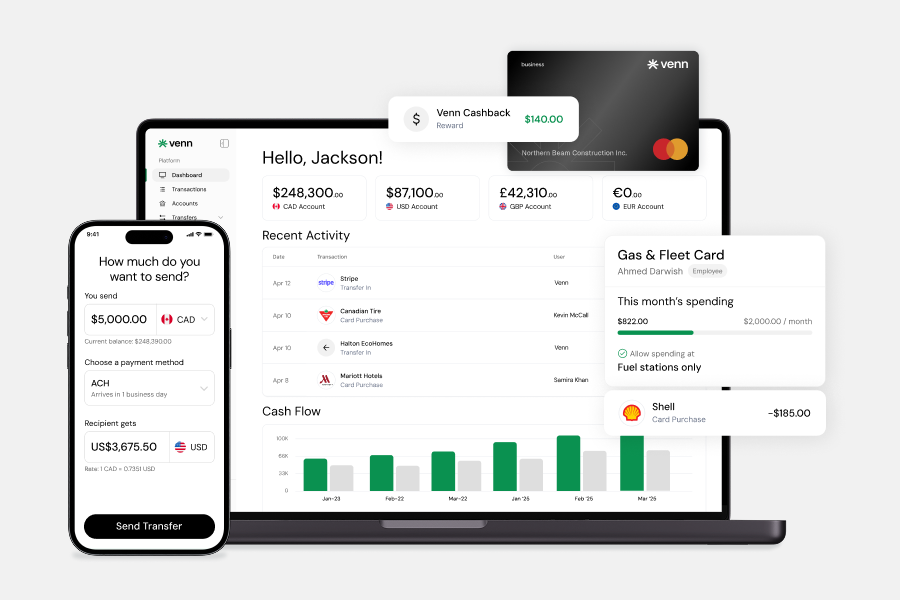
Before diving into hedge strategies, businesses need clean exposure data. That starts with the right financial infrastructure: multi-currency accounts that segregate CAD, USD, EUR, and GBP balances, streamlined payment rails for cross-border transactions, and accounting integrations that keep reconciliation tight. Venn provides this foundation for Canadian businesses, helping finance teams measure exposure accurately and settle transactions efficiently, so hedge decisions rest on reliable data rather than guesswork.
What Is a Cash Flow Hedge?
A cash flow hedge protects against variability in future cash flows tied to a recognized item or a highly probable forecast transaction. The key word is future. You're hedging something that will happen, not something already on your balance sheet.
Common Business Uses
Forecast foreign currency receipts: A Canadian SaaS company billing US clients expects USD 250,000 in revenue next quarter. If the Canadian dollar strengthens, those US dollars convert to fewer loonies, squeezing margins.
Forecast foreign currency payments: An importer purchasing inventory from European suppliers faces the opposite problem. A weakening CAD means higher costs when those EUR invoices come due.
Variable-rate debt payments: A business with a floating-rate loan faces uncertainty about future interest expenses. Each rate adjustment changes the cash outflow.
Common Instruments
• FX forwards and options (for currency exposure)
• Interest rate swaps and caps (for variable-rate debt)
Benefits and Tradeoffs
Cash flow hedges bring predictability to operating budgets. When you know what your USD revenue will convert to in CAD, pricing decisions become clearer. Payroll planning stabilizes. Margin forecasts hold.
The tradeoff? Accuracy matters. You need reliable forecasts of volumes and timing. Documentation requirements can be demanding, and ongoing monitoring is essential to maintain hedge effectiveness.
One practical first step: keeping local currency accounts reduces unnecessary conversions and clarifies your underlying exposure. When USD receipts land in a USD account rather than auto-converting to CAD, you see the true exposure before deciding what portion to hedge. Venn's multi-currency accounts (CAD, USD, EUR, GBP) give Canadian businesses this visibility, making it easier to identify which cash flows actually need protection.
What Is a Fair Value Hedge?
A fair value hedge protects against changes in the fair value of an existing recognized asset, liability, or firm commitment attributable to a particular risk. Unlike cash flow hedges, you're not hedging something that might happen. You're hedging something already on your books.
Common Business Uses
Fixed-rate debt exposure: A company holds fixed-rate debt. As market interest rates move, the fair value of that debt changes. If rates drop significantly, the debt's fair value rises, creating potential P&L volatility.
Commodity inventory: Businesses holding significant commodity-linked inventory may face fair value fluctuations as market prices shift.
Common Instruments
• Interest rate swaps (most common for fixed-rate debt)
• Futures and forwards (for certain commodity or FX exposures)
Benefits and Tradeoffs
Fair value hedges can smooth earnings volatility caused by mark-to-market adjustments on recognized items. This matters for businesses where stakeholders scrutinize quarterly results or where debt covenants reference book values.
The complexity is higher. Explaining fair value hedge mechanics to internal stakeholders takes effort, and strong controls are essential to maintain proper accounting treatment.
Key Differences: Cash Flow Hedge vs. Fair Value Hedge
How the Accounting Treatment Typically Differs
Without drowning in journal entries, here's the conceptual difference:
Cash flow hedge accounting addresses a timing mismatch. The derivative's value changes immediately, but the hedged cash flow hasn't occurred yet. Under many frameworks, the effective portion of the hedge gain or loss parks in Other Comprehensive Income (OCI), a holding area on the balance sheet. When the hedged transaction finally affects earnings, that amount reclassifies from OCI to the income statement, aligning the hedge result with the underlying exposure.
Fair value hedge accounting adjusts the carrying value of the hedged item itself. Both the derivative and the hedged item's changes flow through earnings in the same period, creating an offset that reduces P&L volatility.
Your accounting framework matters. Canadian businesses may follow IFRS, ASPE, or other standards depending on their structure and reporting requirements. The specific rules for hedge designation, effectiveness testing, and documentation vary. Confirm the details with your CPA before implementing any hedge accounting treatment.
Decision Framework: Which Hedge Type Fits Your Situation?
If your problem is budgeting uncertainty on a future transaction, a cash flow hedge is often the conceptual fit. You're trying to stabilize something that will happen.
If your problem is the changing value of something already on your balance sheet, a fair value hedge is often the conceptual fit. You're trying to stabilize something you already have.
Quick Checklist
• What exactly is the exposure: a forecast transaction or an existing recognized item?
• What's the time horizon: near-term (30/60/90 days) or multi-year?
• Can you reliably forecast volumes and timing for future transactions?
• What instrument matches both the exposure type and the tenor?
• What's your tolerance for documentation, monitoring, and complexity?
Businesses often start by improving cash visibility and currency segregation before making hedge decisions. Clean reconciliation through QuickBooks or Xero, combined with multi-currency accounts that separate exposures by currency, ensures hedge decisions rest on accurate data. Venn's direct integrations with both accounting platforms streamline this process, giving finance teams the clarity they need.
Worked Examples
Example 1: Cash Flow Hedge for FX Exposure
A Canadian exporter expects to receive USD $100,000 in 60 days from a US customer. The current exchange rate is $1.35 CAD/USD, suggesting CAD $135,000 in value.
The risk: If the USD weakens to $1.30 CAD/USD by settlement, the receipt converts to only CAD $130,000, a CAD $5,000 shortfall against budget.
Hedge concept: An FX forward contract locks in an effective exchange rate. The company agrees to sell USD $100,000 at a predetermined rate in 60 days. Regardless of where spot rates move, the CAD outcome is more predictable.
This is a simplified illustration, not accounting advice.
Example 2: Cash Flow Hedge for Variable Interest
A growing business has a CAD $500,000 operating line with a floating interest rate tied to prime. Current interest expense runs around CAD $2,500 monthly.
The risk: If rates rise 100 basis points, monthly interest expense jumps to approximately CAD $2,917, adding CAD $5,000 annually to costs.
Hedge concept: An interest rate cap or swap can reduce variability in future interest payments, making cash flow projections more reliable.
Example 3: Fair Value Hedge for Fixed-Rate Debt
A company holds CAD $1,000,000 in fixed-rate debt at 5%. Market rates have dropped, increasing the debt's fair value and creating P&L volatility.
Hedge concept: An interest rate swap converts the fixed-rate exposure to a floating-rate profile. Changes in the swap's fair value offset changes in the debt's fair value, smoothing earnings impact.
Common Mistakes and Risks
Over-hedging or under-hedging volumes: Hedging 100% of a forecast that only materializes at 70% creates problems. So does hedging too little to make a meaningful difference.
Tenor mismatch: A 90-day hedge on a 60-day exposure leaves a gap. A 30-day hedge on a 90-day exposure leaves you exposed for two months.
Ignoring basis risk: The hedge instrument may not move perfectly with the underlying exposure. Currency pairs, benchmark rates, and delivery dates all matter.
Documentation gaps: Hedge accounting requires clear documentation of objectives, hedge ratios, and effectiveness testing approaches. Informal arrangements don't qualify.
Forgetting operational realities: Settlement dates, internal approval workflows, and cash availability on execution day all affect whether a hedge works as planned.
Counterparty risk: The institution on the other side of your hedge needs to perform. Understand credit exposure and any collateral requirements.
How to Implement a Hedge Program
1. Identify exposures: Map FX inflows and outflows by currency, review debt terms for rate variability, and document supplier currencies and payment timing.
2. Define risk policy: Decide what percentage of exposure to hedge, which time horizons to cover, and what instruments are acceptable.
3. Choose instruments and hedge ratios: Match instrument type and maturity to the specific exposure. Consider cost, complexity, and counterparty requirements.
4. Document and execute: Formal documentation is essential for hedge accounting treatment. Execute through appropriate counterparties with proper approvals.
5. Monitor and measure: Track hedge effectiveness, forecast accuracy, and actual outcomes. Adjust policy based on results.
Build the Stack That Makes Hedging Actionable
Hedging only works if your business can hold and deploy funds in the right currency, pay and get paid efficiently, and close the books quickly. A hedge that locks in a favorable rate means nothing if settlement friction eats the savings or reconciliation delays obscure the results.
Venn provides the banking layer that makes hedge outcomes real:
Multi-currency accounts in CAD, USD, EUR, and GBP let businesses hold foreign currency receipts without forced conversions, aligning cash positions with underlying exposures.
Efficient payment rails including free unlimited Interac e-Transfer® for vendor payments ensure settlement happens smoothly when hedged transactions mature.
QuickBooks and Xero compatibility streamlines reconciliation, giving finance teams accurate data for measuring hedge effectiveness and forecasting future exposures.
The Venn Mastercard Charge Card with 1% unlimited cashback optimizes operating expenses and improves spend visibility, contributing to overall cash flow management alongside any hedge program.
Together, these capabilities create a modern finance stack where risk management decisions translate into actual operating results.
Conclusion
Cash flow hedges stabilize future cash flows from forecast transactions. Fair value hedges stabilize the current value of recognized items. Choosing the right approach depends on what you're trying to protect and where the volatility lives.
The path forward starts with mapping your exposures, improving cash visibility through proper currency segregation and clean accounting workflows, and aligning your banking infrastructure with your risk management goals. For hedge accounting decisions, consult qualified advisors who understand your specific framework and circumstances.
Ready to build the foundation? Sign up for a Venn account to simplify multi-currency operations, streamline cross-border payments, and reduce friction in managing international cash flow.
FAQ
Q: Is a cash flow hedge the same as “locking in an exchange rate”?
Conceptually, yes for foreign exchange exposure. A cash flow hedge using an FX forward can lock in an effective conversion rate for a future transaction. However, the exact outcome depends on the hedging instrument used, your hedge policy, and how the hedge is documented and accounted for under your chosen accounting framework.
Q: Does a fair value hedge reduce my actual cash payments?
Not directly. A fair value hedge is designed to offset changes in the fair value of a recognized asset or liability, which primarily affects accounting results. The actual cash paid or received depends on the underlying item. Fair value hedges reduce P&L volatility rather than altering cash flows.
Q: Do Canadian businesses have to follow IFRS hedge accounting rules?
It depends on the type of entity. Publicly accountable enterprises in Canada are generally required to follow IFRS. Private enterprises can choose between IFRS and ASPE. Hedge accounting rules differ between these frameworks, so confirm your obligations and options with a CPA.
Q: Can small businesses hedge without complex treasury systems?
Yes. While enterprise treasury systems are helpful, they’re not required. What matters most is governance, documentation, and accurate exposure tracking. Modern banking and accounting workflows, including multi-currency accounts and integrated reconciliation, allow small teams to manage FX hedging effectively without heavy infrastructure.
Venn Mastercard Charge Card is issued by Peoples Trust Company under licence from Mastercard International Incorporated. Mastercard is a registered trademark, and the circles design is a trademark of Mastercard International Incorporated.
---
**Disclaimer:** This publication is provided for general information purposes and does not constitute legal, tax or other professional advice from Venn Software Inc or its subsidiaries and its affiliates, and it is not intended as a substitute for obtaining advice from a financial advisor or any other professional. We make no representations, warranties or guarantees, whether expressed or implied, that the content in the publication is accurate, complete or up to date.

Venn is all-in-one business banking built for Canada
From free local CAD/USD accounts and team cards to the cheapest FX and global payments—Venn gives Canadian businesses everything they need to move money smarter. Join 15,000+ businesses today.
Frequently asked questions
Everything you need to know about the product and billing.
Join 15,000+ businesses banking with Venn today
Streamline your business banking and save on your spend and transfers today
No personal credit check or guarantee.