Best Business Budgeting Software Tools for 2026 Guide
Best business budgeting software tools for 2026 compared, plus the stack to enforce budgets with Venn, QuickBooks, Xero and cash flow forecasting for SMBs.

Ahmed Shafik
Co-founder

Trusted by 15,000+ Canadian businesses
Business banking for Canada
Local CAD and USD accounts, corporate cards with cashback, the lowest FX rates in Canada, free local transfers, and more.
Business budgeting in 2026 demands more than an annual spreadsheet exercise. Finance teams now need real-time visibility, multi-currency support, and automated reconciliation to stay competitive. The days of setting a budget in January and checking it in December are over.
Understanding what "budgeting software" actually means helps you choose the right tools. The category spans several distinct approaches:
• Accounting-suite budgeting handles budget vs actual tracking within your existing GL
• Forecasting and cash flow tools project short-term runway and scenario planning
• FP&A platforms offer driver-based planning, multi-department budgets, and formal approval workflows
• Spend management solutions enforce budgets through controls, receipts, and policy automation
Here's what most "best budgeting tools" articles miss: budgeting success is 50% planning and 50% execution. You can build the most sophisticated forecast model imaginable, but budgets fail when spend, FX conversion, and payment workflows aren't controlled at the source.
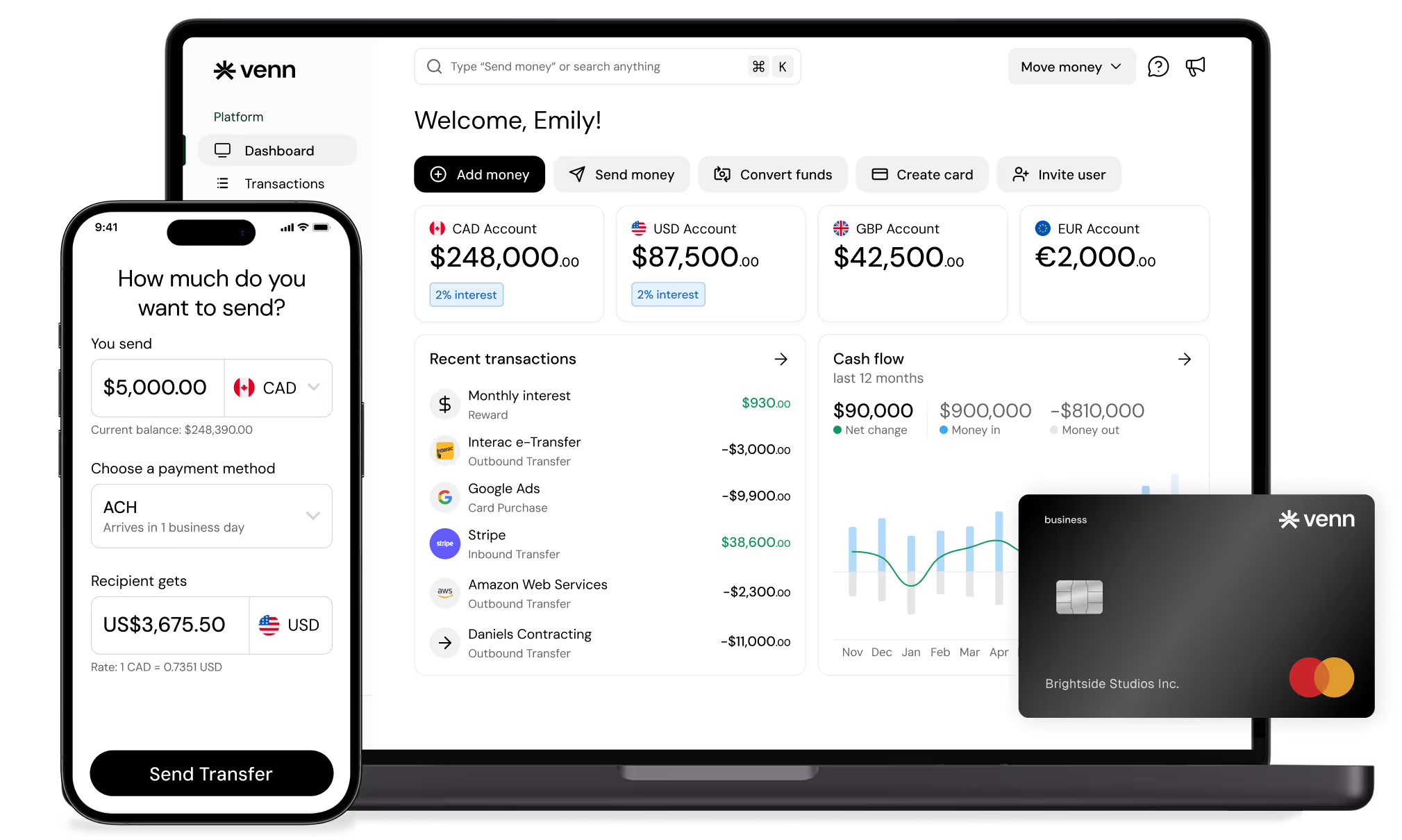
This is where Venn fits into your stack. Venn serves as the execution layer, providing business banking, corporate cards, multi-currency accounts (CAD, USD, EUR, GBP), and direct accounting integrations that help teams operate their budgets rather than just plan them.
Quick Comparison Table
The Best Business Budgeting Software Tools for 2026
Venn — Best for Canadian Businesses That Want Budgets to Actually Stick
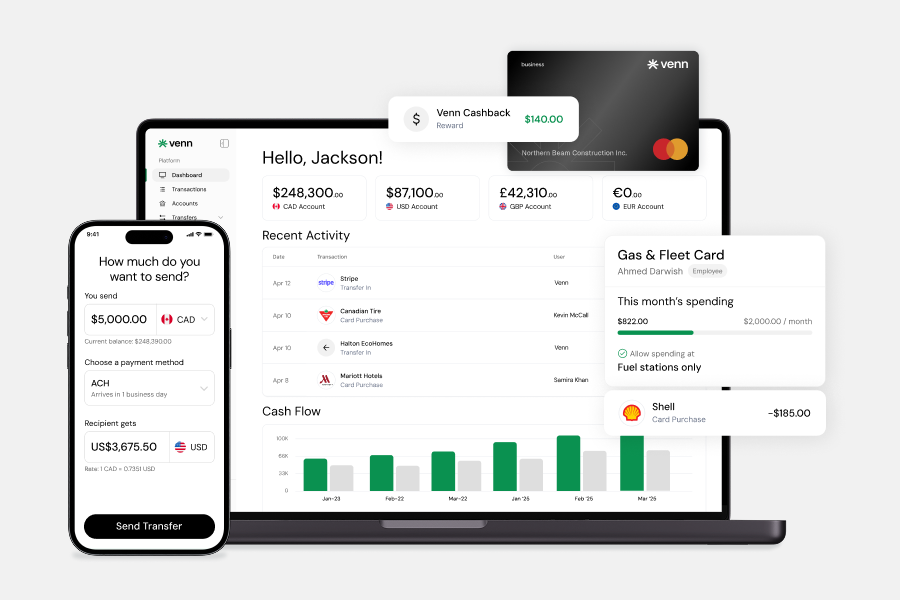
Venn isn't budgeting software in the traditional FP&A sense. It's something more fundamental: the banking and spend layer that makes your budgets executable. When your payment rails, card controls, and accounting sync work seamlessly, budget enforcement becomes automatic rather than aspirational. From the Venn mobile app, finance teams can access account funds, send transfers, and issue cards directly from their phones.
Key features:
• Multi-currency accounts in CAD, USD, EUR, and GBP with local rails (ACH for US, SEPA for EUR, Faster Payments for GBP)
• 1% unlimited cashback on the Venn card, directly reducing operating costs
• Direct QuickBooks and Xero integrations for automated reconciliation and cleaner budget vs actual reporting
• OCR receipt capture and invoice matching to streamline accounting workflows
• Free unlimited Interac e-Transfer® on all plans for vendor payments
• up to 3.5% interest on USD and CAD balances with no minimum requirements (learn more)
Best for: Canadian SMBs with international suppliers or clients, eCommerce businesses receiving cross-border payments, and any company that wants their budgeting tool to work with clean, categorized transaction data.
Watch-outs: Venn handles budget execution and spend management, not multi-year driver-based forecasting. Pair it with a dedicated FP&A tool if you need complex modeling.
How it fits your stack: The modern budgeting workflow combines Venn (banking + spend controls) with QuickBooks or Xero (accounting + budget vs actual) and a forecasting tool like Float for cash runway projections. This three-layer approach separates planning from execution while keeping everything synchronized.
Venn's competitive FX rates (0.25%-0.45% depending on plan versus up to 3% at major banks) mean your budget projections for international spend actually match reality. When you pay a US vendor, the transaction flows through your local USD account via ACH rather than expensive SWIFT wires.
QuickBooks Online — Best for Budget vs Actual Inside Your Accounting System
QuickBooks Online remains the default choice for Canadian SMBs who want budgeting built into their accounting workflow. The platform's budget vs actual reporting pulls directly from your general ledger, making variance analysis straightforward during monthly close.
The budgeting module lets you create annual budgets by account, then compare actual performance throughout the year. For many small businesses, this "good enough" approach works well, especially when the budget lives where all your transactions already exist.
Best for: SMBs already using QuickBooks who want simple budget tracking without adding another tool.
Key limitation: Budget reporting customization can feel restrictive. Complex multi-department budgets or rolling forecasts require workarounds or add-on tools.
The real power of QuickBooks budgeting emerges when paired with strong spend controls at the source. When your banking layer automatically categorizes transactions and captures receipts, QuickBooks receives clean data that makes budget vs actual reporting accurate and actionable.
Xero — Best for SMBs That Want Flexibility and App Ecosystem Choice
Xero's budget manager provides solid foundation-level budgeting with the flexibility to extend through its extensive app marketplace. The platform excels at serving growing businesses that need room to customize their stack as complexity increases.
Budget tracking in Xero follows a familiar pattern: set annual budgets by account, then review variance reports monthly. The platform's strength lies in how easily it connects with specialized tools for forecasting, expense management, and industry-specific workflows.
Best for: Growing SMBs that want accounting flexibility and plan to add specialized tools over time.
Key consideration: If you have multi-currency inflows and outflows, pair Xero with a multi-currency banking layer to reduce manual reconciliation work. Xero handles multi-currency transactions, but the efficiency gains multiply when your banking partner provides local currency accounts that eliminate unnecessary FX conversions.
Futrli (Sage) — Best for Forecasting and Reporting Templates
Futrli provides forecasting dashboards and reporting templates designed for finance owners and fractional CFOs who need to communicate financial projections clearly. The platform integrates with QuickBooks, Xero, and Sage to pull actuals and project forward.
Pre-built templates accelerate setup for common forecasting scenarios, making Futrli accessible for businesses that lack dedicated FP&A resources. The advisor-focused features also make it popular among accountants serving multiple clients.
Best for: SMBs working with fractional CFOs or accounting advisors who need professional forecasting outputs. Mid-market companies that want forecasting depth without enterprise complexity.
Key consideration: Futrli performs best when fed clean accounting and banking data. Inconsistent transaction categorization upstream creates forecasting noise downstream.
Zoho Books — Best for Businesses That Want a Single Vendor Suite
Zoho Books offers budgeting and expense analytics within the broader Zoho ecosystem. For businesses already using Zoho CRM, Projects, or other Zoho products, keeping financial management in the same family simplifies vendor relationships and data flow.
Budget vs actual tracking integrates with expense management, providing visibility into where spend occurs relative to plan. The suite approach means fewer integration headaches but requires commitment to the Zoho way of doing things.
Best for: Businesses already invested in the Zoho ecosystem who want unified vendor management.
Practical consideration: Ensure your chart of accounts and expense categories map consistently across Zoho products. Inconsistent categorization undermines budget vs actual accuracy.
Cube — Best for Spreadsheet-Loving Finance Teams That Need Governance
Cube bridges the gap between spreadsheet flexibility and FP&A governance. Finance teams that live in Excel or Google Sheets can continue working in familiar interfaces while Cube adds version control, audit trails, and workflow approvals.
The platform connects to accounting systems and ERPs, pulling actuals into your spreadsheet models without manual data entry. Multi-department budgets with formal approval workflows become manageable without abandoning the spreadsheet skills your team already has.
Best for: Finance teams managing multi-department budgets who want Excel/Sheets interface with proper governance. Companies transitioning from informal spreadsheet budgeting to structured FP&A processes.
Key limitation: Cube's value proposition assumes your team already works effectively in spreadsheets. Very small teams may not need the governance layer.
Workday Adaptive Planning — Best for Enterprise-Grade Planning
Workday Adaptive Planning serves organizations that have outgrown SMB tools and need enterprise-grade planning capabilities. Deep modeling, complex driver-based budgets, and formal planning cycles across multiple departments and entities all become possible.
Implementation requires significant investment in time and resources. The platform rewards that investment with planning capabilities that scale alongside organizational complexity.
Best for: Larger organizations with dedicated finance teams, multiple business units, and formal annual planning processes.
Key consideration: If you're reading an article about "best budgeting tools for small business," Adaptive Planning probably isn't your current need. It's the graduation path when simpler tools no longer suffice.
How We Chose These Tools
Our evaluation considered several weighted criteria:
• Budgeting depth: Does the tool handle simple budget vs actual, rolling forecasts, or complex driver-based planning?
• Integration quality: How well does it connect with accounting systems, banking platforms, and other business tools?
• Multi-currency readiness: Can it handle international transactions without manual workarounds?
• Implementation complexity: How quickly can a typical SMB get value?
• Total cost of ownership: Including subscription fees, implementation costs, and ongoing maintenance
We reviewed documentation, conducted demo calls, and synthesized user feedback from Canadian businesses. Pricing and feature availability were verified against current published information.
What to Look for in Business Budgeting Software in 2026
Budgeting Depth vs. Forecasting Depth
Annual budgets, rolling forecasts, and driver-based planning serve different purposes. Annual budgets set targets and track variance. Rolling forecasts update projections as conditions change. Driver-based planning models how operational metrics (headcount, units sold, marketing spend) flow through to financial outcomes.
A spreadsheet works fine for simple annual budgets in stable businesses. It breaks when you need rolling updates, scenario modeling, or multi-department coordination with approval workflows.
Match tool complexity to actual needs. Overbuying creates shelfware. Underbuying creates workarounds that eventually fail.
Integrations That Reduce Month-End Pain
The best budgeting tool becomes useless if it doesn't connect to your data sources. Prioritize integrations with:
• Your accounting system (QuickBooks, Xero, or equivalent)
• Banking and card platforms for transaction feeds
• Payroll systems for headcount-related budgets
• eCommerce platforms (Shopify, Stripe) for revenue data
• Subscription management tools for recurring expense tracking
Every manual data transfer introduces delay and error risk. Native integrations that sync automatically keep budget vs actual reporting current.
Spend Controls Are Part of Budgeting
Budgets fail without enforcement mechanisms. Planning a marketing budget of $50,000 means nothing if anyone can spend without approval or visibility.
Effective budget execution requires:
• Category-level visibility into where money goes
• Receipt capture that happens at point of purchase, not weeks later
• Employee spend management with appropriate limits
• Multi-currency handling that doesn't create surprise FX costs
• Payment workflows that route through proper approval channels
Venn addresses these execution requirements directly. The Venn card with 1% unlimited cashback creates an incentive to route spend through controlled channels. OCR receipt capture eliminates the end-of-month receipt chase. Multi-currency accounts mean international payments happen in local currency without unexpected conversion costs.
Multi-Currency and Global Operations Readiness
Canadian businesses increasingly operate across borders. You might pay US suppliers, invoice European clients, or receive payments from customers worldwide. Each currency touchpoint creates potential budget variance if not handled properly.
Local currency accounts eliminate unnecessary FX conversions. When you hold USD and pay USD vendors via ACH, your budget projection matches your actual cost. When you receive GBP from UK clients into a local GBP account, you control when and whether to convert.
Venn's multi-currency accounts (CAD, USD, EUR, GBP) with local payment rails address this directly. The competitive FX rates (0.25%-0.45% versus up to 3% at major banks) mean conversion costs stay predictable when you do need to move between currencies.
Use-Case Recommendations
Best for Canadian SMBs with global suppliers or clients: Venn + Xero or QuickBooks + Float. This stack provides local currency accounts for payment execution, solid accounting for budget vs actual, and cash flow forecasting for runway visibility.
Best for eCommerce with cross-border revenue: Venn + accounting platform + Stripe integration. Receiving USD payments directly into a US account eliminates the 1.5% cross-border fee that Stripe otherwise charges. Budget projections for international revenue become accurate.
Best for agencies and professional services: Strong approval workflows + forecasting + tight expense controls. Project-based businesses need visibility into spend by client or engagement. Venn's receipt capture and categorization feed clean data to accounting systems for project profitability analysis.
Best for startups watching runway: Float + clean banking layer + simple accounting. Cash runway visibility matters more than complex annual budgets when you're managing burn rate. Clean transaction data from Venn makes Float's projections accurate.
Best for finance teams scaling to multi-department planning: Cube for spreadsheet-native FP&A with governance. When you've outgrown informal budgeting but aren't ready for enterprise platforms, Cube bridges the gap.
Implementation Playbook
Getting value from budgeting software requires more than software selection. Follow this sequence:
1. Standardize your chart of accounts and categories. Budget vs actual reporting only works when transactions categorize consistently. Clean up your chart of accounts before connecting new tools.
2. Set budget owners and an approval cadence. Every budget line needs someone accountable. Establish who owns what and how often they review variance.
3. Connect banking and cards to accounting. Venn's direct integrations with QuickBooks and Xero automate transaction sync. Clean data flows from spend to accounting to budget reporting without manual intervention.
4. Build a monthly budget vs actual routine. Close the books, review variance, update forecasts. This rhythm catches problems early and keeps projections current.
5. Add spend policies and receipt capture. Enforce budgets at the point of purchase. Venn's OCR receipt capture and payment workflows make policy enforcement automatic rather than manual.
FAQs
Q: What’s the difference between budgeting software and forecasting software?
A: Budgeting software focuses on creating an annual budget and tracking budget vs. actual performance inside your accounting system. Forecasting software projects future cash position and models scenarios based on assumptions. Many businesses use both: budgeting for accountability and forecasting for forward-looking planning.
Q: What’s the best business budgeting software for small businesses in 2026?
A: For most Canadian small and mid-sized businesses, the best approach is a stack rather than a single tool. QuickBooks or Xero handle accounting and budget vs. actual tracking, Venn manages banking, spend controls, and multi-currency execution, and Float can be added for cash flow forecasting. This setup provides planning and execution without enterprise-level complexity.
Q: Do I need a full FP&A platform, or will QuickBooks or Xero budgets be enough?
A: QuickBooks and Xero budgeting is usually sufficient for single-entity businesses with simple budget structures. Dedicated FP&A tools become necessary when you have multiple departments with separate budgets, approval workflows, complex driver-based models, or formal planning cycles with board-level reporting requirements.
Q: How do I manage budgets when I buy in USD, EUR, or GBP but report in CAD?
A: Hold local currency accounts for your major spend currencies. Venn provides CAD, USD, EUR, and GBP accounts with local payment rails, allowing you to pay vendors in their currency without forced conversion. Budget in the currency you spend, then convert only when needed at competitive rates (Venn offers 0.25%–0.45% versus up to 3% at major banks).
Q: How often should I review budget vs. actual?
A: A monthly review is the standard cadence for most businesses. Close your books, compare actuals to budget, investigate significant variances, and update forecasts. Fast-moving businesses or those with tight cash constraints may also benefit from weekly cash position reviews alongside monthly budget reviews.
Venn Mastercard Charge Card is issued by Peoples Trust Company under licence from Mastercard International Incorporated. Mastercard is a registered trademark, and the circles design is a trademark of Mastercard International Incorporated.
Funds held with Venn are covered under CDIC insurance protection.
FX rate comparison based on internal analysis of total markups and FX fees charged by major Canadian financial institutions in April 2025.
---
**Disclaimer:** This publication is provided for general information purposes and does not constitute legal, tax or other professional advice from Venn Software Inc or its subsidiaries and its affiliates, and it is not intended as a substitute for obtaining advice from a financial advisor or any other professional. We make no representations, warranties or guarantees, whether expressed or implied, that the content in the publication is accurate, complete or up to date.

Venn is all-in-one business banking built for Canada
From free local CAD/USD accounts and team cards to the cheapest FX and global payments—Venn gives Canadian businesses everything they need to move money smarter. Join 15,000+ businesses today.
Frequently asked questions
Everything you need to know about the product and billing.
Join 15,000+ businesses banking with Venn today
Streamline your business banking and save on your spend and transfers today
No personal credit check or guarantee.